 AIFeed
When someone says “prosaic alignment” I find that they loosely mean:
- Systems to monitor AI misbehavior and stop a system if it is doing something it’s not supposed to.
- Techniques which train models to be less likely to take unintended / misanthropic actions in existing evals.
This is roughly what you would get if you were optimizing for making current models safer. In this formulation, prosaic alignment improves alignment or control of pre-superintelligence systems but probably doesn’t make progress on aligning superintelligence.[1] There is a persuasive argument floating around, arguing against this kind of research:
- Prosaic alignment techniques prevent early demonstrations of egregious misalignment (warning shots).
- Warning shots make the public more aware of AI x-risk, making it easier to advocate for an AI pause / superintelligence ban.
- Therefore: working on prosaic alignment research could increase extinction risk by making warning shots less likely.
I think that this argument is doing a lot of unnecessary, highly complex utilitarian thinking. If prosaic alignment doesn’t help align superintelligence, then there is no reason to do it, even if it doesn’t prevent warning shots. If it does help align superintelligence, it’s clearly worth pursuing even if it does prevent warning shots (after all, all methods that scale to superintelligence would help prevent warning shots).
This is a somewhat simplified model; in the appendix, I cover a less simplified model which accounts for uncertainty and finds that whether a technique scales remains the dominating factor. Overall, I would rather have the discourse be centered around whether different alignment techniques would actually work, than have a tangentially related discussion of warning shots and other competing second- or third-order effects.
Thank you to “the Sams” (Samuel Lipsutz and Sam Worthington) for helpful feedback on this draft.
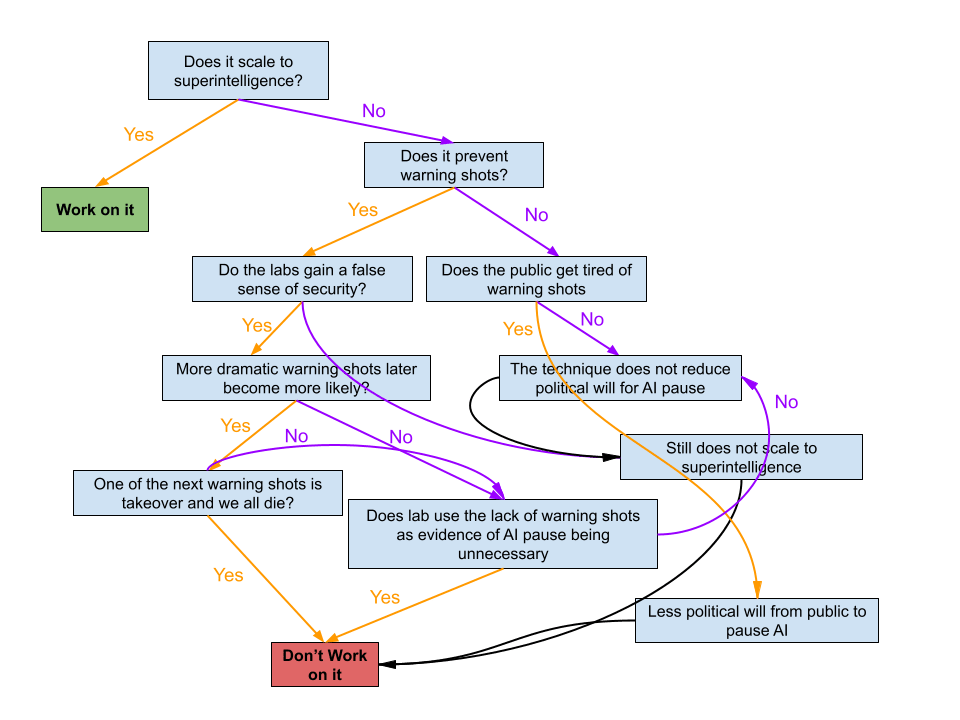
Lots of energy goes into highly complex, difficult-to-understand modeling of warning shot externalities. But if prosaic alignment doesn’t help align superintelligence, then we shouldn’t work on it anyway, and this modeling ends up not mattering.
Warning shot arguments are not a crux
If you can apply a safety technique to GPT-9, you should be able to apply it to GPT-6. If you claim a technique would scale but cannot demonstrate it on current models, researchers would correctly not believe you. There may be theoretical work that won’t affect model safety until it matures into an empirical technique, but once it does, it has the same effect. This means that both “prosaic” and “non-prosaic” alignment have the same warning shot externality:
- Successful non-prosaic alignment (techniques aimed directly at scaling to superintelligence) can be used to align any system, meaning you get fewer warning shots from current systems.
- Prosaic alignment, as formulated above, doesn’t help align more powerful systems but does prevent warning shots.
Saying that #2 is bad because it prevents warning shots misses the point. Both #1 and #2 prevent warning shots, but the thing that makes #2 bad is that, if it really doesn’t scale, it has nothing to offer. Even if it didn’t prevent warning shots, it still would have nothing to offer: the thing that separates the good research from the bad research is not warning shots but how far your techniques scale.
If the goal is to align superintelligence, it’s pretty obvious that prosaic alignment, as formulated above, isn’t the move! The steelman here is:
- Argument 1: Perhaps prosaic methods do scale to superintelligence.[2]
- Argument 2: This work allows us to align current systems, and current-ish systems can help us align superintelligence.
These are the actual cruxes.[3] For example, if you think that we can align current-ish systems robustly, and then use those systems to align superintelligence robustly, then you should work on prosaic alignment.
But if a researcher can’t defend either of the above arguments, they shouldn’t be branding prosaic research as safety. Understanding how this is bad follows from really obvious deontological intuitions. Imagine you tell a four-year-old that you have been hired to fix someone’s roof. You aren’t actually going to fix it, though: you are going to implement a cheap solution that will probably break in a few weeks. The four-year-old would instantly be able to tell you this is bad. It’s just clearly wrong to claim to be solving an important problem when you don’t plan to solve it, because people may believe you.
It’s unclear if optimizing for warning shots is good
I can’t help but feel a little strange about the idea of people hoping for warning shots. These are situations where people may actually die or otherwise experience unnecessary suffering. I don’t think I can ever see this as something worth celebrating.
Putting that discomfort aside, I think the utilitarian calculation itself is pretty dubious. When thinking about how your research affects warning shot probability, and how that probability affects x-risk, you are doing second- or third-order analysis, which is famously really hard. Here are some stories that I consider plausible:
- Preventing warning shots is bad because they are a really useful tool in increasing political will for a pause.
- Preventing warning shots is good because it lures labs into a false sense of security, making more dramatic warning shots later more likely.
- Preventing warning shots is bad because it makes it easier for labs to echo-chamber their way into believing they solved alignment.
- Preventing warning shots is good because the next warning shot might not be a warning shot at all: it could be a full-blown AI takeover and we all die.
- Preventing some warning shots is good because people will get desensitized to AI incidents. In other words, we may want some warning shots but not so many that people get overwhelmed or bored.
It’s hard to tell which of these are credible, if any of them. When you take marginal actions to try to shift probabilities in macro strategy, and the theory of impact involves multiple steps, you are just really in a dubious place.
Why I think these arguments are damaging to the AI safety discourse
It’s pretty frustrating how often AI safety debates descend into the object level of nth-order effects of a given action, and how easy this makes it to come up with a convincing argument for anything. I think allowing “increasing warning shot probability” as a primary consideration in our modeling opens up an entirely new Pandora’s box of bad arguments.
For example, many people are concerned about safety researchers who want to accelerate conceptual reasoning abilities in LLMs, because they worry this could make models better at scheming. Using the power of the “warning shot argument,” perhaps you could argue the opposite: that we should accelerate conceptual reasoning abilities in LLMs because it will make earlier AIs better at scheming, which would illustrate the danger of misaligned AIs to the public earlier. But man, I don’t know. If someone actually argued this, I feel like it should be okay to not engage with it at all.
Or a less straw-man-y example: Jan Kulveit argues that AI Control May Increase Existential Risk because it will suppress warning shots but not full AI takeover. I would argue, however, that the point about suppressing warning shots is way less important than the point about not preventing AI takeover. If AI control doesn’t prevent AI takeover, we shouldn’t work on it! AI control advocates would say that control may not prevent AI takeover but would help get useful work out of early schemers, overall lowering takeover risk. This makes the important crux the same as our “argument 2,” discussed in an earlier section.
When I hear researchers worrying about preventing warning shots, I worry that they are directing their attention in the wrong direction. I believe researchers should be less concerned that they may accidentally align current systems and more concerned that their techniques fundamentally are unable to scale to larger ones.
Appendix: a less simplified model
In the post, I am mostly treating “does it scale” as a binary question with a tractable answer. Unfortunately, there is quite a bit of uncertainty about what could work, and in most cases, the people working on agendas put the probability of their work paying off at far less than one. For example, Paul Christiano puts the probability of ARC Theory’s agenda working at ~10%.
Under this kind of uncertainty, perhaps warning shots do become a crux. For example, if there is a 5% chance of something scaling to superintelligence and a 95% chance it does nothing but prevent warning shots, then maybe the costs do outweigh the benefits. To investigate this, consider a less simplified model:
The terms are:
- : the probability it works on current models at all
- : the probability it scales to superintelligence, given that it works on current models
- : the benefit if it scales
- : the cost of the warning shots it preventsAs discussed above, it is unclear what sign should even be, but for the sake of modeling I will grant the assumption that is positive (i.e., preventing warning shots is bad).
- As discussed above, it is unclear what sign should even be, but for the sake of modeling I will grant the assumption that is positive (i.e., preventing warning shots is bad).
This gives us three situations:
- Probability : It never works, even on current models. This gives .
- Probability : It scales to superintelligence and (the benefit of ~solving alignment).
- Probability : It works only on current systems, so it prevents warning shots and .
In this model, a technique is net positive when is above roughly . This means warning shots become a concern only when the probability that a technique scales is sufficiently low. only changes if is non-zero (and should probably be pretty low because, in most cases, alignment research ideas don’t work at all, even on current systems).
and are arbitrary constants, but we can do a reasonable Fermi estimation for the purposes of grokking some intuitions from the model. Scott Alexander’s autograntor scale puts a US-China pause at one million points. Using this scale, is at least 500k points, about half a pause.[4] If you are especially warning-shot-pilled, you may put alignment techniques that work only for current systems at costing ~5% of a US-China pause in warning shots. This tells us should be pretty small, probably no greater than 0.1.
Assuming this , we can plot given any and :
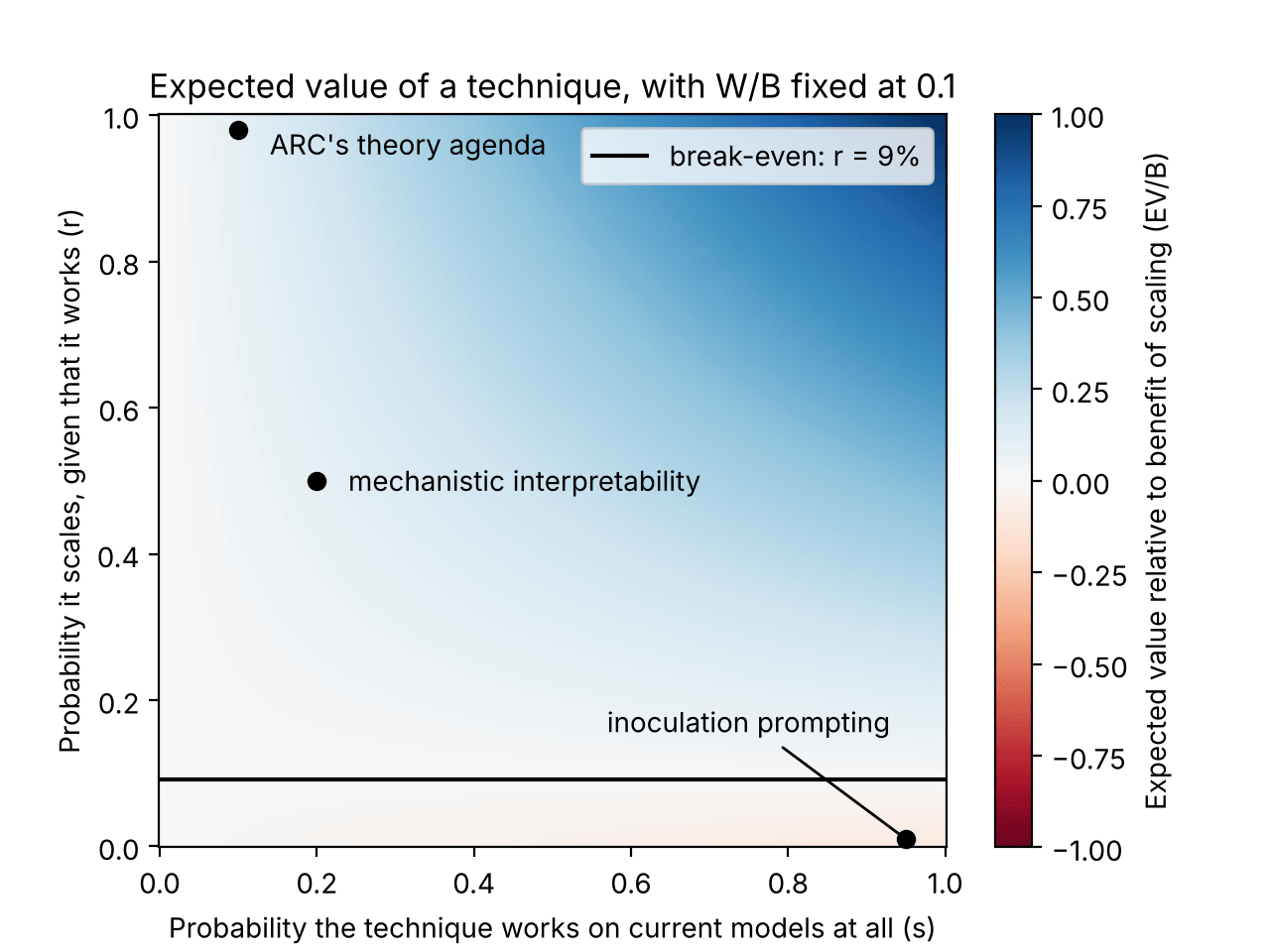
This model is obviously still too simple and contains some mostly made-up numbers, but it does illustrate the same intuition as the post: even if you are worried about warning shots, what you really want is ideas with a high . Notice how ARC’s agenda is clearly net positive, because although there is only a ~10% chance of it working, the chance of it scaling if it does work is really high. Anything below is net negative according to our assumptions. Optimizing for minimizing is pretty orthogonal to optimizing for , which is where all the value lies.
- ^I am using this definition because it lines up with how “prosaic alignment” is commonly used, but I can’t help but feel like there is something circular about the definition. If “prosaic alignment” means alignment that doesn’t actually improve the future, then it is somewhat a tautology to say “prosaic alignment is bad because it doesn’t make progress towards aligning superintelligence.”
- ^To make this point, I don’t think it’s necessary to argue that prosaic methods directly scale to superintelligence. For example, perhaps your alignment plan involves prosaic elements plus scalable oversight to get you all the way to superintelligence.
- ^There is also an additional argument that although prosaic alignment probably won’t work, in short timelines we don’t have time to do anything else. I would argue that this is dangerously close to the “Well, if that’s true, I’m doomed, so I may as well assume it’s not true” fallacy from “MIRI announces new “Death With Dignity” strategy.” If an idea has no hope of scaling in long timelines, it also has no hope of scaling in short timelines.
- ^I am intentionally being conservative here. You could easily argue that this could be worth the full 1,000,000 points. The reason it could be less is because even if you do solve alignment, you do not stop some other actor a year later from building superintelligence in a reckless way. Governance though could plausibly prevent this, so governance may be more desirable than any technical solution.