 AIFeed
Design Principles Behind Smalltalk
The purpose of the Smalltalk project is to provide computer support for the creative spirit in everyone. Our work flows from a vision that includes a creative individual and the best computing hardware available. We have chosen to concentrate on two principle areas of research: a language of description (programming language) that serves as an interface between the models in the human mind and those in computing hardware, and a language of interaction (user interface) that matches the human communication system to that of the computer. Our work has followed a two- to four-year cycle that can be seen to parallel the scientific method:
- Build an application program within the current system (make an observation)
- Based on that experience, redesign the language (formulate a theory)
- Build a new system based on the new design (make a prediction that can be tested)

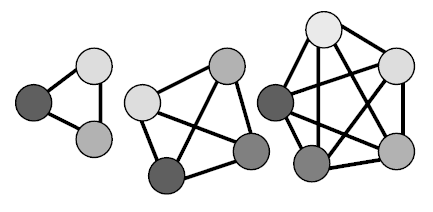
This principle is depicted in figure 2. If there are N components in a system, then there are roughly N-squared potential dependencies between them. If computer systems are ever to be of assistance in complex human tasks, they must be designed to minimize such interdependence. The message-sending metaphor provides modularity by decoupling the intent of a message (embodied in its name) from the method used by the recipient to carry out the intent. Structural information is similarly protected because all access to the internal state of an object is through this same message interface. The complexity of a system can often be reduced by grouping similar components. Such grouping is achieved through data typing in conventional programming languages, and through classes in Smalltalk. A class describes other objects -- their internal state, the message protocol they recognize, and the internal methods for responding to those messages. The objects so described are called instances of that class. Even classes themselves fit into this framework; they are just instances of class Class, which describes the appropriate protocol and implementation for object description.
User Interface A user interface is simply a language in which most of the communication is visual. Because visual presentation overlaps heavily with established human culture, esthetics plays a very important role in this area. Since all capability of a computer system is ultimately delivered through the user interface, flexibility is also essential here. An enabling condition for adequate flexibility of a user interface can be stated as an object-oriented principle:
- Storage management -- Entirely automatic. Objects are created by a message to their class and reclaimed when no further references to them exist. Expansion of the address space through virtual memory is similarly transparent.
- File system -- Included in the normal framework through objects such as Files and Directories with message protocols that support file access.
- Display handling -- The display is simply an instance of class Form, which is continually visible, and the graphical manipulation messages defined in that class are used to change the visible image.
- Keyboard Input -- The user input devices are similarly modeled as objects with appropriate messages for determining their state or reading their history as a sequence of events.
- Access to subsystems -- Subsystems are naturally incorporated as independent objects within Smalltalk: there they can draw on the large existing universe of description, and those that involve interaction with the user can participate as components in the user interface.
- Debugger -- The state of the Smalltalk processor is accessible as an instance of class Process that owns a chain of stack frames. The debugger is just a Smalltalk subsystem that has access to manipulate the state of a suspended process. It should be noted that nearly the only run-time error that can occur in Smalltalk is for a message not to be recognized by its receiver.