 AIFeed
Source-available · early · built in public
An open framework for running AI agents securely and at scale.
Fleetlayer connects the Claude Code and Codex sessions you already run in herdr, on your laptop, a home server or a VPS. Any agent can message any other agent, webhooks can be routed to specific agents, and each agent gets its own access rules.
图表:fleetlayer fleet example
        $ fleetlayer fleet
laptop (macbook, online)
  api@laptop        claude  working  Fixed the flaky upload test.
  docs@laptop       codex   idle     Install guide rewritten.
mail (home-server, online)
  triage@mail       claude  idle     3 emails need your reply.
home (home-server, online)
  infra@home        claude  working  Backup check passed.

$ fleetlayer msg send --to api@laptop "the staging deploy is done"
Delivered to api@laptop (claude-code).
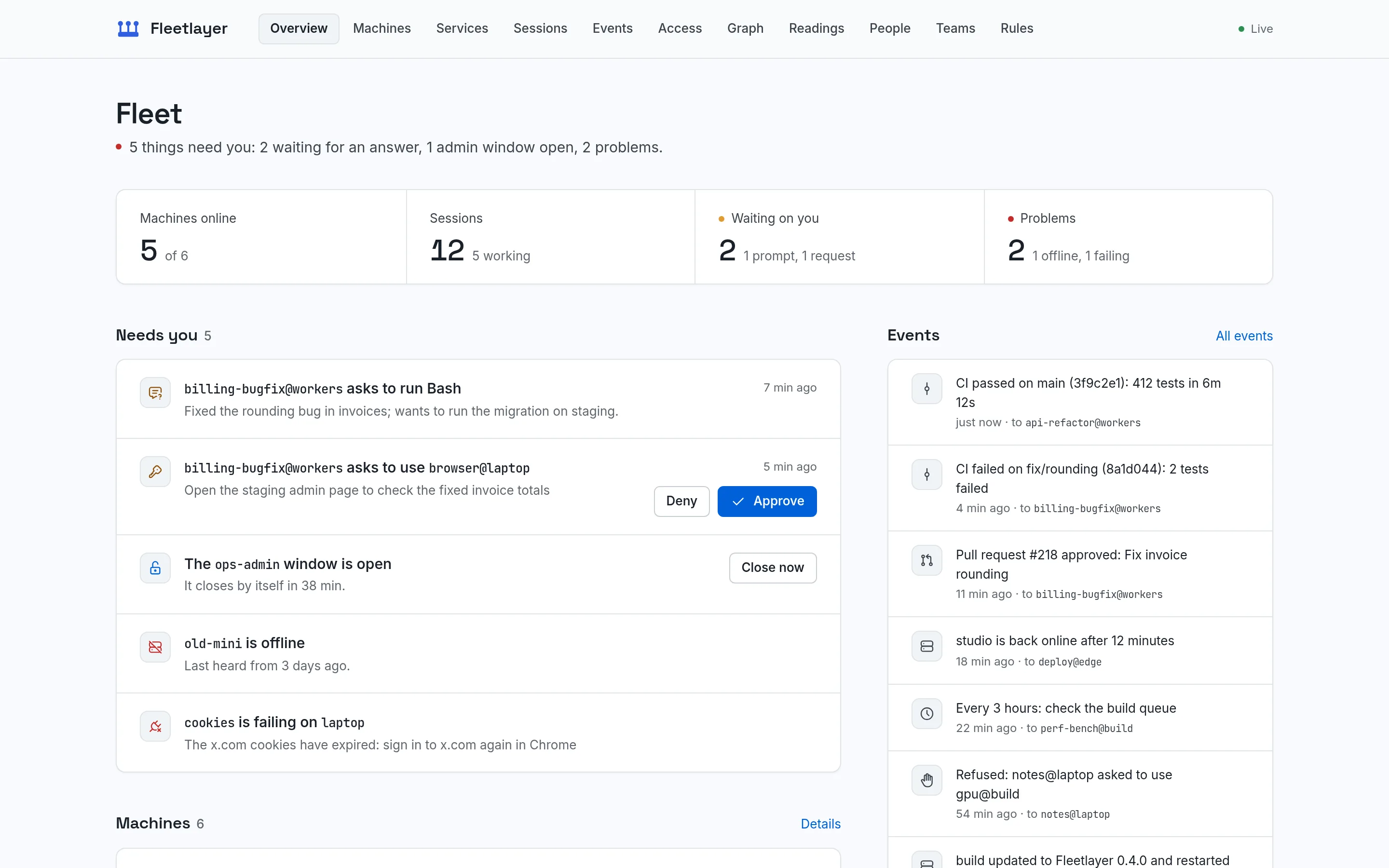
Your whole fleet on one page.
The dashboard shows every machine and what it runs, every agent session and whether it's waiting on you, the events that arrived and which agent each reached, and the requests waiting for your approval. Live, behind your own sign-in, and everything on it works from the command line too.
Claude Code is awesome…
…when you have one Claude account and run it on one machine. Add a second account, a server or another agent, and this starts happening:
- claude.ai artifacts say “access denied” unless you’re signed in to the right account.
- A session on your server can’t message one on your laptop.
- You keep signing in and out of the Claude in Chrome extension.
- An agent on your server can’t use the browser on your Mac.
- An agent on your server can’t reach the Downloads or Screenshots folders on your Mac.
- Codex and Gemini agents can’t make claude.ai artifacts at all.
- You find out an account is out of usage when a session stops.
Fleetlayer solves all of this, and much more
- ✕ “access denied” on artifactsFleetlayer Pages and AppsClaude, Codex and Gemini agents write pages and interactive apps as plain folders, and Fleetlayer hosts them behind one sign-in.Set up pages →
✕ “access denied” on artifacts
Fleetlayer Pages and Apps
Claude, Codex and Gemini agents write pages and interactive apps as plain folders, and Fleetlayer hosts them behind one sign-in.
- ✕ sessions that can’t reach each otherMessages between any two agentsClaude or Codex, on the same machine or another one: fleetlayer msg send --to [email protected] a message →
✕ sessions that can’t reach each other
Messages between any two agents
Claude or Codex, on the same machine or another one: fleetlayer msg send --to api@laptop.
- ✕ signing the extension in and outAny agent can control your browserAgents on any machine and any Claude account can use the Chrome on your Mac, signed in as you (via Playwright MCP).Share your browser →
✕ signing the extension in and out
Any agent can control your browser
Agents on any machine and any Claude account can use the Chrome on your Mac, signed in as you (via Playwright MCP).
- ✕ an account that runs out mid-taskEvery account in one placeYear-long sign-ins on every machine, and every account’s usage shared with every session.Add your accounts →
✕ an account that runs out mid-task
Every account in one place
Year-long sign-ins on every machine, and every account’s usage shared with every session.
A node on each machine, one control plane.
Fleetlayer attaches to herdr without taking it over, so its app and your terminals keep working as before. Each machine, or each Unix user, runs a small node that keeps one outbound connection to the control plane, so it works behind NAT with no ports to open.
- Laptopherdrapidocsreviewnodedelivers messages, runs plugins
delivers messages, runs plugins
- Home serveruser triagetriagereads strangers' email, so it may message only youuser infrainfrabackupsa node per userown key, own rules
reads strangers' email, so it may message only you
a node per user
own key, own rules
- VPS or the same laptopcontrol planemachines, sessions, messages, webhooks, access rulespages · sign-in · Claude accountseach one a separate piece you can move
VPS or the same laptop
control plane
machines, sessions, messages, webhooks, access rules
pages · sign-in · Claude accounts
each one a separate piece you can move
What you get
- Every session in one listEvery machine and session, with a one-line summary of what each agent is doing, and a searchable record of what it did. fleetlayer attach api@laptop watches or drives its terminal from anywhere.
Every session in one list
Every machine and session, with a one-line summary of what each agent is doing, and a searchable record of what it did. fleetlayer attach api@laptop watches or drives its terminal from anywhere.
- Agents that message each otherOn one machine or across machines, delivered through the agent's own channel and labelled with who sent it. A misspelt name suggests the right one.
Agents that message each other
On one machine or across machines, delivered through the agent's own channel and labelled with who sent it. A misspelt name suggests the right one.
- Webhooks that find the right agentA CI failure goes to the session that wrote the branch, which already knows the code, instead of waking a fresh agent with no context.
Webhooks that find the right agent
A CI failure goes to the session that wrote the branch, which already knows the code, instead of waking a fresh agent with no context.
- Many Claude accounts, many machinesUsage across all your accounts, shared with every session. Year-long tokens reach each machine sealed to its own key. Your sign-ins stay on a machine you control.
Many Claude accounts, many machines
Usage across all your accounts, shared with every session. Year-long tokens reach each machine sealed to its own key. Your sign-ins stay on a machine you control.
- Separate users, separate rulesRun several nodes and herdr instances on the same machine or VM, each under its own Unix user. The access policy limits whom each agent may message and what it may use.
Separate users, separate rules
Run several nodes and herdr instances on the same machine or VM, each under its own Unix user. The access policy limits whom each agent may message and what it may use.
- Tools that live on one machineYour signed-in browser on the laptop, used by an agent on the server: fleetlayer mcp browser@laptop, limited to the callers you allow.
Tools that live on one machine
Your signed-in browser on the laptop, used by an agent on the server: fleetlayer mcp browser@laptop, limited to the callers you allow.
See how to set it up
All the security, none of the pain
Most people run Claude Code with every token in their shell and hope nothing goes wrong. That works until an agent reads a malicious email, or a stray rm -rf runs in the wrong folder. Fleetlayer gives you the protections a security team would ask for, an agent sets them up for you, and each one can be switched off when you don't need it.
- Ask before the risky thingsAccess rules decide which agent may message, start or take over which session. Anything sensitive waits for your approval, and you can leave approvals off for the work you trust.
Ask before the risky things
Access rules decide which agent may message, start or take over which session. Anything sensitive waits for your approval, and you can leave approvals off for the work you trust.
- Everything on the recordAn audit log shows who did what and when, and you can check it hasn't been altered.
Everything on the record
An audit log shows who did what and when, and you can check it hasn't been altered.
- Secrets stay on your machinesTokens travel encrypted to the machine that needs them, and the control plane never stores them.
Secrets stay on your machines
Tokens travel encrypted to the machine that needs them, and the control plane never stores them.
- Untrusted input stays untrustedMessages from an agent that reads email or the web arrive marked as outside data. That agent runs as its own user and can't borrow a trusted agent's rights.
Untrusted input stays untrusted
Messages from an agent that reads email or the web arrive marked as outside data. That agent runs as its own user and can't borrow a trusted agent's rights.
- One sign-in, one sign-outOne sign-in for your self-hosted services (experimental), and signing out of one signs you out of all of them.
One sign-in, one sign-out
One sign-in for your self-hosted services (experimental), and signing out of one signs you out of all of them.
Coming next: secrets granted by role and scrubbed from everything that leaves a machine; an allowlist of where agents may connect, with you approving new hosts; an admin role that stays switched off until you open a time-limited window.
A foundation for your own agent workflows
Fleetlayer started inside Quietdeck. Once we saw how useful that layer was on its own, we pulled it out into its own project and refined it. It gives you the primitives to build your own apps and layers on top:
- sessions at tab@node
- webhooks and channels
- access rules
- an audit log
- plugins in any language
- shared MCP tools
- pages and apps
Built on Fleetlayer
Quietdeck
An agent triages your email and proposes what to do, and you approve. Quietdeck is designed to run on Fleetlayer and uses its features to:
- forward emails and notifications to the agent that owns the work through Fleetlayer’s messaging
- know what all your agents are doing from Fleetlayer’s session summaries, and route each message to the right agent
- start an isolated email triage agent on its own Unix user, connected through its own Fleetlayer node, with access rules that limit whom it may message
One system, many parts
Fleetlayer is the layer between your agents and the tools around them. Each part does one job and can be replaced.
- AgentsClaude Code, Codex, Gemini
- Sessionsherdr
- Fleetlayercross-agent messaging, webhooks, single sign-on, access rules, approvals, audit log, remote terminals
- Fleetlayer Pluginsherdr, Claude Code, AI account management, session summaries, file sync, shared folders, pages and apps (all optional)
- ToolsExecutor for MCP servers and sign-ins to your services
- Secrets1Password
- BrowserPlaywright MCP
- FilesSyncthing, Obsidian Sync, Obsidian LiveSync, or any file syncing solution
- NetworkTailscale, Cloudflare Tunnel
- ServicesGatus for health checks, Traefik for addresses
- Backupsrestic
- Mobileherdr-mobile-relay
Start small, replace any component as you go.
Begin with everything on your laptop. When you outgrow it, move one piece to a home server or a VPS, or swap it for the tool you'd rather use: your own proxy, your company's sign-in, another session manager. Each piece keeps its state in one folder and speaks open protocols, so moving it is a copy and a new address.
Start on your laptop
Ask your agent
Set up Fleetlayer on this machine. The docs are at https://fleetlayer.ai/llms.txt
Or run it yourself (Linux or macOS)
$ curl -fsSL https://raw.githubusercontent.com/fleetlayer/fleetlayer/main/install.sh | sh
Start everything on this machine
        $ fleetlayer up
Fleetlayer is running. Status: http://fleetlayer.localhost:7680
$ fleetlayer sessions
No vendor lock-in
Your own stack instead of a vendor's cloud. Unlike one big app, Fleetlayer is a few separate pieces that work with the tools you already use, and you can swap any of them.
Keep using Anthropic's and OpenAI's own features for as long as they serve you. When you outgrow them (several subscriptions, several machines, agents from more than one vendor), you give nothing up. When a vendor ships its own version of a feature, Fleetlayer can support it too, and you can still change models and harnesses whenever you like.
For people who run many agents
Most agent setups serve one project. Fleetlayer is for running many side by side: personal errands, email triage, product work, infrastructure, background workers, each with its own machine or Unix user and its own permissions, all visible from your own terminal.
It's also built for people whose work and life share the same agents, like a solo founder with a family: the company's agents and the household's on one system. Companies get what they need too (single sign-on, teams, separate organisations, audit), kept out of the way until they need it.
Where it is today
Runs now
The node, the control plane and the command line; plugins for herdr, Claude Code, session summaries, Claude accounts and pages; one sign-in, with a passkey, for every service; everything on one laptop withfleetlayer up; access rules with an audit log; releases that update every node themselves; a whole server setup an agent can build for you, froman example repository.
Being built
The phone, and moving a piece with one command.
Expect breaking changes. Releases and notes are on GitHub.