 AIFeed
METR's report estimates that Anthropic's AI R&D has accelerated in the past year, and that 80% of this acceleration is due to AI itself. But if AI accelerated Anthropic researchers, Anthropic would have a strong incentive to scale up its R&D compute proportionally to AI uplift. Accounting for this scaleup reduces the AI-attributed share of acceleration to <50%, and favors AI regulations that restrict R&D compute.
Experiments and labor
Software progress comes from trying ideas and seeing which ones work. Researchers come up with the ideas and write the code to test them, and R&D compute runs the tests of these ideas. Each input is only as useful as the other allows: researchers without compute can't find out which of their ideas work, and compute without researchers has nothing worth running.
We can represent this dynamic with a model where research labor (whether AI or human) is combined with R&D compute to generate software progress. One specific way to model this relationship is with Ryan Greenblatt’s model, in which software progress is proportional to (labor)^0.55 x (R&D compute)^0.45. As I’ll explain later, the headline doesn’t depend on this specific equation.
In my METR explainer, I showed how AI uplift alone could generate enough R&D acceleration to explain Anthropic’s acceleration. But that calculation held R&D compute fixed. Does that make sense?
No. With AI uplift, researchers come up with ideas faster, so an extra unit of R&D compute becomes more valuable, and Anthropic would want to give them more R&D compute to burn. This is how the Anthropic staff that METR interviewed talked about why AI accelerated them:
- "I've seen us discovering very promising directions ~entirely because people can spam 10 ideas at [agent-scaffold] and see what sticks." (Researcher E)
- "I think it's true [that] we're now trying a lot more experiments at the same time because of claudification." (Researcher H)
- "People don't try [redacted] things bc it takes 1-2 days to implement per idea, but now its ~free with mythos-preview." "I personally think this is a large lift and has led to me trying far more ideas." (Researcher D)
- "Now only bottlenecked on ideas & compute, no longer bottlenecked on code." (Researcher A)
In the model above, when labor becomes K times more productive, it is optimal to scale up R&D compute by K times as well.[1] So if AI uplift made Anthropic's researchers K times more productive, Anthropic would have scaled up its R&D compute by K times too.
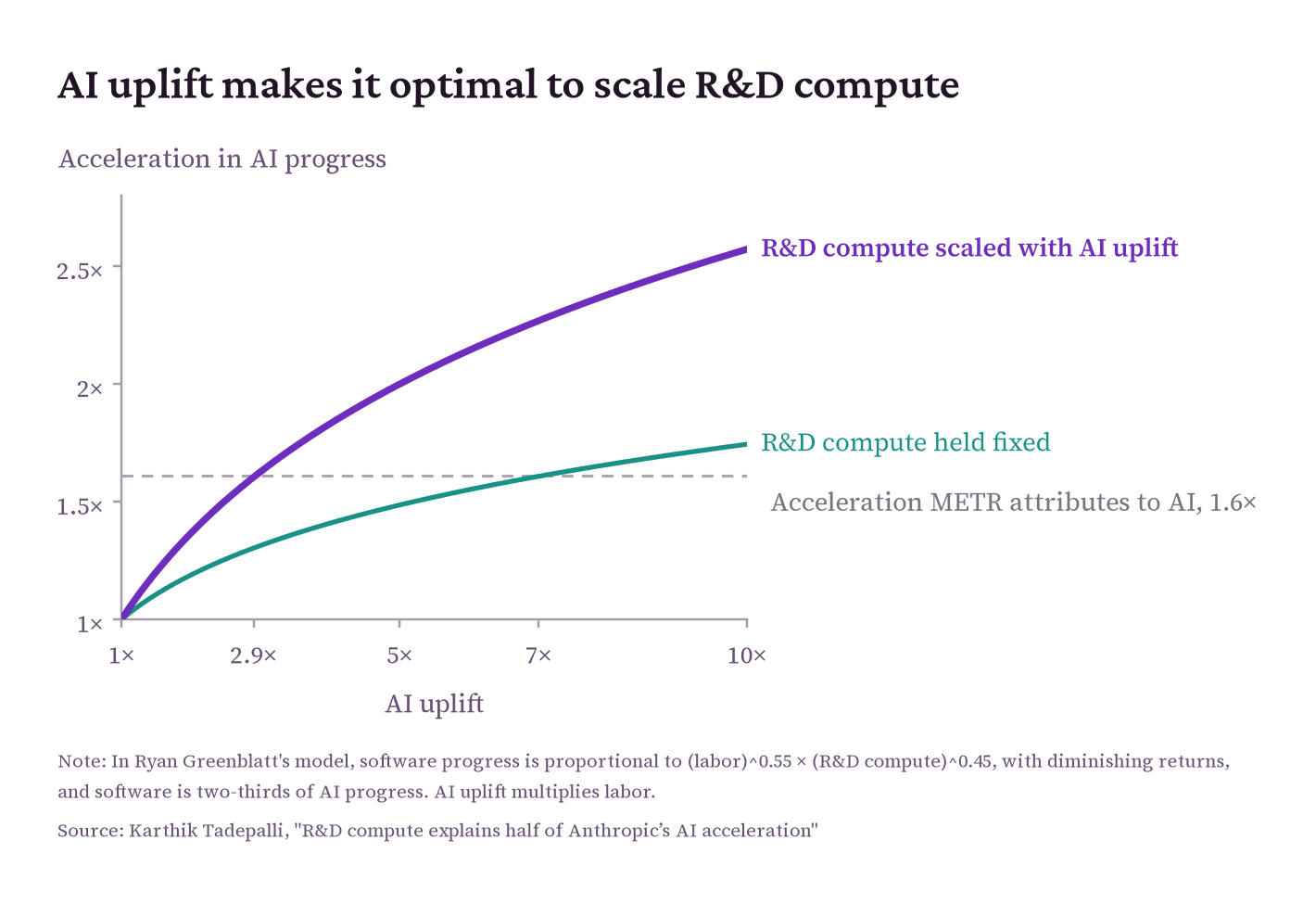
This matters, because it means that R&D compute will scale with AI uplift. Specifically, it’s optimal to scale R&D compute one-for-one with labor, so that an AI uplift of K times raises R&D compute by K times and software progress by K = K^0.55 x K^0.45. So 55% of the gain comes from AI uplift and 45% from R&D compute, whatever the size of the uplift.[2]
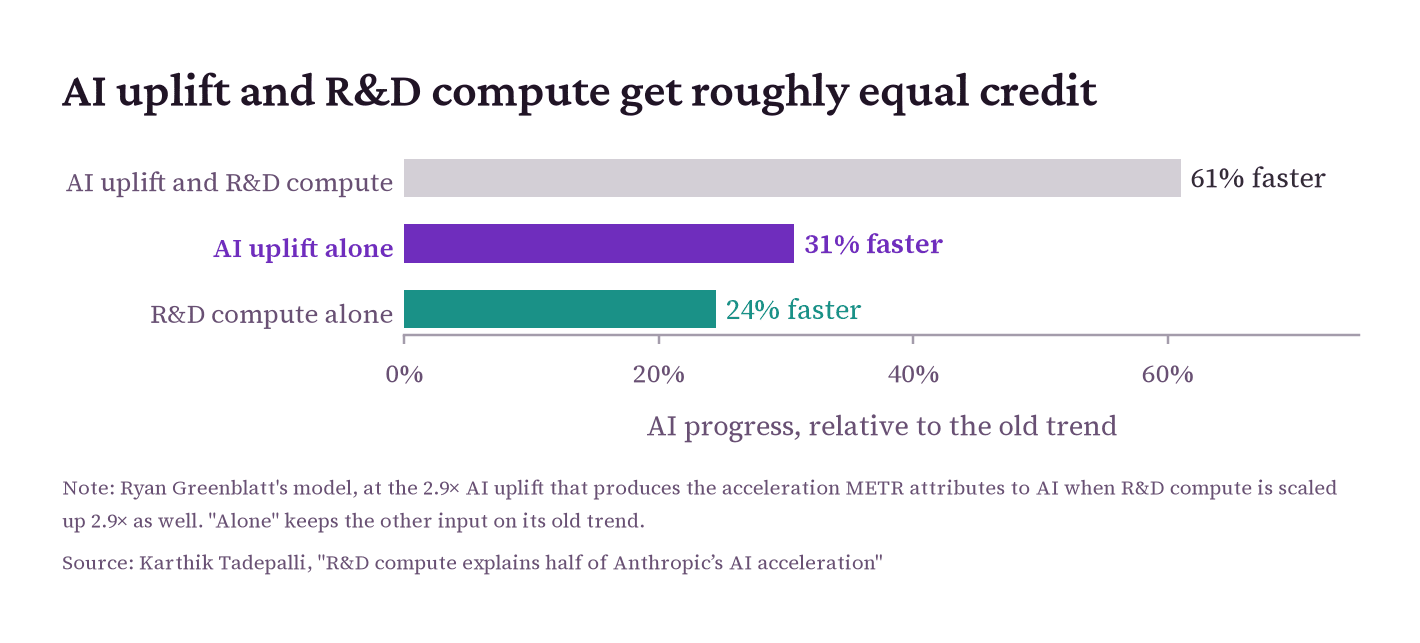
There’s some messiness because we don’t know what makes up the residual 20% of credit, but the key point is that AI uplift and R&D compute should get roughly equal credit for the acceleration – it is implausible that AI is responsible for essentially all software progress.
Scaling R&D compute also changes how much uplift the acceleration requires. In my earlier explainer I showed that a 7x acceleration of labor is consistent with the observed overall acceleration of 1.61x, the speedup METR attributes to AI – but if R&D compute scales with labor, a much more reasonable 2.9x uplift is enough to explain Anthropic’s acceleration.[3]
Key assumption
This argument seems a bit too clean, too universal. What’s the sneaky assumption behind it?
The key is that I assume R&D compute has a constant marginal cost. In other words, I assume Anthropic can scale up R&D compute without paying extra for the marginal GPU. This is likely false, and we have no idea by how much. Extra R&D compute has to come from buying more chips, or from taking compute away from training and serving customers. If so, Anthropic would scale up R&D compute by less than I’ve calculated above, and AI uplift would get proportionately more of the credit for the observed acceleration.
How much the conclusions would change depends on how steeply the marginal cost rises and on how substitutable labor and R&D compute are. The more substitutable they are, the less extra compute Anthropic needs once its labor is more productive.[4]
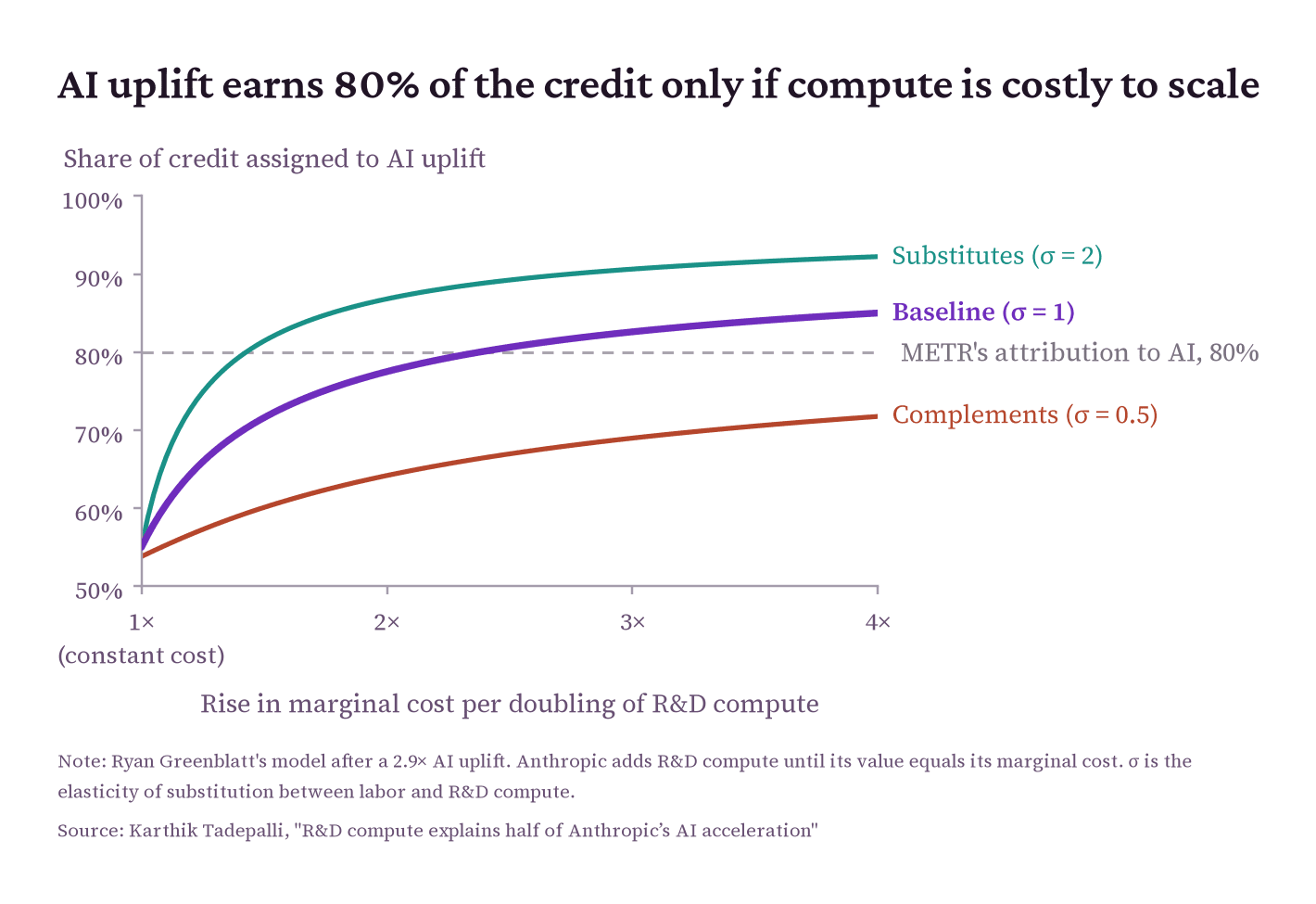
In the baseline model, AI uplift's share of the credit reaches METR's 80% only if the marginal cost of R&D compute rises about 2.5x with every doubling of R&D compute. If labor and R&D compute are complements, as the staff quotes suggest, the share stays below 75% even when the cost quadruples with every doubling.
So: we should be concerned about my assumptions if marginal cost increases steeply per doubling, and labor and R&D compute are substitutes rather than complements. Otherwise, my results are likely to hold.
Objections
Maybe AI uplift reduces the need for experiments, so there is no scaling of R&D compute? AI might substitute for experiments instead of complementing them. Maybe an AI with good research taste could tell researchers which ideas will fail before they are run, so better AI means fewer experiments are required.
But as I showed above, this result depends very little on whether AI and experiments are substitutes or complements. Also, this story is flatly contradicted by the Anthropic staff quotes about how they used AI, which focus overwhelmingly on the benefit of being able to try more things. This story would instead predict that researchers try fewer things.
Maybe labor's contribution to software progress is larger than my model assumes? The 55-45 split of credit comes from the exponents in Greenblatt's research production function, which are rough estimates. Suppose instead that software progress depends 90-10 on labor vs R&D compute. Then labor would deserve 90% of the credit for the labor-R&D compute combination, which is consistent with METR’s results.
But while a 55-45 split is somewhat arbitrary, the extreme ratio needed to support this conclusion is implausible. Where we can see AI companies' spending, staff cost less than R&D compute (Epoch’s estimates from OpenAI, and from MiniMax and Z.ai). If companies spend on each input in proportion to what it contributes, labor's share is below 55%, not above it.
Maybe Anthropic reallocated compute very slowly? I’ve argued that it is optimal for Anthropic to scale up its R&D compute in proportion to AI uplift. But that doesn’t mean Anthropic actually scaled it up. If compute is allocated far in advance and shared with training and serving customers, Anthropic may not have been able to move much of it toward R&D yet.
I don't know how frontier labs allocate compute internally. But I would be shocked if the allocation of compute between research/training/inference was not the single most important decision they obsess over every month. Maybe there are some frictions that prevent them from allocating the fully optimal amount of R&D compute, but these frictions would have to be very large to explain the gap. Specifically, for AI uplift to get 80% of the credit, Anthropic would have had to make less than a third of the optimal adjustment, a full year into the uplift.[5] That is an implausibly slow response.
How do we square this with METR?
I think these results are surprisingly compatible with the METR headline. Specifically, I think the most likely explanation for the divergence is that METR credited the effects of scaling R&D compute to AI. The additional R&D compute was only valuable because of AI uplift, so it wouldn’t be crazy to attribute its effects to AI. It is still acceleration “caused” by AI – it’s just that one of the channels for this causality was that AI gave Anthropic the ability to scale R&D compute above trend.
This interpretation fits a few otherwise puzzling features of the report. The only two statements that METR makes about R&D compute are:
- Ruling out that training compute scaling is responsible for the acceleration. This conspicuously fails to rule out R&D compute scaling, which fits with the evidence above that R&D compute scaling would be optimal.
- Saying they "did not see evidence for significant bottlenecks in algorithmic progress, training compute, experiment compute, or data that will take effect in the next 12 months". This is true: Anthropic can simply scale up its R&D compute over the next 12 months.
If this interpretation is correct, it provides a totally different interpretation of the METR report. The way most of us have interpreted the report is as evidence that AI alone, without scaling of other inputs, could cause an acceleration in AI capabilities. But if these accelerations in progress also required accelerations in R&D compute, then the intelligence explosion might in principle be bottlenecked by R&D compute.
If R&D compute ends up being a big part of the explanation, this suggests that AI regulation should center R&D compute as an important target for regulation. For example, the AI Futures Project has proposed caps on how much compute can be used for R&D and training; these caps look much better after accounting for R&D compute’s role in past AI progress.
- ^Write software progress as S = L^0.55 x C^0.45, where L is research labor and C is R&D compute. The value of an extra unit of R&D compute is 0.45 x (L/C)^0.55, which depends only on the ratio C/L. If Anthropic adds R&D compute until this equals its cost p, then C = (0.45/p)^(1/0.55) x L, so optimal R&D compute is proportional to labor. This assumes the cost of a unit of R&D compute, including what it would have produced in training or inference, stays the same.
- ^In logs, K = K^0.55 x K^0.45 splits 55/45 for any K. Splitting the acceleration itself gives the same answer. The 1.61x acceleration METR attributes to AI takes a 2.9x AI uplift and 2.9x the R&D compute. The uplift alone gives 1.31x and the R&D compute alone gives 1.24x, and averaging over the order in which the two are added (a Shapley split) assigns 55% of the gain to AI uplift and 45% to R&D compute. Applied to METR's 80%: 0.8 x 0.55 = 44% and 0.8 x 0.45 = 36%.
- ^With R&D compute scaled one-for-one, research output rises by the AI uplift K. Solving 1.61 = 2/3 x K/2^0.61 + 1/3 gives K = 2.9. A 7x AI uplift with 7x the R&D compute would instead give a 2.3x acceleration, more than the whole 1.9x that METR measured.
- ^Suppose the marginal cost of R&D compute is multiplied by m each time R&D compute doubles, and write g = log2(m). In the baseline, an AI uplift of K makes it optimal to scale R&D compute by K^(0.55/(0.55 + g)), so AI uplift's share of the credit is (0.55 + g)/(1 + g). There is no closed form for other elasticities of substitution, so I solve for the optimal R&D compute numerically given AI uplift and split the gain in research output with a Shapley split.
- ^If R&D compute rises by K^s when AI uplift is K, AI uplift's share of the credit is 0.55/(0.55 + 0.45s). Setting this to 0.8 gives s = 0.31.