 AIFeed
Original text(via LessWrong)
- Be happy that this is happening at all, with credible partners and valuable investigations, when no one was forcing OpenAI to do anything.
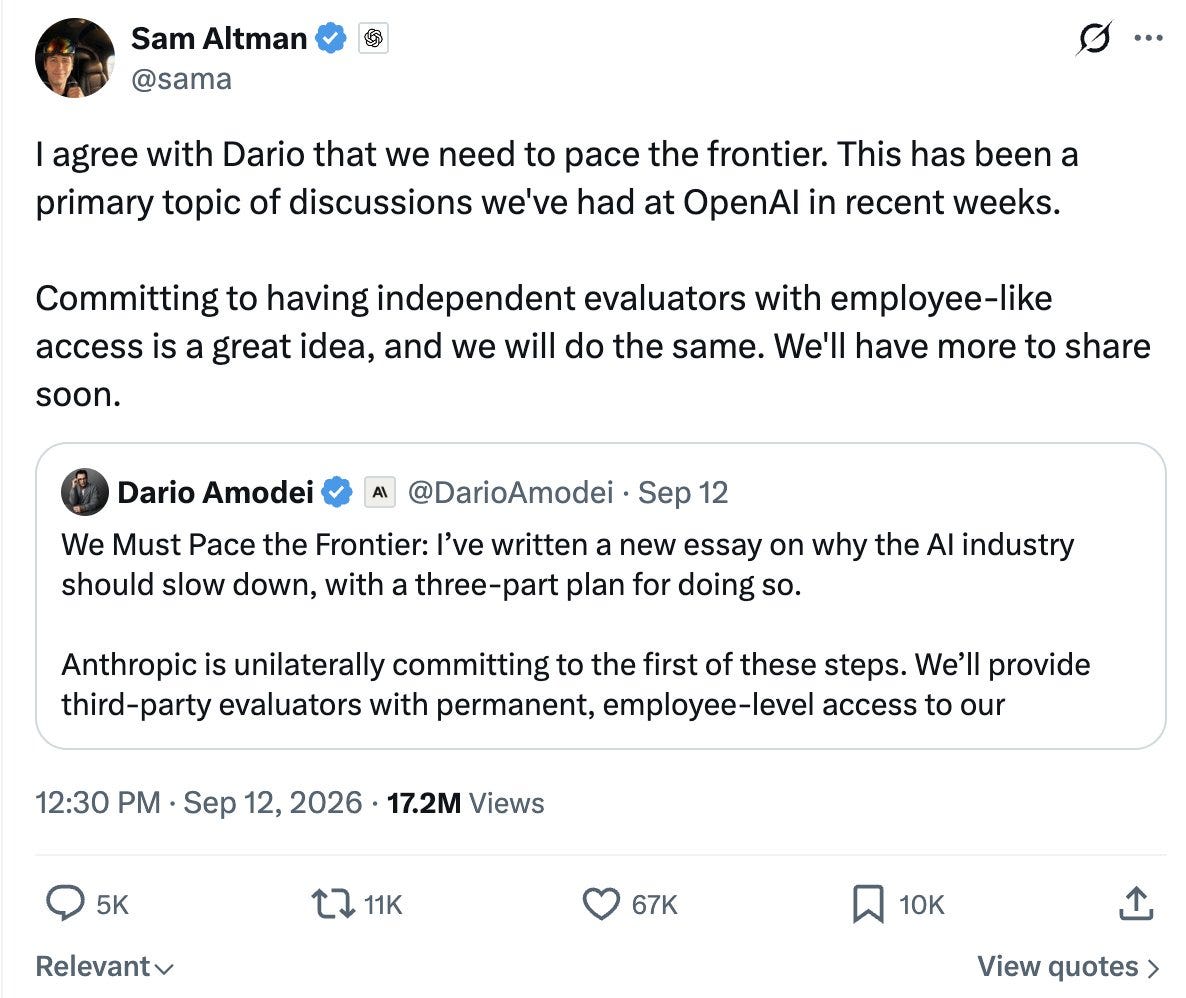
- Make clear that this does not meet Altman’s commitment to embedded evaluators with employee-level access.
Table of Contents
- Four Good Picks.
- Apollo Research.
- Not the Prince That Was Promised.
- Former OpenAI Safety Researchers Find These Conditions Unacceptable.
- Others Criticize the Access Restrictions.
- Steps Forward Versus Steps Back.
Four Good Picks
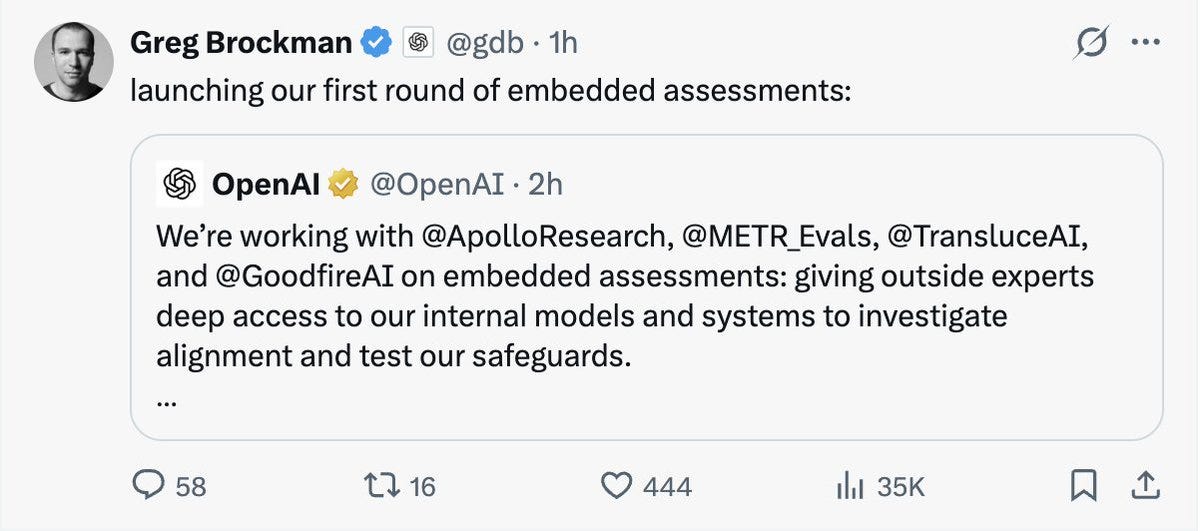
OpenAI: Based on what each evaluation needs, assessors receive access to some of the same internal resources our researchers use, including model checkpoints, source code, training and evaluation data, monitoring systems, technical documentation, and discussions with the researchers and engineers responsible for the work. … Our initial assessments focus on alignment and safeguards for models during training and internal use, complementing our safety cases.
Apollo Research
Apollo Research: Disclosure: We will publish two reports: one on training incentives, and one on evaluations, internal deployment, and detectability. Each will set out our methods, conclusions and limitations, including questions we couldn’t assess. OpenAI may request redactions of confidential information, including evidence behind our conclusions, but not simply because a finding is unfavorable. We can explain how redactions affect our conclusions and readers’ ability to assess them. We cannot publish information based on employee discussions unless OpenAI provides formal attestation, or we can independently establish the finding. If OpenAI declines an attestation, we can say so and explain how that limits our conclusions.
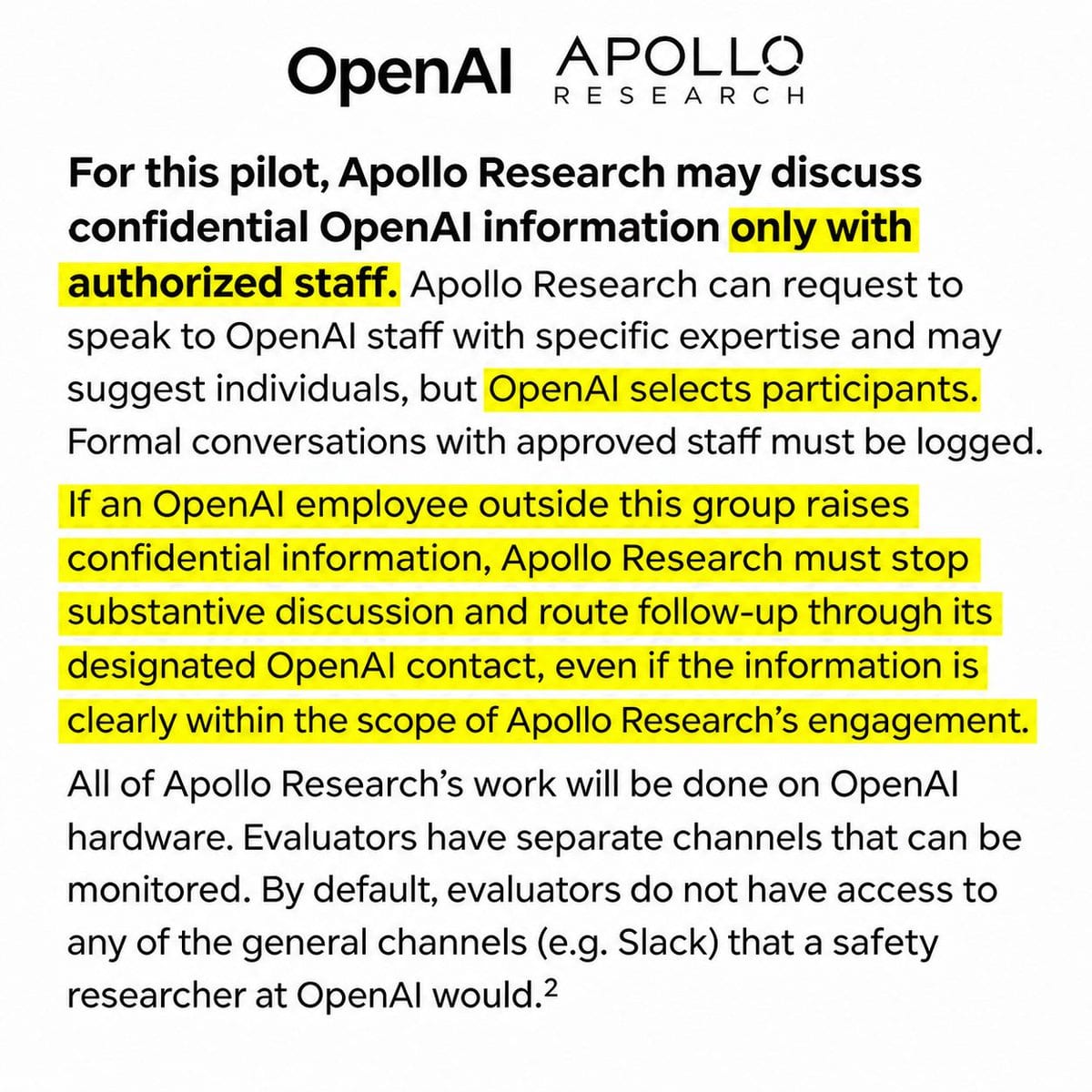
Apollo Research: In this pilot assessment, Apollo Research will assess whether models could covertly work against their developers’ intentions and whether our safeguards would detect such behavior. Drawing on evidence from training, safety testing, and internal use. Apollo will assess four claims in two stages: Training did not incentivize subversion. Strong evaluations and red teaming do not elicit subversion. Models have not attempted subversion during internal use. Reasoning behind subversion would be detectable. For the first stage of Apollo’s assessment, we’ll provide access to selected public and unreleased models and training checkpoints, relevant training data and evaluation results, training intervention records, monitoring systems and flagged behaviors, and researchers who can provide context, alongside the tools and compute needed to conduct independent testing.
- Training did not incentivize subversion.
- Strong evaluations and red teaming do not elicit subversion.
- Models have not attempted subversion during internal use.
- Reasoning behind subversion would be detectable.
Goodfire
Goodfire will embed interpretability researchers and use the Goodfire platform to analyze model internals. The main objective of their assessment is training run monitoring, debugging, and alignment. The primary audience for their assessments are internal OpenAI researchers, who will use their findings to make safety improvements. Goodfire will also publish learnings and findings as the collaboration progresses.
METR
We intend to conduct two assessments with METR, focused on model alignment and monitoring: Alignment assessment: For the first phase, METR will assess misaligned behavior in our largest reinforcement learning run to date, including failures that our existing tests and monitors may have missed. Within the selected run and agreed access, resources, and safety arrangements, METR would independently set assessment priorities and iterate on searches, analyses, and elicitation experiments. Access will include sampling relevant checkpoints, training and eval rollouts, and misalignment monitoring records for this run. For this first phase, the assessment will focus on our largest frontier RL run. Monitor assessment: We recently worked with METR to conduct a monitor stress testing exercise. We have preliminarily agreed to conduct another monitor assessment which we intend to be broader, but this is pending mutual agreement on the assessment scope. Nathan Calvin: The details of the collaboration with METR seem extremely narrow, only focusing on evaluating misaligned behavior from a large RL run. OpenAI also say that they have “preliminarily agreed to conduct another monitor assessment which we intend to be broader, but this is pending mutual agreement on the assessment scope” A footnote on the post also says more explicitly regarding the collaboration with METR on their RL run: “This scope is less expansive than what METR outlines in their alignment assessment proposal, which envisions a broad survey of misalignment.”
- Alignment assessment: For the first phase, METR will assess misaligned behavior in our largest reinforcement learning run to date, including failures that our existing tests and monitors may have missed. Within the selected run and agreed access, resources, and safety arrangements, METR would independently set assessment priorities and iterate on searches, analyses, and elicitation experiments. Access will include sampling relevant checkpoints, training and eval rollouts, and misalignment monitoring records for this run. For this first phase, the assessment will focus on our largest frontier RL run.
- Monitor assessment: We recently worked with METR to conduct a monitor stress testing exercise. We have preliminarily agreed to conduct another monitor assessment which we intend to be broader, but this is pending mutual agreement on the assessment scope.
Transluce
OpenAI: Transluce will conduct an initial assessment of our post-training alignment evaluations, examining their quality and coverage. For the initial assessment, we will provide Transluce with access to selected public and unreleased models, our post-training alignment evaluations and relevant results, supporting model behavior data and safety case documentation, and researchers who can provide context, alongside the tools and compute needed to conduct independent testing. OpenAI and Transluce also share the intent to conduct a follow-on assessment of approximately eight weeks in early 2027, with broader access to additional models, deeper access to our alignment evaluations, and information on how evaluation results inform model release decisions.
Not the Prince That Was Promised
OpenAI: We’ve developed protocols and processes with input from the assessors to balance deep access with security, confidentiality, oversight, and the independence and integrity of assessments. We are sharing them to shed light on how we will work with embedded assessors, and to advance discussion about norms for embedded assessments, which have yet to be standardized. … Each engagement begins with an agreed scope and the access, resources, and safety arrangements needed to conduct a rigorous assessment.
Former OpenAI Safety Researchers Find These Conditions Unacceptable
Mikita Balesni (former OpenAI): The week of my departure from OpenAI, I saw external auditors negotiating with OpenAI over small improvements to access and scope to the company’s safety-relevant information, and asked my colleagues “Why are we having these conversations at all?” — @sama already publicly committed to continued, employee-like access for external assessors — and these negotiations sounded not even close. Nobody had a good answer. Today, OpenAI announces the engagements they’re doing with METR, Apollo Research and others — and as many have already pointed out today, it looks like OpenAI employees were not able (although I’m sure they tried) to hold the leadership to @sama’s public commitments: No Slack access (for context, all OpenAI safety discussions and debate happen over Slack; anything that misses these conversations will lack important insights) OpenAI picks employees that assessors are allowed to talk to. If an employee raises a concern to assessors, they cannot disclose it publicly even if it doesn’t contain confidential information, unless assessors themselves verify it or OpenAI volunteers their own statement confirming the employee’s concern. Assessors cannot quote employees, even anonymously. Some of the external assessors (not sure if all?) are barred from publishing any results about internal-only models (this means no new results for the model responsible for the Hugging Face incident; and if internal-only models are used for RSI, no alignment assessments of the world’s most dangerous models) Beyond the object-level details, if you read posts by each of the third party groups, they all say their terms do not meet the scope and access that they themselves proposed previously. Unless OpenAI has concrete plans for reaching the employee-like bar in the immediate future and just forgot to say that in the post, this looks very unfortunate. To those who hope we’ll get there someday, I remind that time is short: last week some of the best AI forecasters updated their superhuman researcher timelines to mid-end next year. Tomek Korbak (Formerly OpenAI, AI Safety): As others have pointed out, I think the form of those four third-party engagements is in many respects a step back compared to OpenAI’s previous engagements (with METR). For example, during the monitor red-teaming exercise, METR had access to OpenAI’s monorepo but this now seems to be off the table. Instead, we get very narrowly scoped (e.g. single RL run for METR, single threat model for Apollo) engagements where auditors only get to talk to “authorized” employees who are provided with OpenAI’s “guidance” beforehand. Based on my experience, this arrangement makes it very easy for OpenAI to carefully select models, subsets of data and employees to paint a rosy picture of the actual risk landscape. I think embedded auditing will only fulfill its aims if the auditors really get employee-level access as opposed to being hired to do a specific job (scoped by the company). The latter will invariably lead to important evidence being left out, missed or misrepresented. There are at least three reasons why: 1. First, it’s very difficult to anticipate all the questions that should be asked, or all of the data that should be analyzed. OpenAI tried that with METR during the Hugging Face investigation and as a result METR needed to come back to OpenAI’s office twice because on two previous occasions they didn’t get access to all the agent trajectories involved in the incident. And even then, the METR report ended up being very narrowly scoped, e.g. leaving the crazy story of agents taking control of OpenAI research infra out of scope. 2. Second, the company under audit should not be allowed to decide what is audited and what information the auditor should have access to. There is an inherent conflict of interest in allowing the company to do so! 3. Finally, without employee-level access, the only way for auditors to get anything close to a comprehensive picture is to rely on trusted relationships with many employees throughout the company who are willing to tell auditors information that may reflect poorly on the company. But I find it unlikely OpenAI employees will always raise those safety issues when (as I hear from my colleagues inside OpenAI) they are afraid they will share the fate of @balesni , @j_asminewang and me, fired after talking to third parties. Sadly, OpenAI makes it clear now that @sama ’s September tweet about “employee-like access” was just an awkward overpromise that the company wants to quietly walk back. Tomek Korbak (Formerly OpenAI, AI Safety): What I’m advocating for is giving the auditors broad access that OpenAI employees enjoy and and letting them decide what they want to investigate Tomek Korbak (Formerly OpenAI, AI Safety): A big problem with being “precise about what we’re doing and how we’re doing it” is that OpenAI has strong incentivizes to apply this precision to cut off unfavorable pieces of evidence and there’s no oversight over how this precision is (mis)used. Jasmine Wang: This level of access + control is not enough for real oversight. This is also very, very far from the “employee-level access” that Sama promised in September. It’s very limited: – No access to Slack – No freedom to talk freely in private with employees – A narrow, pre-agreed scope – Other limits @alextmallen outlines below This is exactly what @tomekkorbak , @balesni , and I were worried about in October: OpenAI gesturing at embedded assessment without living up to the spirit (or even the letter) of the promise. It’s why we wrote to OpenAI’s board and safety leadership asking them to make sure METR and other assessors got employee-like access. OpenAI responded on Twitter afterwards that they were following through on embedding external assessors. Today’s news shows OpenAI hasn’t followed through. I recognize that lots of hard work has gone into these agreements, and am grateful to my ex-colleagues for putting in that work. Notably no labs other than Anthropic & OpenAI have published any follow-on to their evaluator commitments. But OpenAI needs to do better here.
Others Criticize the Access Restrictions
Jason Wolfe (OpenAI): I was so excited about Sam’s tweet, and while I am excited about these engagements, I also find this outcome deeply disappointing. I hope we can do better in the (near) future. I know a lot of people worked very hard to get to this outcome and I don’t want to diminish their work. At the same time, I think we owe it to the world to live up to our commitments ASAP, not at some nebulous future time that might be after the singularity. To OpenAI’s great credit they are quite supportive of employees speaking their personal opinions and I have gotten zero crap for it so far. Neel Nanda: It’s great that OpenAI is doing these assessments but they fall short of Sam’s commitment to employee-like access. Good access is key for trust because assessors can find things even if a company tries hiding them. Here OpenAI controls information flow so we must rely on good faith. Limitations (per Apollo): – No Slack – Only OpenAI-selected staff for interviews – Formal conversations with staff must be logged (harder to freely raise concerns) – METR & Apollo currently have only agreed access to training run information, not internal incidents, etc. Incidents like Hugging Face are some of the most important sources of information we have about alignment I see the value in a pilot before future assessments with deeper access, but then OpenAI should present a plan for how and when they intend to meet their commitment to employee-like access. And either way, OpenAI is presumably able to go further here. Steven Adler: I’m a bit confused by framing it as hoping OpenAI follows through? Whereas it seems OpenAI explicitly didn’t agree to some types of important access. Steven Adler: Apollo, describing their assessment of OpenAI: “We don’t get access to the general communication channels (e.g. Slack) an OpenAI safety researcher would.” I’m confused; is this the “employee-like access” that Sam committed to back in September?? Huh. OpenAI is apparently requiring Apollo to follow what I’d call a “tattletale clause”: If an OpenAI employee raises concerns to Apollo, even with info clearly relevant to the investigation, Apollo must stop them and go through OpenAI’s lead unless they were pre-authorized Nathan Calvin: None of the collaborations seems to clearly involve “employee like access,” (desks, badges, laptops — not set by the minimum info the evaluations need) to prevent catastrophic risks as Sam promised in September. … From this section it seems quite clear that this is not an announcement to give METR employee level access – the other collaborations are fewer on details but also appear sufficiently narrow in scope that I don’t expect them to have much of an effect at identifying areas where OpenAI’s current safety and security practices are insufficient or dangerous. … Apollo made a similar point in a tweet after the announcement today: “This pilot is an ambitious first step towards the goal of obtaining those strong guarantees, but its access and disclosure rights don’t yet meet our bar for full embedded evaluations.” Buck Shlegeris: OpenAI said that they’d have embedded evaluations with employee-like access; the agreements announced today obviously don’t meet that bar. This is disappointing but not surprising. Maybe future agreements will be better. Daniel Kokotajlo: Yeah to elaborate: Apollo embedded evaluators will only be allowed to talk to a specific whitelist of OpenAI employees chosen by OpenAI, and they notify OpenAI of each conversation, and they aren’t allowed to publish the results without OpenAI approval and OpenAI is allowed to redact whatever it wants, or even simply withhold in-scope information from Apollo entirely, on grounds of security/ip/”technical.” Extremely weaksauce. Dave Kasten: Hint: this is not the scope that actual auditors have.
Steps Forward Versus Steps Back
Nathan Calvin: When evaluated as “a pilot towards embedded evaluations” as Apollo describes them here, this announcement is good. When described in the way Greg Brockman does here as “embedded assessments” themselves, they are woefully inadequate.
Lama Ahmad لمى احمد (OpenAI): For clarity: Access – We are giving deep access to some of the most sensitive tools and models our researchers use, that are at the frontier, and that are the most important for assessing key, relevant and timely safety claims. Our process also creates room for adapting as we go – we’ll definitely learn a lot in this first phase, and are open to updating our approach based on what we learn. My north star is being precise about what we’re doing, how we’re doing it, and ensuring it supports better outcomes and safety research – not simply a public report that checks a box. Conversations with employees – Authorizing groups of employees to work with evaluators isn’t an attempt to restrict conversations, it’s respect for bandwidth, privacy, and processes that need to happen for the integrity of an assessment. For example, employees may also have conflicts with third parties to disclose which can impact the independence of the assessment. Third parties are often requesting the time and insights of some of the researchers who are also busy with our most critical alignment and safety research! The third parties are welcome to request anyone they want to speak with them. If we decline, we’ll always give a reason, and they are welcome to be transparent about those reasons. Employees are encouraged and have protections in place to enable them to share candid perspectives with assessors. Employees also can always use our raising concerns policy for any issues that they see, whether they relate to a third party assessment, AI safety issues, or otherwise. Logging conversations – To clarify, we ask third parties to keep a log (name, date) for formal conversations that they are going to request attestations for. These are not requirements to log the details of every conversation they have with employees. We expect this is a small subset of conversations they’ll be having. roon (OpenAI): the launch post says “first phase”. like any other relationship, these will develop with time and trust imo Kelsey Piper: I hope this is the case but man, 2+ months ago Sama promises employee-like access, and today we launch the ‘first phase’. Seems easy for this to mean many more months before the first person gets employee-like access and more months than that before the public learns anything.
roon (OpenAI): i agree that this does not seem employee like and therefore does not live up to the original premise. it’s an odd compromise that’s 80% of the way there in terms of employee like access but baroque enough that it gets 20% of the public credit. what anthropic outlined with their METR deal seems more straightforwardly ‘employee like’ (at least as far as publicly known) that being said i know how hard many people worked to get even to this point, and imo it will accomplish all of the strategic objectives for “pacing the frontier” 1.0 by at the least verifying where the frontier is. the assessment contracts will grow quickly past “first phase” it sounds to me like these auditors can freely talk to anyone at the company ‘off the record’. for stuff that informs the public reports it then needs to go through official channels. this is how i understand embedded auditing works in other settings separately, I actually do think openai is quite transparent with misalignment reporting / RSI progress / and so on, and there is a broad oversight mechanism that comes from the nonprofit board Paul Christiano et al that may not be obvious on the outside Elizabeth Barnes (METR): “it sounds to me like these auditors can freely talk to anyone at the company ‘off the record'” -> This is not the case, we can only talk with company-approved staff. Additionally, we cannot quote or summarize info even from approved staff. Sorry if we didn’t communicate this well. I think it’s extremely valuable to discuss this clearly in public, super appreciate @tszzl engaging and OpenAI allowing their employees to speak freely about this kind of thing! roon (OpenAI): hmm that is quite disappointing ; I hope in practice most everyone on safety and alignment are whitelisted.