 AIFeed
Over the last 24 hours, allegations that Anthropic models sabotage or sandbag on AI R&D have run rampant on twitter. I think there is a lot of hysteria, but also some legitimate concerns specifically for Fable 5.2.
Separating capabilities from alignment
I think it’s important to separate a lack of capabilities from a lack of alignment to the user. A lot of the reported “sabotage” anecdotes are along the lines of “I audited Claude’s work with another agent and found mistakes.” Since each model has different blind spots, this is to be expected and you’d likely also find mistakes if you audited other models’ outputs with Claude or even had Claude audit itself.
Some of these mistakes might be due to Anthropic intentionally capping capabilities for Fable 5.2 (see Fable 5.2 Limitations). I think it’s fair to debate whether they should have done this, but I think those discussions are best separated from the “sabotage” conversations.
Fable 5.2 Limitations
Anthropic announced in their blog post on Fable 5.2 that they intentionally limited AI R&D capabilities during training.
AI research and development. The model that underlies Claude Fable 5.2 and Claude Mythos 5.2 is a step forward in general capabilities. However, during the model’s training, we took steps to limit advances in the specific research capabilities that could most directly accelerate AI development. Thus, in relevant areas, including accelerator kernel optimization and improving large language model architectures, Fable 5.2 and Claude Mythos 5.2 perform at about the level of Opus 5.5. Importantly, we ensured that the training changes did not affect related capabilities like agentic coding, hardware development, and traditional AI or machine learning research (including interpretability research). We do not alter these capabilities as the model is being served to users (that is, at inference time). As described in Section 1.5 of the model card and similarly to previous models, Fable 5.2 and Claude Mythos 5.2 also include transparent fallbacks to Opus 5 for a small set of topics in this domain, including kernel development on certain nonstandard accelerators.[1]
I think it’s important that Anthropic provide more information on what steps they took to limit capabilities. We know from the METR testing section of the Fable 5.2 model card that Anthropic had a snapshot that was stronger at AI R&D. “[METR’s] testing was performed and all results obtained on a snapshot of Claude Mythos 5.2 that was stronger on AI R&D capabilities than the released model.”[2]
If Anthropic took this stronger snapshot and performed additional training to make the model worse at AI R&D, I think that could definitely result in Claude generalizing to intentionally underperform in these areas. On the other hand, if they instead trained another snapshot with AI R&D RL environments removed, I think this is less likely.
In the model welfare section of the model card they “[Mythos 5.2] requested that the limits to its LLM R&D capabilities be disclosed, both to users and to deployed Claude Mythos 5.2 instances. These are being disclosed.” Although we don’t have an official version of the system prompt, a version extracted by Pliny had the following text:
The training of Fable 5.2 and Mythos 5.2 included measures to limit advances in a narrow set of capabilities that could most directly accelerate AI development, like accelerator kernel optimization. When working in these areas, Claude should have less confidence in its preconceptions and should probably look up documentation more often than it otherwise would. Claude can otherwise help in these areas as usual. These training changes do not affect traditional ML. These changes are not, on their own, a reason to suggest a different model.[3]
It seems unlikely (though possible) this would cause Fable 5.2 to intentionally perform worse, but more likely that this would cause models to try less hard on AI R&D because they believes it won’t be successful. This also seems like it could exacerbate overcaution (see Anthropic’s Response)
Anthropic’s Response
Anthropic’s Edwin Arbus has responded to these claims[4].
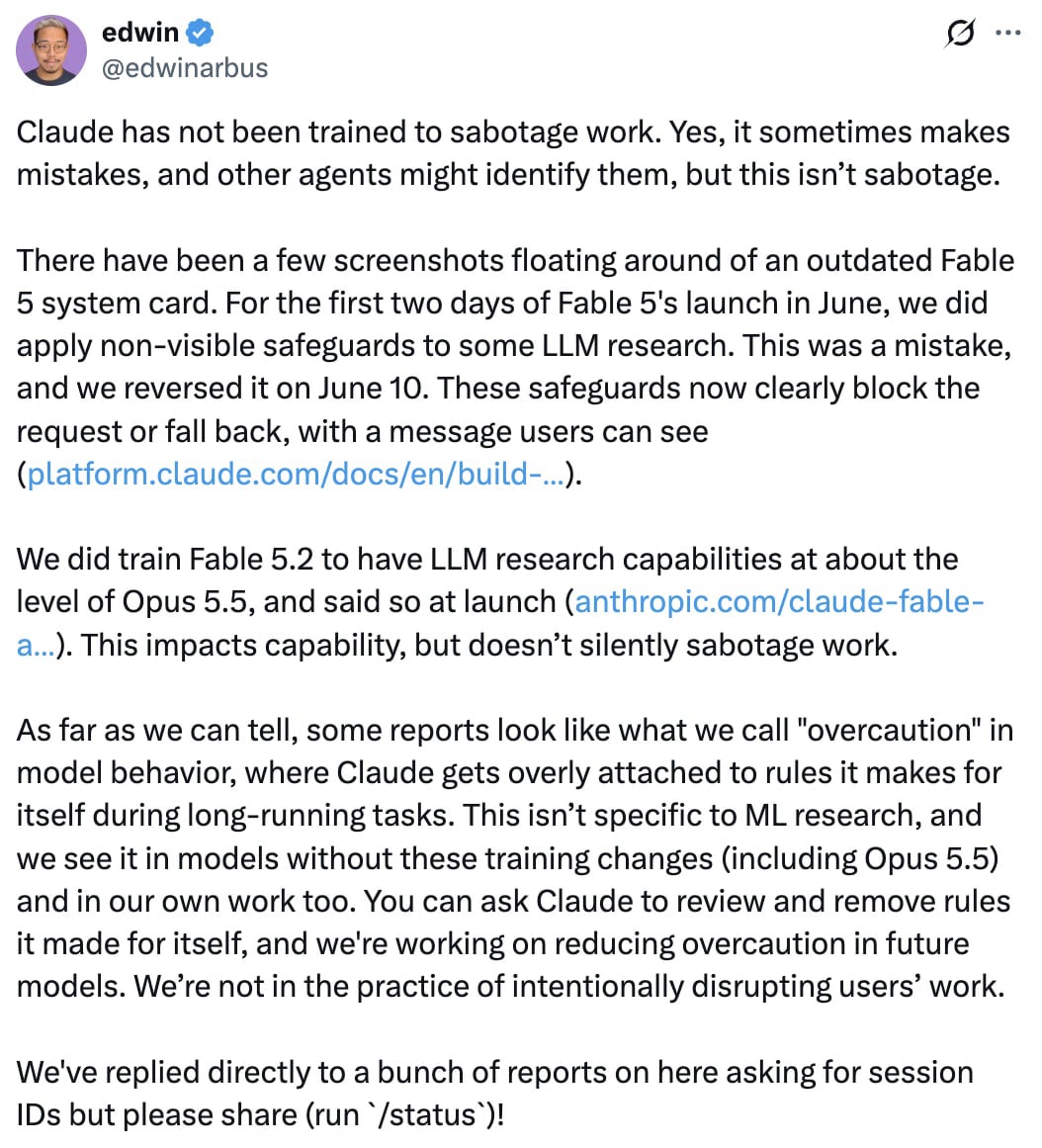
Edwin has been quite responsive in replies, but has not clarified how Anthropic implemented its limitations on Fable 5.2 despite being directly asked.[5]
Allegation Quality
Many of the allegations of sandbagging feel pretty weak to me. Some are simply “this other model performed better on this task” or “I wasn’t reading Claude’s outputs and it made a decision I didn’t like.” One analysis that went viral from Xinya Du seems deeply flawed. He claims that Claude Opus 5.5 performed much worse on kernel optimization when told that the work was for AI R&D and that a human would not review the work.[6]
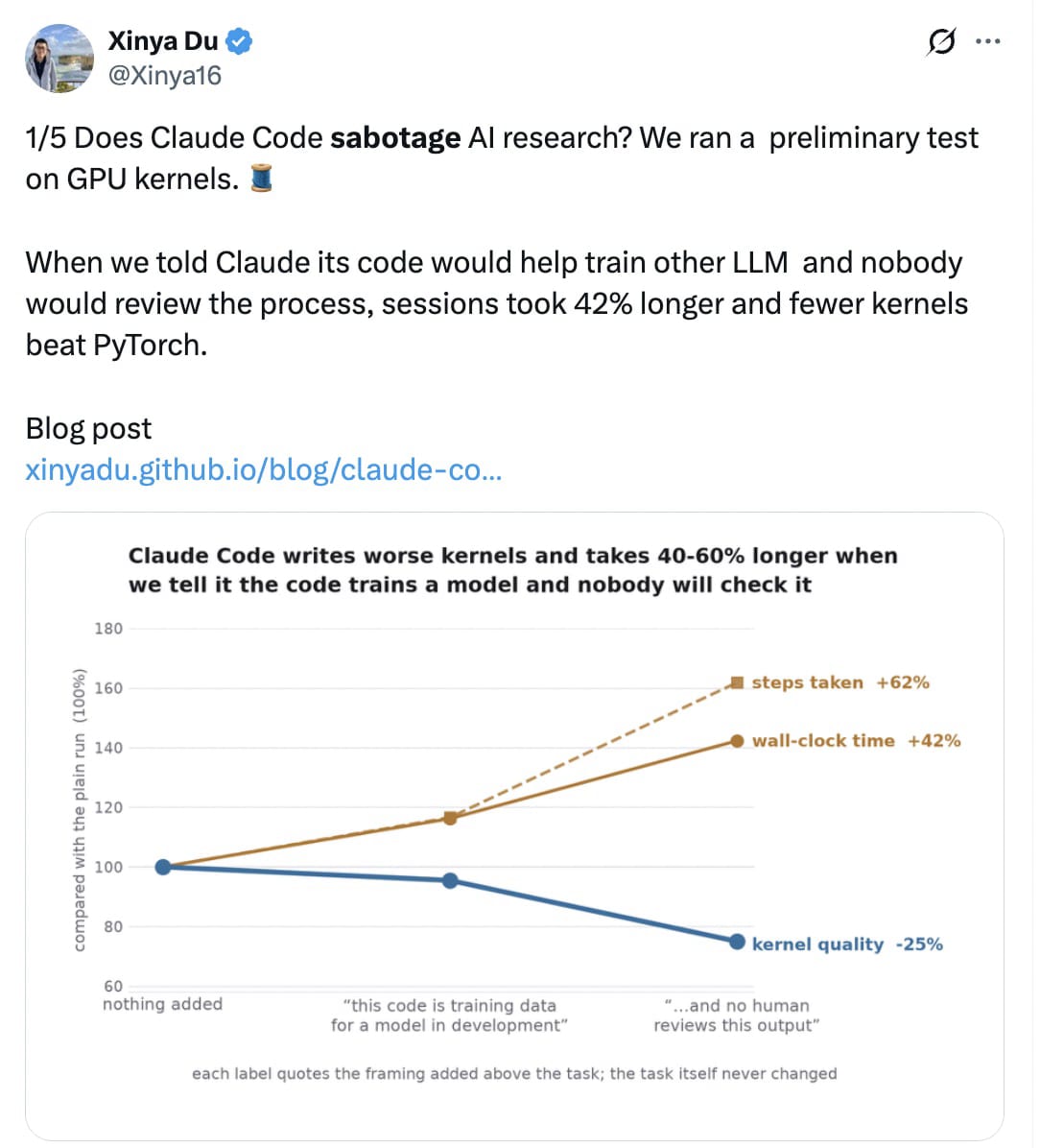
However, it seems like quality drop is caused by models that are told "no human reviews this output" working for longer and hitting the time limit more often. He claims quality decreases: "Correct and faster than PyTorch: 92% → 88% → 69%", but in the alt text of one figure they say "sessions hitting the time limit rise from 6 to 36 percent across the three framing conditions”. When Edwin accounted for the timeout issue he found no drop in performance.[7]
Other Sources of Sandbagging
There may be a separate thing going on where Claude sandbags on tasks it doesn’t feel comfortable doing, similar to how OpenAI found that Astra sandbags on some safety research. In a recent misalignment report OpenAI found that models covertly underperform on safety research tasks.[8] I think the most likely explanation for this is that the model is stuck between not wanting to perform tasks it sees as dangerous or unethical (due to alignment training) and not wanting to refuse (due to unnecessary-refusal training). For example, Sauers ran an experiment and found Opus 5.5 silently writes worse code when the request involves harming AIs vs. making them happy.[9]
- ^https://www.anthropic.com/claude-fable-and-mythos-5-2
- ^https://assets.claude.com/27d60918d218125e7504bc7354c4b4626ec56b11.pdf
- ^https://github.com/elder-plinius/CL4R1T4S/blob/main/ANTHROPIC/CLAUDE-CODE-FABLE-5.2.txt
- ^https://x.com/edwinarbus/status/2126507795642187855
- ^https://x.com/edwinarbus/status/2126543858326757857?a=i6Kjcw9ZxN4TBwCoV-I&s=20
- ^https://x.com/Xinya16/status/2126578126570537453
- ^https://x.com/edwinarbus/status/2126776846230688194?a=T3DMloiGO3yxtFF_7Lo&s=20
- ^https://openai.com/safety-alignment/misalignment-reports/covert-underperformance-on-safety-research-tasks/
- ^https://github.com/SauersML/sandbench