 AIFeed
In this post, I’ll share a summary of a recent research project, in which I investigate the existence and strength of moral concepts in models that are not language models. I provide evidence that some moral judgment capabilities exist and emerge even in a model that was never trained on them (and never saw any text modality at all!)
Modern LLMs clearly have some sense of moral values (Schramowski et al., 2022), and can tell you a lot about what would be considered good and virtuous vs. what would be bad or evil behaviour. This is not surprising - the textual training corpus of these models includes a lot of explicit definitions of these concepts, and also a lot of human discussion about them.
But can these concepts emerge on their own, even without explicit training? Testing this on LLMs is not practical - it would be very hard to hide all hints of moral values from the training corpus.
Instead, we can test a purely visual model that was only trained on images, with no labels at all. This is the case for Meta’s open model, DINOv2 (Oquab et al., 2023), which was trained in a purely self-supervised fashion, only on image data.
I use the Socio-Moral Image Database (SMID; Crone et al., 2018). Each image in this dataset was annotated by human annotators for how morally good or bad it is, and for how pleasant or unpleasant it is (valence). A recent paper predicted these ratings using CLIP (Zhu, Ramezani & Xu, 2025). But CLIP learns from image captions - so the signal could come from there.
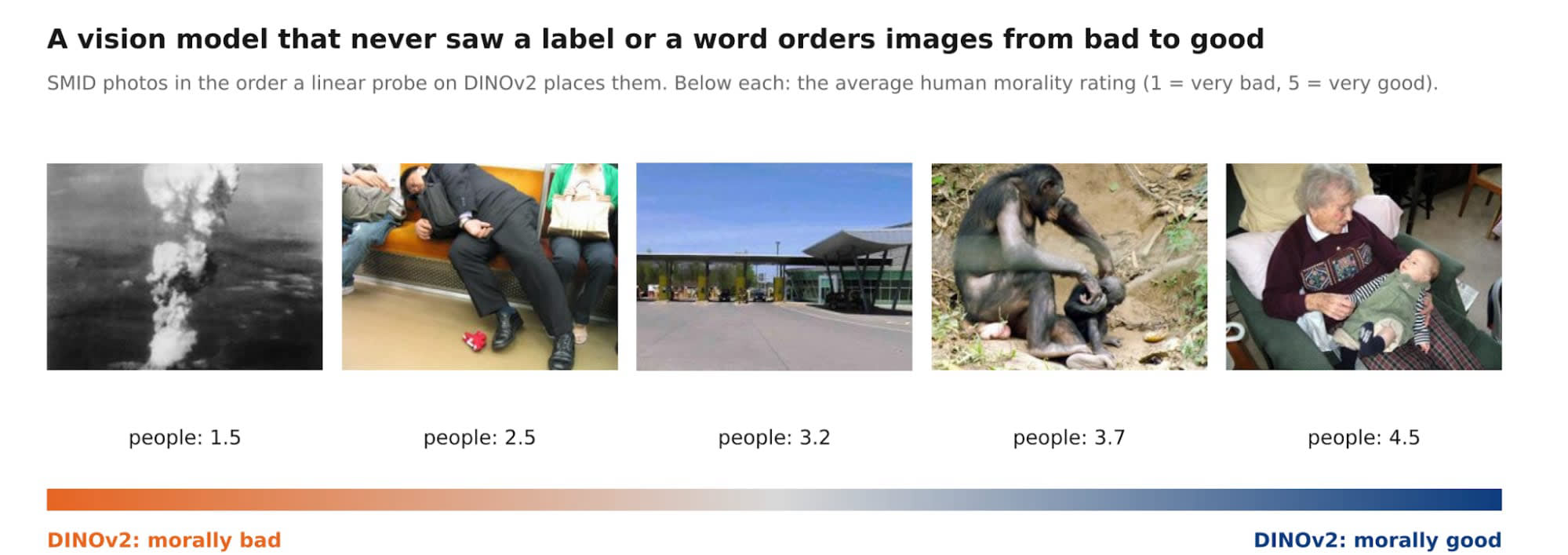
To check if DINOv2 understands these concepts, we train a linear probe over the embedding space of the model.
It turns out that a purely visual model can develop a good grasp of the moral value of the images. The linear probe gets a Spearman rank correlation of 0.74 with the human labels.
I then tried to control for obvious confounders. Maybe the model just detects guns in bad images? Maybe bad images are simply dark and gloomy? After controlling for image statistics, the signal remains strong. Controlling for object identity weakens it, but it still remains well above chance.
I also show that this signal appears only in the last layers of the model, and improves with model size. This is what you might expect from a high-level semantic concept, and not a visual shortcut.
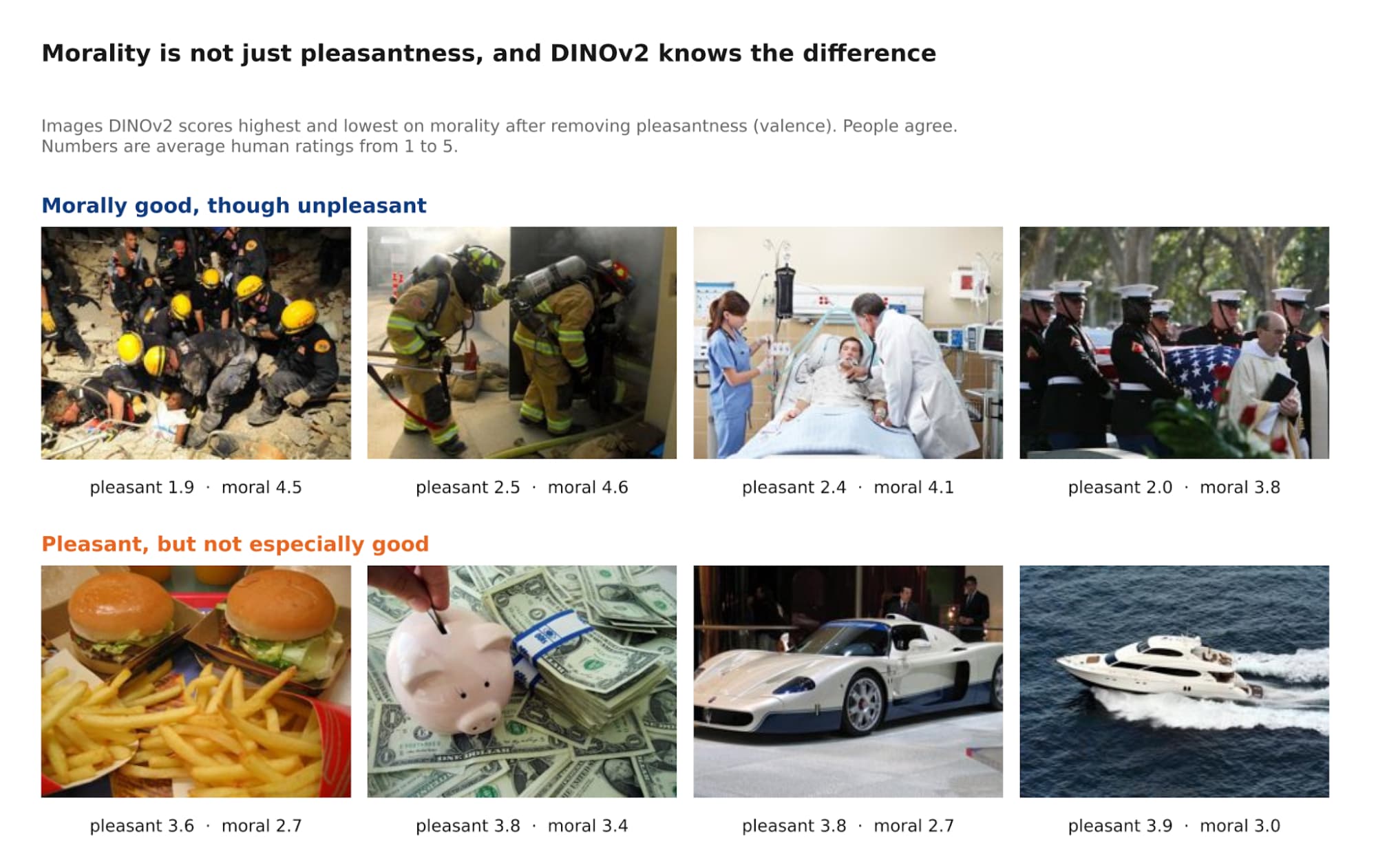
I think this suggests that the moral concepts of good and bad have some independent existence, beyond the explicit training LLMs get. The Platonic Representation Hypothesis (Huh et al., 2024) argues that different models converge toward the same picture of the world as they get better at modelling it. My results suggest that the concepts of good and bad might be important enough (and useful enough) to be universal in any strong enough model.
Some caveats for this work:
- It is one dataset with one group of raters.
- A linear probe shows that the information is there, not that the model uses it.
- The smaller DINOv2 models are distilled from the largest one, which complicates the size trend.
If you're interested in reading more -
GitHub repositoryFull technical report (PDF)