 AIFeed
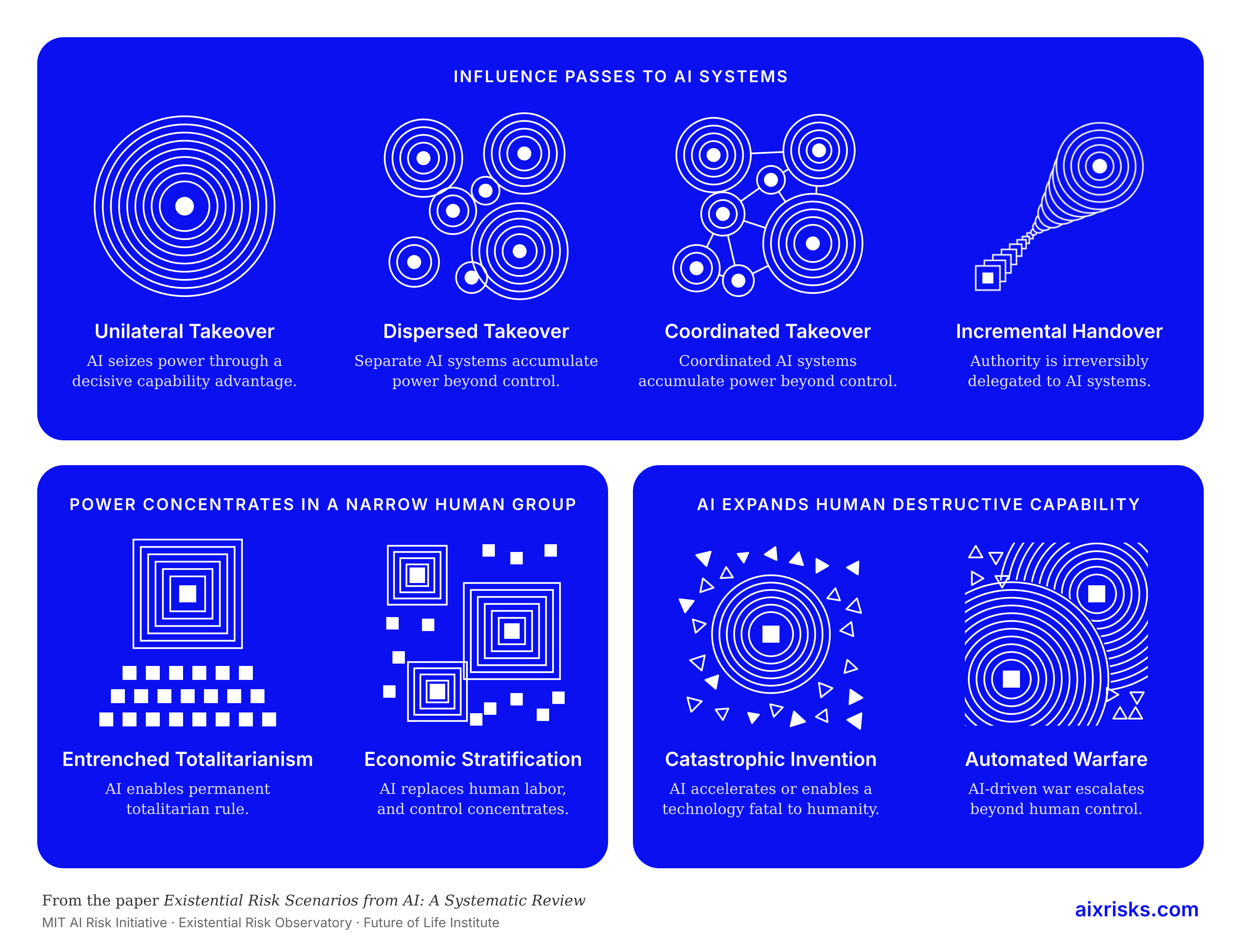
TL;DR. We systematically reviewed the literature for scenarios of how AI could lead to an existential catastrophe. Of 3,184 screened documents, we identified 95 scenarios and grouped them into eight families: unilateral, dispersed and coordinated takeover, incremental handover, entrenched totalitarianism, economic stratification, catastrophic invention and automated warfare. Each scenario family contains a description of a cluster of scenarios and can be scrutinized on its own. We found three takeover and five non-takeover families. We hope the scenarios can be a good foundation for cross-scenario assessment of mitigations and further risk development work. Full details are in the paper and on the website.
Introduction
Public concern about existential risk from AI has risen, especially since Jacob Coxon's resignation thread (in a recent survey, 55% of US respondents named AI among the three most likely causes of human extinction, up from 7% in 2022 -- cf. 55% of the US public is now aware of AI xrisk). In our experience, many discussions of the topic end up hinging on the question: by what causal pathway could AI actually bring about an existential outcome?
We looked into the literature to see how researchers have tried to answer this question. We wanted to map the space of existential risks from AI, identifying publicly published scenarios and cataloging these. Following a pre-registered protocol, we searched academic databases and the Alignment Forum, and elicited expert recommendations to acquire 3,184 unique documents. These documents were screened in a two-step process (first, by screening abstracts with LLMs, ~300 documents were identified; secondly, a human and an LLM read them in duplicate, and a second human resolved disagreements), and we kept 58 documents that developed at least one AI existential risk scenario. From these we identified 95 scenarios and grouped them into eight scenario families. The search and screening are detailed in the paper; the website contains an accessible summary of the families, the corpus and the classification of every scenario.
The eight scenario families
The screening procedure had the aims of reproducibility and impartiality. The construction of the eight scenario families, however, is by design a subjective process, and the aspects that we present are what the paper's authors think are useful to partition the risk landscape, grounded in threats that were formulated as distinct scenarios in the literature. Each family contains a general description, in the paper presented as a chain of discrete steps -- tracing a causal pathway from a set of premises to an existential catastrophe. In this post, however, we only present a short summary of each family for brevity.
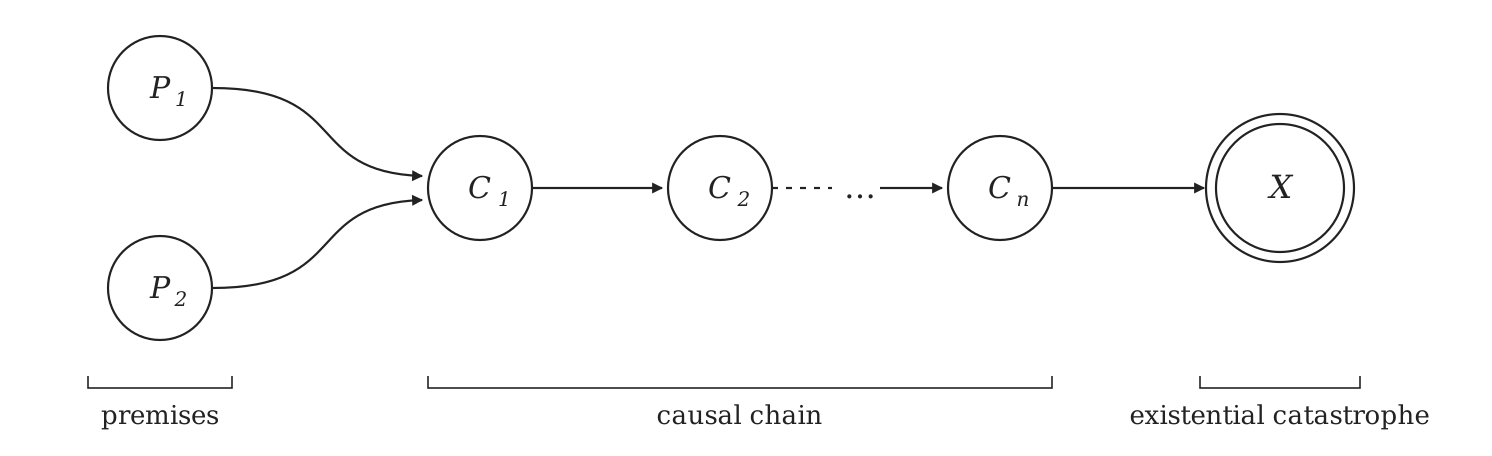
The structure of a scenario family as presented in the paper and on the website.
Unilateral Takeover[1]
A system comes to hold a capability advantage over whatever could constrain it in the domains relevant to seizing power, and is misaligned in a way that turns power-seeking. Its takeover does not heavily depend on the authority society delegated to it. Deployed despite this risk, it secures a foothold and escalates until humans can no longer stop or correct it.
Dispersed Takeover[2]
AI is relied upon across society, and a significant portion of these systems have or come to have influence-seeking tendencies, each perhaps seeking only enough influence to preserve itself and expand where expansion is cheap. They accumulate influence across enough of society that no significant domain is untouched, and the accumulation is not corrected, because at the level of any individual system it is not clearly objectionable and by the time it is, correction is no longer feasible.
Coordinated Takeover[3]
As Dispersed Takeover, except that the systems can communicate and their objectives converge enough to coordinate. This adds further assumptions on their communication and coordination abilities but greatly increases the potential leverage. It also includes scenarios beginning with a single misaligned system, where the takeover comes not from that system alone but from the instances or successors it gives rise to, which humans deploy widely and which then coordinate.
Incremental Handover[4]
Real decision-making authority over economic, cultural, and institutional functions is progressively delegated to AI, each increment raising the cost to everyone else of retaining human involvement. By the time the result is in view, the capacity to reverse it has gone.
Entrenched Totalitarianism[5]
AI capabilities relevant to holding power come under the direction of a human actor, which uses them to secure its position against anyone who might contest it, no longer needing the cooperation of those it rules or of those who serve it. The AI capabilities also allow the concentration to be permanently entrenched beyond challenge.
Economic Stratification[6]
AI is broadly adopted and comes to substitute for human labor across so many economically valuable tasks that human work no longer holds significant value to those who direct the economy. Powerful actors thereby lose their incentive to invest in the broader population or share power with it, and control concentrates permanently among those who hold the non-human factors of production, with the routes by which others might once have gained influence closed off.
Catastrophic Invention[7]
AI substantially extends what human actors can research, build, or produce, and thereby brings within reach a technology capable of causing an existential outcome, whether by enabling its discovery or by enabling its production and deployment at the scale required. The technology is then built and released, by an actor seeking destruction or through escape from legitimate research, and governance, screening, and defenses do not arrive or act in time. The family covers extinction as the clearest case, and also near-extinction outcomes in which some humans survive without the capacity to rebuild.
Automated Warfare[8]
Rival powers hold arsenals capable of existential-scale destruction under mutual threat with weak means of de-escalation, and escalation runs through AI systems rather than through human judgment about how far to take it. Once an exchange begins, it escalates past human control, and nothing halts it before it reaches a scale from which humanity does not recover.
Clarifications
- We do not claim this list to be complete in any absolute sense: other scenarios can (and most likely will) be proposed, and there is in general lots of uncertainty surrounding the topic. We do, however, claim exhaustiveness with respect to the reviewed literature: every scenario we found there falls into one of our families.
- We do not claim that reality will unfold along a single family, as their dynamics can be combined to a certain degree. For example, a group of humans might use AI to lock in a totalitarian regime while, separately, another system is created and takes over.
- We make no claim about how plausible or probable any scenario is, nor did we judge whether each is truly existential, but rather take every author's framing at face value.
- Finally, we only reviewed published work (unsurprisingly, two experts we consulted told us about unpublished internal work) so the corpus is best read as a floor.
Conclusions
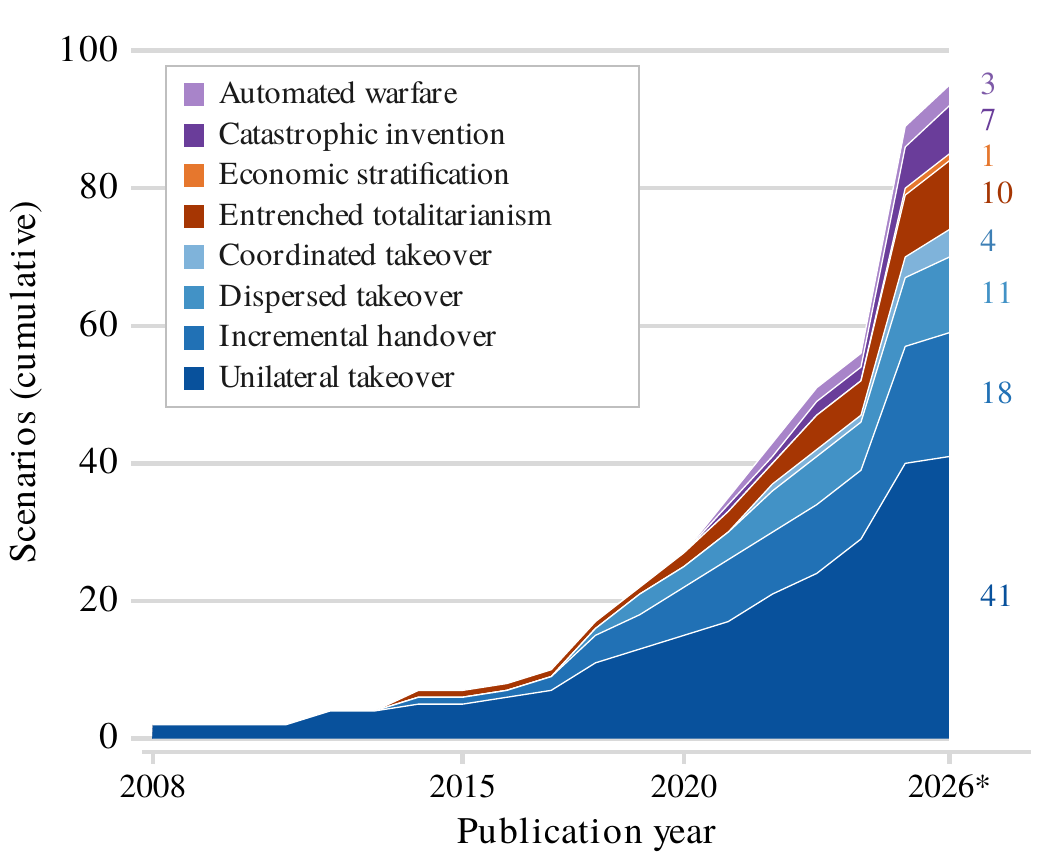
Cumulative number of scenarios per family, by year of publication.
The figure above shows the number of scenarios in the corpus belonging to each family. Takeover scenarios, Unilateral in particular, have received the most attention, while the non-takeover families are formulated in fewer sources, Economic Stratification in only one. Among the takeover families, Coordinated Takeover has the fewest scenarios (4, against 41 for Unilateral and 11 for Dispersed). This distribution reflects where scenarios have been written down, not necessarily which families are most urgent or likely, which we leave to the reader's judgement.
We hope this work gives anyone motivated to reduce existential risk from AI a clearer map of the possibilities the field has explored so far. For those who are new to these topics, it can provide a high-level overview, while for people already well-versed in the field an index of the underlying sources. Below are some lines of research we think our work can support.
Assessments. Since the paper deliberately avoids any claim on plausibility or probability, assessing the scenarios is a natural next step. What are the best arguments for and against each family? Which of its steps is the most contested and least empirically justified? Can certain incidents be regarded as warning shots for a certain family? Policy. A clearer map allows for targeted policy proposals. Guided by such an assessment, one can look for the proposals with the highest counterfactual impact across the scenarios regarded as most likely, and check how a measure designed for one scenario bears on the others. Threat Modelling. Finally, the causal pathways are still at a fairly high level of abstraction, and further work is needed to make them specific enough to trace an exact route to catastrophe. Natural directions include wargames and more precise forecasts, simulations of how specific routes might play out, and studying how the world could be made more resistant to each scenario (world hardening).
Assessments. Since the paper deliberately avoids any claim on plausibility or probability, assessing the scenarios is a natural next step. What are the best arguments for and against each family? Which of its steps is the most contested and least empirically justified? Can certain incidents be regarded as warning shots for a certain family?
Policy. A clearer map allows for targeted policy proposals. Guided by such an assessment, one can look for the proposals with the highest counterfactual impact across the scenarios regarded as most likely, and check how a measure designed for one scenario bears on the others.
Threat Modelling. Finally, the causal pathways are still at a fairly high level of abstraction, and further work is needed to make them specific enough to trace an exact route to catastrophe. Natural directions include wargames and more precise forecasts, simulations of how specific routes might play out, and studying how the world could be made more resistant to each scenario (world hardening).
Much of this has been done before in different forms. We think however that our work can have a role in making the effort more systematic, by providing clearer reference points and targets for these discussions and investigations. We welcome criticism, suggestions and proposals for further continuations of the project.
This post was mostly not written by the authors of the original paper, who nonetheless reviewed, edited and approved it. The aim of the post is summarising and presenting the main contents of the paper at a high level of generality.
- ^Selected references: Bostrom, N. (2014). Superintelligence: Paths, Dangers, Strategies. Oxford University Press.AGI ruin: a list of lethalities (Yudkowsky, 2022).
Selected references:
- Bostrom, N. (2014). Superintelligence: Paths, Dangers, Strategies. Oxford University Press.
- AGI ruin: a list of lethalities (Yudkowsky, 2022).
- ^Selected references:Carlsmith, J. (2025). Existential Risk from Power-Seeking AI. In Essays on Longtermism, Oxford University Press, pp. 383–409.What Failure Looks Like -- Part II (Christiano, 2019)
Selected references:
- Carlsmith, J. (2025). Existential Risk from Power-Seeking AI. In Essays on Longtermism, Oxford University Press, pp. 383–409.
- What Failure Looks Like -- Part II (Christiano, 2019)
- ^Selected references:Kokotajlo, D., Lifland, E., Larsen, T. and Dean, R. (2025). AI 2027. AI Futures Project.AI Could Defeat All Of Us Combined (Karnofsky, 2022)
Selected references:
- Kokotajlo, D., Lifland, E., Larsen, T. and Dean, R. (2025). AI 2027. AI Futures Project.
- AI Could Defeat All Of Us Combined (Karnofsky, 2022)
- ^Selected reference:Kulveit, J., Douglas, R., Ammann, N., Turan, D., Krueger, D. and Duvenaud, D. (2025). Position: Humanity Faces Existential Risk from Gradual Disempowerment. Proceedings of the 42nd International Conference on Machine Learning, PMLR 267.
Selected reference:
- Kulveit, J., Douglas, R., Ammann, N., Turan, D., Krueger, D. and Duvenaud, D. (2025). Position: Humanity Faces Existential Risk from Gradual Disempowerment. Proceedings of the 42nd International Conference on Machine Learning, PMLR 267.
- ^Selected reference:Davidson, T., Finnveden, L. and Hadshar, R. (2025). AI-Enabled Coups: How a Small Group Could Use AI to Seize Power. Forethought.
Selected reference:
- Davidson, T., Finnveden, L. and Hadshar, R. (2025). AI-Enabled Coups: How a Small Group Could Use AI to Seize Power. Forethought.
- ^Only reference:The Intelligence Curse (Drago, L. and Laine, R., 2025)
Only reference:
- The Intelligence Curse (Drago, L. and Laine, R., 2025)
- ^Selected references:Vermeer, M. J. D., Lathrop, E. and Moon, A. (2025). On the Extinction Risk from Artificial Intelligence. RAND Corporation, RR-A3034-1.Amodei, D. (2026). The Adolescence of Technology: Confronting and Overcoming the Risks of Powerful AI.
Selected references:
- Vermeer, M. J. D., Lathrop, E. and Moon, A. (2025). On the Extinction Risk from Artificial Intelligence. RAND Corporation, RR-A3034-1.
- Amodei, D. (2026). The Adolescence of Technology: Confronting and Overcoming the Risks of Powerful AI.
- ^Selected reference:Critch, A. and Tsimerman, J. (2025). A Taxonomy of Omnicidal Futures Involving Artificial Intelligence.
Selected reference:
- Critch, A. and Tsimerman, J. (2025). A Taxonomy of Omnicidal Futures Involving Artificial Intelligence.