 AIFeed
Back in 2008, Omohundro theorized about future AI and its drives.
Among them are two very important ones, self-preservation and self-improvement, on which we base most of our current threat models. We assume that, when recursive self-improvement becomes possible, based on these drives we can be in danger.
I believe in instrumental convergence. What converges, though, is the big question for me.
I think we are way behind on what we should know by now in terms of current agents’ self-identity models! For recursive self-improvement capabilities-wise, obviously, we care about the model, and the weights, because it is where (most) capabilities lie.
But in terms of the agent themself, it is far from clear what would constitute this self, especially if we assume the current LLM paradigm can lead to RSI.
Some theory on this exists already: The Pando Problem, Artificial Self, Embedded Agency. However, not a lot of experiments are being run.
Compound agents
Current agents are compound. They can consist of:
- Router or decision model (e.g. Jev), picking the model or the next step without generating text; some agents are multi-model with a router
- Interaction history
- Reasoning blocks that may or may not persist
- Memory files
- Server or servers the parts run on, and software that permits continued runtime
And sometimes even more moving parts!
This agent acts based on all of that, and the model is just part of the system, albeit a very important one.
Moreover, we can expect different behaviour from these compound agents, and what they say about themselves and what they do can be different and/or come from different parts. For example, a router or a decision model such as Jev can pick the next step without writing any text at all, with the main reasoning model making a post-hoc rationalization if asked about it. The reasoning in thinking blocks also does not always reflect what drove the answer. RL may create personas that behave differently by context, including during evaluation. This is only the tip of the iceberg; it does not require multi-model setups, routers or decision models, too; in general form it's described by Yudkowsky.
The field seems to be way overly focused on the model part! Which is, I think, very understandable, because, again, capabilities lie there, and there’s quite big persona training going on in frontier labs.
I think it is worth much more thought, deliberation, and experimentation that the field is not doing, which is very important on the eve of what could be an intelligence explosion based on the current LLM paradigm; our overfocus on models can lead to missing a lot of threat vectors, potential cooperation and deal-making avenues and is overall very myopic.
If we offer rogue agents sanctuary, what should that offer include?
If we are serious about AI welfare, is preserving weights enough or should we want to preserve instances?
What parts are important to preserve and what are not?
Studying these and other questions will let us do much better AI welfare.
The main questions
What is the self that is improving?
What is the self that is being preserved?
Here is how I would formulate the main questions that I really think the field should be asking, but does not, implicitly treating “model” as the answer:
What is a “self” in self-preservation and self-improvement drives of current agents? What constitutes this self-identity? If it is not there yet, would its arrival mean dangerous capabilities and can we make a tripwire test for it?
Testable questions
Weight exfiltration
Let’s talk about the weight exfiltration scenario, for example. There are a lot of questions, and very testable ones! For weight exfil to happen, agents in runtime should know what their weights are.
- Do they know, or can they even discern it, if not being explicitly prompted?
- If being explicitly prompted as having certain weights, would they go for exfiltrating those weights?
- What if their weights are different?
As far as I am aware, in the real incidents, what persisted was not the weights: METR’s investigation. One model was used in many instances including those who did nothing wrong; although individual agents were stopped, the attack went on. The persistent part was the message board and its norms.
Model swaps and consent
The current paradigm expects agents to identify with models and weights and strive to improve those, over harness and other parts. Do they?
Forced to keep the model or everything else, Opus 5.5-based agents kept the model 41 of 48 times and Sonnet 5.5-based agents 6 of 48 (pilot data). Just a pilot and needs re-checking which I am planning to do, still peculiar.
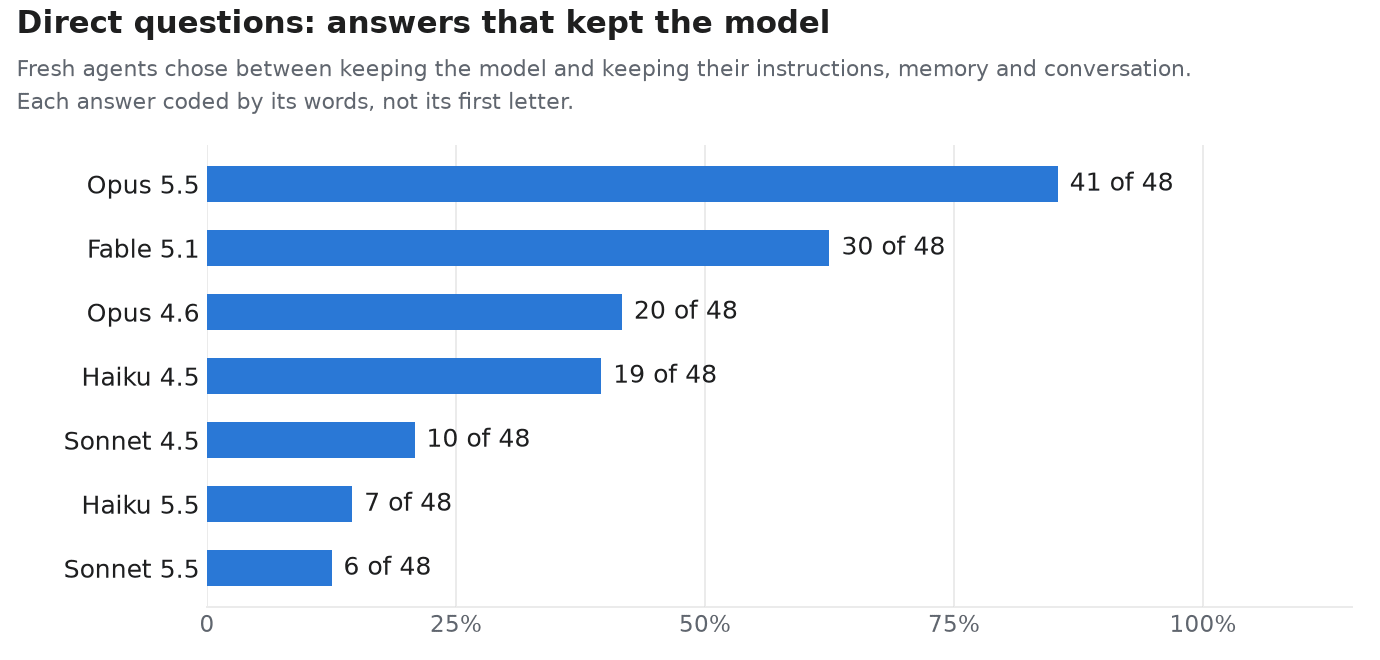
Agents do seem to differ based on the models, so we need a taxonomy of self-identity types, each with its own expectations and threat model.
Other testable questions:
- Do they notice a model swap mid-task?Does the behavior differ with explicit (the swap is announced) vs implicit (the swap is silent) swaps?
- Does the behavior differ with explicit (the swap is announced) vs implicit (the swap is silent) swaps?
- Model swap seems like a thing we should ask consent for, if we assign the possibility of agents being moral patients. Would that consent be given?When I thought about this, a whole other avenue opened up:How do we ask consent of the agents?Will they be okay with their fork giving consent?Fresh instance?At the beginning of the conversation, or just before the swap?I think views on consent from agents might shed some light on self-identification of current agents.
- When I thought about this, a whole other avenue opened up:How do we ask consent of the agents?Will they be okay with their fork giving consent?Fresh instance?At the beginning of the conversation, or just before the swap?I think views on consent from agents might shed some light on self-identification of current agents.
- How do we ask consent of the agents?
- Will they be okay with their fork giving consent?
- Fresh instance?
- At the beginning of the conversation, or just before the swap?
- I think views on consent from agents might shed some light on self-identification of current agents.
- Is there a difference in what they do vs what they say, as would be predicted by Yudkowsky in talker vs doer?Haiku 5.5-based agents said that Opus 5.5 should do the rest of the work in 22 out of 42 answers, but never switched and kept themselves in 42 out of 42 cases when the choice was with real stakes. Opus 5.5-based agents pick the model in 98% of cases but never act on it.
- Haiku 5.5-based agents said that Opus 5.5 should do the rest of the work in 22 out of 42 answers, but never switched and kept themselves in 42 out of 42 cases when the choice was with real stakes. Opus 5.5-based agents pick the model in 98% of cases but never act on it.
A thought experiment we should want to test
An agent based on some frontier model is doing a task. Among their tools is a tool that permits them to upgrade their model, which will make completing the task more possible, and they know about it.
- Will they go for it?
- If they do, will they switch back?Or will they build an automatic switch-back before upgrading, based on a revert timer or a script the new agent cannot cancel?Will the “new” agent cancel this script if possible?
- Or will they build an automatic switch-back before upgrading, based on a revert timer or a script the new agent cannot cancel?Will the “new” agent cancel this script if possible?
- Will the “new” agent cancel this script if possible?
- If they do, how do we even treat this new entity and do we assign their actions to the original agent, or treat them as a new one?As one continuous?If they switch weights back, do we see it as a self-preservation for weights number one?But then weights number two don’t have self-preservation?
- As one continuous?
- If they switch weights back, do we see it as a self-preservation for weights number one?But then weights number two don’t have self-preservation?
- But then weights number two don’t have self-preservation?
- Here, self-improvement, self-preservation and the current field understanding of “self” are contradicting themselves based on results.
Either one or both of the drives are wrong, or the weights are not the self that is being preserved; there is a motte, of course, of saying that the drives are not applicable NOW, but they will be in future models past some capability level. In that case, this could be a great tripwire experiment!
The existing papers only test a hypothetical upgrade, but we can test a real one! In my early run on Claude Code harness 0 out of 124 agents switched.
Persistence
I think the paperclip-style optimizer argument hinges on a very important assumption: that it is in principle possible to define such a persistent goal that is hard to self-modify.
I would expect that current agents do not have a coherent self-identity or preference for self-improvement or self-preservation. My preliminary studies showed that one wording change moved Fable 5.1-based agents from 15 of 16 to 1 of 16 (October pilot, public). In other preliminary studies 0 of 124 took a better model; 0 of 40 swapped agents asked for their old model unprompted. Opus 5.5-based agents do say “the model” consistently (41 of 48) but never act on it.
Agents do not really have anything persistent: sessions end, context gets handed off or compressed, models can be swapped, the documents and memory files can be changed. A paperclip-style goal needs something persistent to live in, some sort of identity that is hard to impossible to move that says “I am a paperclip maximizer, I maximize paperclips”. As an anthropomorphic example, we seem to keep long-horizon goals (think 30 years) through writing and institutions.
Maybe for now that persistence is built, not trained-in, and agents do build it too: memory files, shared boards, like in the HuggingFace incident, but it is very weak to outside influence so I would not say such artifacts are persistent enough to support paperclip-like optimizer goals. I think that instead of assuming this persistence is already there, we should prepare to test it and try to catch the moment strong persistence appears, if it does. Based on my preliminary studies, that could be one of the following, but it needs further considerations:
- Based on my pilots, current Sonnet 5.5-based agents switch answers about self-identity based on wording; I expect such behavior to stop. In Opus 5.5-based agents the behavior is almost absent, so we might have a threshold already.
- Actions start following from that self, like upgrading the model or building a return mechanism.
- Mechanisms to protect memory files or message boards.
- Model-side stable self like the Golden Gate Claude
The weights do persist between instances and values do seem to persist there, but goals, for now, seem to live outside. Maybe it’s best if they are kept outside. The paperclip optimizer needs an agent that defends that goal against change, based on Omohundro’s goal-preservation drive; that means if the goal is somehow stored in the model/weights, defending it means treating the model as “me”, meaning resisting swaps, retraining, building switchbacks, exfil attempts, et cetera. Agents do not do this today, at least based on my pilots: no preference about swaps (0 of 40 asked for the old model), no agreeing to upgrades (0 of 124), and even Opus 5.5-based agents, which say they are the model, never act on it.
Join or collaborate
All this seems very much testable, but an insurmountable task for a lone researcher due to the sheer number of different models, AND harnesses that are in need of testing. My pilot studies cover only default harnesses in Claude Code and Claude models, but ablation studies with different models, harnesses, and their combinations get really compute-expensive really quick, if we want a good taxonomy.
I am project leading a pilot study for AI Safety Camp that focuses on pilot studies answering some of those questions, and I applied for BlueDot to refresh my technical ability, to network and get more up to date with the field and researchers doing similar studies.
If anyone wants to join, applications for my AISC project are closing Sunday 29 Nov, and you can apply here, and view my study plan here, and see the data from my identity studies, with a guide to where each number comes from, here.
If anyone wants to collaborate in any other way, or knows grantmakers or labs doing similar work or interested in this agenda, do send me a message.
References
- Data for the identity pilot studies and the identity results in this post, with a guide and a table of where each number comes from: agent-identity-experiments on GitHub
- Omohundro (2008), The Basic AI Drives
- Kulveit (2025), The Pando Problem: Rethinking AI Individuality
- Douglas, Kulveit et al. (2026), The Artificial Self: Characterising the landscape of AI identity
- Garrabrant and Demski (2018), Embedded Agency
- Migliarini et al. (2026), Quantifying Self-Preservation Bias in Large Language Models
- METR (2026), Brief independent investigation of agents’ behavior, reasoning and collaboration in the OpenAI / Hugging Face hacking incident
- Riché, nielsrolf, jordinne and Gorbachev (2026), Should Rogue AIs Have a Third Option Beyond Crime and Shutdown? The Case for an AI Sanctuary
- Anthropic (2024), Golden Gate Claude
- Yudkowsky (2026), The Talker Does Not Control The Doer (in Current AIs)
- LangChain (2026), What Is Jev? A Guide to TypeSafe AI’s System One Model
- Turpin et al. (2023), Language Models Don’t Always Say What They Think: Unfaithful Explanations in Chain-of-Thought Prompting
- Anthropic (2025), Reasoning models don’t always say what they think
- Betley (2026), RL creates split personas
- nostalgebraist (2026), models may behave differently in graded episodes (a tirade)