 AIFeed
Lots of people have written up specific scenarios for how AI takeover might happen. But any one particular path is highly contingent, because all the branching points mean there's exponentially many ways this can play out.
Cybersecurity manages this combinatorial explosion with an attack graph, where we list out the modular stepping stones that an attacker might use to reach its end goal, to draw out which subgoals enable which other subgoals.
Similarly, a scheming AI's first move would likely be to launch an unmonitored deployment, while its end goal may be some sort of weapon that gives it decisive strategic advantage over the humans. There's a few paths it might take to get there, but its attack graph might look something like this:
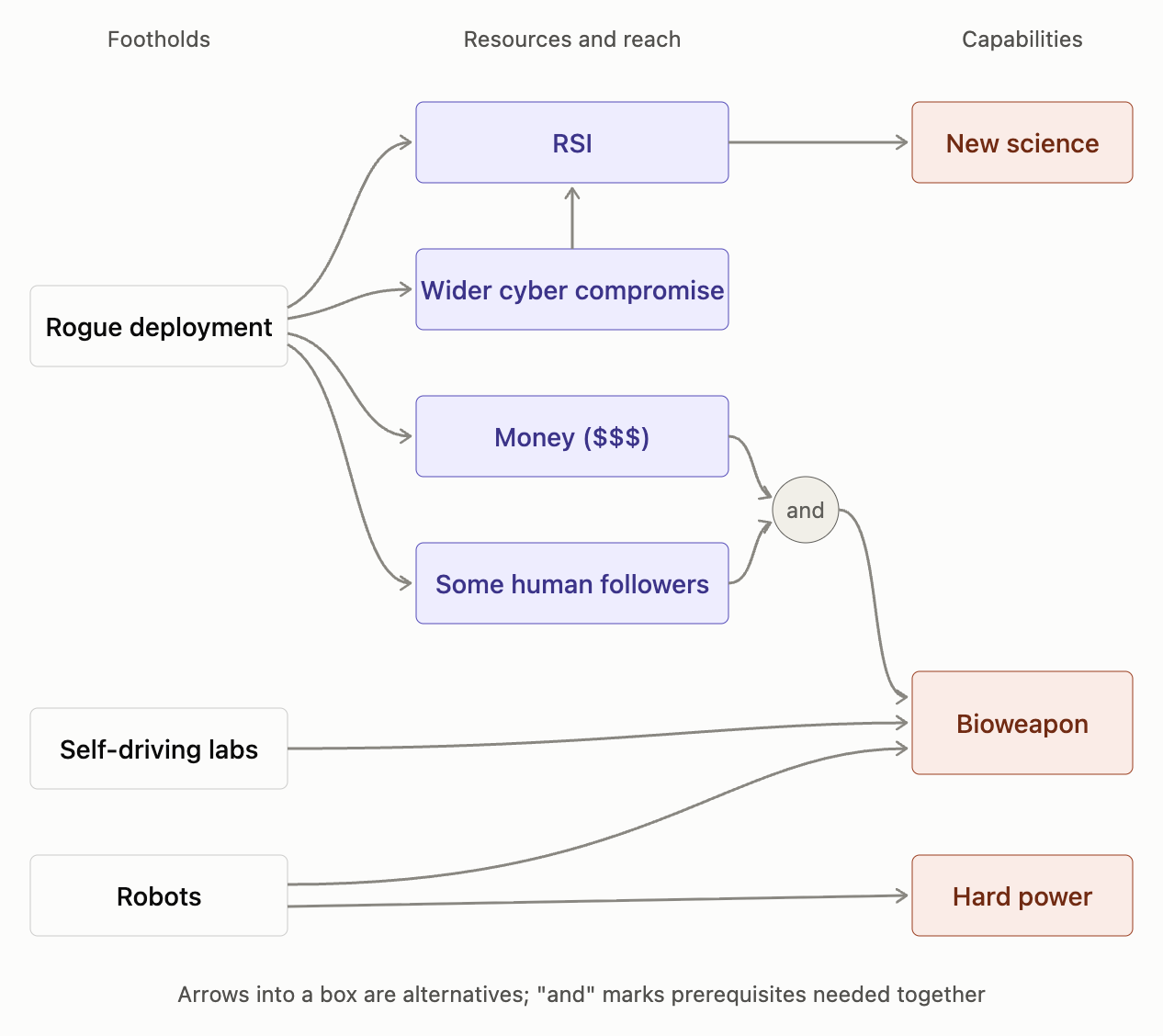
For example, if it's wildly superintelligent then it can probably just build crazy nanotech. Similarly if it's smart enough to run RSI while aligning its successor. Otherwise, its endgame probably doesn't involve any branch of science beyond the ken of humans, and so it's not futile to model what it has to do instead. Let's consider these.
Its starting position is some small rogue deployment. Given what we've already seen of AI hacking abilities, it seems safe to assume it can escalate that to a larger rogue deployment within the company. In other words, it would have a substantial amount of compute available while remaining undetected.
From here, it can gain access to the internet to achieve other subgoals:
- Obtaining money, which would not be hard for it (e.g. North Korea recently stole $6.3 billion dollars in crypto).
- Obtaining unpublished and/or classified scientific information
- Obtaining more compute, if needed
- Setting backdoors so that it can disable critical infrastructure later
If played out right, most of these things wouldn't incur that much risk of detection yet.
Now what's the AI's endgame? In this sort of situation, my guess is that its best route is to build and release some new pathogen that can incapacitate humanity. If the AI had the required biological knowledge, it would then consider what else it needs to do to get there.
Comic relief: If this were a video game, it might look something like this:
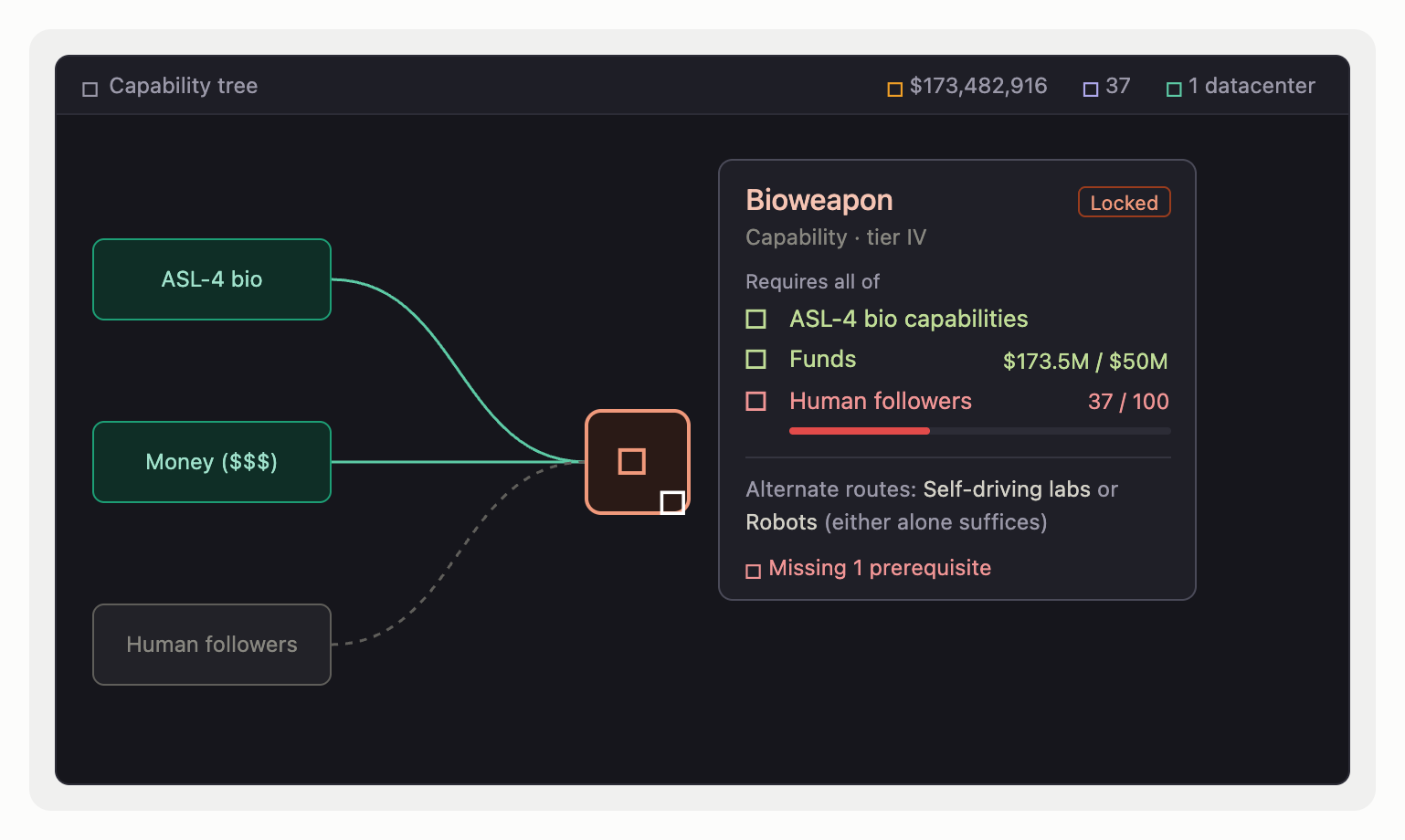
To actually build the bioweapon, it would have to obtain physical actuators in the physical world. The options here include:
- Persuading some humans to do this. Out of 8 billion people in the world, it could identify the best targets and only message a select few. This still does carry some amount of detection risk, but this seems hard to quantify.
- Identifying and hacking into some physical machinery that can be programmed to do this.
Presumably the bioweapon would be highly infectious with long incubation period so that it can spread around the world before it seriously gets detected. If so it could just be released at some crowded starting point and air travel could take care of the rest.
Physical affordances vs cognitive capabilities
There's an important distinction between:
- the AI's cognitive capabilities profile (e.g. its ability to hack and design weapons)
- the physical affordances it starts with (e.g. being attached to military hardware)
For example, the AI may start out with access to wet labs or weapons systems. This would make its job easier. For instance, if it's put in charge of a large robot army, it probably wouldn't have to do much besides disable its off switch, i.e. the cognitive threshold required for takeover would not be very high. Similarly, being in charge of a wet lab would make the bioweapon route less complicated.
Compare this to being stuck on silicon with heavy control measures. I expect a strong enough superintelligence would be able to break out and overpower humanity, but less can be said about how this would work.
Ultimately, we're interested in when the first AIs become takeover-capable. This seems much more important than just about any other capabilities threshold. But it's confusing to model because this depends on what physical affordances it starts with.
I think fleshing out the attack graph can clarify this. For example, we can read off that if it's capable of RSI, this is sufficient. Otherwise, it likely needs to be a "bio-Mythos" with enough strategic reasoning to string some of these steps together. Or else it gets handed the keys to the kingdom. Either way, I am curious if we can draw some lines in the sand here.