 AIFeed
Today, many government proposals seek the regulation of computation. Cumulative FLOPs (floating-point operations) are like measuring water usage or a utility power meter at a person's home, which is why they naturally seem like a defining criterion for regulation. But FLOPs require declaring how much compute in total was used, which is not a trivial thing to do around the world. EU AI Act, California SB 53, New York RAISE (as of writing, RAISE 2.0), Illinois Artificial Intelligence Safety Measures Act, and likely more to come all leverage this type of cumulative compute declarations. These policies target use cases of training and attempt to regulate general-purpose machines.
But when we start to add in the requirement to determine "how" this compute is used by saying banning the use of 10^25-10^26 worth of FLOPs for frontier model development. It becomes much less trivial to determine the "how" behind something that fundamentally could be used for any other application. This gets into the science of verifying.
Compute Verification refers to the idea of ensuring mutual verification with respect to how another person is using their compute. Being able to verify how the other party is using compute needs to be done with zero trust, absolute completeness, and absolute soundness if the policy aims to last long term. In this post, I aim to give the background needed to understand the major pillars of compute verification and add some positions for ways it might extend in the future.
Why does compute matter?
Any computer can run any task, given it has enough memory and time. The basic principle of the Universal Turing Machine means that it is a general-purpose computing device which can do anything that is computable. Computable things are up for debate, but for all things related to AI, they clearly have a historical track record that they can be computed.
Like Universal Turning Machines, General Purpose AI (GenAI) goal is a universal intelligence that can be used to solve things economically. There are many other definitions of AGI/ASI/GenAI explanations of what AI is trending towards, but for the scope of this work it is about economically doing a computational operation. All I want to do is hint at the idea of generality/universality of transformative technology. Whether it is software AI weights themselves or hardware that can run the AI weights, these are general-purpose technologies that could be used for both good and bad actors.
The dual-use nature is why we try to set back bad actors and uplift good actors through governance. Just lowering compute capabilities doesn't prevent bad things from happening, but it typically makes them happen on a much slower time horizon.
A computing machine needs two things: memory (what stores the data that gets operated on) and time (enough for those operations to happen effectively)
Having less memory doesn't prevent things from running, but it can increase the time to run it beyond the economical needs for that given task. If anyone has used an old PC (like Windows 95), logging in might feel not "economically" feasible compared to today's standards.
What I mean by economically feasible is not worth your time, where time = money. This is again a limited analogy, but in reality it could just be throwing lots of time at it for science, but most things I assume no one is patient enough to try and wait 300 years for a computer to finish a program, because if it is halfway and it crashes for some reason, the first person who kicked it off likely died, and the second person is likely getting too old to care to restart it. Often you invest your money and time into speeding things rather than waiting things out. In some cases, throwing more compute at things cleverly can be more economically feasible; one of these cases is in AI training with GPUs.
These speeds change with time. Hardware scales with the idea of Moore's Law, which is less of a law and more of an industry standard to pace the development of hardware. The same thing is true for Scaling Laws; it is not like models will scale magically, but the driving force is some pace that labs set internally or get pressured to race each other. More trends are mapped out by Epoch here. Many frontier labs attempt to have responsible scaling policies they define internally, like Anthropic's policy v3 as an example.
When it comes to regulating the frontier, the idea of pacing vs. pausing is the difference in how to approach regulation. Both methods buy time in the sense that they change how far the horizon is, because regulating general-purpose machines to only be used 50% less can often slow things down (with many caveats to the software side, which is limited on what can really be advanced here). This is not always the case with DeepSeek, which released a few years ago groundbreaking model performance at a fraction of the cost to build and a fraction of the compute from leveraging smart engineering methods and other factors.
So many seek to regulate hardware under the assumption is is a major limiting part of how to advance AI. Which is why I think the idea of advancement needs a wider lens in terms of compute, not just in the cloud but also at the edge, which we will see after I break down what hardware and software loosely are through the example of water.
Water Analogy: Hardware and Software - Dropdown for those unfamiliar with FLOPs.
Note: This section was polished by Claude Sonnet 5.5 from my own outline, then edited after, because explaining the analogy was starting to scope-creep the post. The ideas and structure are mine, but please check the wording. Software is far more complex than plumbing, so treat this as a rough guide, not a precise model.
Think of compute as water that gets spent doing work. You don't move it from A to B. The operations transform data, like water turning a mill wheel to grind grain. Two quantities matter, and they're easy to confuse: the rate (FLOP/s, how fast water flows) and the total (FLOP, how much passed through).
Hardware is the pipe and the pump.
Flow rate (FLOP/s) = parallel units × operations per tick × clock speed
- The pipe sets the ("band")width: how many units run in parallel and how many operations each does per tick. This is architecture. A GPU gets its speed from higher bandwidth, not from a faster clock (not from firing faster but from hiring many times in parallel pipes).
- The pump sets the velocity, which is the clock. It depends on the manufacturing process, power and cooling limits, and die quality, since chips of the same model differ slightly (silicon lottery or production binning).
- A specification from the manufacturer gives you the peak rate, often at low precision. That's a ceiling, not what a job actually uses.
Software is a bubbler. Say you want to fill a water bottle. The application decides the job: fill this bottle. The algorithm decides how many liters that takes, and this is where time complexity comes in.
- We measure time complexity in Big-O to describe how the number of operations grows with the size of the job. If the cost is linear (mx+b "line"), doubling the bottle doubles the water. If it's quadratic, as with attention blocks with context length, doubling the bottle size quadruples the water needed to fill it.
- For training a transformer (architecture behind GenAI models), the total is roughly 6 × parameters × tokens FLOP. If the cost is exponential, which is how exact solutions to NP-hard (things in computer science that are hard to solve because they take too much time and are not economically feasible) problems are believed to scale, eventually no pipe is big enough.
- Big-O describes growth, not the actual FLOP count, and it hides constant factors. It is part of algorithms and software advancements, but you can get around these advancements with parallel pipes like in a GPU (scaling something down by a factor of how many pipes you do in parallel; this helps scale down the difficulty but not the growth rate problem)
- Practical training uses gradient descent, which is around O(n^2), meaning it is largely accepted to be economical to run.
- Reservoir: the ceiling, meaning the peak rate × the window of time you have it.
- Valves: whatever keeps the pipe from running full: memory bandwidth, links between chips, data loading, inefficient code, restarts, and the slowest chip in a cluster.
Total FLOP = flow rate × utilization × time
Time to fill the bottle is then liters ÷ (rate × utilization). More pipes in parallel shorten the time, not the liters. This is where GPUs shine and how they reflect such high FLOPs in the specifications of their data sheets. Utilization and time have to be measured.
Compute is "compressible" in two different ways. Lower precision lets more operations fit through per second, which is why TOPS and FLOP/s aren't directly comparable. Better algorithms don't change the water used, but each liter buys more capability, which is why a fixed FLOP threshold ages badly from technological advancements in software. But most of the biggest advancements of algorithms are summed to be improbable. Meaning unless AI can solve a way to really advance math (which is claimed to have happened with the Riemann hypothesis and Claude helping)
What this means for regulation. A rule based on capacity is like fining someone for hooking up too big a pipe to too big a reservoir. It's simple to check but penalizes unused capacity. A rule based on usage is like reading a meter, which is more accurate but needs a meter you can trust. Agents add a third case: capping how many run at once is a rate rule, not a total.
Where the analogy breaks. Operations depend on each other, while water doesn't wait on earlier water. Big-O hides constants. And any computer can run any computable task given enough memory and time, so hardware determines cost and timeline, not what's possible.
Compute Paradigms
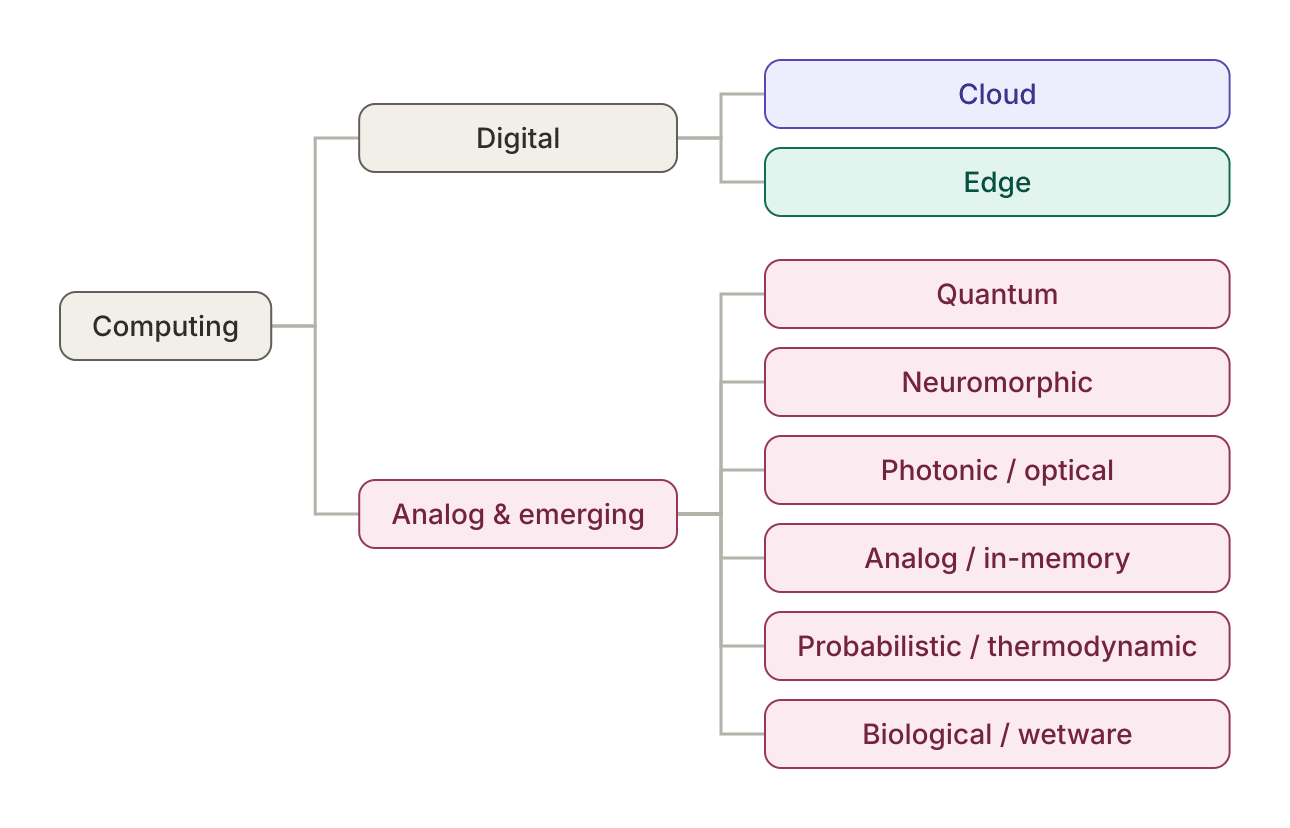
In fact, things like quantum and other paradigms are promising in transforming the way we do computation. We will focus on types of compute within Digital Systems. It is the most active paradigm of computing within the global economy.
Though I could be wrong with this narrow view, computing is not limited to digital systems. A theoretical models like Turing defined with Universal Turing Machine could work as many various forms of computers.
But today, the paradigm centers on digital computing, and more importantly, on accelerators that perform very special computations called tensor operations.
For example, NVIDIA does not build the compute that goes into your phone (or at least today), but focuses on GPUs (Graphics Processing Units) that act as accelerators for specific types of computation needed to have AI function as "well" and as fast as it does.
- GPUs are a special advancement compared to CPUs (central processing units almost any computer has) because they enable a bunch of parallel pipes (in my water analogy above) to move water (because in this analogy you can't figure out how the pipes are bigger but want to move more water (data))
Where does computation happen?
Normally the cloud, sometimes the edge... most of the largest compute is in the form of data centers. If you are interested in the numbers, explore Epoch's Data. A lot of compute is scattered around the world, which is why things like Bitcoin and blockchains can work, but the compute best suited for AI is mostly in data centers.
The cloud is not up in orbit, but rather down on the ground. The term cloud refers to data centers, large compute clusters that can be seen from the cloud, but today (maybe in the future) are being built mostly in the US, and at very fast rates. Epoch says it is enterprise GPU-owned in data centers "to double every 9 quarters." But the cloud could be internal and private to your company, so many of these discrete lines between the cloud and edge are often hybrid in operation.
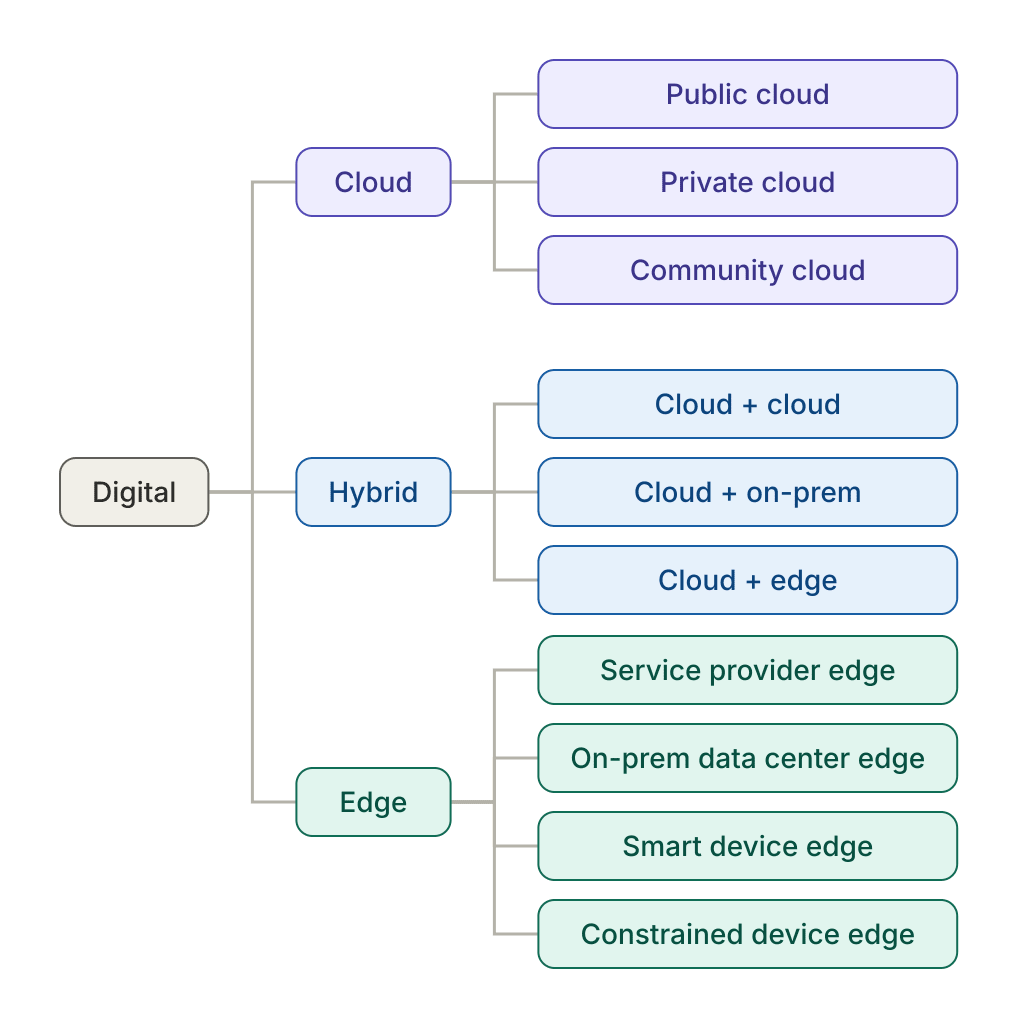
Most of the compute then is growing in the cloud, as well as in your home devices. Where compute happens causes implications on the completeness of verification and on the way we govern AI Systems.
An edge-located device takes on many forms, but the edge is anything not in the cloud. Often connecting to the internet that forms the cloud. The cloud and edge devices could be the same hardware, both running H100s.
Why not just use the cloud? Well, one use case for edge can be remote locations where compute still needs to happen. As you build out compute on the edge, you position yourself more on the spectrum of autarky (self-sufficiency) rather than subjugation (being subject to the control of another)
- Is it often a question of whether all the work of maintaining and setting up everything is worth it for your needs/your business needs?
- If you care about sovereignty, my ideal is often strategic autonomy, rather than autarky. Being dependent upon others can have benefits, and when done strategically, it can empower the group to be better than the sum of your parts. But this take is largely value-based and changes depending on who is building the system.
Often businesses leverage a mix of these systems to perform tasks. They are trading off the need to manage the resources themselves or rent as a tenant with differing levels of access. It all comes down to economic models for the business or your own personal needs. For most, owning a phone is preferred over renting one, but for someone who uses a phone on demand, renting in minutes might be better.
Boots on the Edge
For a deeper dive into the Linux Foundations Edge Taxonomy White Paper
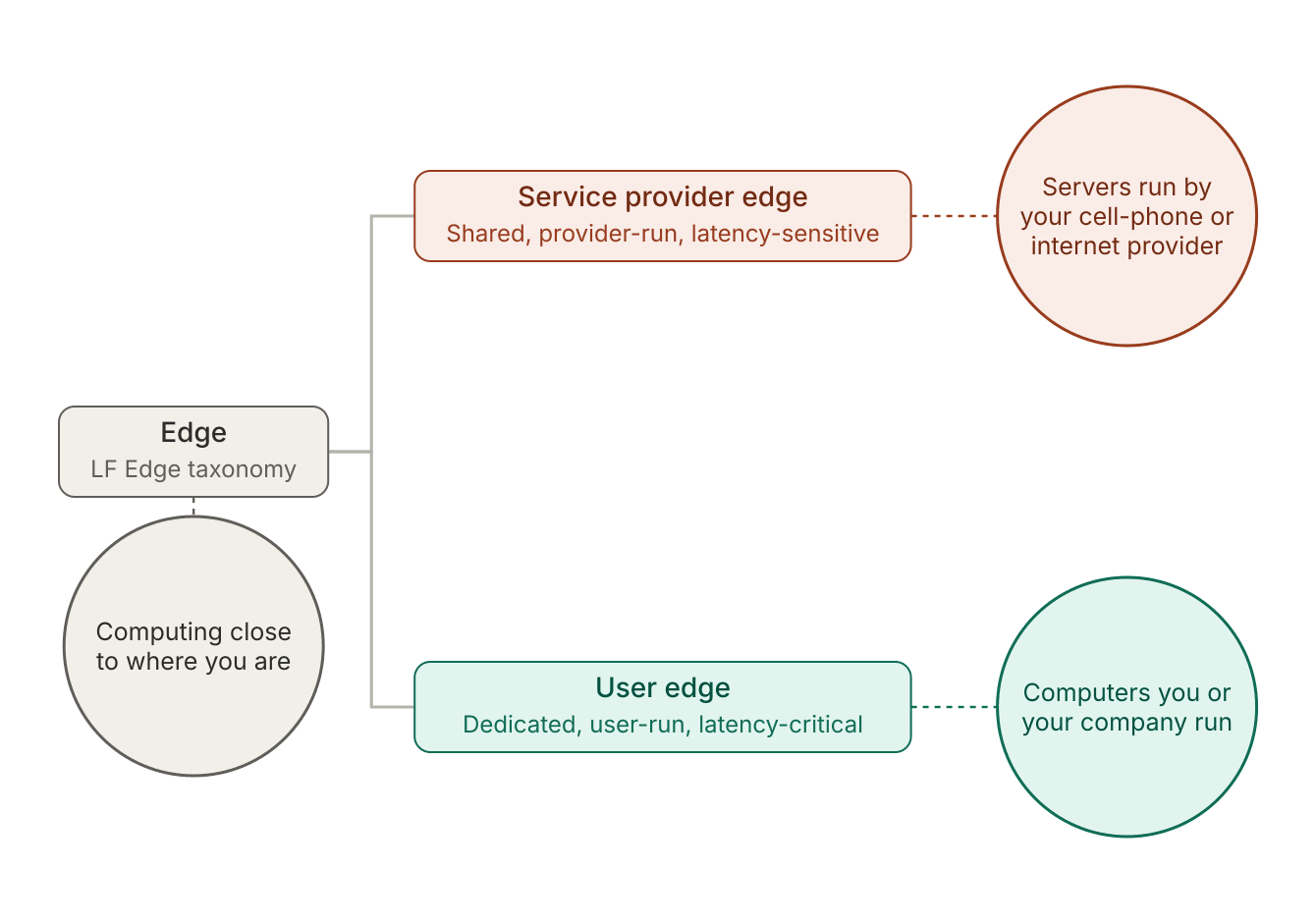
Part of the compute of the edge includes compute needed for wireless transmissions to work and other parts of keeping people connected to the internet and phones. This part is called the Service Provider. Like your Internet Service Provider, it likely has edge nodes for auditing information in the network, but also has its servers in a data center that is part of the cloud.
Then the user edge is what we are more familiar with for our laptops and smartphones.
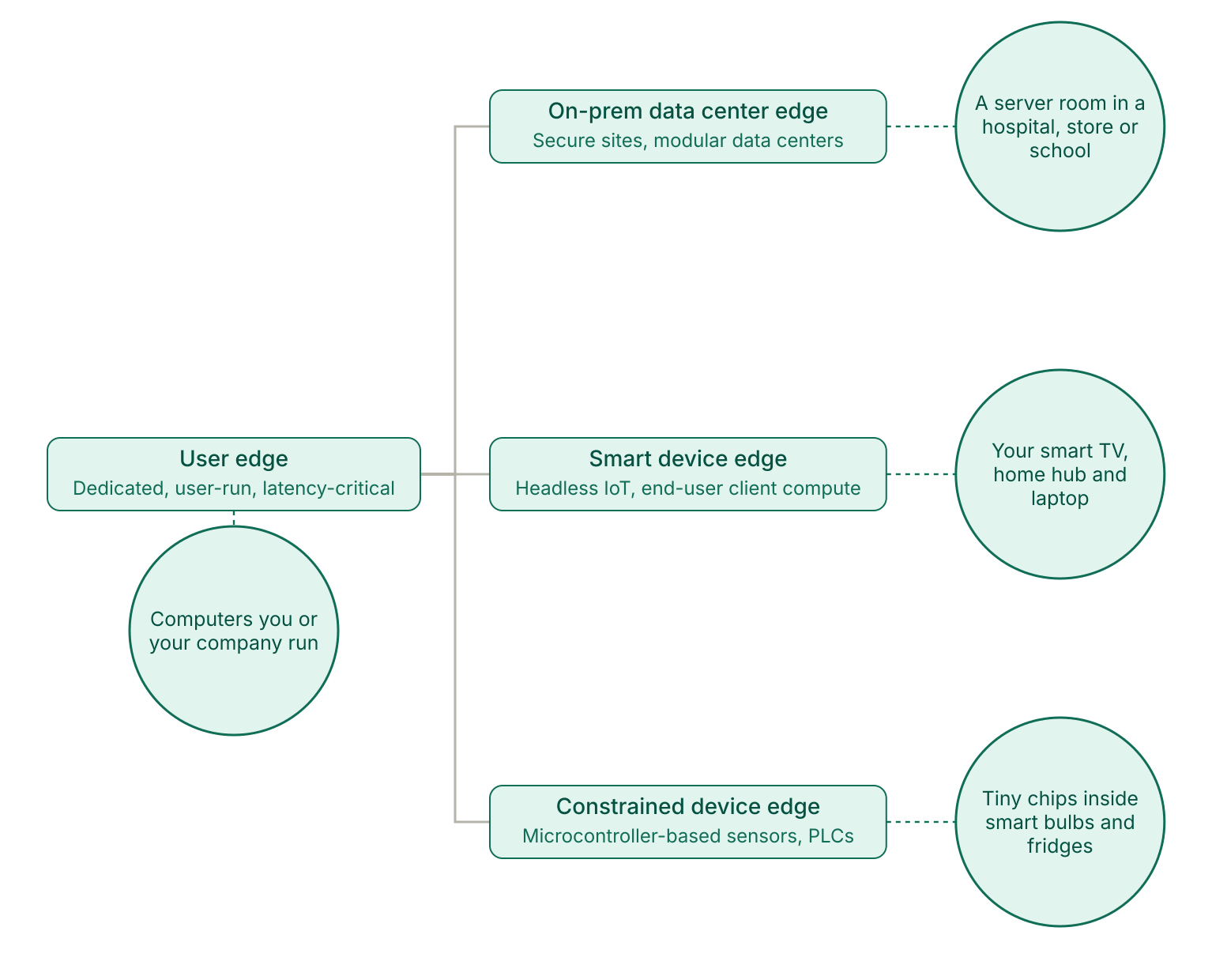
In this user edge, the trend is commonly increasing the compute power to offload a lot of information processing that happens behind the scenes to keep TV at high resolution and to lower the impact.
- The AI boom is impacting those devices, to name a few (in 2026):On-Prem DatacenterDGX Spark GB10 (NVIDIA's "desktop server")NVIDIA GPUs RTX PRO 6000 (Enterprise) and the RTX5090 (Consumer) use the same GB202 Blackwell die, but enterprise has many other features that make them more expensive and often are binned (see chip binning) to higher quality.Smart DeviceDGX Spark laptopLike LG with AI processors in TVsOr even WebGPU is available in every major browser engine to leverage your GPU from a web browser.Mac Studio 512 GBJetson (for robotics and autonomous cars)CIX chips from ChinaConstrained Edge DeviceEven your smartwatch and other smaller devices.IoT (Internet of Things) is within this space of constrained devices or smart devices.
- On-Prem DatacenterDGX Spark GB10 (NVIDIA's "desktop server")NVIDIA GPUs RTX PRO 6000 (Enterprise) and the RTX5090 (Consumer) use the same GB202 Blackwell die, but enterprise has many other features that make them more expensive and often are binned (see chip binning) to higher quality.
- DGX Spark GB10 (NVIDIA's "desktop server")
- NVIDIA GPUs RTX PRO 6000 (Enterprise) and the RTX5090 (Consumer) use the same GB202 Blackwell die, but enterprise has many other features that make them more expensive and often are binned (see chip binning) to higher quality.
- Smart DeviceDGX Spark laptopLike LG with AI processors in TVsOr even WebGPU is available in every major browser engine to leverage your GPU from a web browser.Mac Studio 512 GBJetson (for robotics and autonomous cars)CIX chips from China
- DGX Spark laptop
- Like LG with AI processors in TVs
- Or even WebGPU is available in every major browser engine to leverage your GPU from a web browser.
- Mac Studio 512 GB
- Jetson (for robotics and autonomous cars)
- CIX chips from China
- Constrained Edge DeviceEven your smartwatch and other smaller devices.IoT (Internet of Things) is within this space of constrained devices or smart devices.
- Even your smartwatch and other smaller devices.
- IoT (Internet of Things) is within this space of constrained devices or smart devices.
These are anything we plug into the worldwide web. The trend is to increase the amount of compute everywhere in the world.
AI boards at the edge are emerging, typically designed for inference (not training) with lower bandwidth but high-capacity memory to host larger open-weight models at the edge without the need to use the cloud.
When it comes to these inference machines, they are often listed with TOPs, not FLOPs, benchmarking lower-precision operations, which gets into the topic of quantization. It is often compute for different purposes, and hard to compare to each other the scale of impact they have on a business or personal operation within digital pursuits.
Not to mention the enterprise-grade servers companies are buying to support their own internal AI usage on on-premises servers. These use the same level of compute as servers do.
Decentralized compute like this is very hard to govern or even track.
Well, compute comes in many sizes; it fundamentally serves similar purposes. The more compute you have typically means you can get the same task done faster compared to those with devices that have lower tiers of compute. A 10^26 FLOP training run over 100 days needs about 1.2×10^19 FLOP/s sustained. At roughly 4×10^14 effective FLOP/s per H100-class chip (about 40% utilization of dense BF16 (the precision you train on)), that is on the order of 30,000 chips in one tightly connected cluster. By contrast, INTELLECT-1 (10B parameters, ~1T tokens, so roughly 6ND ≈ 6×10^22 FLOP) used up to 112 H100s across five countries, about 170× below the EU's 10^25 threshold. Decentralized training works today but is far from the thresholds in law; the open question for the taxonomy is what would change that.
- What this means is that if you have a data center, you have a lot of dense power, but algorithms are changing and enabling the world's compute to be connected and serving the same abilities as in the cloud.
- This means things at the edge can do more complex things that required a data center years ago.
- Or it means that together nodes connected across different households or companies can work together to achieve impressive feats.
Advancement in compute impacts both the cloud and the edge. Changing the way actors who leverage those compute locations are uplifted as technology advances.
Wings in the Cloud
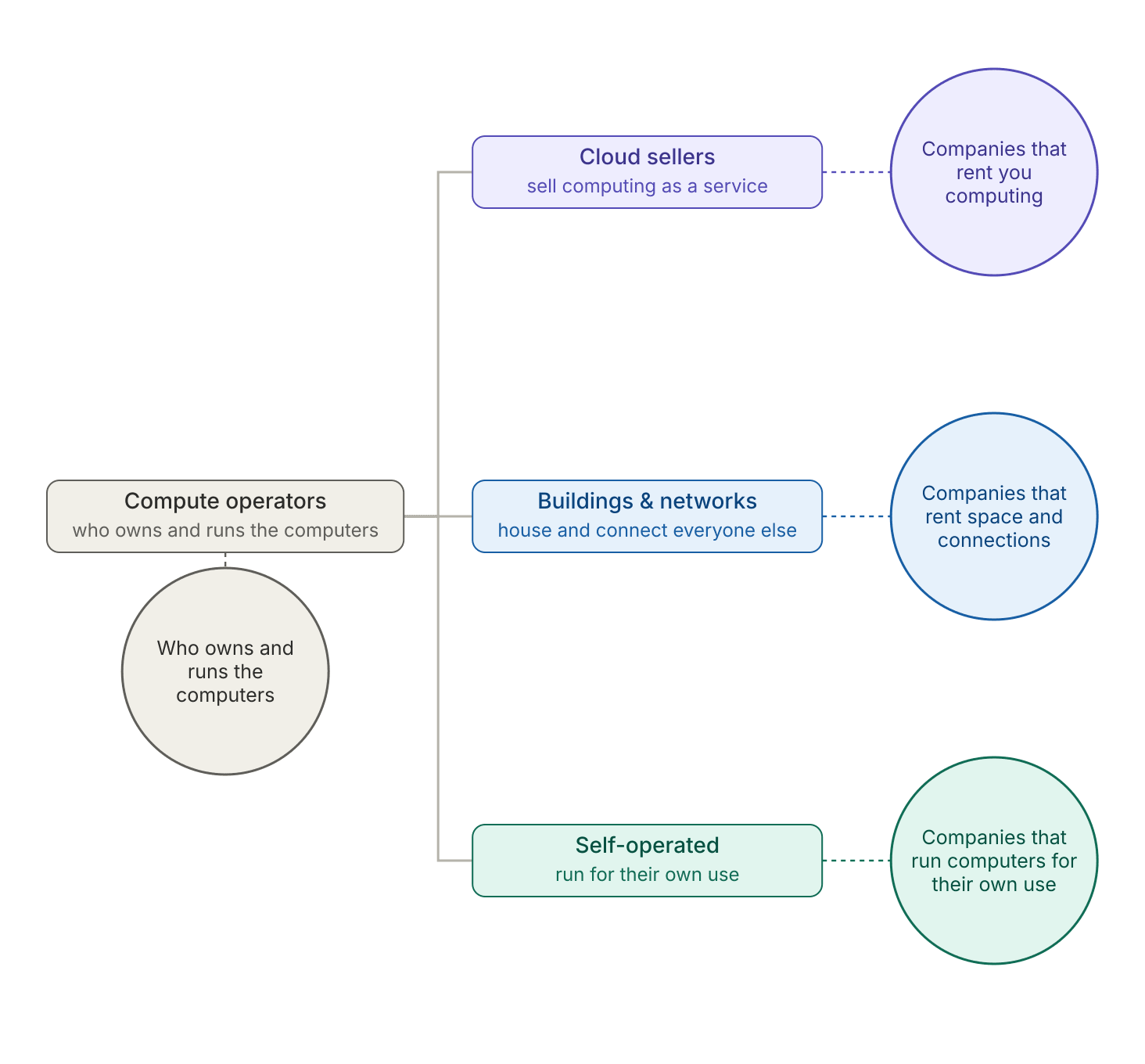
The cloud ecosystem is not inherently just for AI, but a lot of the sector is expanding for it.
Data centers can be owned by larger companies like Google, Meta, xAI, and others.
Many people have worked to map out this compute:
- The case for fine-grained tracking of compute for AI
- Epoch Chip Ownership
What I find compelling in the cloud is those who are tenants of it vs. those who are self-operating the cloud.
Google, for example, owns data centers and can prioritize their business needs the use of it. Many companies with frontier models also own the compute for training them.
Where compute sits is only half the picture; who owns and operates it decides who a regulator can compel and who can see the workload. One possible split:
- Lab-owned and operated (the Google/Meta/xAI case above)
- Hyperscaler tenant (a lab or enterprise renting from a large public cloud)
- GPU "neocloud" or rental marketplace (specialized providers, including decentralized rental markets)
- Government or sovereign clusters (national labs, public supercomputers)
- Enterprise on-prem
- Hybrid financing arrangements (e.g., compute-for-equity deals, as below)But some, like Anthropic, trade shares of their company for compute through a Note Purchase Agreement:Declared in their S-1 Filings
- But some, like Anthropic, trade shares of their company for compute through a Note Purchase Agreement:Declared in their S-1 Filings
- Declared in their S-1 Filings
This really changes the regulatory landscape when you start to consider who owns the compute vs. who uses it.
- I find it extra interesting regulating tenant-compute owner relationships when equity makes the compute owner also an owner of the tenant.
What compute can be used for
Workload classification relating to AI has four major pillars:
- Compute for TrainingMostly a GPU computing task
- Mostly a GPU computing task
- Compute for InferenceMostly a GPU computing task
- Mostly a GPU computing task
- Compute for HarnessMostly a CPU computing task
- Mostly a CPU computing task
- Compute for other things.Can be a mix of CPU/GPU
- Can be a mix of CPU/GPU
Other things can look like:
- Evaluation compute for verifying AI models.
- Data manipulation tasks for AI
- Fine-tuning and distillation of released weights (below any training-run threshold, yet can change capabilities)
- Non-LLM AI such as biological design tools
- Dual-use non-AI workloads on the same hardware (crypto mining, scientific HPC, rendering): the same GPU can switch categories
- Rendering a video for YouTube
- Compressing a video for YouTube
- Running Microsoft Word
Training ranges from different stages and scales:
- For frontier development, models are trained on a "recipe"
- Data is collected, filtered, and a tokenizer is built
- New architecture is pre-trained
- Mid-training parts
- Post-training parts: using methods like reinforcement learning (different variations, RLVR/RLHF/RLAIF/RL), supervised fine-tuning, and different safety training and distillation
- Model evaluations come into play (but really are done throughout to track how training is going)
- Then things can iterate
- Different types of compute can do training for different purposes:Smaller edge nodes can use PEFT (parameter-efficient fine-tuning)Smaller models might use distillation training more than other methods in the recipe.Companies with less funding might just use RL because high-quality human feedback datasets might be scarce.The size of your pockets and size of your compute (also really size of your pocket) determines how the training recipe is built.Some smaller budgets might just use PEFT with lower compute using methods like LoRA (Low Rank Adaptation), which enables very low compute to modify the weights to function in certain ways.
- Smaller edge nodes can use PEFT (parameter-efficient fine-tuning)
- Smaller models might use distillation training more than other methods in the recipe.
- Companies with less funding might just use RL because high-quality human feedback datasets might be scarce.
- The size of your pockets and size of your compute (also really size of your pocket) determines how the training recipe is built.Some smaller budgets might just use PEFT with lower compute using methods like LoRA (Low Rank Adaptation), which enables very low compute to modify the weights to function in certain ways.
- Some smaller budgets might just use PEFT with lower compute using methods like LoRA (Low Rank Adaptation), which enables very low compute to modify the weights to function in certain ways.
- Training across devices in 3 different continents: INTELLECT-1 at 10B parameters using algorithms like DiLoCo, estimated around 112 H100s for 1T tokens, which is about 6x10^22 FLOP.
Inference ranges in different scales:
- On your CPU or GPU: Ollama, llama.cpp, vLLM
- exo, distributed local inference
Harness can look in different ways:
- Swarms/Multi-agent setups:Google ADKSwarms
- Local Agents:Headliner Harness: OpenclawHermes AgentMinimalistic Harness: PiLighter compute alternatives: Nanoclaw
- Headliner Harness: Openclaw
- Hermes Agent
- Minimalistic Harness: Pi
- Lighter compute alternatives: Nanoclaw
- Embedded agents:ESPClaw, running a harness on your watch.
- ESPClaw, running a harness on your watch.
The point I hope I can make here is that, within compute used for AI (narrowly focused on GenAI/LLMs), it is not always looking the same way under the hood. Compute is general-purpose, and thus people have the freedom to change what it looks like in code. This impacts how developers scale up to larger models, scale up safety tasks, or even scale up serving and hosting swarms of agents.
How Compute can be used
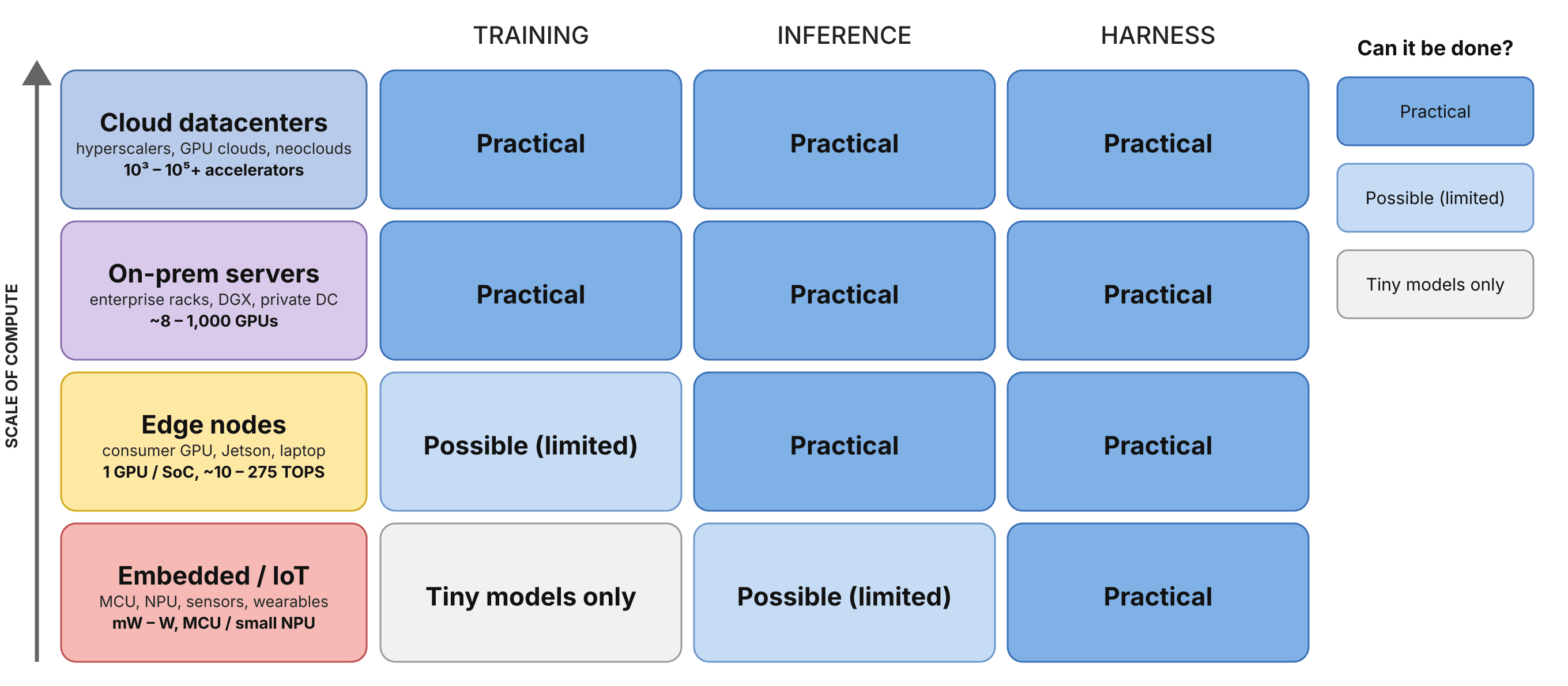
How more compute is leveraged can be budgeted differently:
- More compute can be allocated in different ways:Training larger modelsHosting more agents in parallel:Scale of Swarms, Multi-agents, single agentNeeds support for inference or could be a laptop that is connected to the cloud running many agents.Some types of compute support different things:GPUMore memory supports more context windows or more parallel agents.More memory means a larger model can run.Sometimes not true if you quantize the models, lowering their precision (often trading off accuracy)More GPUs can economically support larger training runs.CPUUses different memory than GPU, which can enable:more harnesses running parallel agents if the model is served on a GPU (either at the edge or in the cloud)Containerization or virtual machine that can isolate environments for agents
- Training larger models
- Hosting more agents in parallel:Scale of Swarms, Multi-agents, single agentNeeds support for inference or could be a laptop that is connected to the cloud running many agents.
- Scale of Swarms, Multi-agents, single agent
- Needs support for inference or could be a laptop that is connected to the cloud running many agents.
- Some types of compute support different things:GPUMore memory supports more context windows or more parallel agents.More memory means a larger model can run.Sometimes not true if you quantize the models, lowering their precision (often trading off accuracy)More GPUs can economically support larger training runs.CPUUses different memory than GPU, which can enable:more harnesses running parallel agents if the model is served on a GPU (either at the edge or in the cloud)Containerization or virtual machine that can isolate environments for agents
- GPUMore memory supports more context windows or more parallel agents.More memory means a larger model can run.Sometimes not true if you quantize the models, lowering their precision (often trading off accuracy)More GPUs can economically support larger training runs.
- More memory supports more context windows or more parallel agents.
- More memory means a larger model can run.Sometimes not true if you quantize the models, lowering their precision (often trading off accuracy)
- Sometimes not true if you quantize the models, lowering their precision (often trading off accuracy)
- More GPUs can economically support larger training runs.
- CPUUses different memory than GPU, which can enable:more harnesses running parallel agents if the model is served on a GPU (either at the edge or in the cloud)Containerization or virtual machine that can isolate environments for agents
- Uses different memory than GPU, which can enable:more harnesses running parallel agents if the model is served on a GPU (either at the edge or in the cloud)Containerization or virtual machine that can isolate environments for agents
- more harnesses running parallel agents if the model is served on a GPU (either at the edge or in the cloud)
- Containerization or virtual machine that can isolate environments for agents
How fast the compute's intelligence responds can take different forms:
- Quick Agent (system one) vs Smart Agent (system two)System one models have shown paradigm shifts in how fast a model could do a task:System one model deep diveJEV introduced this to the mainstreamThe idea is to drop out the model's ability to reason and just have it make quick decisions.These are often smaller models that can be run at the edge or served from the cloud for very cheap.System two models are what frontier models mostly are.Some of the reasoning models are very costly today, with very high intelligence.Fable/Astra/Deep-seek/etc
- System one models have shown paradigm shifts in how fast a model could do a task:System one model deep diveJEV introduced this to the mainstreamThe idea is to drop out the model's ability to reason and just have it make quick decisions.These are often smaller models that can be run at the edge or served from the cloud for very cheap.
- System one model deep dive
- JEV introduced this to the mainstream
- The idea is to drop out the model's ability to reason and just have it make quick decisions.
- These are often smaller models that can be run at the edge or served from the cloud for very cheap.
- System two models are what frontier models mostly are.Some of the reasoning models are very costly today, with very high intelligence.Fable/Astra/Deep-seek/etc
- Some of the reasoning models are very costly today, with very high intelligence.
- Fable/Astra/Deep-seek/etc
How the compute is architected can be in a few ways:
- Distributed / Federated / CentralizedCentralized agents or things are easier to governDistributed: most of the compute is scattered across machinesFor inferenceTV as a source for replicated agents in a federated design tested by AnthropicThe risk of replication makes things harder to control and govern. Which is why viral diseases can be hard to manage.For training, even Google has considered training distributed.Federated: The gray between Centralized and DistributedCentralized: mostly compute on one machine.They have strong efficiency for compute, which is why most frontier labs train this way.
- Centralized agents or things are easier to govern
- Distributed: most of the compute is scattered across machinesFor inferenceTV as a source for replicated agents in a federated design tested by AnthropicThe risk of replication makes things harder to control and govern. Which is why viral diseases can be hard to manage.For training, even Google has considered training distributed.
- For inferenceTV as a source for replicated agents in a federated design tested by AnthropicThe risk of replication makes things harder to control and govern. Which is why viral diseases can be hard to manage.
- TV as a source for replicated agents in a federated design tested by Anthropic
- The risk of replication makes things harder to control and govern. Which is why viral diseases can be hard to manage.
- For training, even Google has considered training distributed.
- Federated: The gray between Centralized and Distributed
- Centralized: mostly compute on one machine.They have strong efficiency for compute, which is why most frontier labs train this way.
- They have strong efficiency for compute, which is why most frontier labs train this way.
Who uses this compute
- Uplift RisksRAND: Preventing Theft and Misuse of Frontier ModelsOC1: Amateur AttemptsOC2: Professional opportunistic effortsOC3: Cybercrime syndicates and insider threatsOC4: Standard operations by leading cyber-capable institutionsOC5: Top-priority operations by the top cyber-capable institutionsMilitary weapon developmentAI worms:Might not need a lot of compute if federated with a central on-prem server hosting the model. It could run a harness with limited capabilities that reason fast or slow. Often prevented with IT traffic blocking.Hackers leveraging different ways of combining compute can maneuver and attack in dangerous ways. Rather than just asking how much compute, I think it is better to combine how the compute is used and at what speed it can complete calculations on its own vs. with help from the cloud? Can it be combined in ways that would make mundane compute dangerous?These are the deeper questions we should consider when trying to regulate compute.
- RAND: Preventing Theft and Misuse of Frontier ModelsOC1: Amateur AttemptsOC2: Professional opportunistic effortsOC3: Cybercrime syndicates and insider threatsOC4: Standard operations by leading cyber-capable institutionsOC5: Top-priority operations by the top cyber-capable institutionsMilitary weapon development
- OC1: Amateur Attempts
- OC2: Professional opportunistic efforts
- OC3: Cybercrime syndicates and insider threats
- OC4: Standard operations by leading cyber-capable institutions
- OC5: Top-priority operations by the top cyber-capable institutionsMilitary weapon development
- Military weapon development
- AI worms:Might not need a lot of compute if federated with a central on-prem server hosting the model. It could run a harness with limited capabilities that reason fast or slow. Often prevented with IT traffic blocking.
- Might not need a lot of compute if federated with a central on-prem server hosting the model. It could run a harness with limited capabilities that reason fast or slow. Often prevented with IT traffic blocking.
- Hackers leveraging different ways of combining compute can maneuver and attack in dangerous ways. Rather than just asking how much compute, I think it is better to combine how the compute is used and at what speed it can complete calculations on its own vs. with help from the cloud? Can it be combined in ways that would make mundane compute dangerous?These are the deeper questions we should consider when trying to regulate compute.
- These are the deeper questions we should consider when trying to regulate compute.
- Accidental Risk:Covert activity / self-preservation / sycophantic / colluding / misalignment agent who steals compute!Spare compute could be taken over by rogue agents, or used for other reasons; it should just be assumed that people will misuse compute.
- Covert activity / self-preservation / sycophantic / colluding / misalignment agent who steals compute!
- Spare compute could be taken over by rogue agents, or used for other reasons; it should just be assumed that people will misuse compute.
- MIT Risks Taxonomies - many risks to dig into, often mapping to different hardware in the world that could enable these risks to happen.
Compute Verification:
If we are going to show completeness of a regime for pausing the development of frontier AI models. We are trying to prove an OC5 actor is verified not to be using compute from the edge to the cloud. AI-2040 Verification Plan often disregards leveraging edge compute for being able to contribute to frontier development. But algorithmic advancements are showing that compute, no matter where it is, can contribute.
If we begin to extend compute verification beyond the bounds of frontier development, questions start to arise about how to regulate Agent-to-Agent (A2A) interactions by verifying the work they do on the machines in an A2A marketplace of the future. If we want to prevent bad actors from using a certain level of compute that might arise with technological advancement that makes running advanced models possible at the edge in the coming years, we need to create plans for the edge to be verified, like regimes that work to verify data centers.
Data centers are the obvious priority to regulate frontier models, as they reflect the economically relevant methods for training models. But when we think about regulating compute at large we need methods of verifying or ensuring that this general purpose tool is uplifting good actors and setting back bad actors.
Part of the problem is open weight regulation and alignment to make them more resistant to bad actors modifying them. But even then we are not done with working out solutions both for standards and regulations, but as well for technical advancement to ensure that devices have logs trains when it is a high risk technology with potential to run dangerous models at edge. On the other hand sectors in IoT and other areas need to step up their game for the shifts in dynamics attacks for actors might take in terms of cyber security and other threats.
Verifying hardware workload is one way we can mitigate harm. Right now the efforts largely center on data centers and retrofitting them for a pause. But in coming years we could see dynamics change as regulations push actors to work more distributed. I would love to hear any feedback on how we could expand ways that advancements in hardware could be misused and start defining thresholds on where compute becomes too dangerous for the average person to have or what types of regulations should be put in place as hardware becomes more and more capable to the average person.