 AIFeed
The first year of Agents in cars: Alipay builds an action cockpit
2026-11-27 18:01
In 1983, British Leyland launched the Austin Maestro, the world's first mass-produced car that could "talk." Engineers used a chip to record 32 voice reminders, from "fasten your seatbelt" to "you need fuel," which would speak up when triggered by sensors—arguably the most sci-fi model of the 1980s.
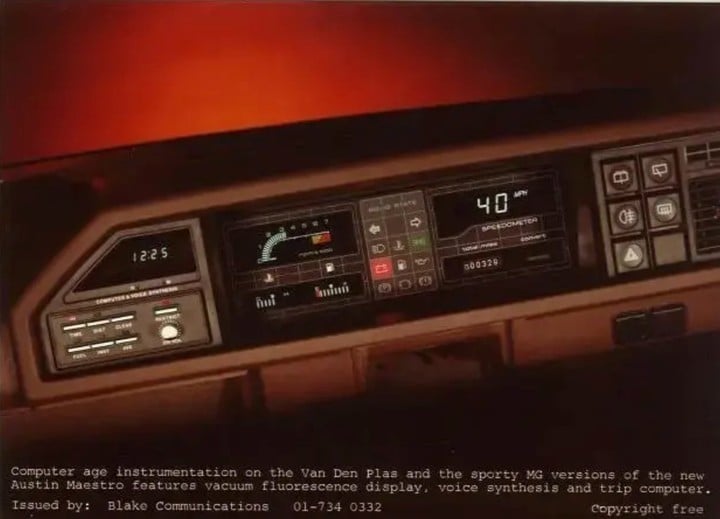
But it could do nothing beyond reminding, and it would keep chattering whenever there was a false alarm. Within six months, fed-up owners drove their cars to repair shops and had mechanics cut the wires to the voice module.
Nearly half a century later, AI can prove the Riemann hypothesis, cockpit computing power has multiplied tens of thousands of times, and synthesized speech has been replaced by on-device large models.
Yet at the 2026 Guangzhou Auto Show, sitting in many new cars still brings up the same problem from 43 years ago: the infotainment system can chat with you about the stock market and tell jokes, but when you're about to drive out of the garage, or want to order a coffee before getting on the highway, you still have to park the car and honestly pull out your phone.
On November 27 during the Guangzhou Auto Show, Alipay released its AI-native in-car agent "Alipay In-Car Assistant 3.0" and announced progress on cooperation with multiple automaker brands. Following the announced Tesla partnership, it will successively roll out "task-handling" cockpit cooperation with BYD, Zeekr, Li Auto, BAIC, Chery, Deepal and other automakers, and also launched the A.I. Car (Alipay Inside Car) ecosystem alliance.
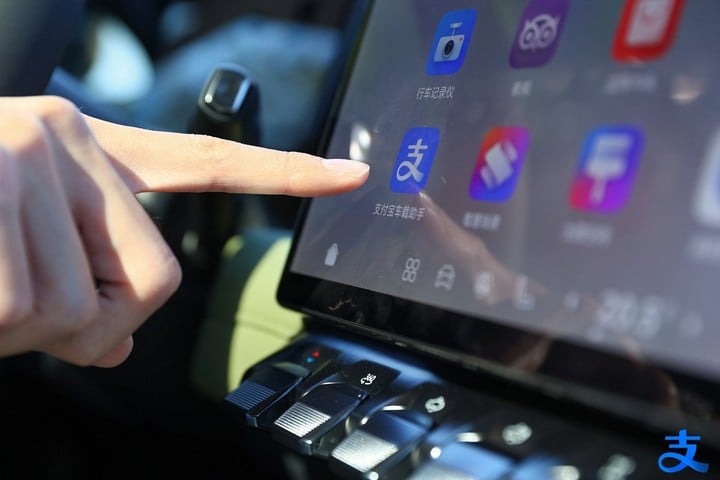
Alipay President Wu Minzhi said at the launch event that over the past 22 years Alipay has built a life services platform around user trust, and as smart cockpits evolve, what they want to do is join hands with automakers and partners to truly bring this life services capability into the car.
Now large models in cars have basically solved the problem of "understanding human speech." Smart cockpits have reached a new crossroads: whether AI, after understanding an instruction, can reach across the car window and get things done has become the new dividing line for automakers.
From "chatting by voice" to "getting things done by voice," the phone finally becomes redundant in the car
Most people who drive regularly have experienced being "held hostage" at a parking lot exit.
You have to hold the steering wheel with one hand as you approach the barrier, while frantically pulling out your phone with the other to find the QR code screen. If the garage signal is poor, the horns of the cars behind you immediately blare in unison.
Today's new energy vehicles are pushing infotainment and AI to the point of exhaustion—even embodied intelligence is getting into cars—yet when it comes to many seemingly trivial matters, you really wish you could move all the various Agents from your computer into the infotainment system.
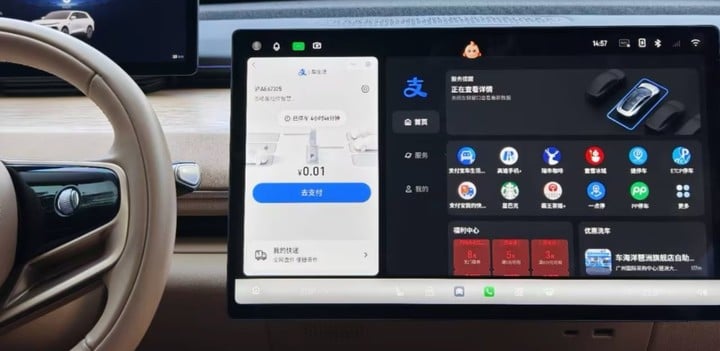
At the Guangzhou Auto Show, ifanr was among the first to experience a cockpit connected to Alipay In-Car Assistant 3.0 (the functions and services demonstrated are non-production versions; the final version is subject to the OTA version on actual vehicles).
This new set of features lets you complete with your voice what used to require freeing up a hand to pull out your phone.
When the vehicle enters a parking lot, the center screen pops up a billing reminder. When leaving, you just say "pay the parking fee," and the infotainment system identifies you via voiceprint, automatically settles the bill, raises the barrier and lets you through—all in one go.
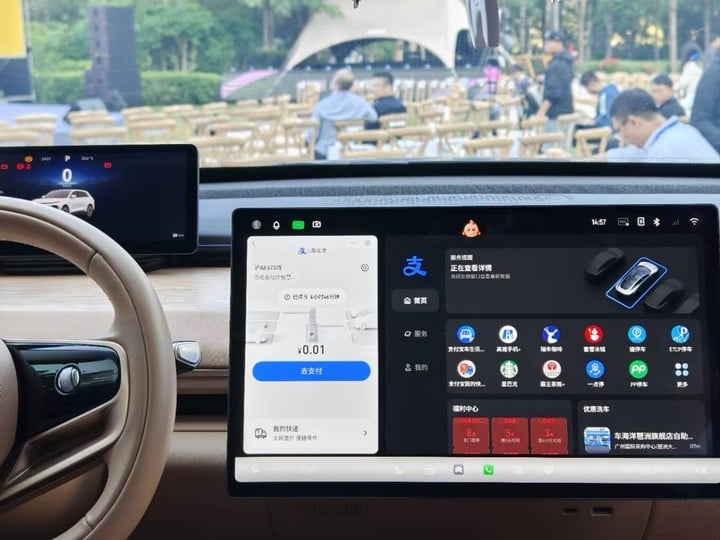
On the highway, with the "phone+" capability, the system recognizes the license plate on entry with no need to take a card, and on exit a single sentence enables password-free or voiceprint deduction—no need to return the card or scan a code; you just drive straight through.
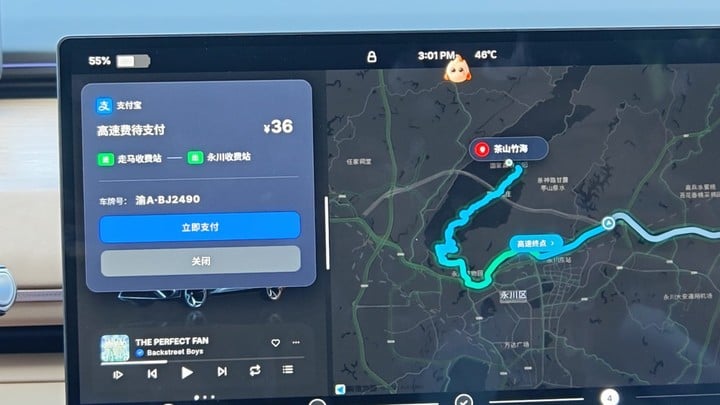
This service is currently in partnership with Chongqing Expressway Group and has already been deployed in Chongqing first.
The same applies at gas stations: when the infotainment system notices the fuel is running low, it proactively reminds you; you say "I want to refuel," and it navigates to the station, pulls up the order, applies the coupon and pays automatically—all without even rolling down the window.
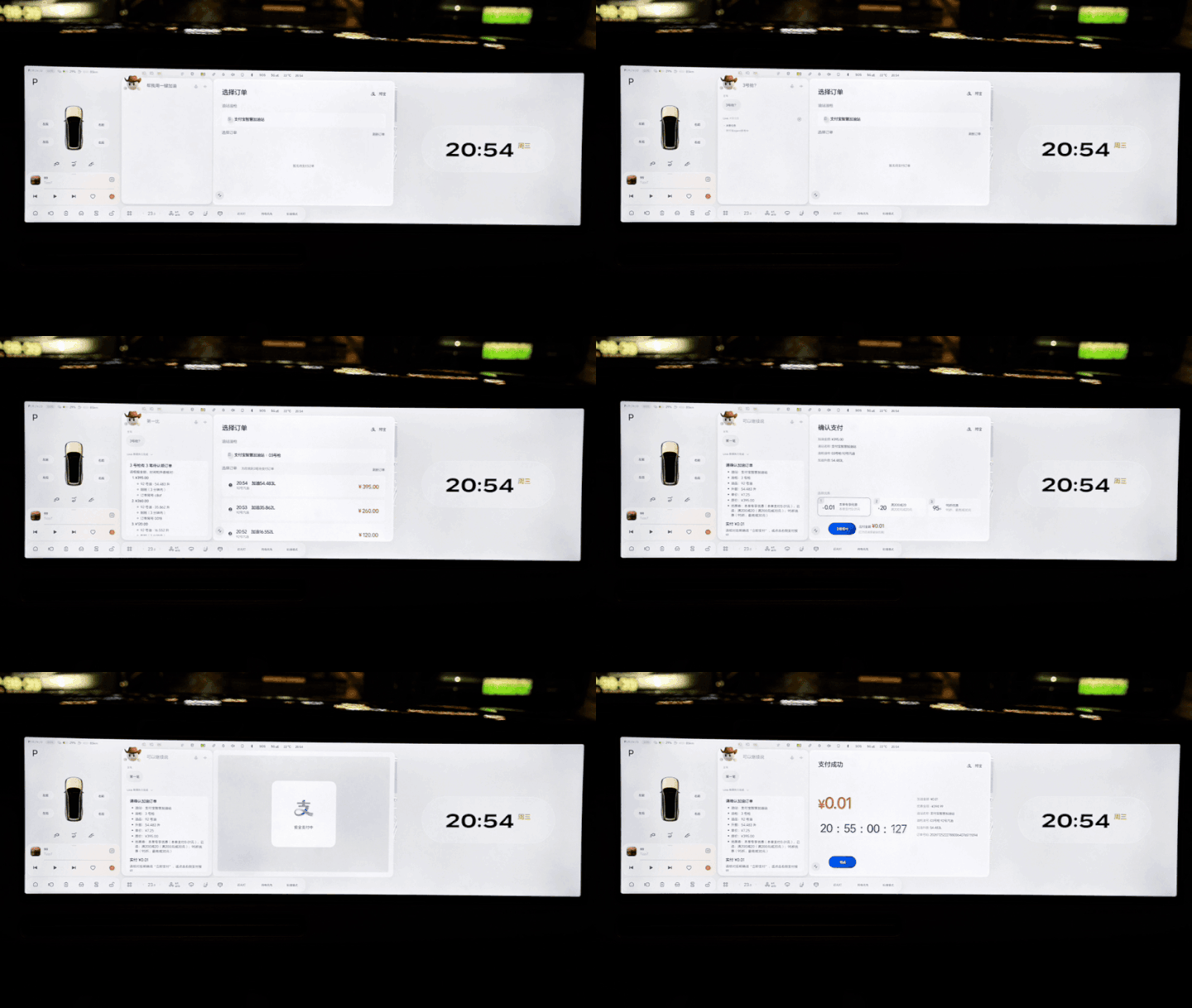
Recently, Personal Agents like Muse have gone viral. Unlike office Agents, AI personal assistants solve specific small troubles in life and genuinely improve everyday happiness. Alipay In-Car Assistant 3.0 is somewhat similar:
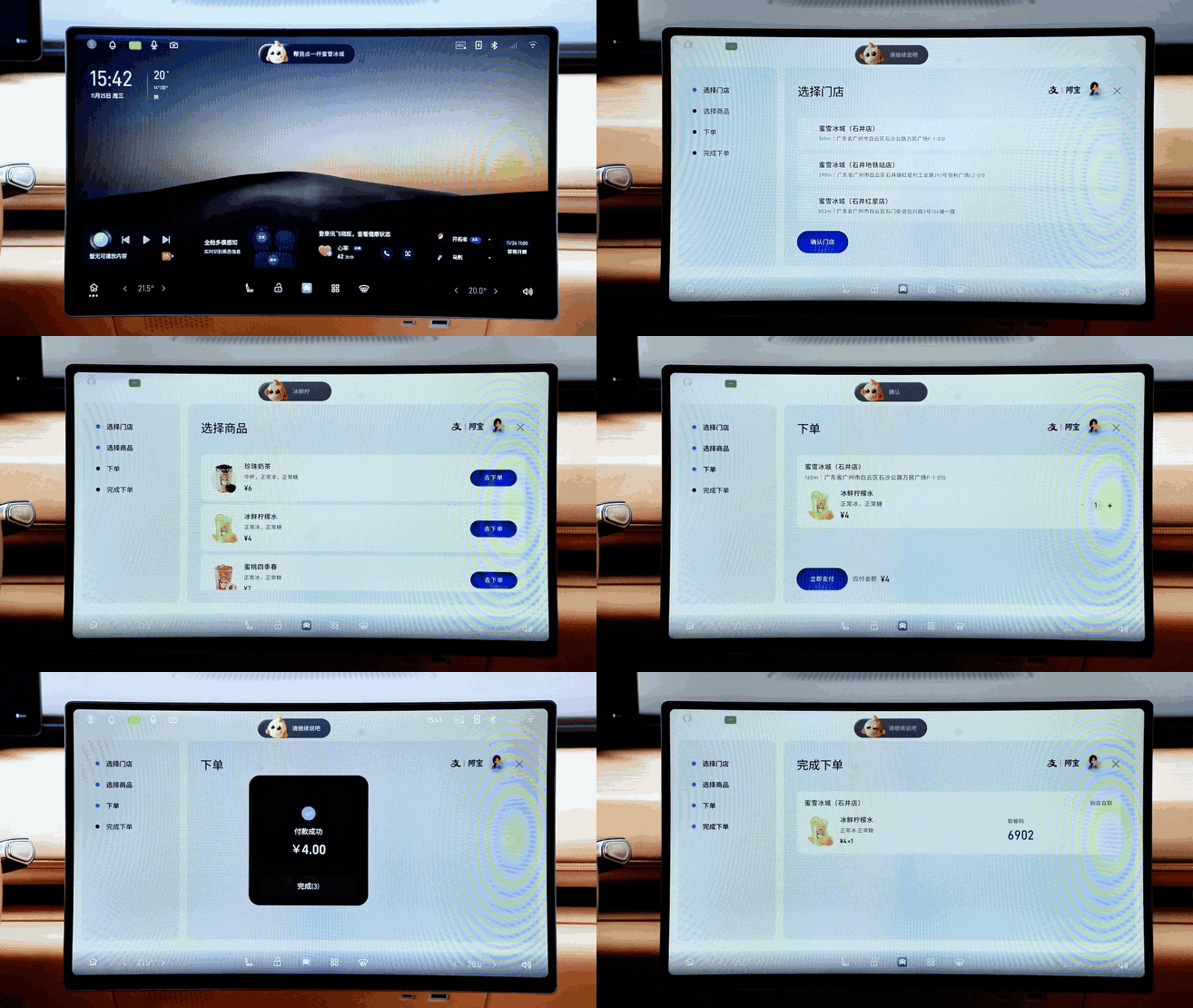
On the morning rush, you say "I want coffee," and it remembers your usual flavor, picks a store along the route, and asks back "Still a large iced latte?" You say yes, it calculates the discount, deducts payment and places the order, and you just grab it when you arrive.
Driving home past a courier station, when the infotainment system detects entering a geofence, it proactively pops up a reminder along the navigation route to pick up a package on the way.
On the way to the mall on the weekend, you can filter showtimes and book movie tickets by voice. If you haven't picked seats by the time the car stops, that's fine—after you open the door, the seat selection page automatically transfers to your phone so you can continue.
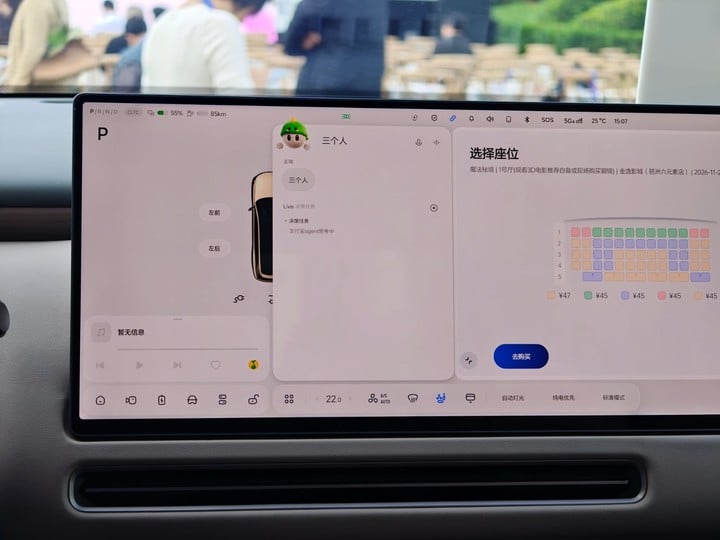
Compared with Tesla FSD v15 Reality View, which dominated feeds a few days ago, In-Car Assistant 3.0 has no such flashy demo. Its experience focuses on making services smoother and raising task-handling efficiency, and precisely because of this, it is closer to ordinary people's daily lives, genuinely solving in the car the everyday chores people run into every day.
Having experienced quite a few new cars this year, my biggest takeaway is that people's expectations for smart cockpits have changed.
With infotainment and cockpits pushed to where they are now, what users want is not just a smooth screen. McKinsey research shows that 84% of Chinese consumers expect "proactive in-car agents" that go beyond simple voice commands.
Previously, infotainment systems also had plenty of life and entertainment apps, but after reviewing more than 100 cockpit projects worldwide this year, Bosch China President Wu Yongqiao said bluntly that the factory-installed coffee-ordering and restaurant-booking features are "almost never used."
You say you want coffee, and it can recite the ratings of three nearby stores, but in the end it still pops up a QR code on the center screen and makes you pull out your phone to scan and pay yourself.
Now Alipay In-Car Assistant 3.0 can already use multi-agent collaboration to run perception, dispatch, payment and verification through in one go, showing us that in 2026, the year of the agent explosion, is becoming the true first year of Agents in cars.
The first year of Agents in cars
The national standard "Artificial Intelligence Terminal Intelligence Grading" implemented this year divides cockpits into four levels, L1 to L4. Professor Ma Jun of Tongji University predicts that the core of future cockpit competition will shift from chips and models to system organization and orchestration capability (Harness).
At present, almost all tech giants and automakers are fighting for the "first wake word" of the cockpit, but this is also the automakers' most sensitive line of defense; few automakers are willing to completely hand over the primary interaction authority behind the steering wheel.
Alipay In-Car Assistant 3.0 cleverly sidesteps this conflict: it leaves the front-stage interaction dominance to the automakers and retreats to the underlying layer to do the dirty and tedious work—connecting merchants, checking bills and transaction risk control.
Not long ago at the Alipay AI Ecosystem Conference, OPPO Vice President Tang Kai mentioned that building a to-C Agent product based on models is no longer difficult; what's difficult is that data, services and ecosystems remain isolated islands.
Automakers are good at building cars, but they can't maintain a team of thousands to negotiate interfaces and handle clearing with hundreds of thousands of parking lots, gas stations and milk tea shops across the country, one by one.
Therefore, in the architecture of In-Car Assistant 3.0, Alipay chose to co-build a perception center with automakers.
The automaker's self-developed voice assistant remains the front-stage Master Agent, responsible for understanding the owner's needs. Once it encounters tasks like refueling, buying coffee or paying parking fees that require calling services outside the car, it dispatches orders in the background via the AHA protocol to Alipay In-Car Assistant 3.0, the cockpit service Sub Agent, which executes the specific process.

As for those traditional mini-programs that haven't yet been AI-transformed, there is a "device-cloud integrated" hand behind the scenes that runs through the steps of clicking, selecting specifications and claiming coupons on behalf of the owner, and directly serves up the final checkout page.
Compared with many infotainment solutions, Alipay can push the process all the way to "payment completed," making the whole experience much smoother. Still, letting people hand their wallets to AI is somewhat of a dilemma.
To this end, In-Car Assistant 3.0 introduces voiceprint payment and the Ant APASS trusted identity system, which is equivalent to issuing AI a "limited-reimbursement work badge." The agent can only work within the scope authorized by the user, and when it comes to the actual deduction, it still requires voiceprint or facial confirmation with a nod.
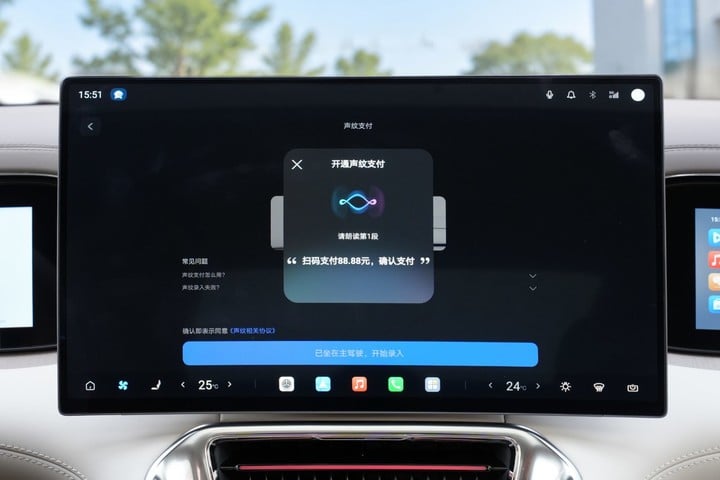
Today at the launch event, Alipay revealed that In-Car Assistant 3.0 has completed designation with more than 80 brands. BYD, Li Auto, Chery, Freelander, Dongfeng eπ, Dongfeng Fengshen, Deepal, BAIC ARCFOX and others will successively reach mass production and delivery, and multiple brands will start OTA remote upgrades after the Guangzhou Auto Show.
APPSO also found on site that Alipay's way of getting into cars is not only direct connection and co-building with automakers, but also partnering with ecosystem vendors like iFLYTEK, Huawei Yinwang and Shanghai Yitu. For example, iFLYTEK packages its own voice interaction and Alipay's in-car services into a complete software solution and installs it into cars together.
Such a fast pace of getting into cars is largely because Alipay leaves the core interaction to automakers and focuses only on underpinning transactions at the underlying layer, which has also allowed Alipay to run flexible multiple cooperation models in the cockpit.
The second half of smart cockpits is the "action cockpit"
Automakers that were still competing over refrigerators, TVs and big sofas a few years ago are now lining up to add Agent capabilities, largely because the logic of selling cars is starting to change.
Article title: The First Year of Agents in Cars — Alipay Builds an Action Cockpit
J.D. Power research shows that among reasons for purchasing a new energy vehicle, "service" accounts for 64.1%, ranking first. Smart cockpits badly need to leverage external ecosystems to complete their task-performing capabilities, transforming from merely stacking hardware into continuously serving car owners.
Relying solely on building its own ecosystem, it is very difficult for automakers to make up for this shortfall. Alipay, drawing on the foundation accumulated over the past 22 years — 400,000 parking lots, 85,000 gas stations, and more — saves automakers the lengthy cycle of negotiating with merchants from scratch, and also crosses the threshold for in-car Agents from "small talk" to "transactions."
Currently, Alipay's in-car business already covers 18 million smart vehicles, and existing models can also be connected via OTA upgrades starting from the end of the year. Automakers can call on the capabilities of the Alipay cockpit open platform as needed, and external merchants can also move their services into the cockpit with a low barrier to entry.
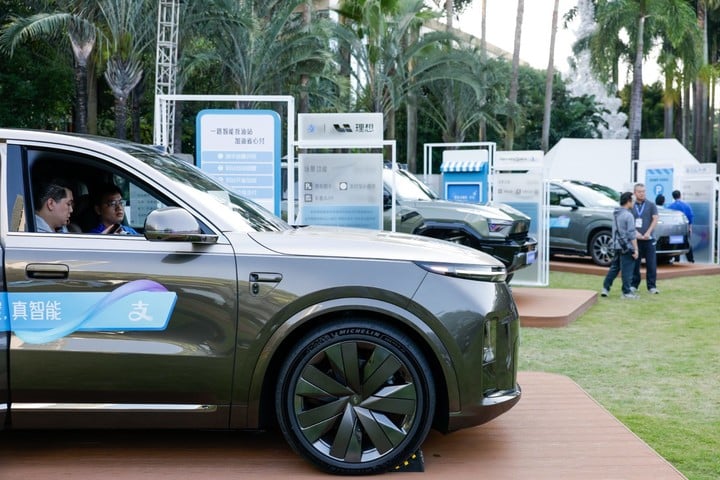
Under the main Agent, more vertical Agents may be coming to cars in the future.
On the morning commute, a medical Agent books a specialist appointment based on symptoms; at lunch break, a wealth management Agent helps the owner allocate maturing funds; on the way to a camping trip, charging pile reservations and restaurant queue numbers have already been handled in the background.
When you get home or to the office, these services can seamlessly continue — this is the "person-car-home" ecosystem of the AI era, and automakers need corresponding new selling points too.
In this A.I. Car ecosystem alliance, Alipay has brought out 21 high-frequency co-built services and over 150 travel and lifestyle benefits, available like side dishes for automakers to install with the car or freely combine. BAIC Group announced at the launch event that it would be the first to integrate, installing in-car assistant 3.0 into subsequent new models to manage owner services over the long term.
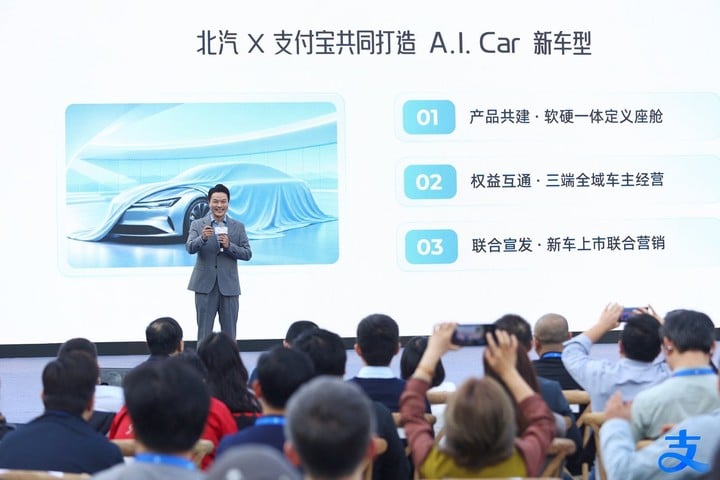
As cockpit software and hardware capabilities become increasingly similar, whether more services and benefits can be continuously provided to owners is what automakers are most concerned about right now.
The second half of the smart cockpit is moving from "conversational intelligence" to "action intelligence."
Ultimately, what determines a cockpit's degree of intelligence is, after all, its execution capability — whether it can give attention back to driving and take care of life's trivial matters in the background.
The most natural in-car intelligence has never been about keeping people in front of the screen for a few extra seconds; ideally, from the moment you close the car door, you don't even have the thought of reaching for your phone.