 AIFeed
Article title: The Soul of Claude Code Starts Rethinking the Future of Vibe Coding
Body:
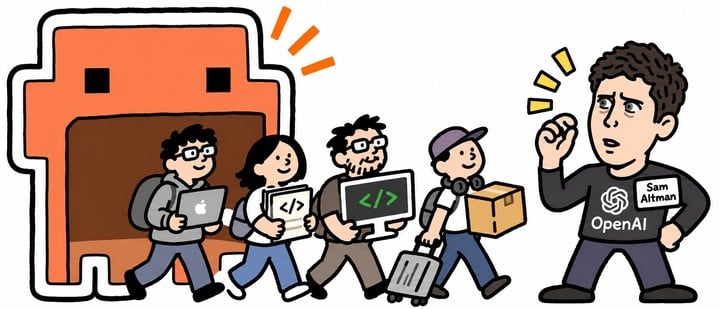
The Soul of Claude Code Starts Rethinking the Future of Vibe Coding
2026-11-27 11:49
Anthropic has really hit a rough patch lately.
On one side, it went public with the halo of the largest IPO in history, only to fall below its offering price within a week; on the other, its strongest team, Claude Code, has seen core members leave one after another for competitor OpenAI.
Yesterday, Claude Code core engineer Thariq Shihipar officially announced he was joining OpenAI. Just before that, an overseas netizen asked him point-blank, saying that if he truly believed in safe AI he wouldn't jump ship—in plain terms, it was all for the big paycheck.
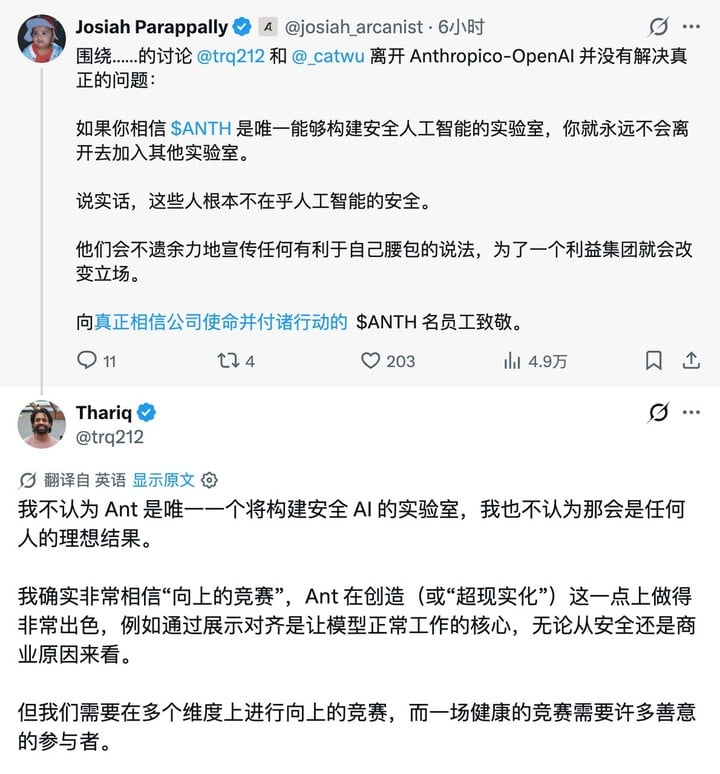
In response, Thariq gave a gracious piece of PR speak, saying he believes in a race to the top, and that one company dominating benefits no one.
Claude Code's old acquaintances are reuniting at OpenAI
Laying out the timeline of the past week, folks can get a sense of just how complicated Anthropic's shareholders must be feeling right now.
First, the capital markets. On the evening of November 19 Beijing time, Anthropic made a grand listing on Nasdaq at an issue price of $83. Intraday on the first day it peaked at $115.1, closing up 17%, with bullish sentiment briefly maxed out.
However, the underwriter Morgan Stanley, responsible for stabilizing the stock price, exercised the greenshoe option in full very early, depriving Anthropic of a potential means of price support. Combined with weakening market sentiment, the stock came under sustained pressure. By the U.S. market close in the early hours of November 25, Anthropic had fallen to $81.91, hitting an intraday low of $75.61—officially breaking its issue price just four trading days after listing.
Beyond the stock pressure, what hurts Anthropic more is the loss of its core fighting force.
The one handling this wave of recruitment is OpenAI core product boss Thibault Sottiaux, known in the circles as Tibo. Throughout November, Tibo went through the contacts like a roll call, scooping up the core four of Claude Code one by one.
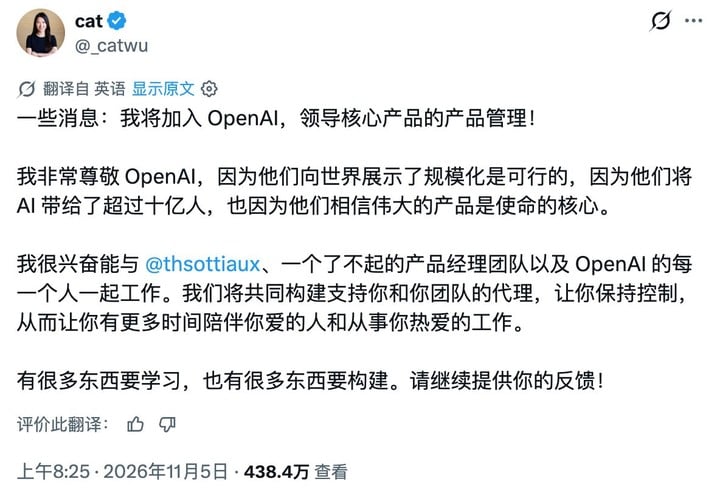
The first to be announced was product lead Cat Wu.
This female executive, a Princeton computer science alumna, was once an Index Ventures investor and led product at YouTube and Scale AI. It was she who turned Claude Code from an internal prototype into a hit commercial product. She left Anthropic at the end of October, announced joining OpenAI on November 5, and directly oversees ChatGPT, Codex, and the developer API.
Announced the same day was Austin Lau. The guy was Anthropic's first growth marketing employee, specifically responsible for pushing Claude Code to developers worldwide, and on November 5 he simultaneously announced joining OpenAI's Codex growth team.

Then on November 18, leaker Arfur Grok released the news that Anthony Morris, founder of Claude Code desktop and main client developer, had also joined OpenAI. Although he hasn't publicly announced it himself, he had already left on October 24.
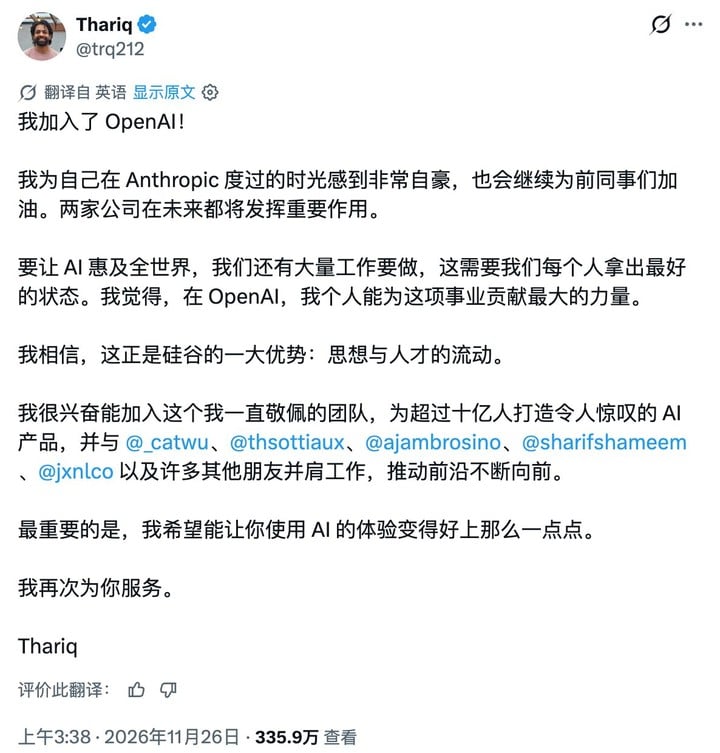
The finale was Thariq Shihipar, announced on November 26.
He left on the same day as Anthony Morris, October 24. At Anthropic he was responsible for Agent interaction and tool design—tools like AskUserQuestion, the Claude Agent SDK, and Skills dynamic workflows all came from him.
In just three short weeks, the product lead, the Agent interaction core, the main desktop developer, and the first growth marketer—four key positions were poached in succession. OpenAI even skipped the team磨合 period and directly took in a ready-made Claude Code team.
AI is both an industrial revolution and a Renaissance
Setting aside the war of words in the public sphere, the reason OpenAI paid big money to poach Thariq and this batch of people in one package is ultimately their judgment on the next generation of programming tools.
Around the time Thariq announced joining OpenAI, a nearly 54-minute interview he had recorded earlier during the AI Engineer Code Summit was officially released. Combining this interview, perhaps we can catch a glimpse, through Thariq's reflections, of how young people should embrace AI in the future, and the possible development directions of the next generation of programming agents.
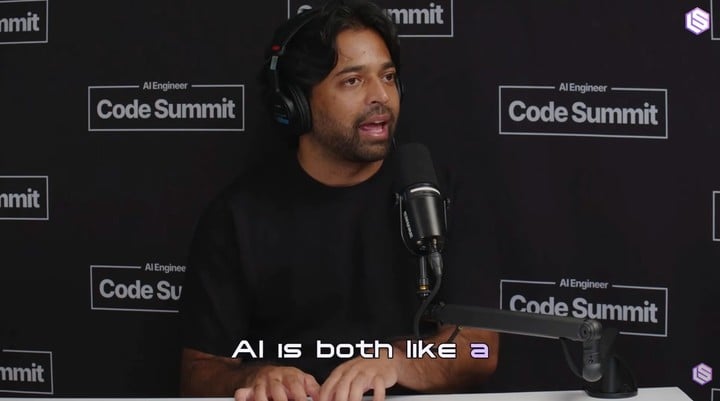
The first direction is to bring humans back into software development.
Over the past year, Thariq was a staunch advocate of "Bash is all you need" and "React is all you need," believing all operations should be crammed into the command line, the frontend should only be written in React, and even MCP was superfluous.
Now he has publicly overturned his old judgment. Today AI can already directly operate Figma through Computer Use to draw frontend interfaces; the development approach that used to require humans to actively accommodate AI is now becoming AI actively adapting to human workflows.
Following this line of thought, he began to re-examine the currently popular Vibe Coding.
Recently, in his spare time, Thariq used AI to make a game about element manipulation, only to find that the model would make many design decisions on its own. It wasn't until he actually played it himself that he discovered the character had a bunch of behaviors he had never known about.
This black-box sense of losing control made him very uncomfortable. To solve this problem, he specially wrote a scripting language and created a directory called /human, requiring that the code inside must be fully commented, single-character variable names be banned, and line length be limited.

His goal is to make every file read like a specification and run like proper code.
The underlying engine and basic components are handed to AI to rewrite with WebAssembly, while he himself tunes parameters and changes designs inside /human. Even if AI is allowed to automatically run game balance tests, how to make the final changes must still be decided by humans, because a perfectly balanced game is actually boring.
From this, Thariq proposed a rather interesting industry judgment.
2026 is the year of software factories and software industrialization, where everyone competes on low cost, standardization, and mass production. But next, the industry will move toward a software Renaissance: as development costs plummet, tiny quality improvements and personal aesthetics become valuable again.
He also shared a counterintuitive personal experience: he runs two $200-per-month AI subscriptions at the same time, and to this day hasn't used up the quota, and rarely feels limited by model intelligence. Even without knowing PyTorch or CUDA, he can now rely on AI to do reinforcement learning and model interpretability experiments—in the future, smart generalists will actually be more in demand.

The second direction is to confront the hard problem of personal software and introduce a "decision model."
After AI lowered the barrier to writing code, a trickier problem emerged: humans may simply not know what they really want.
Thariq himself has stepped in this pit. He once used AI to cobble together an app to replace the macOS Dock, hoping to separate writing, programming, and scrolling social media, but after finishing it he barely used it a few times. Later he realized that what he really wanted was to reduce the distraction of social media while preserving his freedom in life.
So he began making a new app combining to-dos, screen time, sleep reminders, and a calendar, and plans to introduce a "decision model"—the System 1 model mentioned in the podcast.
For example, scrolling the feed while attending the AI Engineer conference counts as normal work, but frequently checking your phone while gathering with friends is a distraction. Relying on a lightweight "decision model" to quickly assess context and intent in the background, daily routing responds in seconds, and only when hitting complex hard nuts does it call in the full-power large model for reasoning—keeping both speed and cost down.
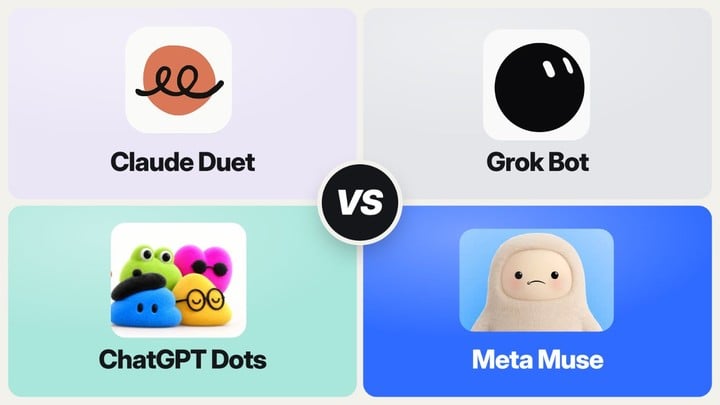
In addition, he hopes that personal agents from different companies, such as Dot, Duet, and Grok Bot, can communicate with each other, so users don't have to jump back and forth among a bunch of homogeneous products.
The third direction is to draw clear human-machine boundaries for RSI.
Talking about the recently hot RSI, many people are imagining AI labs becoming completely unmanned, letting models modify themselves. But Thariq poured cold water on it—he doesn't think self-improvement with no human involvement at all is the best choice.
In his view, a more ideal state is to turn AI research into knowledge work. AI takes on the complex technical execution and experiments, while humans come up with ideas, choose directions, and allocate resources.
After all, every lab's compute is limited, and a single frontier model training run can burn billions of dollars. Such a massive compute ledger ultimately still has to be decided by humans on how to spend it.
The article title: The leading figure behind Claude Code begins to reflect on the future of Vibe Coding
Body: He even believes that similar changes will spread to every industry. In biology labs, robots will conduct wet-lab experiments while humans design research topics and secure budgets. The same goes for opening a restaurant: robots handle the wok and execution, while humans set the menu and calculate profit margins. If this evolution goes smoothly, AI may even create more white-collar jobs.
Toward the end of the conversation, Thariq also touched on a very practical question: in the AI era, as degrees and GPAs matter less and less, how should young people prove their abilities?
In response, he brought up the achievement assistance mechanics in video games—for example, being a guild leader in World of Warcraft. Leading raids, scheduling deadlines, and coordinating dozens of people in a game shares something with the organizational skills needed to manage hyperscale compute clusters in the future.
The two hosts beside him chimed in: in the past, people looked at GitHub commit history; now, beyond public talks and project outcomes, a person's token consumption is, to some extent, becoming a new reference for ability.
Watching the entire interview, from reintroducing human feedback when developing games, to abandoning the Dock app he designed himself, to hoping humans retain the right to allocate AI research resources, what Thariq repeatedly emphasized is actually the same thing.
The industrial revolution of software gave more people the ability to realize their ideas, and the Renaissance of software may redefine the value of ideas themselves. When AI makes implementing an idea easier and easier, having an idea worth implementing may be the scarcest ability of the future.