 AIFeed
Article title: Huawei's All-New Generation Whale Battery Platform: Battery Safety Cannot Be Judged Only by the Day a New Car Leaves the Factory
Body:
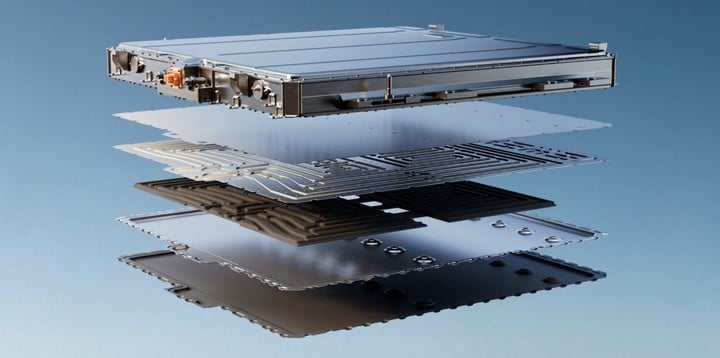
Huawei's All-New Generation Whale Battery Platform: Battery Safety Cannot Be Judged Only by the Day a New Car Leaves the Factory
2026-11-27 15:06
If consumers were asked to buy a new energy vehicle right now, regarding the power battery, they would most likely care about three questions: how long the range is, how fast it charges, and whether the battery is safe.
But if they were buying a used new energy vehicle that has already driven 100,000 kilometers, there might be one more question: after so many years of use, how much of this battery's performance and safety remains?
There is a big difference between cars and consumer electronics: the service life of a car is often measured in decades. Over this long usage cycle, a car may undergo hundreds or thousands of charge-discharge cycles, may be driven from humid and hot Guangdong all the way to cold Northeast China, and may also experience countless speed bump jolts, chassis impacts, and water wading on rainy days.
The electrochemical characteristics of the battery are changing, and seals and structural components are also undergoing slow aging. Therefore, the safety of power batteries is in fact a dynamic proposition, and time is also an important variable in evaluating battery safety.
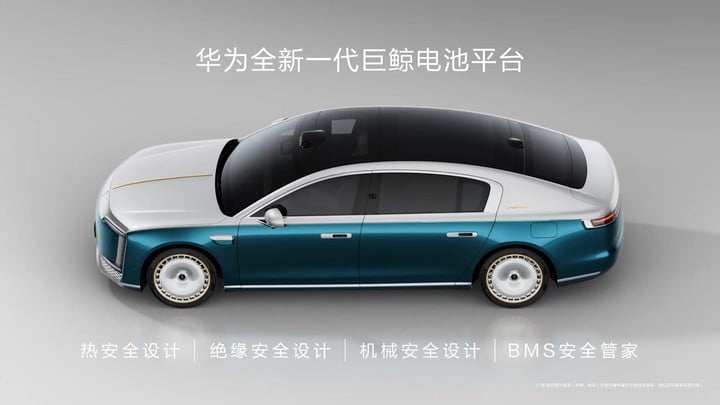
On November 26, HIMA held a TECH DAY technical communication meeting about the all-new generation Huawei Whale Battery Platform, at which it was announced that the Luxeed RX equipped with the Huawei Whale Battery Platform became the industry's first model to pass the new group standard test of "Safety Requirements and Test Methods for Power Battery Systems During the Operating Cycle of Electric Vehicles."
Adding a time dimension to the battery safety exam
On September 2 this year, the China Consumer Products Quality and Safety Promotion Association released a power battery safety group standard numbered T/CPQS A0065—2026, and Huawei was one of the main participating drafters of this standard.
Compared with the new national standard for power batteries, this group standard has two notable changes:
One is coverage of more real-world vehicle usage scenarios, as well as higher standards for some tests.
For example, in the bottom quasi-static extrusion test, the battery system needs to withstand an extrusion force equivalent to 110% of the vehicle's fully loaded weight, and no less than 25kN; the starting temperature of the high-temperature thermal diffusion test has been raised to around 40°C. In addition to the battery pack not catching fire or exploding, the group standard also imposes limits on the spread range of thermal runaway in the initial state.
The other is the introduction of safety tests after mechanical durability, environmental durability, and cycle durability tests.
We can imagine such a vehicle usage scenario: a new energy vehicle used for a long time in a coastal city, after years of salt spray erosion and high-temperature, high-humidity environmental challenges, then experiences low air pressure on a plateau, low temperatures, and ice water impact during a long-distance road trip. After returning home, the owner uses a high-pressure water gun to clean the vehicle's chassis.
Each scenario involved here may be within the designed protection scope of the battery pack, but when they occur one after another over a long period of time, risks will also accumulate.
The environmental durability test in the new group standard is to have the same test sample sequentially undergo high altitude, salt spray, humid heat cycling, temperature shock, and ice water impact, and then conduct immersion, high-pressure water impact, and various electrical safety protection tests.
Similarly, after completing 500 standard charge-discharge cycles simulating the temperature alternation of the four seasons, or completing 300 fast-charging cycles for eligible batteries, the battery system still needs to undergo safety tests such as high-temperature thermal diffusion.
The significance of this serial testing lies in having the battery enter the next exam with the wear accumulated previously, which is closer to our real vehicle usage process. The more than 200 test standards previously accumulated by the Huawei Whale Battery Platform, as well as market operation verification data at the million-vehicle level, also provided engineering practice references for the formulation of this group standard.
With the same cells, why are safety performances different?
In the past, when evaluating the battery of a new energy vehicle, we were used to focusing on which supplier the cells came from and what battery chemistry system was adopted. But from cells to battery pack, and then to a complete vehicle, there is still a considerable amount of engineering design work in between.
Even with cells of the same specification, the final battery system may still differ in safety, durability, and service life.
On the Huawei Whale Battery Platform, there are several design details that consumers usually cannot see but are quite interesting.
The first is the handling of cell thermal runaway.
By fully arranging fireproof and heat-insulating materials such as aerogel and mica plates between cells, the Huawei Whale Battery Platform achieves "one cell, one isolation," limiting thermal runaway to a single cell as much as possible.
In this group standard test, after the battery underwent high-temperature pretreatment and needle puncture to trigger thermal runaway, the battery pack was opened for inspection, and it was found that thermal runaway had not spread to other cells.
If the battery pack not catching fire or exploding is a safety requirement at the outcome level, then blocking heat transfer between cells further reduces risk from the process level.
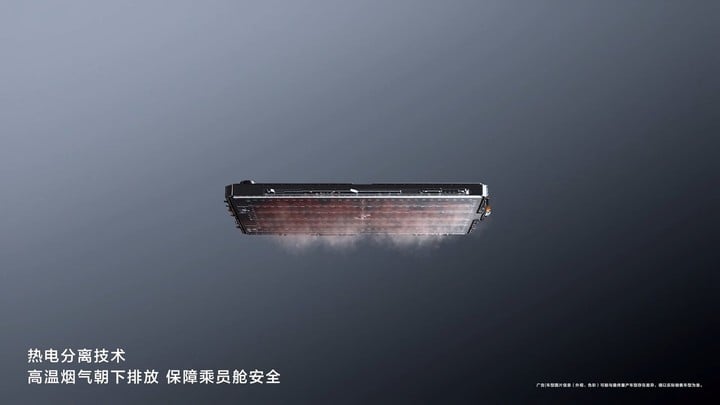
Another detail is that the Huawei Whale Battery Platform always adheres to an upright cell architecture with terminals facing upward.
Since most new energy vehicle battery packs are arranged in the chassis, once a severe bottom impact occurs, damage to cell terminals and high-voltage connection components may produce high-voltage arc flashing, bringing further safety risks.
The upright architecture keeps high-voltage components away from the bottom of the battery pack, which is more susceptible to impact. At the same time, multiple layers of fireproof and heat-insulating materials are arranged between the terminals and the passenger compartment, and exhaust and heat under abnormal conditions are handled through explosion-proof valves and the liquid cooling system.
In dealing with external impacts, the Huawei Whale Battery Platform also draws on the arch bridge structure we are familiar with.
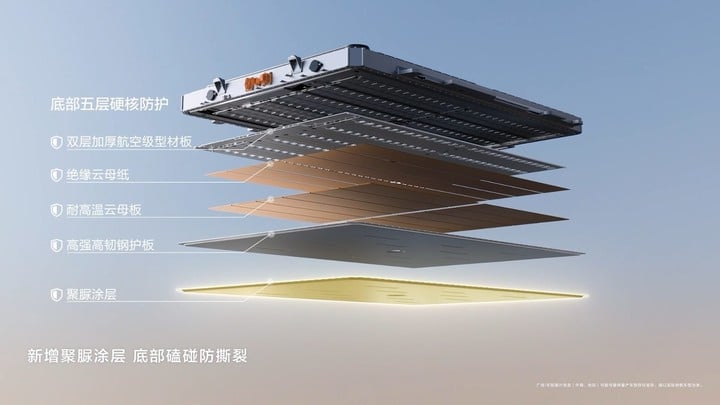
The reason an arch bridge can carry loads far exceeding its own weight is largely due to its dispersion of forces. A similar structural design is applied to the bottom of the battery pack, combined with a fifteen-layer protective structure, to disperse locally received impact force to the surroundings and reduce the load directly borne by the cells.
The approach to water is somewhat like building a breakwater. Through special sealing structure design and a 50% increase in sealing area, the Huawei Whale Battery Platform can withstand immersion in 1 meter of water for up to 72 hours.
In the high-pressure water impact test, it also withstood continuous spraying of hot water at 80°C and 10000 kPa pressure for a cumulative duration of 230 seconds.
Of course, safety at the design level ultimately needs to be implemented in every mass-produced vehicle.
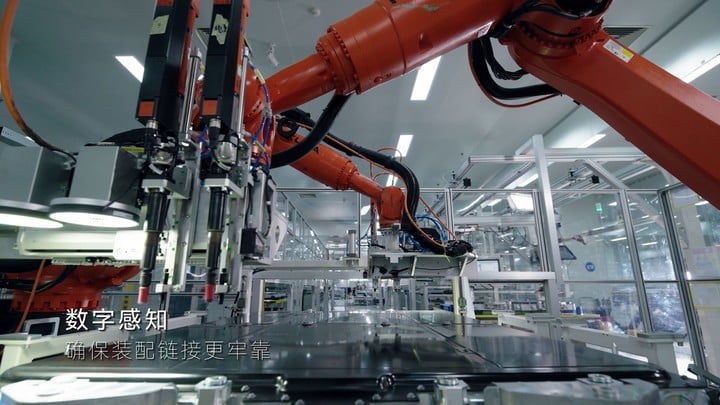
The Huawei Whale Battery Platform conducts 100% X-Ray inspection of cells, and through AI defect recognition, automated inspection, and digital management of the production process, extends the granularity of quality traceability from cells to various components of the battery pack.
For an automotive brand with a user scale at the million-vehicle level, how to make every mass-produced battery as close as possible to the safety expectations at the design stage is just as important as building a battery that can pass rigorous tests.

Another place for AI to shine: making batteries safer and longer-lasting
If heat-insulating materials, sealing structures, and bottom protection are regarded as the battery's physical defense system, then the Huawei Whale Battery Platform also has a safety system built on data and algorithms.
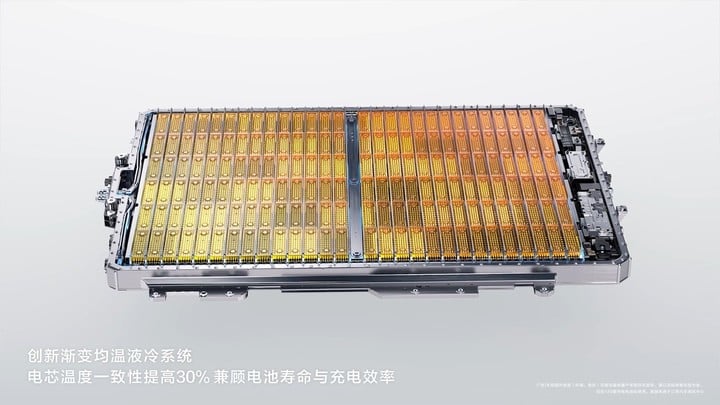
Inside the battery pack, the Huawei Whale Battery Platform deploys nearly 200 sensing nodes to collect multi-dimensional information such as voltage, current, and temperature. Core data can be collected at the millisecond level and uploaded in real time to the cloud battery management system.
On this basis, the Huawei Whale Battery Platform has built an intelligent AI battery steward running 24/7, adopting an architecture driven by both AI agents and battery mechanism models.
These two types of models have different divisions of labor.
Battery mechanism models are based on understanding materials and electrochemical reactions and analyze the internal operating state of the battery; AI agents are good at identifying abnormal features from large amounts of actual operating data and discovering some risks that traditional fixed thresholds are difficult to capture.
The combination of the two is equivalent to equipping each vehicle with a family doctor that can continuously understand its physical condition.
For example, consider two cars that have both driven 50,000 kilometers. One has long been used in the north, mainly relying on household slow charging for energy replenishment; the other has been driven year-round in a high-temperature environment in the south, frequently using public fast-charging piles. The battery aging degree and internal state of the two cars may differ considerably.
Through analysis of more than 2,000 battery operating condition features and more than 1,000 user behavior features, the intelligent AI battery steward can build more refined battery and user profiles, dynamically adjust charging voltage, current, and temperature management strategies, and keep the battery operating within a healthy range as much as possible.
When potential risks are discovered, the AI agent can also determine the risk level, trigger corresponding handling processes, and link services such as emergency calls and user notifications.
The "battery black box" is similar to a black box in aviation. The Huawei Whale Battery Platform hopes to record the battery's operating state as completely as possible. Through triple communication redundancy, triple power supply redundancy, and NearLink wireless communication technology, battery data can be better preserved even in some extreme situations.
In dangerous scenarios such as vehicle flooding, this system also supports microamp-level low-power monitoring to continuously track changes in battery status.
In the past few years, discussions about AI in the automotive industry have mostly focused on intelligent driving and smart cockpits, but in fact, the value of AI for the underlying hardware of automobiles also deserves attention.
An intelligent system that can understand battery status, predict safety risks, and slow battery degradation may not bring intuitive experience changes like intelligent driving, but it may bring users more lasting value over the next several years of vehicle use.
As the new energy vehicle industry gradually matures, more and more new energy vehicles will enter the middle and later stages of their usage cycle. How to ensure battery safety after aging, how to extend the healthy service life of batteries, and how to maintain the second-hand residual value of new energy vehicles will all become issues the entire industry needs to face.
From this perspective, the industry significance of the Huawei Whale Battery Platform being the first to pass the new power battery group standard also lies in pushing the entire industry to re-examine the time scale by which a good battery is evaluated.
The standard for a good car should include what it looks like after many years. The same is true for a good battery.