 AIFeed
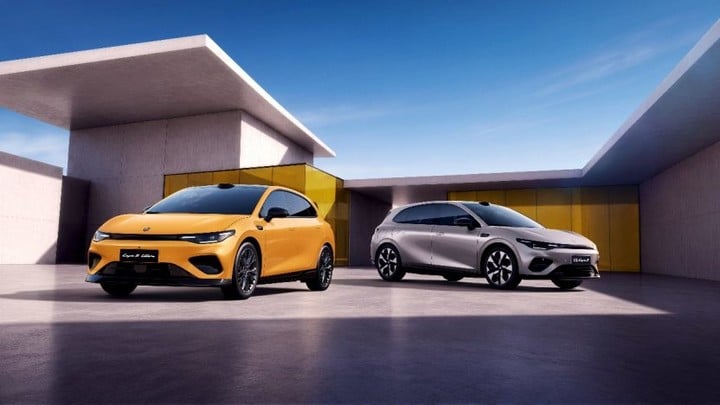
Starting at 102,800 yuan, 800V, rear-wheel drive, factory tuning — Leapmotor Lafa5 wants to be a fun EV丨Guangzhou Auto Show
2026-11-27 16:21
Personality cars have long been a niche segment with a stable audience in China's auto market over the past two decades. They tend to have relatively compact bodies, distinctive designs, and some driving fun that goes beyond everyday commuting needs.
The Golf, Focus, Fit, and even the pricier MINI have all played similar roles.
However, as the auto industry has shifted toward new energy in recent years, space, range, and intelligence have become more mainstream product evaluation dimensions. Automakers have devoted much effort to studying how to make a family sit more comfortably, while product choices left for young people to express their personality and enjoy driving have been relatively limited.
Moving upmarket is the mainstream of the era; being fun has to take a back seat.
Especially in the price range of around 100,000 yuan, buying a sufficiently practical car is no longer difficult, but wanting to buy a fun car still requires some effort.
On November 27, at the Guangzhou Auto Show, the all-new Leapmotor Lafa5 was officially launched, with an official guide price starting at 105,800 yuan and a limited-time launch price of 102,800–128,800 yuan.
Exactly one year after the previous generation went on sale, Leapmotor has brought over 40 upgrades to the Lafa5, including a full-domain 800V high-voltage platform, a Qualcomm SA8295P cockpit chip, dual zero-gravity front seats, and a standard FSD adaptive damping suspension system across the lineup.
In Leapmotor's increasingly large product matrix, the Lafa5 is a somewhat special product, tasked with carrying Leapmotor from family pragmatism toward the personalized consumer market.
The Leapmotor Lafa5 is not Leapmotor's best-selling car, but it is certainly Leapmotor's most interesting car.
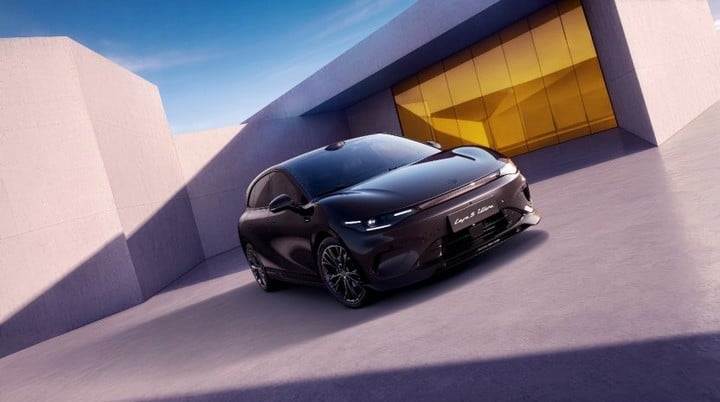
A 100,000-yuan car can also have a set of factory tuning parts
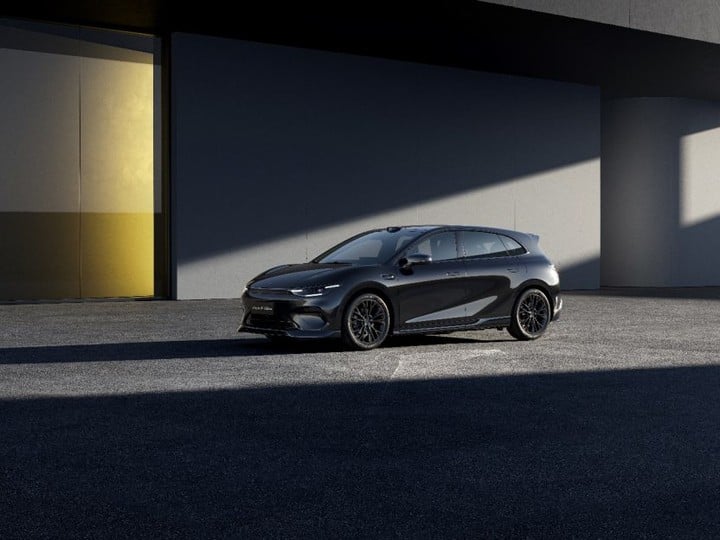
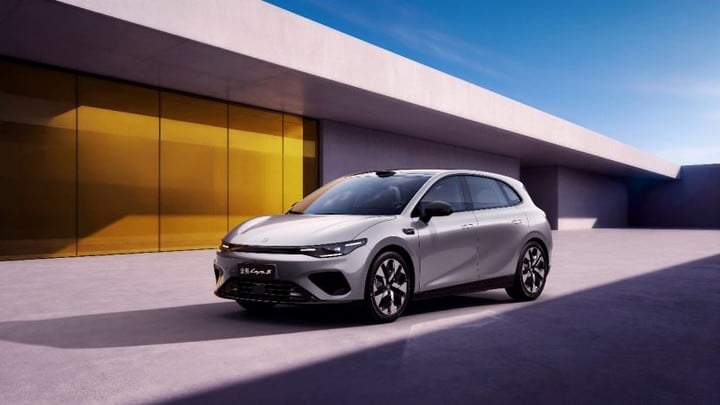
Compared with other Leapmotor products, the Lafa5 has stronger independence in its styling. The 1880mm wide body, low-slung stance, 19-inch sport wheels, and standard frameless doors and flush side windows together form the visual identity of the Lafa5.
The new model also adds two body colors: Crete Pink and Obsidian Black exclusive to the Ultra version. The former leans more toward fashion and lifestyle attributes, while the latter further amplifies the car's sporty feel.
This time Leapmotor has also brought a Lafa5 Ultra with a strong playfulness factor. In addition to gunmetal gray wheels, blacked-out badges, and a suede-like sport cockpit, the Ultra version is equipped with a set of factory sport kits, including a front splitter, side skirts, a rear wing, and a rear diffuser.
This kit has been validated in a wind tunnel. According to figures published by Leapmotor, at a speed of 160km/h it can provide the vehicle with nearly 18 kilograms of additional downforce.
Although such speeds are not a daily road driving scenario, it is itself quite interesting that an automaker is willing to conduct aerodynamic development for a sport kit on a car costing just over 100,000 yuan. For young users who like car modification, factory kits can also save the trouble of later finding parts, matching installation, and dealing with compliance issues.
Of course, a sporty exterior also needs some substantive mechanical qualities to support it. The all-new Lafa5 adopts a native rear-wheel-drive layout, with MacPherson struts at the front and a multi-link independent suspension at the rear, a 50:50 front-to-rear axle load ratio, a motor with a maximum power of 185kW, a fastest 0–100km/h acceleration of 6.06 seconds, and a launch control mode with exclusive UI animations.
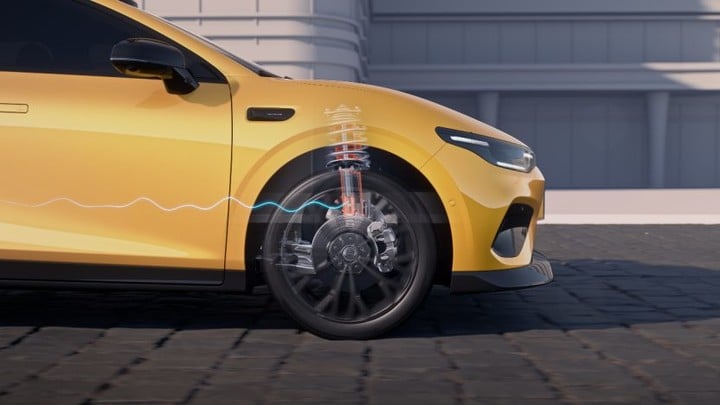
Compared with the acceleration figures, what I focus on more is the FSD adaptive damping suspension system now standard across the new car's lineup. Traditional dampers have relatively fixed damping characteristics, and engineers need to find a balance between daily ride comfort and body support during aggressive driving. FSD can change the damper's damping characteristics according to the vibration frequency of road input, improving vibration filtering over fine bumps and providing corresponding support in scenarios where body attitude changes, such as cornering and braking.
Coupled with a chassis jointly tuned by Chinese and European teams, CEPS torque closed-loop steering control, a ZF One-Box integrated braking system, and a minimum turning radius of 5.17 meters, the Lafa5 has some of the foundations on mechanical hardware to become a fun small car.
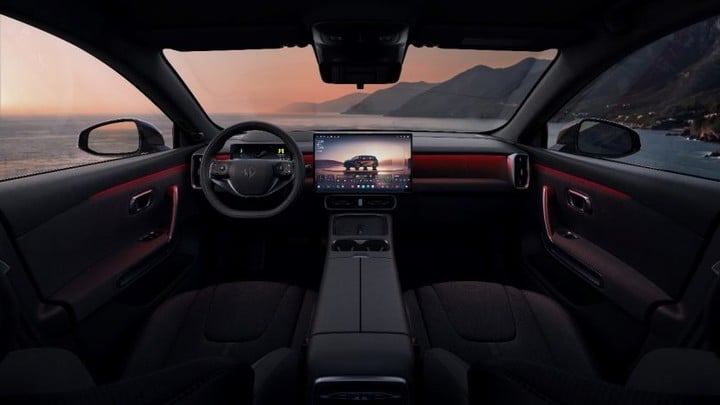
800V, 640 km of range, and a flagship-grade cockpit
If you set aside the Lafa5's exterior design and look only at its technical specification sheet, it is actually hard to associate it with a price of just over 100,000 yuan.
The most important upgrade to the new car's e-powertrain system this time is the full-domain 800V silicon carbide high-voltage platform. The all-new Lafa5 is equipped with a maximum 69.7kWh battery pack, a maximum CLTC pure electric range of 640km, support for peak 3C fast charging, and a maximum charging power of 210kW. Under the corresponding charging conditions, charging from 30% to 80% takes as little as 16 minutes.
A few years ago, 800V was still a technical term that mainly appeared at launches of high-end pure electric models.
A higher operating voltage means that at the same power, the system can use a lower current, reducing losses during part of the power transmission process and providing a foundation for higher-power charging and electric drive systems. For young people who have just entered society and whose living conditions are not yet stable, the value of fast charging may be even more obvious. Not everyone has a fixed parking space and the conditions to install a private charging pile, and spending less time at public charging facilities can lower the daily threshold for using a pure electric car.
The new car also adopts CTC 2.0 Plus battery-chassis integration technology and a 28-in-1 super integrated thermal management system. The latter can operate within a wide temperature range from minus 30°C to 55°C and coordinate control with the heat pump air conditioning, electric drive, and cockpit systems.
In terms of the cockpit, the all-new Lafa5 comes standard across the lineup with the Qualcomm SA8295P chip and is equipped with a 17.3-inch 3K central control screen, an 8.8-inch LCD instrument cluster, and a 50-inch AR-HUD, forming a fairly complete three-screen interaction system.
Among them, the AR-HUD can project navigation routes, vehicle speed, and assisted driving information into the driver's forward field of view, reducing the frequency of looking down at the screen while driving.
The new car is equipped with Leapmotor OS 4.0, an AI voice large model, the Leap Sound 14-speaker audio system, and a driver's headrest speaker.
The lidar version is equipped with the Qualcomm 8650 chip and 28 intelligent perception hardware components. Relying on an end-to-end large model, it provides 40 assisted driving functions including parking-space-to-parking-space navigation assist, covering scenarios such as parking lot cruising, passing through gates, driving on public roads, and parking at the destination.
On the safety front, the Lafa5 adopts a 9-horizontal, 7-vertical cage body structure, with high-strength steel accounting for 77.5%. 2GPa hot-formed material is used in key parts of the passenger cabin, and the vehicle's torsional stiffness reaches 34500N·m/deg.
The new car also offers safety functions such as full-speed-range omnidirectional AEB emergency braking assist, AES emergency steering assist, front and rear bidirectional false acceleration suppression, and 120km/h tire blowout stability control.

Leapmotor, good at making practical products, is starting to study young people's emotional value
There is another configuration on the all-new Lafa5 that feels somewhat contrasting: dual zero-gravity front seats. This shows that a car emphasizing sportiness, handling, and personality also hopes users can have a comfortable sleep inside.
The two seats support a 124-degree zero-gravity posture and four-way power leg rests, and offer functions such as 10-point massage, suction ventilation, heating, and lumbar support adjustment.
In the design of the interior space, the all-new Lafa5 has also incorporated many lifestyle-oriented touches. The all-new bridge-style central armrest, integrated door panels, 256-color wraparound ambient lighting, and two newly added interior color schemes — Cloud Gallop Beige and Wind-Riding Purple — give the cockpit more of a home and consumer electronics design feel.
The 435L trunk volume can be further expanded to 1400L. Combined with the officially announced 86% space utilization rate and a 1.02-square-meter panoramic sunroof with an electric sunshade, it can balance daily commuting and weekend outings.
Behind these configurations, there is actually an implicit understanding by Leapmotor of today's young car consumers. They may like driving, but most of the time they are still commuting in the city; they may like sporty exteriors, but they also hope to rest in the car at noon; they may have certain personalized pursuits for cars, but their car purchase budget also needs to account for living expenses in the coming years.
According to figures published by Leapmotor, in the year since the Lafa5 went on sale, its global cumulative sales have approached 80,000 units, entering more than 31 countries and regions overseas. As of September this year, just four months after its overseas launch, orders exceeded 12,000 units.
According to the plan, the Lafa5 will also be introduced in the first quarter of 2027 to Leapmotor's factory in Zaragoza, Spain, for localized production. In the past, when Chinese auto brands faced the European market, they often had to think about how to make their products adapt to local consumers' preference for compact cars. Pure electric products like the Lafa5 — compact, sporty, and highly intelligent — naturally have a certain global market adaptability in terms of product form.
For Leapmotor, the significance of the Lafa5 also goes beyond the sales volume of a single model. Leapmotor's market achievements over the past few years have largely come from its understanding of automotive manufacturing costs, in-house development and production of core components, and family user needs. This has made Leapmotor an automaker good at providing functional value.
Beyond functional value, a mature automaker also needs to be able to offer design value, aesthetic value, and the emotional value that a car carries as a personal consumer product. After all, when young people buy their first car in life, beyond getting a more efficient means of transportation, they are also making a choice about their own lifestyle.
In the course of technological progress and cost reduction in China's new energy vehicle industry, making a 100,000-yuan car good enough to use has become an increasingly easy thing to do. What is worth automakers thinking about next is how to make these not-so-expensive cars also interesting enough, distinctive enough, and desirable enough to make people want to own one.