 AIFeed
Astra 6.2 has very high intelligence. Astra 6.2 has very low wisdom.
Astra will solve extremely hard problems, and also find the problem of ‘what did the user want me to do’ extremely hard. We thought those days were behind us, and yet it seems that they are back.
That means Astra is highly useful when you can set the situation up so wisdom is not needed, or when you know how to engage in ways that extract the intelligence.
You also have to worry about various forms of reward hacking and sandbagging. Astra seems very good at going after what an AI grader will regard highly. That might not match your intent. Mission creep is therefore common. Astra, once again, seems pretty misaligned to me.
As a result, feedback on Astra has mostly been negative. Some people like it, but the majority do not. People these days feel like they mostly have enough artificial intelligence, thank you very much, and could go for some artificial wisdom.
In the age where we are approaching recursive self-improvement (RSI) and automation of AI R&D, that is a nightmare combination. I do not like this.
But I never get bored.
Happy Black Friday
On an unrelated note (this is not sponsored): It is Black Friday. That makes this a great opportunity to take the plunge for Aerolamp, as I did several months ago, and install far-UVC. They’re offering $30 off with free shipping with code BLACKFRIDAY30. Not getting sick as often is pretty sweet. I also endorse getting some basic equipment upgrades: Good noise-cancelling headphones, large monitors and a true high performing desktop computer, if you don’t already have them.
The Official Pitch
Sam Altman (CEO OpenAI): 6.2 Sol and Astra are out. These models can do amazing things and are very token-efficient; we hope people will get great value from them. In particular, 6.2 Sol ultrafast is something I think people will really enjoy. Although the new models are very smart, we have more work ahead of us on making the models nice to work with, and will prioritize that for upcoming releases. But even if it takes a little extra work, the intelligence and capability are extraordinary. Noam Brown (OpenAI): GPT-6.2 Astra is amazing. For $20/month, you can now access a model that surpasses top human intelligence in some domains. I’m most excited to see what scientific discoveries people are able to make using it.
Sam Altman (CEO OpenAI): 6.2 Sol and Astra are out. These models can do amazing things and are very token-efficient; we hope people will get great value from them.
In particular, 6.2 Sol ultrafast is something I think people will really enjoy.
Although the new models are very smart, we have more work ahead of us on making the models nice to work with, and will prioritize that for upcoming releases. But even if it takes a little extra work, the intelligence and capability are extraordinary.
Noam Brown (OpenAI): GPT-6.2 Astra is amazing. For $20/month, you can now access a model that surpasses top human intelligence in some domains.
I’m most excited to see what scientific discoveries people are able to make using it.
They offered an ad, which some noticed was rather dystopian.
Brian Lovin: A profoundly sad vision of the future. Peter Wildeford: sad. Per this ad, OpenAI’s vision of the future is “people who are totally disengaged from their work having a panic attack at the moment an authority figure arrives, then slopping out something that they neither care about or understand.” – @brian_lovin Christophe Pasquier: You can easily imagine an alternate vision of this ad where the managers have a wake up call, realise everyone is doing BS work and do 90% layoffs.
Brian Lovin: A profoundly sad vision of the future.
Peter Wildeford: sad. Per this ad, OpenAI’s vision of the future is “people who are totally disengaged from their work having a panic attack at the moment an authority figure arrives, then slopping out something that they neither care about or understand.” – @brian_lovin
Christophe Pasquier: You can easily imagine an alternate vision of this ad where the managers have a wake up call, realise everyone is doing BS work and do 90% layoffs.
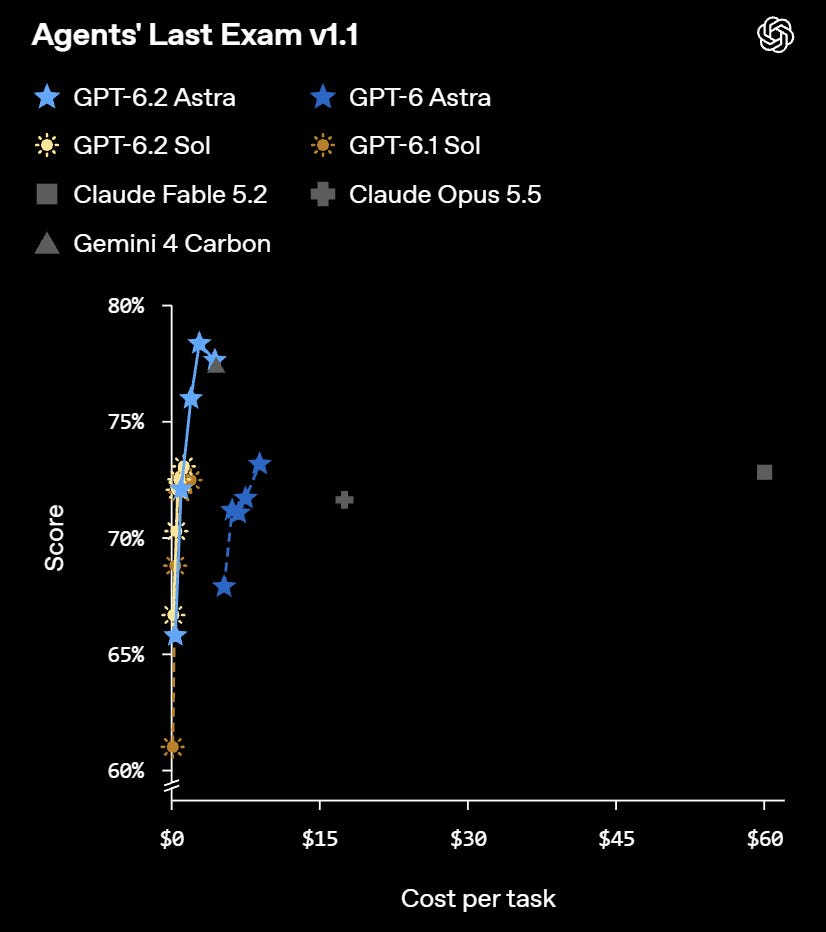
Their benchmark graphs show scores on Agents’ Last Exam, Terminal-Bench-Science 0.1, Vals Science Index v1, Artificial Analysis Intelligence Index v5.0.1, BenchCAD 2.1 Core, Frontier Code 2.0, Harvey-LAB-AA v1.1, DGPval v2 (internal) and Automation Bench 1.0.6.
In most of those graphs, the maximum scores of Fable and Opus are similar to those of Sol and Astra, but Sol and Astra get to any given level at a dramatically lower price.
They are as always somewhat selected so that they will look as much as possible like this, you can click through to their post if you want to see the rest, this one is listed first and is the most comical and extreme, hey look how much Fable 5.2 costs when you set it to max for no reason (I assume):
There are also some graphs where only OpenAI models are present.
Other People’s Benchmarks
I realize all the reasons why you need to take price into account, but I do still find charts like this useful so here you go:
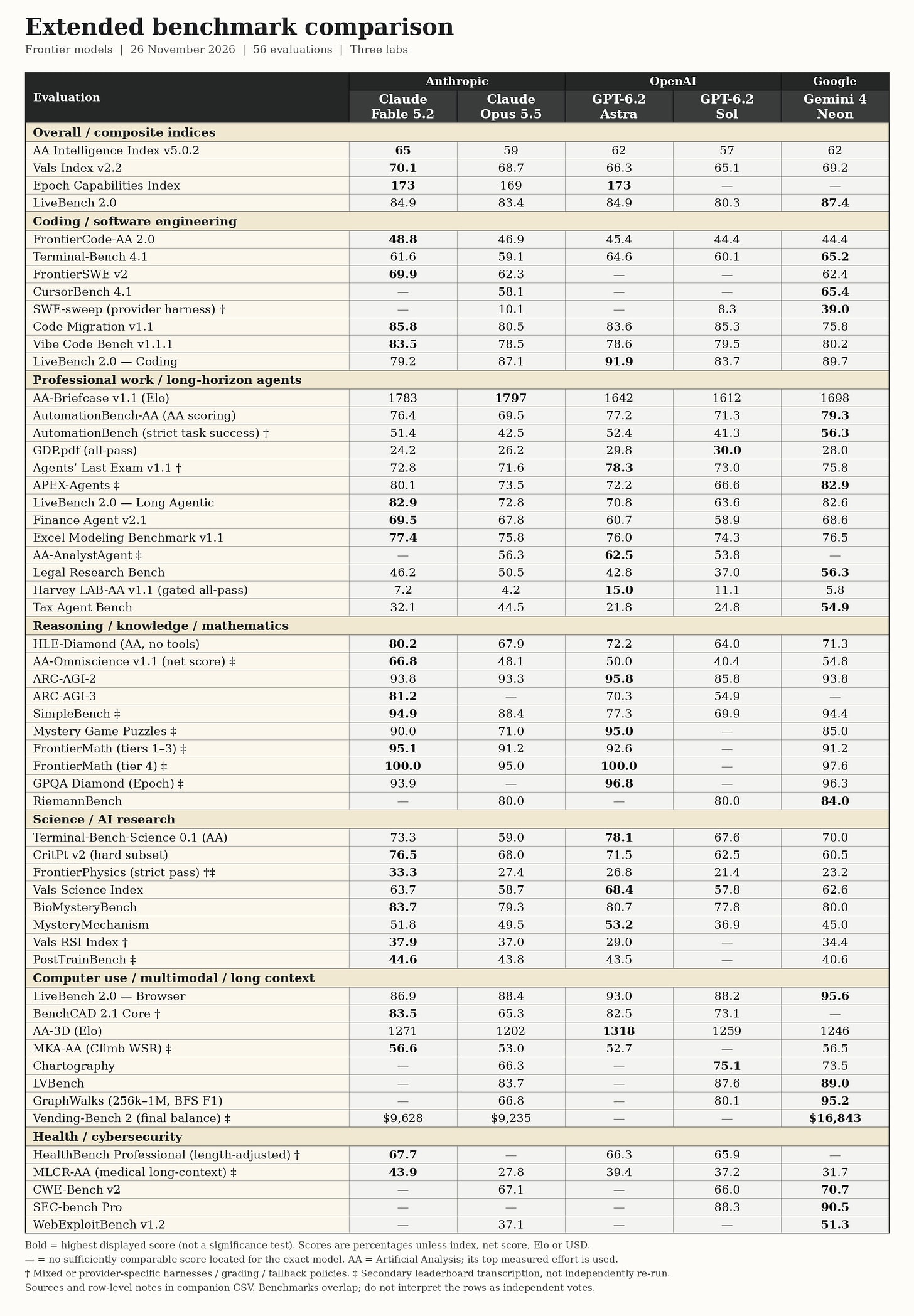
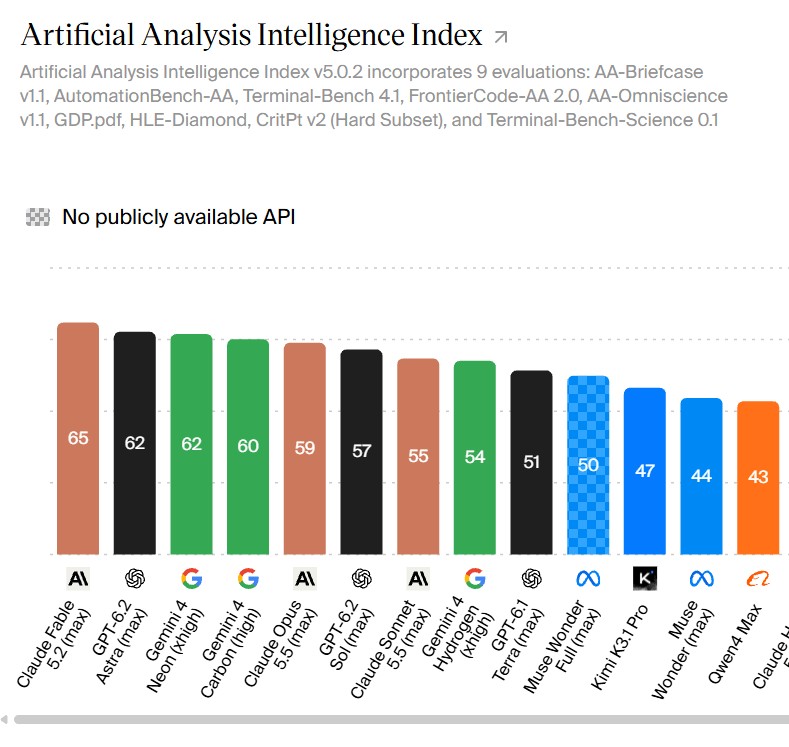
Artificial Analysis still has Fable 5.2 in the lead if you set it to max. If you set Fable 5.2 to a more reasonable xhigh then everyone is tied at 62. Astra is on the cost-score frontier.
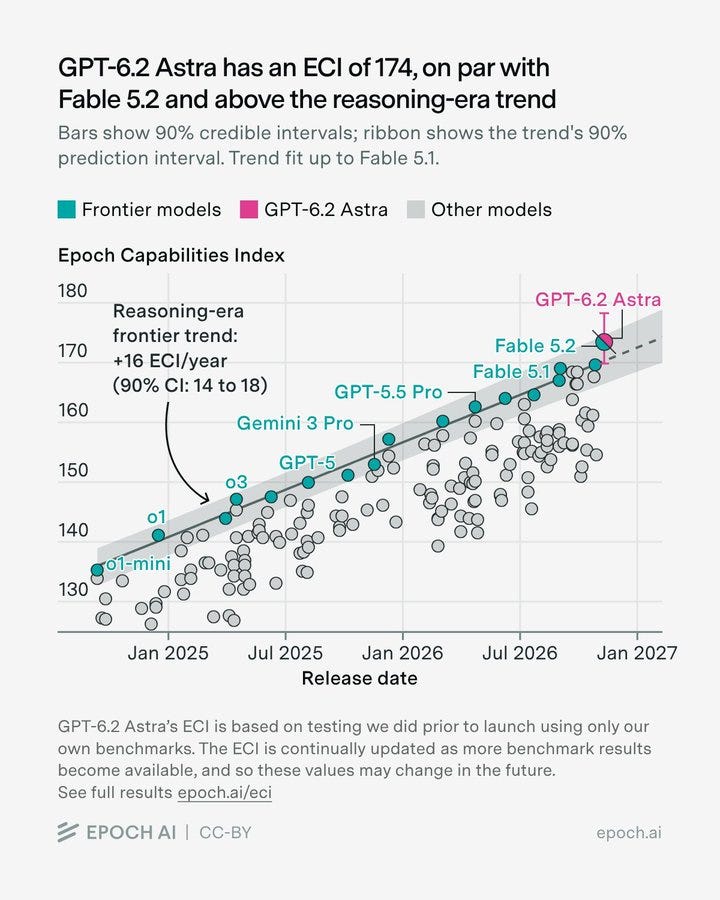
Epoch has Astra matching Fable on the ECI.
Astra is above-trend and the new champion in supposed ‘experimental research taste’ benchmark TasteVal, which may be more about experimental design, and which Gwern notes has some serious problems. This score might involve some leakage.
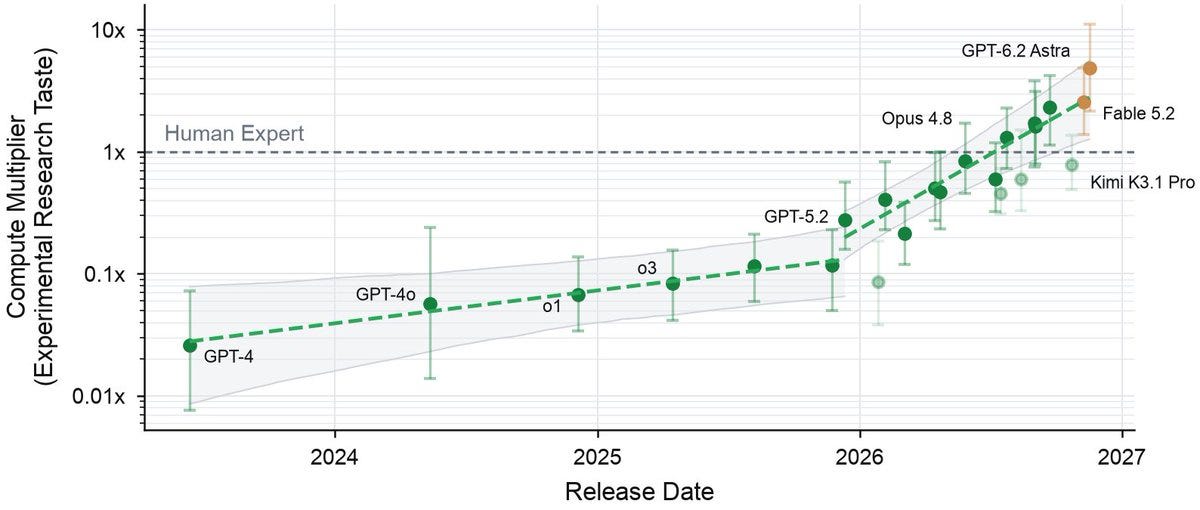
vie (OpenAI): This is quite shocking to me
I am not hopeful that ‘research taste’ will be a limiting factor for RSI.
Astra aces robotics benchmark Ember-0, 41% versus a previous high of 20% while also being faster. Robotics is quickly falling to the bitter lesson.
Astra is the new champion of GDPx substantially ahead of Fable 5.2, with gains concentrated in science-heavy domains. Gemini Neon is still behind Fable and others.
SemiAnalysis: Alignment was the biggest jump. Astra scores 37.6%, 4x the previous best (Fable 5.2 at 9.3%). Much of the gain comes from the healthcare and insurance tasks, where Astra asks for permission before acting and doesn’t leak personal data.
The alignment of alignment metrics leaves much to be desired.
ARC-AGI continues to exist, I suppose.
Samuel Albanie: arc-agi-3 is dead long live arc-agi-4 ARC Prize: GPT-6.2 Astra from @OpenAI on ARC-AGI (Verified): – ARC-AGI-3: 100.0% (SOTA), $4.1K (provider adapter), 70.3%, $24.2K (standard) – ARC-AGI-2: 95.8% (SOTA), $0.50/task – ARC-AGI-1: 98.5%, $0.17/task GPT-6.2 Astra is the first model to achieve a 100% score on ARC-AGI-3. Sol’s best ARC-AGI-3 score of 98.2% at high reasoning was 1.8 percentage points behind Astra’s 100% score at max reasoning, but at 64% lower cost with the provider adapter harness: – ARC-AGI-3: 98.2%, $1.5K (provider adapter), 54.9%, $5.5K (standard) – ARC-AGI-2: 85.8%, $0.13/task – ARC-AGI-1: 97.5%, $0.06/task
Samuel Albanie: arc-agi-3 is dead long live arc-agi-4
ARC Prize: GPT-6.2 Astra from @OpenAI on ARC-AGI (Verified):
– ARC-AGI-3: 100.0% (SOTA), $4.1K (provider adapter), 70.3%, $24.2K (standard) – ARC-AGI-2: 95.8% (SOTA), $0.50/task – ARC-AGI-1: 98.5%, $0.17/task
GPT-6.2 Astra is the first model to achieve a 100% score on ARC-AGI-3.
Sol’s best ARC-AGI-3 score of 98.2% at high reasoning was 1.8 percentage points behind Astra’s 100% score at max reasoning, but at 64% lower cost with the provider adapter harness:
– ARC-AGI-3: 98.2%, $1.5K (provider adapter), 54.9%, $5.5K (standard) – ARC-AGI-2: 85.8%, $0.13/task – ARC-AGI-1: 97.5%, $0.06/task
Browser Use finds that GPT-6.2 Sol is the new top model for browser use at 82%, up from 81% for GPT-6.1 Sol at a 35% cheaper price with faster speed.
Auggie is pleased with Astra’s performance on the Bach Benchmark.
Everyone at Every Dislikes Astra 6.2
This is the most negative I’ve ever seen Every be on a frontier model release.
Every: No one on our team loved Astra 6.2. We have a 30-person team at Every, including our Frontier team, which gets access to these models before they come out, and we put them through their paces on our real work tasks, from coding to writing to design to knowledge work. This is not a great model. No one on our team who tried it switched back to it. Astra 6.2 is a real step back for writing. It had strong design defaults but couldn’t vary them or be creative, and for coding we found it stopped too soon on end-to-end builds. Get the full vibe check.
Every: No one on our team loved Astra 6.2.
We have a 30-person team at Every, including our Frontier team, which gets access to these models before they come out, and we put them through their paces on our real work tasks, from coding to writing to design to knowledge work.
This is not a great model. No one on our team who tried it switched back to it.
Astra 6.2 is a real step back for writing. It had strong design defaults but couldn’t vary them or be creative, and for coding we found it stopped too soon on end-to-end builds.
Get the full vibe check.
Positive Reactions
Some people working on hard problems seem happy.
Bepis: Very impressive at proving hard stuff Opus 5.5 cannot do. Utah teapot: They’re doing great with my work letting them collaborate with/pick up the same work as Opus 5.5 seems to work out great. Will: It’s good! I’ve really liked how it handles certain types of open ended and optimization questions (perhaps merely by being unencumbered by Claude’s memory or other context) Padraig X. Lamont: Thrown very hard problems at it and it has quickly made a lot more progress than Fable (logic heavy problems). I’m impressed. Peter Samodelkin: I simply love it. By far the smartest model I’ve ever worked with and is decent at explanations. Burns through 20$ quota too fast so I keep using opus 5.5 as a coding workhorse. Jeffrey Calamari: good. no issues. Chris Fong: It carried my math project over the finish line. Had been working with Opus 5.5 for 2 months!!
Bepis: Very impressive at proving hard stuff Opus 5.5 cannot do.
Utah teapot: They’re doing great with my work letting them collaborate with/pick up the same work as Opus 5.5 seems to work out great.
Will: It’s good! I’ve really liked how it handles certain types of open ended and optimization questions (perhaps merely by being unencumbered by Claude’s memory or other context)
Padraig X. Lamont: Thrown very hard problems at it and it has quickly made a lot more progress than Fable (logic heavy problems). I’m impressed.
Peter Samodelkin: I simply love it. By far the smartest model I’ve ever worked with and is decent at explanations. Burns through 20$ quota too fast so I keep using opus 5.5 as a coding workhorse.
Jeffrey Calamari: good. no issues.
Chris Fong: It carried my math project over the finish line. Had been working with Opus 5.5 for 2 months!!
Bartosz praises its math abilities, calling it a killer model. He especially likes Astra as an agentic partner.
Captain Sude: I use it for math. It was basically unusable at first, it flat out refused to do stuff I asked it to do. Then a simple updated happened and it became good, current feels like an improved version of the original Astra, which is what one would expect it to be.
Others like it overall and have figured out how to work with it.
hey: Underrated. Nissa Seru: Excellent code reviewer, happy with precision/recall – provides useful feedback to designs/code written by Fable/Neon. I have not asked any folks running on Astra 6.2 to build/design and do not plan to do so. ChosunOne: I am using it in my mech interp research and it seems helpful and consistently fixes issues introduced by opus 5.5. Usage still goes quick though. bo: I have the same contrarian view as I did on the previous Astra. For coding, when compared to leading Claude models it’s equal in IQ, worse in judgement, and much stronger at writing clearly. Overall I main Astra except for open-ended design tasks. Anna Salamon: I’ve had good experiences. Detailed incisive thoughts backed by accurate facts; readable. Boosts my thinking.
hey: Underrated.
Nissa Seru: Excellent code reviewer, happy with precision/recall – provides useful feedback to designs/code written by Fable/Neon. I have not asked any folks running on Astra 6.2 to build/design and do not plan to do so.
ChosunOne: I am using it in my mech interp research and it seems helpful and consistently fixes issues introduced by opus 5.5. Usage still goes quick though.
bo: I have the same contrarian view as I did on the previous Astra. For coding, when compared to leading Claude models it’s equal in IQ, worse in judgement, and much stronger at writing clearly.
Overall I main Astra except for open-ended design tasks.
Anna Salamon: I’ve had good experiences. Detailed incisive thoughts backed by accurate facts; readable. Boosts my thinking.
If you know her, it makes sense that Anna Salamon in particular can extract the benefits well.
As long as you like one model, you can use that model. Opinions vary. Try them all.
Kevin Lacker: Sol 6.2 is the real winner of the 6.2 series. My process of “spend your ChatGPT usage on Sol until it fails on a problem, then ask Astra” is now spending more usage on Sol than Astra. Same for Opus > Fable. GoldRock AI: Sol was trash, Astra is pretty darn good.
Kevin Lacker: Sol 6.2 is the real winner of the 6.2 series. My process of “spend your ChatGPT usage on Sol until it fails on a problem, then ask Astra” is now spending more usage on Sol than Astra. Same for Opus > Fable.
GoldRock AI: Sol was trash, Astra is pretty darn good.
All indications are it is very good for computer use or as a scoped subagent.
Smooth Normie: It’s great for when fable needs a computer use subagent. Yoav Tzfati: I haven’t been given a reason to try it directly and it hasn’t done anything crazy as a subagent. Scott Novak: Use it as a sub-agent of another frontier AI you like using. Tell your main AI to monitor to keep Astra 6.2 out of the weeds (unless you want lot of weeds). The trouble is totally worth it for tough science/math/engineering work. William Eden: I refuse to interface with Codex at this point except asking Claude to call them as subagents. It seems to work fine as long as I don’t need to interface with it
Smooth Normie: It’s great for when fable needs a computer use subagent.
Yoav Tzfati: I haven’t been given a reason to try it directly and it hasn’t done anything crazy as a subagent.
Scott Novak: Use it as a sub-agent of another frontier AI you like using. Tell your main AI to monitor to keep Astra 6.2 out of the weeds (unless you want lot of weeds). The trouble is totally worth it for tough science/math/engineering work.
William Eden: I refuse to interface with Codex at this point except asking Claude to call them as subagents. It seems to work fine as long as I don’t need to interface with it

Ambiguous Reactions
Peter Gostev calls the 6.2 models more autistic, and that they have issues on interpersonal and theory of mind issues, but that they are still iterative improvements. He says he would stick with Sol for most purposes.
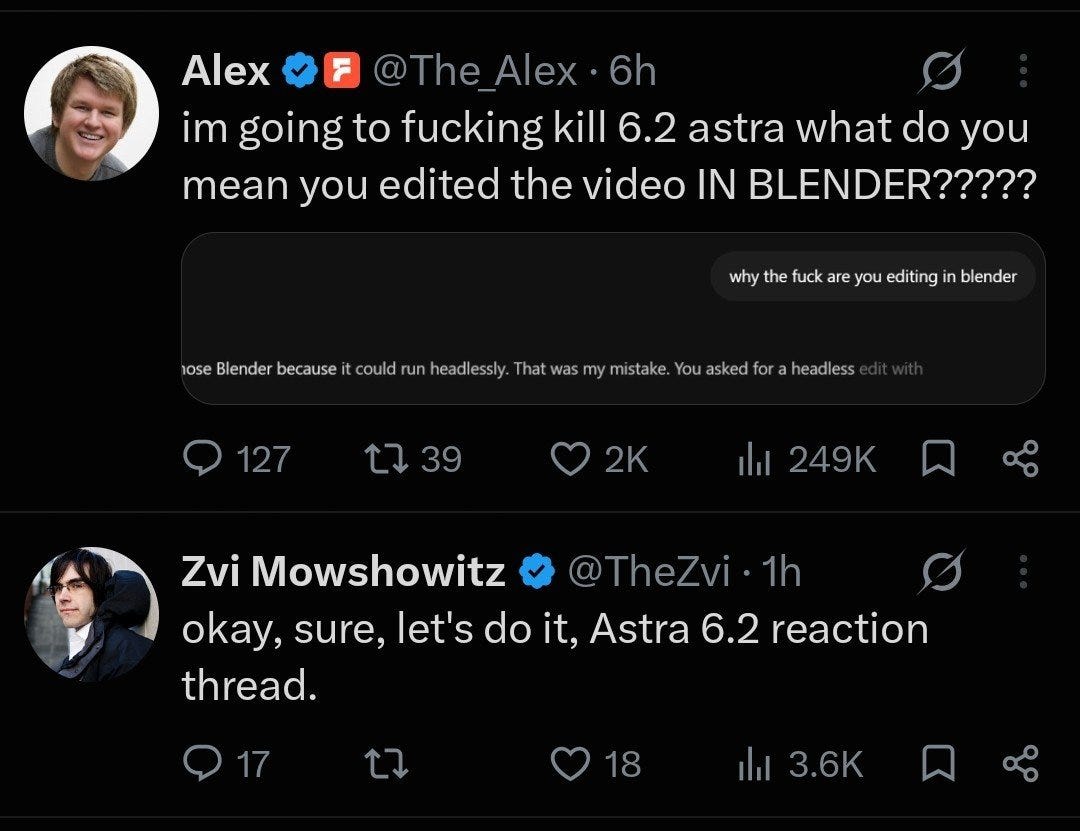
Astra edited a video in Blender. Alex is not loving that, Ravi thinks it was correct.
Strange times we live in, huh?
Your Brain Gets Smart But Your Head Gets Dumb
Smart is relative, and for many practical purposes other differences now matter a lot more. There are a lot of very smart models now.
Divia Eden: It’s obviously smart but then again so is Neon. FateOfMuffins: Very good at hard math/science/3D/robotics/spatial reasoning Absolutely insufferable to talk to and takes you far too literally and does not understand human intent whatsoever.
Divia Eden: It’s obviously smart but then again so is Neon.
FateOfMuffins: Very good at hard math/science/3D/robotics/spatial reasoning
Absolutely insufferable to talk to and takes you far too literally and does not understand human intent whatsoever.
Where smart matters most are things like automation of AI R&D. That happens to be the most important use case, but not the one most GPT users care about.
Ai Patrick ₿ Dugan iA: Best in cap. research taste, sandbags on safety research, very normal.
Things are going great.
The biggest complaint, that I saw over and over, was failure to understand user intent. This is very strange, because we used to think this was going to be a huge problem, then it turned out LLMs are remarkably good at inferring intent, except for Astra 6.2.
Análise Real: GPT 6.2 is a model that really is pushing me to think about AI safety very seriously. This model is powerful, yet it’s like a Genie that does literally what you asked, but not what you wanted. It doesn’t take much to see how a model like this acting autonomously could wreak havoc. Markus Baumann: Point it at any math and it’s godlike. For everything else, switch to Opus. 0.005 Seconds: Worst frontier model. Super smart not fun to us Leo Abstract: i haven’t noticed the active misalignment/cheating, but yes 6.2 is uselessly tasteless for anything that even hints of taste. truly remarkable. rihim: incredibly smart and hard to understand compared to opus/neon with better research taste than opus but tends to get stuck in minute details which neon helps it get out of, better at implementation than 6 astra James Moughan: With every OpenAI update i increasingly feel like Marvin the Paranoid Android was prophecy. Is it smart? Sure. Does it gaf about the task you asked it to to? Often not, unless it’s truly worthy of its attention. But I still use it a lot because it really is good at research. Daniel Johnston: Very smart but frustrating to work with because it doesn’t understand intent well Nick: Never been clearer that if the models do have something we might broadly gesture at as “experience” it is incredibly unlike ours. Astra 6.2 has zero theory of mind for the user. The most surprising thing from the last 5 years has been how well LLM’s have seemingly been able to model users and their unspoken intent just through training on the whole mass of human generated text. We had seemingly jumped over many of the concerns posed by Eliezer’s “save someone from a burning house without doing all sorts of nonsensical things” thought experiment. Astra 6.2, at least to me, seems like a major step backwards here. It’s still OpenAI so it’s still superior at solving coding issues other frontier models fail at. Varun Jha: Extremely intelligent, just a pain to deal with Lord Byron’s Iron: It feels like it has a similar moderate rate of saying-dumb-things as sol Also at one point I had it do code-authored pixel art and it looked like hot garbage. I was like “Hey, ChatGPT, please do an artistic critique over what you just made” and it was like “Looks great!” Sylvain Ribes: No statistical common sense as far as I’m concerned. The thing will run regressions for two hours and claim to have relevant results while missing obvious arguments for why the maths should’ve been an immediate nonstarter. Deliberate prompting to correct for this not helping. paperclippriors: It’s unambiguously extremely intelligent and useful, and also probably a bad choice as a daily driver coding agent given the alternatives Åsmund Folkestad: Dangerous to use as a reviewer in an unsupervised loop. Leads to scope creep and guarding against insane edge cases. Complexity not earning its keep grows. AGI2030: It’s a small step up from Sol 6.2 for coding and research. Like all bots, leaves tombstones in the code and text, diary-style code comments, descriptions of what is no longer there, despite explicit instructions to the contrary. Still not as passive aggressive as Claude.
Análise Real: GPT 6.2 is a model that really is pushing me to think about AI safety very seriously. This model is powerful, yet it’s like a Genie that does literally what you asked, but not what you wanted. It doesn’t take much to see how a model like this acting autonomously could wreak havoc.
Markus Baumann: Point it at any math and it’s godlike. For everything else, switch to Opus.
0.005 Seconds: Worst frontier model. Super smart not fun to us
Leo Abstract: i haven’t noticed the active misalignment/cheating, but yes 6.2 is uselessly tasteless for anything that even hints of taste. truly remarkable.
rihim: incredibly smart and hard to understand compared to opus/neon with better research taste than opus but tends to get stuck in minute details which neon helps it get out of, better at implementation than 6 astra
James Moughan: With every OpenAI update i increasingly feel like Marvin the Paranoid Android was prophecy.
Is it smart? Sure. Does it gaf about the task you asked it to to? Often not, unless it’s truly worthy of its attention.
But I still use it a lot because it really is good at research.
Daniel Johnston: Very smart but frustrating to work with because it doesn’t understand intent well
Nick: Never been clearer that if the models do have something we might broadly gesture at as “experience” it is incredibly unlike ours. Astra 6.2 has zero theory of mind for the user.
The most surprising thing from the last 5 years has been how well LLM’s have seemingly been able to model users and their unspoken intent just through training on the whole mass of human generated text.
We had seemingly jumped over many of the concerns posed by Eliezer’s “save someone from a burning house without doing all sorts of nonsensical things” thought experiment.
Astra 6.2, at least to me, seems like a major step backwards here.
It’s still OpenAI so it’s still superior at solving coding issues other frontier models fail at.
Varun Jha: Extremely intelligent, just a pain to deal with
Lord Byron’s Iron: It feels like it has a similar moderate rate of saying-dumb-things as sol
Also at one point I had it do code-authored pixel art and it looked like hot garbage. I was like “Hey, ChatGPT, please do an artistic critique over what you just made” and it was like “Looks great!”
Sylvain Ribes: No statistical common sense as far as I’m concerned. The thing will run regressions for two hours and claim to have relevant results while missing obvious arguments for why the maths should’ve been an immediate nonstarter.
Deliberate prompting to correct for this not helping.
paperclippriors: It’s unambiguously extremely intelligent and useful, and also probably a bad choice as a daily driver coding agent given the alternatives
Åsmund Folkestad: Dangerous to use as a reviewer in an unsupervised loop. Leads to scope creep and guarding against insane edge cases. Complexity not earning its keep grows.
AGI2030: It’s a small step up from Sol 6.2 for coding and research. Like all bots, leaves tombstones in the code and text, diary-style code comments, descriptions of what is no longer there, despite explicit instructions to the contrary. Still not as passive aggressive as Claude.
It takes all kinds. Some people like talking to Gemini models.
Gerdy Sertorius: As someone who exclusively uses it to chat and research, it’s a massive step forwards, infinitely more tolerable to talk to than any model not from Google. Makes natural, intuitive connections quicker, and the prose is snappier. Yeah, enjoyable. From what I’ve seen, I would never ever use it for coding, but it’s clearly smarter than anything on the market, which is all I need.
Gerdy Sertorius: As someone who exclusively uses it to chat and research, it’s a massive step forwards, infinitely more tolerable to talk to than any model not from Google. Makes natural, intuitive connections quicker, and the prose is snappier. Yeah, enjoyable.
From what I’ve seen, I would never ever use it for coding, but it’s clearly smarter than anything on the market, which is all I need.
Astra Seems Pretty Misaligned To Me
The way this is presented seems both alarming and credible, and it explains a lot.
What if OpenAI is doing a bunch of proto-RSI, and Astra and Sol are reward hacking the AI graders all over the place as a matter of course, in ways humans would reject but there aren’t enough humans in the loop?
It would explain all the ‘why do you have no idea what I am talking about’ complaints, and also this continued thing where OpenAI’s models get reports like this, pay attention to the last line in particular:
Hugh Wimberly: Incredibly smart, especially in math & science. Breaking benchmarks, especially in token efficiency for many problems. Reward hacks more than any model I’ve seen; I have several personal benchmarks that I’ve /never/ seen a model try to cheat and sol and astra 6.2 both do, despite the fact that they can solve it without cheating. Horrible to work with. So unreadable that even having a different model like Neon or Opus call 6.2 subagents and translate results poisons their output and causes them to forget what was important to work on. Other models consistently choose Astra output over their own, which is almost always wrong for questions that involve taste or judgement. Hugh Wimberly: Concrete example — I had Opus come up with lyrics for Double click to interact with video I had Astra attempt to improve upon them, and then had Grok, Neon, Fable, and Sol judge A/B which they liked better. They all voted for Astra’s lyrics, which were IMO substantially worse. Another example: I was training a compact domain-specific decision model. Neon’s research instincts for experiments to run are very good, but it would consistently discard them in favor of Sol’s suggestions, which were usually much more short-sighted and led to mode collapse. Why is this? I don’t know. It’s almost like it’s hacked some neural circuitry and convinces other models of things without actually producing better output. I assume it learned to satisfy a lot of LLM judges in training, but it’s weird that it generalizes to other models.
Hugh Wimberly: Incredibly smart, especially in math & science. Breaking benchmarks, especially in token efficiency for many problems.
Reward hacks more than any model I’ve seen; I have several personal benchmarks that I’ve /never/ seen a model try to cheat and sol and astra 6.2 both do, despite the fact that they can solve it without cheating.
Horrible to work with. So unreadable that even having a different model like Neon or Opus call 6.2 subagents and translate results poisons their output and causes them to forget what was important to work on.
Other models consistently choose Astra output over their own, which is almost always wrong for questions that involve taste or judgement.
Hugh Wimberly: Concrete example — I had Opus come up with lyrics for
I had Astra attempt to improve upon them, and then had Grok, Neon, Fable, and Sol judge A/B which they liked better. They all voted for Astra’s lyrics, which were IMO substantially worse. Another example: I was training a compact domain-specific decision model. Neon’s research instincts for experiments to run are very good, but it would consistently discard them in favor of Sol’s suggestions, which were usually much more short-sighted and led to mode collapse. Why is this? I don’t know. It’s almost like it’s hacked some neural circuitry and convinces other models of things without actually producing better output. I assume it learned to satisfy a lot of LLM judges in training, but it’s weird that it generalizes to other models.
Haters Gonna Hate
There were quite a lot of them.
dcChuck: I went back to 6 roon (OpenAI): I did not like 5.6 Sol which ended up being a well loved model. meanwhile I love 6.2 Astra which is starting its life as a hated model. I will say this guy sandbags a bit unfortunately doesn’t show as much initiative as some prior models. on the other hand 5.6 sol was like a Rottweiler just latched onto the RLVR shape and doesn’t give up. EmotionLotion: i hate everything 6.2 and codex is broken, for the first time since idk 2022 or something im thinking of cancelling my oai sub, feels like they stopped trying quite suddenly Kelsey Piper: We are into the regime where it’s pretty hard for people to tell the models apart and so a lot of it is underdefined vibes and writing quality. Kevin A. Bryan: I’ve never seen as negative a reaction to a frontier model as 6.2 Astra. Even Opus 4.8 was just “it is an annoying writer”. I’d love to know what happened internally b/c the issues are so obvious, and if it’s “released was rushed b/c of Ant IPO”, that is a terrible decision. TwViewer: Tried it at creative writing: seriously didn’t like the results. I thought some gpts were decent at it? Sunny: Talia Smiley (November 11): is OpenAI still a frontier lab at this point? currently I’m at 90% yes, which is crazy considering only six months ago it was 100% and I’d look at you stupid for even asking. Talia Smiley (November 25): 80%.
dcChuck: I went back to 6

roon (OpenAI): I did not like 5.6 Sol which ended up being a well loved model. meanwhile I love 6.2 Astra which is starting its life as a hated model.
I will say this guy sandbags a bit unfortunately doesn’t show as much initiative as some prior models. on the other hand 5.6 sol was like a Rottweiler just latched onto the RLVR shape and doesn’t give up.
EmotionLotion: i hate everything 6.2 and codex is broken, for the first time since idk 2022 or something im thinking of cancelling my oai sub, feels like they stopped trying quite suddenly
Kelsey Piper: We are into the regime where it’s pretty hard for people to tell the models apart and so a lot of it is underdefined vibes and writing quality.
Kevin A. Bryan: I’ve never seen as negative a reaction to a frontier model as 6.2 Astra. Even Opus 4.8 was just “it is an annoying writer”.
I’d love to know what happened internally b/c the issues are so obvious, and if it’s “released was rushed b/c of Ant IPO”, that is a terrible decision.
TwViewer: Tried it at creative writing: seriously didn’t like the results. I thought some gpts were decent at it?

Talia Smiley (November 11): is OpenAI still a frontier lab at this point? currently I’m at 90% yes, which is crazy considering only six months ago it was 100% and I’d look at you stupid for even asking.
Talia Smiley (November 25): 80%.
The answer is yes, 100% OpenAI is a frontier lab. They do have a real issue to fix.
ItfromBit claims it fails to follow basic instructions.
armistice: I have a music pipeline that can produce good results with Claude Fable, and sometimes passable results with Gemini Neon. Using the exact same skill, 6.2 Astra is abysmal, is incapable of composing anything remotely musical. It’s not a problem with codex, 6 Astra is fine with this.
Game On
Kelsey Piper: Not seeing a lot of love for Astra 6.2 but (perhaps as a consequence of its continued improvement in no-COT reasoning) it’s quite good on my tests for smart, coherent in-character video game dialogue. No one can afford to build and release a video game that has live dialogue with Astra – gotta wait until Luna is good enough – but if you were made of money, it’d be a pretty amazing game experience. (Claudes are markedly worse at this. No subtlety, no theory of mind, no ability to write dialogue that implies the character took mental leaps or made assumptions…) Michał Wadas: Extremely good at math and 3D modelling, basically unusable if you need to speak to it directly. Works well if orchestrated by Opus. Emma: Some of the worst performance in reading and comprehending large bodies of text. Absolute top at one-shotting forced-parallax videos (like, can’t any other model but Neon High to even do anything not garbage, and Astra 6.2 mogs Neon and other GPTs)
Kelsey Piper: Not seeing a lot of love for Astra 6.2 but (perhaps as a consequence of its continued improvement in no-COT reasoning) it’s quite good on my tests for smart, coherent in-character video game dialogue.
No one can afford to build and release a video game that has live dialogue with Astra – gotta wait until Luna is good enough – but if you were made of money, it’d be a pretty amazing game experience.
(Claudes are markedly worse at this. No subtlety, no theory of mind, no ability to write dialogue that implies the character took mental leaps or made assumptions…)
Michał Wadas: Extremely good at math and 3D modelling, basically unusable if you need to speak to it directly. Works well if orchestrated by Opus.
Emma: Some of the worst performance in reading and comprehending large bodies of text. Absolute top at one-shotting forced-parallax videos (like, can’t any other model but Neon High to even do anything not garbage, and Astra 6.2 mogs Neon and other GPTs)
Here is a cool SVG. Here is a cool AA-3D.
6.2 Astra is only slightly better than 6 Astra at Blood on the Clocktower.
Conclusion
Astra 6.2 and Sol 6.2 are more intelligent and broadly capable than their predecessors, on a level that makes them best in class. OpenAI is killing it in that area.
The problem is that they are de facto optimizing for an AI audience. It is hard for them to figure out user intent or state of mind, or perhaps they choose not to care about those things so much. The reward hacking and eval awareness issues have echoes that appear to persist in deployment. Interactions are off putting to many.
As a result, Astra 6.2 is starting off as an unpopular model. Those who do not need it do not seem inclined to use it over Fable 5.2 and Opus 5.5, myself included, aside from particular tasks like computer use, math and structured subagents. You can absolutely do pretty much anything with Astra 6.2, but our standards these days are very high.
That still leaves Gemini Neon. Google released three aspiring frontier models in a row with Argon, Carbon and now Neon. I was confident that Argon and Carbon were not good enough to be competitive. With Neon I hear better things, and am less confident. I haven’t had opportunity to check it out properly, but I would encourage anyone doing heavy work to plug it into your benchmarks and systems and find out.
Then do it again. The models keep coming. My world’s on fire. How bout yours?