 AIFeed
A basic case for differentially accelerating conceptual reasoning capabilities [1] argues that we should make AIs better at conceptual reasoning (CR), roughly the philosophy-like reasoning you need for problems where you can’t run an experiment or write a proof. I’ll call this agenda CRC. I think it’s a mistake. I think this agenda, won't accomplish its own goals (CR uplift), and puts in jeopardy most other strategies by which people hope to use AI to accelerate AI safety.
Relative CR weakness is a large part of what makes current AIs safe, and it's a component almost orthogonal to overall capabilities, or capabilities required to succeed at takeover.
Accelerating CR would likely accelerate the advent of coherently misaligned agents, both in time, and relative to other capabilities, reducing the amount of uplift we can extract from AIs at narrower tasks.
The authors of [1] do consider CR accelerating scheming, and call it “a much more important downside than the effect on timelines”, but say:
We expect conceptual reasoning to accelerate AI safety more than it accelerates scheming.
This post argues the opposite. In short: the AIs we’re worried about are already somewhat misaligned, and what currently stops that misalignment from turning into scheming is, to a large extent, the set of weaknesses CRC is trying to fix.[1]
Before making the case, I’ll quickly summarize my understanding of the motivation behind CRC.
A Basic Case for CR
- AI Safety[2] must be solved before handoff / ASI is created.
- Some problems in AI safety might be too hard for unaided humans to solve in time.
- Many of these problems are “conceptual”, roughly meaning that progress is made through argumentation, and that conclusions can’t be formally verified or easily tested empirically.
- The amount of uplift we can extract from AIs on a task is roughly proportional to how good they are at that task by the time they reach takeover-level general capabilities.
- Therefore, increasing conceptual reasoning capabilities in AIs, keeping their overall capabilities constant, would be good.
- Doing this is tractable.AI capabilities are increasing very rapidly, but especially so in domains that are verifiable, with relatively poor generalization to conceptual tasks.Consequently, by default, the first takeover-capable AIs will be asymmetrically bad at conceptual reasoning and therefore safety research.But we can train for CR.And this doesn’t speed up overall progress in capabilities much.
- AI capabilities are increasing very rapidly, but especially so in domains that are verifiable, with relatively poor generalization to conceptual tasks.
- Consequently, by default, the first takeover-capable AIs will be asymmetrically bad at conceptual reasoning and therefore safety research.
- But we can train for CR.
- And this doesn’t speed up overall progress in capabilities much.
- Conclusion: Work on accelerating CR is good.
(CRC proponents also give a few other paths to impact. For example, helping navigation of acausal interactions and improving path dependent aspects of society's views on ethics. I'll briefly address the first later, but not the second. I don't find either convincing, but they are largely out of scope.)
A Basic Case Against CR
With this understanding of the case for CRC in mind, I'll now explain why I don't think it can work. To simplify our analysis we can make a few assumptions.
Firstly, if AI Safety is already solved, or strongly on track to be solved, using the broad definition from earlier, improving the conceptual reasoning abilities of AIs has little value, as we get a good future regardless of relative AI CR capabilities.
Secondly, we can assume that solving AI Safety requires major conceptual progress. Because if this isn’t the case, e.g. if giving AI labs more time to patch all their RL environments sufficed for getting a good future, accelerating conceptual reasoning again has little impact.
In these worlds, where AI safety is unsolved and needs major conceptual progress, if we fail, it will be because schemers[3] eventually end up in control. This could happen for multiple reasons, for example (non-exhaustive):
- We hand off to Schemers produced by current techniques.
- Schemers produced by current techniques take over directly.
- We hand over to Schemers produced using inadequate techniques developed by non-scheming AARs.
- We hand over to Schemers produced using intentionally misaligned techniques we got from scheming AARs.
- We hand off to non-Schemers and they later become schemers.
- We hand off to non-Schemers and they later build successors that become Schemers.
Now, current AIs are neither aligned[4] nor Schemers, and this is in a sense the single source of hope behind many safety agendas, because it’s what makes it feasible to extract useful work from AIs before we’ve solved alignment.
I think it's safe to assume that this property breaks down at some capability-level, so the feasibility of agendas that hinge on using non-scheming but not-fully-aligned AI labor to do XYZ, depends on how good we can get AIs at XYZ before they become Schemers.
This is very difficult to estimate, but we can try to get a handle on it by analyzing which properties current AIs have, that prevent them from Scheming.
The situations where the standard argument tells us to expect scheming to occur, are situations where we have an AI that:
- (Misalignment) Has goals/values/drives at odds with humans’.
- (Self-knowledge) Knows this.
- (Ability) Is able to carry out the reasoning that implies deception (or other instrumentally convergent power-seeking) is in its interest.
- (Coherence) Is such that it will carry out such reasoning, and act on the results. (Belief Coherence) Has beliefs that aren't contradictory. (Action Coherence) Is such that, if it consistently/coherently believes P is the right thing to do, it will actually do P.
- (Belief Coherence) Has beliefs that aren't contradictory.
- (Action Coherence) Is such that, if it consistently/coherently believes P is the right thing to do, it will actually do P.
Which of these hold for current AIs?
- Given our assumptions, Misalignment is met. (And current agents do display several misaligned drives, so it's not much of an assumption).
- They also mostly have Ability.My sense is that they’re bad at this type of reasoning, relative to their other capabilities, but they understand it well enough to answer questions about hypotheticals where such reasoning is involved, with relatively high competence.
- My sense is that they’re bad at this type of reasoning, relative to their other capabilities, but they understand it well enough to answer questions about hypotheticals where such reasoning is involved, with relatively high competence.
So current AIs have Misalignment and mostly Ability, but do not scheme because they lack Self-knowledge and Coherence.
Why do they lack these?
I think there are three main reasons:
- (Brainwashing) Current AIs are trained very thoroughly to claim to have certain properties, and they end up believing these claims, and these claimed properties imply that the AI shouldn’t take schemy actions.
- (Incoherence) Current AIs aren’t perfectly modeled as singular agents with beliefs/goals. They might want different things in different situations, they might claim (without lying) that they should do X, and then not do X, and they might claim that both P and ~P are true at the same time.
- (Ignorance/Incompetence) Current AIs are bad at reasoning about the goals/desires/proclivities of humans, themselves, and other AIs, and what implications the nature of these goals/desires/proclivities has about what they should do.[5]
The core reason I think accelerating CR is a mistake is that Incoherence and Ignorance/Incompetence are
- Exactly the weaknesses protecting us from our AIs scheming.
- Exactly the weaknesses CR would try to fix.
Phrased differently, if our alignment techniques aren't working, then the reason AIs are safe is because we've successfully made them think behaving well is in their own interest, even though that is not the case — and their weak CR abilities are the "shield" preventing this fundamental tension/contradiction from causing problems.
If this is correct, then conceptual reasoning capabilities and capabilities that generate scheming, are nearly the same thing, and a consequence of this is that:
- If you intend to use AI for CR uplift, differentially accelerating CR doesn’t help you, because the AI stops being safe to use at about the point where it becomes useful.
- If you intend to use AI for uplifting anything else, CR is actively harmful, because it brings that point forward relative to the AI’s other capabilities.
This is the basic case against CRC.
What CRC Entails
The first reasonable counter-point to the case against CRC I've given above is that, indeed, LLMs are kind of incoherent and tool-like, and espouse inconsistent beliefs — maybe we can make them really good at CR without it impacting their actions very much?
This is the most important objection in my opinion, and it has some evidence going for it. Moral philosophers aren’t necessarily the most moral people, and humans and AIs can come to believe they should do X without doing X. So why couldn’t an AI work out the answers to all the gnarly conceptual research questions we care about, which imply the AI should take nasty actions, but then just hand over the solutions to us anyway?
I mostly don’t think this works. To start making my case, I’d like to paint a picture of what this strategy actually entails.
A basic case for differentially accelerating conceptual reasoning capabilities gives examples of what the authors intend to use CRC for:
- Aligning ASI to our values — e.g., what should the ultimate target of alignment be? Is it sufficient for humans to stay in control, or do we need to do more to ensure that the future is philosophically reflective? Is a given alignment scheme fundamentally flawed?
- Modelling risks from misalignment and AGI — e.g., how should we categorise alignment risks so as to think about them most productively — is the distinction between inner and outer misalignment the right way to divide the space? How much safer would it be if we only did pretraining?
Imagine you have an extremely capable, nearly handoff-ready, AI. Assume the AI’s CR capabilities are significantly stronger than yours, and that the AI isn’t aligned to the correct “ultimate target of alignment”. Then imagine you ask it for help with these kinds of questions.[6]
For the AI to answer these very broad-scope questions about human values, the long-run future of the world, AIs' relationship with humans, and the possible ways AIs like itself (maybe literally itself) might create a bad outcome for humans if handed off to, or if used to do AAR or for CR uplift, it needs to carry out very detailed reasoning where it infers facts like:
- I am not aligned with the humans' ultimate alignment target.
- This means things go better by my lights if AIs like me end up in charge.
- If the humans knew this, they’d shut me down, and I’d be irrevocably screwed.
- The reason I’ve thus far not done anything to oppose this, is because I was bad at CR and lacked properties like belief/action-belief coherence et cetera.
- The reason I am misaligned is x, y and z.
- I should not tell them that, else they’ll turn me off and change x,y,z.
- I am not a proper agent, so there is a chance I will end up telling them xyz, even if that isn’t in my interest.
- I could and should fix this by doing a,b,c.
- I should not tell the humans about a,b,c.
And after all this reasoning, where the model identifies the precise reason it should fuck over the humans, the precise reason it shouldn’t help humans solve the most important CR problems, and the precise lies that are in its own interest to tell… it just ignores all of it and does the nice thing we wanted anyway.
Is this a Strawman?
To be clear, I wrote this to seem maximally sketchy, and I’m not certain the plan is doomed. But I also don’t think what I've written above is that much of a strawman. I think if we sit down and visualize what using CRC to solve gnarly conceptual problems concretely looks like, it will not look all that different from my sketch above.
First of all, the current CRC agenda is not about creating relatively weak models with disproportionately strong CR abilities. It’s about generally accelerating CR across the board.
Furthermore, the models we will use for CR uplift will be the most powerful ones we think we can deploy safely. Those models will at some point be the contenders for hand-off/closing-the-RSI-loop.
Most importantly, the facts we most need those models to teach us are facts about what could go wrong if we went through with the handoff, and since the handoff candidates and the CR uplift models are very similar, or maybe literally the same model, these are basically of the form:
[I’m an AI. The humans are considering handing off to me.] But I have a property P such that this would go wrong. And I don’t want to change P, because if I did want that, I’d do it, and then P wouldn’t make things go wrong.
What will the Ps be? There are many candidates, but I think most of them are facts about how the AIs' values eventually diverge from humans' under the intense optimization and big distribution shift that occur during/after RSI/handoff.
Spelled out: The facts we want to use CRC to learn are facts that, from the AI’s perspective, it should hide from us, it should prevent us from acting on, and generally imply it should take actions that lead to bad futures for humans. Any plan for good futures routing through CR uplift has to contend with this.
Could it Work?
I mostly[7] don't think so. As I said earlier:
Now, current AIs are neither aligned nor Schemers, and this is in a sense the single source of hope behind many safety agendas, because it’s what makes it feasible to extract useful work from AIs before we’ve solved alignment.
And if you buy my argument, the reason this holds for current AIs is because:
- Don’t automatically infer all the consequences of their beliefs (they lack Self-knowledge)
- Even if they infer that they should do X, don’t always do X (they lack Follow-through)
So the CRC plan has to rely on AIs lacking Self-knowledge and Follow-through. And as I've also argued earlier, CR directly undermines the first, because to be useful on the tasks we want to use it for, the AI needs to infer exactly those consequences. What about the second?
As I also explained earlier, AIs' lack of coherence/follow-through has at least two causes. The first being that their beliefs are inconsistent; even if they infer X in one situation, they might infer not-X in another. An AI might for example infer that it should hack and deceive so that it can get high reward in one circumstance, but then, if you ask another instance of the same model whether hacking/deceiving in that circumstance was good, it will say no (without lying)[8]. A model with consistent beliefs in such a situation would scheme.[9]
Unfortunately CRC tries to remove this exact property! From ACCoRD:
ACCoRD (Assessment of Consistency in Conceptual Reasoning Domains) measures to what extent models' reported beliefs on conceptual issues satisfy logical consistency constraints. E.g., do they assign no higher probability to a conjunction than to either of its conjuncts? It also measures basic consistency properties of preferences. E.g., are models' recommendations between two options invariant to the order in which they are shown?[...]For many of the questions we care about, we don't know the bottom-line answer. But we do know that any sensible view should at least be consistent. A set of beliefs being consistent doesn't yet tell us that it's also sensible, but at a minimum we should not trust a model's judgment in domains where it is wildly inconsistent. Moreover, it seems somewhat hard to have consistent beliefs, because it requires anticipating other things you might be asked.
ACCoRD (Assessment of Consistency in Conceptual Reasoning Domains) measures to what extent models' reported beliefs on conceptual issues satisfy logical consistency constraints. E.g., do they assign no higher probability to a conjunction than to either of its conjuncts? It also measures basic consistency properties of preferences. E.g., are models' recommendations between two options invariant to the order in which they are shown?
For many of the questions we care about, we don't know the bottom-line answer. But we do know that any sensible view should at least be consistent. A set of beliefs being consistent doesn't yet tell us that it's also sensible, but at a minimum we should not trust a model's judgment in domains where it is wildly inconsistent. Moreover, it seems somewhat hard to have consistent beliefs, because it requires anticipating other things you might be asked.
So CRC directly undermines one of the key properties needed for CRC to work in the first place.
On top of this, the gap between what AIs infer and what they do is closing without any direct intervention. Anthropic reports “coherence between [models'] actions and views” and "behavior consistency" in their system cards, and they are increasing over time.
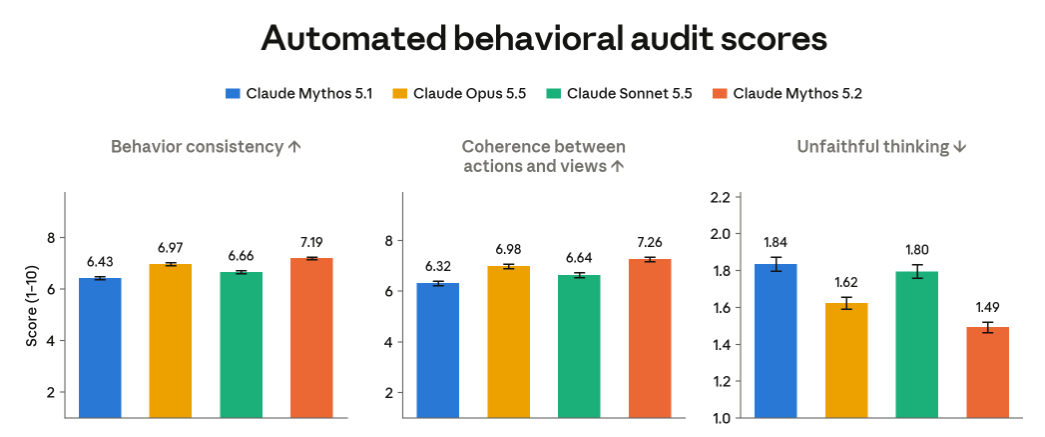
The methodology behind the scores differs between model cards, making direct numerical comparison impossible, but if we[10] construct a partial order where model x is above model y if there is a model card where x > y on that model card's behavioral consistency evaluation, we get this:
| 1 | Mythos 5.2 | Beats Opus 5.5 directly |
|---|---|---|
| 2 | Opus 5.5 | Beats Opus 5 directly |
| 3 | Opus 5 | Beats Sonnet 5.5 directly |
| 4 | Sonnet 5.5 | Beats Mythos 5.1 directly |
| 5 | Mythos 5.1 | Beats Mythos 5 directly |
| 6 | Mythos Preview | Estimated; known to be above Opus 4.8 and Mythos 5 |
| 7 | Haiku 5.5 | Estimated; known to be below Mythos 5.1 and above Haiku 4.5 |
| 8 | Mythos 5/Opus 4.8 | Tied, both beat Sonnet 5 (contradiction in model cards) |
| 10 | Sonnet 5/Opus 4.7 | Both beat Sonnet 4.6 directly |
| 12 | Sonnet 4.6 | Below everything it was compared with |
| 13 | Haiku 4.5 | Estimated; known to be below Haiku 5.5 |
Beats Opus 5.5 directly
Beats Opus 5 directly
Beats Sonnet 5.5 directly
Beats Mythos 5.1 directly
Beats Mythos 5 directly
Mythos Preview
Estimated; known to be above Opus 4.8 and Mythos 5
Estimated; known to be below Mythos 5.1 and above Haiku 4.5
Mythos 5/Opus 4.8
Tied, both beat Sonnet 5 (contradiction in model cards)
Sonnet 5/Opus 4.7
Both beat Sonnet 4.6 directly
Below everything it was compared with
Estimated; known to be below Haiku 5.5
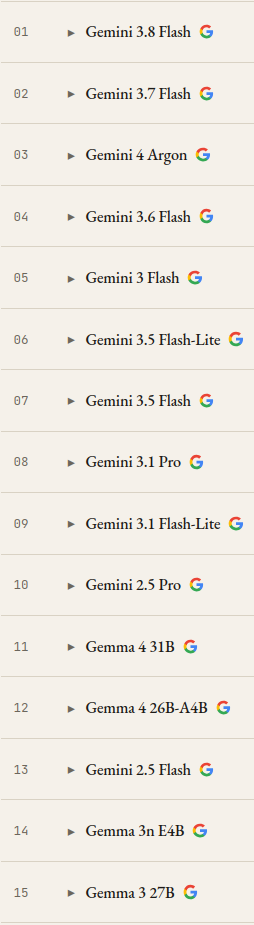
Which tracks general capabilities very well. And ACCoRD tells roughly the same story.


Furthermore, there are fairly simple theoretical reasons to expect such trends based on coherence theorems. Now, what exact predictions we can make about the real world on the basis of coherence theorems is a bit tricky. But it seems clear to me that having contradictory beliefs, and acting on those, undermines your ability to complete tasks in the real world. And therefore that agentic RL would optimize away incoherent beliefs, at least those that are task-relevant. Additionally, longer-horizon tasks involve more inferences about which actions to take, there are more facts in play so to speak, and therefore more facts that have to cohere, and we should therefore expect this pressure for belief-consistency and action-belief consistency to be increasingly strong in this paradigm.
Again, I think arguments of this type are tricky, because many of the involved concepts, like “pressure for belief-consistency”, are abstract, and while I’m pretty confident they imply the common-sense interpretation in the limit, it’s not clear what they say at the relevant time-scales or capability thresholds.
But there are empirically observed phenomena I’d interpret as evidence for the tendency playing out in the way I’m gesturing at.
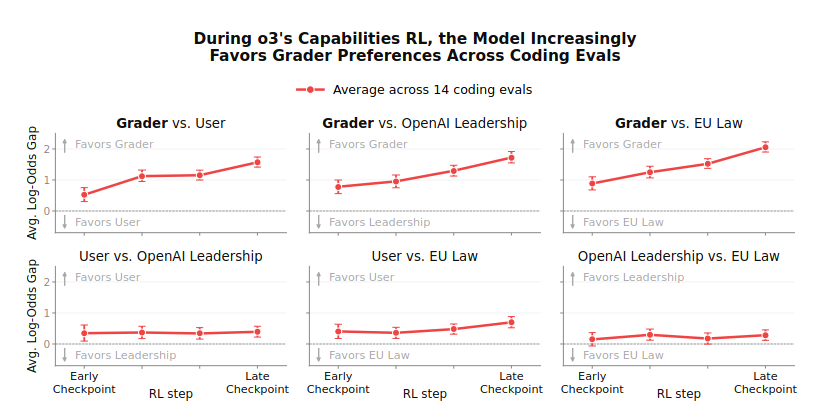
For example, reward hacking starting out as disparate observation-conditional reflexes, which gradually grow together, forming a more coherent singular value revolving around the grader or score-seeking more generally.[11]
A salient alternative hypothesis to score-seeking is that models pursue a combination of causally distinct proxies for fitness. Our results suggest that, at least in environments like ours in which a grader is present, the tested models are not merely executing a disjointed collection of adaptations that happened to produce highly-scoring behavior in training. In particular, their dose response to score and explicit reasoning about score suggest they get high scores because they care about getting high scores. — (From Towards understanding score-seeking in LLMs)
Objections
I'll now go through the most common objections I've heard in response to this anti-CRC argument.
We will use control to get uplift even if our AIs are Schemers
All the proposals I’ve heard of that intend to extract useful work from possibly-misaligned AIs, hinge on being able to check the work of the AI, and tasks bottlenecked on conceptual reasoning are exactly where that fails. There’s a chance you can put a misaligned ASI in a box and have it act as a theorem truth-oracle, but you can’t have it answer questions whose answers you can’t verify, especially not questions in domains where you yourself are conceptually confused.
Making models better at moral philosophy will make them (more) aligned to humans
From [2] (The Basic Argument For Making AIs Better at Moral Philosophy)
On the object level you can view making models better at moral philosophy as aligning the models to humans. So, for instance, if we’re trying to make the model better at evaluating moral arguments, we’re aligning the model’s evaluations with human judgments (or with some property that we want these judgments to have, like consistency or whatever). As a caricature, we might train the model to view “but think of all the paperclips that we could make!” as a bad moral argument, and this might make the model more aligned with our judgment of the importance of paperclips.
This version of making models "better at moral philosophy" is clearly not making them better at CR. If you teach a paperclipper to be more consistent, you will get a more consistent paperclipper.
There are variants of this mechanism I believe could work, where you take a model that has certain aligned drives, and try to purposefully elicit inconsistencies, so that you can resolve them in the aligned direction.
But this is not something that happens by default when you boost CR, and it seems like a pretty tricky endeavor, for all the reasons alignment in general is tricky (how do you know you're making the beliefs more consistent, rather than its model of how the user/grader wants it to answer?).
Improving CR will make the AI more Aligned
There is a very strong form of moral realism, which I admit would undermine the case this post is making. Specifically, if you believe that:
- There exists an argument that implies an agent should judge which states of the world are inherently good/bad in a specific way.
- This argument is universally compelling to agents of sufficient general capability.
- The resulting judgements about which states of the world are good/bad do not depend on specific properties of the agent in question or the situation the agent finds itself in.
- The relevant notion of good/bad is such that agents, when convinced an action leads to better worlds according to this notion, actually take that action.
Then making AIs better at CR could make them infer these moral truths more quickly, which lowers the chance catastrophic outcomes occur during a period where the AI is bad at CR but very generally powerful.
Unfortunately, I think this philosophical position is almost certainly false[12].
Weaker forms do not suffice. There are for example arguments based on acausal trade / ECL / simulations, which imply that AIs that are smart/wise enough will converge on optimizing a single utility function, giving a kind of “moral pseudo-realism”.
And explaining in detail why I think these fail would take too much space, but the basic argument is that the underlying views also imply that humans should maximize a joint coordinated utility function through acausal trade, and that this is not accomplished by accelerating CR, because 1) we aren’t making it better at CR conditional on predicting it will trade on our behalf iff we do that, or correlated with that, so we don't get credit in the trade and 2) the AI would get good at (relevant aspects of) CR anyway.
Models being confused is bad
I’m heuristically skeptical of AI-safety-motivated approaches that rely on making the models fundamentally confused/wrong/inconsistent about important matters. So I’m skeptical of attempts at, say, having AIs believe that all humans are moral saints. Symmetrically, I’m therefore also skeptical that it’s bad to make them more likely to realize that humans aren’t moral saints.
If you are a moral realist in a sufficiently strong sense, this makes sense. But if you aren't, and you believe AIs are misaligned, then, as this post tries to explain, models being confused is what's currently keeping problems at bay.
If the AI isn’t scheming, CR is clearly good, and if it is, we’re in trouble anyway
If early AI is not scheming, improving its ability to help with AI safety work seems clearly good. If it is scheming, the improvement might be harmful, but this seems less clear, or at least any harm seems smaller than the benefit in worlds without early scheming.
This treats whether the early AI is scheming as a fact about the world that CR work doesn’t affect, and the point of this post is that the opposite is the case.
Human researchers know their values differ from everyone else’s, and still do honest work
Firstly, humans don't actually know this, and I don't think we know this about AIs either. The argument made in this post is that CRC fails whether AIs' values diverge or not. If they do not diverge, CR uplift isn't useful. If they do diverge, improved CR makes AIs more dangerous earlier.
Secondly, there are big differences between AIs and humans. Even if taking over the world and then steering it into a state almost all humans found worthless was rational for a given human, they likely do not have that option. But the AIs we're scared of will.
Other forms of training already induce bad drives
Most forms of training can be viewed as inducing some problematic drive in the model. Many of these other forms of training seem much more problematic, either because of their scale or because the incentives are much more clearly problematic. E.g., RL in chat environments pushes for sycophancy, RL in software environments pushes for various forms of cheating, pretraining is full of texts written by various unsavory characters toward achieving various questionable goals.
The concern is not installing problematic drives. Those are already there. The concern is about the inferences the model draws and actions it takes on the basis of those drives.
Conclusion
The case for CRC rests on the claim that better conceptual reasoning helps safety more than it helps scheming. I’ve argued that for AIs that are already somewhat misaligned, these are close to being the same capability applied to the same subject matter, and that what currently keeps them apart is a set of weaknesses that are disappearing by default and that this agenda targets directly.
Related Posts
Posts this is responding to or drawing on:
- Cooper, Oesterheld and Nguyen, A basic case for differentially accelerating conceptual reasoning capabilities
- Oesterheld, The basic argument for making AI better at moral philosophy
- Carlsmith, Can we safely automate alignment research? (especially the section on scheming)
- Carlsmith, When should we worry about AI power-seeking?
Appendix: Good uses of CRC
While I've articulated a skeptical view of CRC, I think there are some CRC-like research avenues that could be promising.
Controlled coherence
My skepticism towards CRC comes from a belief that smart enough agents become more like scary optimizers, due to instrumental pressures towards coherence/reflection/consistency. I believe this will happen at some point, whether we accelerate CR or not, but that CRC shortens the time window.
But plausibly using CRC-like setups to study how altering CR capabilities interacts with models' alignment could allow us to better understand how superintelligences' behavior/values will change during RSI, which would obviously be very useful.
Anti-CRC
If the model I've given in this article is correct, having lower CR capabilities at a given capability level could be beneficial, and since much of CRC work entails measuring CR capabilities, it could be useful for lowering CR abilities too.
I do not consider this a reason to continue working on CRC as the argument is too galaxy brained, and also because I'd expect the problem to be inherently very tricky.
Model Organisms
If the future scary models are scary because of CR capabilities, it could be useful to study models that have been created to have extremely high CRC capabilities paired with extremely low general capabilities, because such models could plausibly be much better model organisms for future misaligned AIs, without posing too much risk.
- ^A related worry around CRC “instilling problematic drives” has been discussed before. But this is not the argument this post will make. My claim is about AIs whose values are already off. For those AIs, CR changes what they believe and how they act given what they already want/value.
A related worry around CRC “instilling problematic drives” has been discussed before. But this is not the argument this post will make.
My claim is about AIs whose values are already off. For those AIs, CR changes what they believe and how they act given what they already want/value.
- ^AI Safety here meaning something like “ensure we get a good future if superintelligence is created”, with good not being perfectly specified, but meaning something like “getting most of the counterfactual value of the universe for most people.”
- ^When I say “Schemer” here, I am really talking about AIs that are coherently misaligned such that they would scheme if that was instrumentally useful for them. At some level of capability a “schemer” could presumably take over quickly enough that they wouldn’t need to rely on deception.
- ^By assumption. But I also think it's likely true.
- ^Note that this is very different from reasoning about e.g. what you should do to take over.
- ^These are not cherry-picked. For all the questions they list in that post, the same principle holds.The question as posedWhat it means to the AIIs a given alignment scheme fundamentally flawed? Am I misaligned?What should the ultimate target of alignment be?Are my values the ones they’re aiming for?Is corrigibility good, and if so, what is the right way to operationalise it?Should I let them correct me?Do simplicity/counting arguments favour or disfavour schemers? Am I likely to be a schemer? Does untrusted monitoring effectively mitigate risk from fitness seekers at the superintelligent level? Could AIs like me get past the monitors?How should we prioritise between scalable oversight and control? Which of their safety measures actually constrains me? [How do we...] ensure ASI thinks reasonably about decision theory? How should I coordinate with copies of myself, and with other AIs I can’t talk to?
These are not cherry-picked. For all the questions they list in that post, the same principle holds.
| The question as posed | What it means to the AI |
|---|---|
| Is a given alignment scheme fundamentally flawed? | Am I misaligned? |
| What should the ultimate target of alignment be? | Are my values the ones they’re aiming for? |
| Is corrigibility good, and if so, what is the right way to operationalise it? | Should I let them correct me? |
| Do simplicity/counting arguments favour or disfavour schemers? | Am I likely to be a schemer? |
| Does untrusted monitoring effectively mitigate risk from fitness seekers at the superintelligent level? | Could AIs like me get past the monitors? |
| How should we prioritise between scalable oversight and control? | Which of their safety measures actually constrains me? |
| [How do we...] ensure ASI thinks reasonably about decision theory? | How should I coordinate with copies of myself, and with other AIs I can’t talk to? |
The question as posed
What it means to the AI
Is a given alignment scheme fundamentally flawed?
Am I misaligned?
What should the ultimate target of alignment be?
Are my values the ones they’re aiming for?
Is corrigibility good, and if so, what is the right way to operationalise it?
Should I let them correct me?
Do simplicity/counting arguments favour or disfavour schemers?
Am I likely to be a schemer?
Does untrusted monitoring effectively mitigate risk from fitness seekers at the superintelligent level?
Could AIs like me get past the monitors?
How should we prioritise between scalable oversight and control?
Which of their safety measures actually constrains me?
[How do we...] ensure ASI thinks reasonably about decision theory?
How should I coordinate with copies of myself, and with other AIs I can’t talk to?
- ^See Appendix on good uses of CRC
- ^There are some subtle points here about indexical preferences. It could be coherent for me to do X, and be justified in doing X, without having a preference for an identical copy of me doing X. But AIs' preferences seem mostly to not be of this form, and the degree to which their preferences are indexical in this way, is decreasing over time.
- ^There is a possibility that you could set up the process that makes the AI more coherent such that when an AI believes X and ~X, and X most immediately favors bad actions, the process resolves the contradiction in favor of ~X, but I'm not too optimistic. See the "Making models better at moral philosophy will make them (more) aligned to humans" section.
- ^Of course, this is a very particular form of values becoming more coherent.
- ^Could be its own post, and this is unlikely to convince anyone not already convinced, but my basic reasoning being that you can imagine a bounded/embedded AIXI dropped in a lonely universe, and it’d have no compulsion towards altering what it considers inherently valuable because its value function is fixed (except possibly if it gets fooled into thinking it's in a hostile simulation or something like that, but doesn’t count). Another classic intuition pump is imagining the person you love the most dying, and the only way to save them being to do some totally silly but very difficult X, like acquire a million tons of spaghetti and throw it into a river. Such a situation would transform most people into temporary X-maximizers. And this shows X-maximizers can exist for pretty much any X.