 AIFeed
Article title: 439,900 yuan, only one configuration, Voyah Taishan pure electric version brings tri-chamber air suspension | Guangzhou Auto Show
Body:
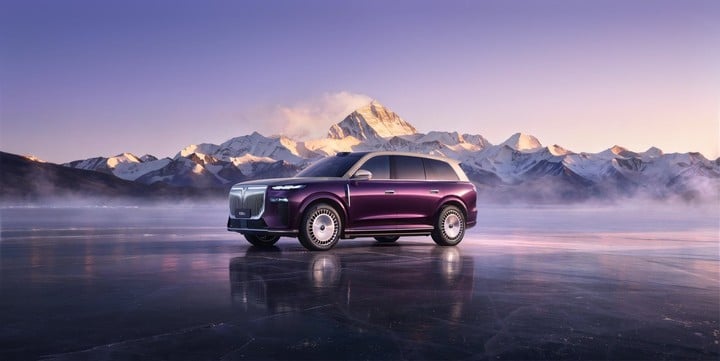
439,900 yuan, only one configuration, Voyah Taishan pure electric version brings tri-chamber air suspension | Guangzhou Auto Show
2026-11-27 20:11
On the first day of the Guangzhou Auto Show, the 2027 Voyah Taishan officially opened global pre-sales, with an official pre-sale price of 439,900 yuan.
Yes, this car has only one configuration version, and is expected to officially launch and begin deliveries in early December.
Previously, the 2026 Voyah Taishan was mainly positioned as a 1.5T plug-in hybrid four-wheel-drive model, priced between 379,900 and 509,900 yuan, with 4 models available. The 2027 model unveiled today completes the Taishan lineup with a pure electric version.
The self-cultivation of a big car
When it comes to full-size pure electric SUVs, due to objective factors such as body dimensions and curb weight, buyers are most worried about nothing more than two things: not going far enough and not being easy to drive. Voyah's answer is only one: pile on as much hardware as possible.
The 2027 Voyah Taishan is built on a full-domain 800V silicon carbide high-voltage platform, equipped with a 119.6kWh CATL ternary lithium battery, with CLTC pure electric range reaching 705km.
The officially announced maximum ultra-fast charging current is about 560A. The company claims that within the high-power ultra-fast charging range it can add 568km of range, about 80% of the vehicle's CLTC range, minimizing waiting time at service areas during long intercity trips.
In terms of power, the Taishan adopts a dual-motor four-wheel-drive system, with a front motor maximum power of 175kW and a rear motor of 300kW, for a combined maximum power of 475kW and total torque of 765N·m.
But compared with power, Voyah prefers to emphasize smoothness and quietness. The company says that after triple noise-reduction optimization covering transmission, vibration and electromagnetic sources, the vehicle's interior electric drive noise is controlled within 62dB during 120km/h high-speed cruising.
Having solved the issue of going far, Voyah also needs to solve the problem of being hard to drive.
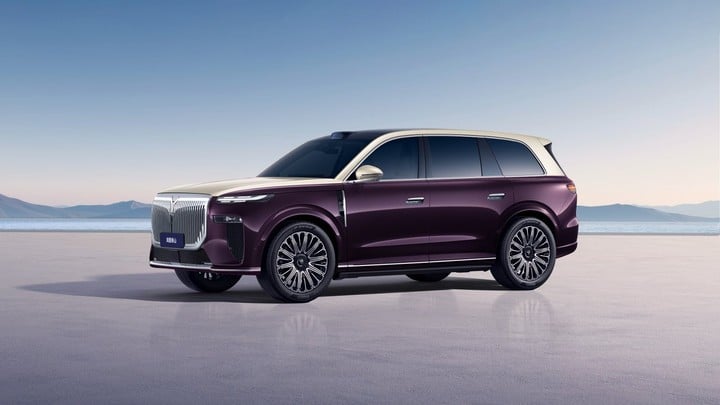
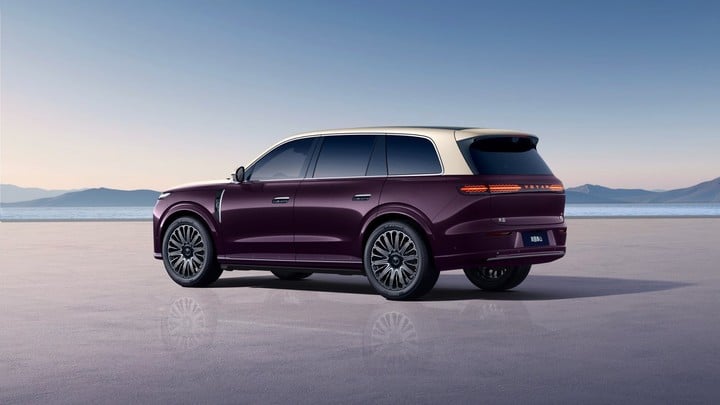
The 2027 Voyah Taishan measures 5230/2025/1817mm in length, width and height, with a wheelbase of 3120mm, making it an absolute big car.
To handle the vehicle weight, Voyah equipped the Taishan with a full-aluminum aviation-grade chassis officially called "Huju Chassis A," adopting a front double-wishbone plus rear five-link structure, paired with torque vectoring intelligent four-wheel drive and Bosch's new-generation IPB 2.0 brake-by-wire system.
The more core configuration is the tri-chamber air suspension on the Taishan, which is also the first mass-produced tri-chamber air suspension from a Chinese brand. Combined with the EDC magic carpet function, through 2 stiffness valves controlling 3 working air chambers, the Taishan can achieve 5 levels of height and 4 levels of stiffness switching, covering 7 driving modes.
Tri-chamber air suspension used to appear on million-yuan imported luxury flagships such as the Porsche Cayenne Turbo GT and Bentley Bentayga. Its value lies in stretching the span of soft and hard support wide enough to separately address vibration filtering and support requirements. According to Voyah, with magic carpet preview coordination, the Taishan can reduce brake pitch by 35% and cornering roll by 20%.
As for the awkwardness of U-turns and maneuvering on narrow roads in a big car, the Taishan relies on rear-wheel active steering with up to 16° in both directions.
Traditional luxury big cars usually have rear-wheel steering angles between 7° and 10°. After pushing the steering angle to 16° in both directions, the Taishan compresses its turning radius to 5.4m, basically equivalent to the U-turn level of a compact sedan, while also supporting a crab-walk mode for low-speed diagonal entry and exit.
It is not hard to see that Voyah Taishan's approach to solving the problems of big cars is very "simple and crude": use better hardware to improve the overall experience.
A big car empowered by Huawei
As for the intelligent level, Voyah Taishan this time has basically entrusted itself to Huawei.
The 2027 Voyah Taishan uses Huawei Qiankun ADS 5, and in terms of hardware is equipped with what is currently the top-tier four-lidar solution in the Huawei ecosystem.
Among the vehicle's 34 smart sensors are 1 896-line dual-optical-path image-grade main lidar and 3 DTOF short-range solid-state lidars, complemented by 5 millimeter-wave radars and other perception units.
This system gets rid of reliance on high-precision maps and supports parking-space-to-parking-space 3.0 nationwide full-scenario connectivity, automatic reversing and yielding when meeting vehicles on narrow roads, NCA activation on unstructured roads, and RCA roaming cruise assistance.
The active safety part is equipped with the CAS 5.0 six-dimensional all-time-domain safety system, covering functions such as 1–150km/h forward AEB, eAES 3.0 active lane-change avoidance, prevention of mistaken steering wheel input, and driver incapacitation assistance.
From the perspective of daily driving, the extra short-range solid-state blind-spot-filling lidars mainly serve complex urban road traversal. When meeting vehicles in narrow alleys, turning around pillars in underground garages, or dealing with sudden pedestrian cut-ins, there are fewer blind spots around the body, so the mental tension of driving a big car is less obvious.
Beyond intelligent driving, the cabin also uses HarmonyOS Cockpit 6, equipped with the MoLA 2.0 hundred-billion-parameter large model architecture and the Xiaoyi intelligent agent.
This interaction system focuses on wake-free direct access to cross-domain tasks such as navigation, vehicle control, and audio-visual entertainment, while also supporting mixed recognition of 10 dialects without setup, so family members with different accents can directly control the car inside.
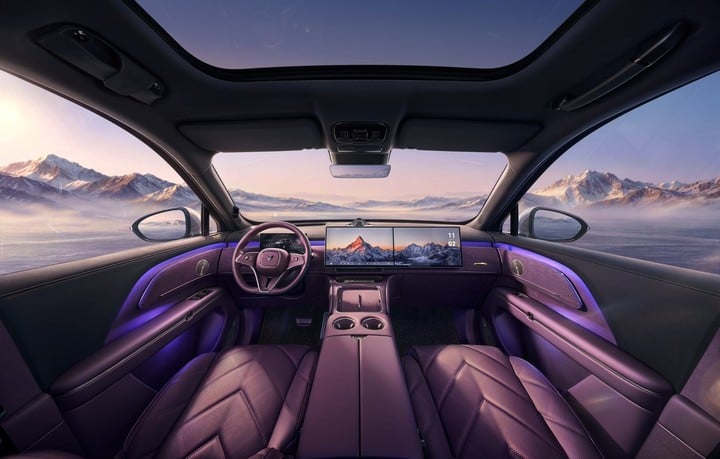
In the front row, the Taishan is equipped with a 55-inch AR-HUD, a 10.25-inch LCD instrument panel, and dual 15.6-inch 2.5K Huawei smart dual screens, supporting three-finger screen transfer and NFC one-touch transfer.
In the rear row there is a 21.4-inch 3K entertainment ceiling screen, and both sides of the second row are independently equipped with 3.5-inch ultra-thin armrest screens, so rear passengers can adjust seats and audio-visual settings separately without leaning forward or shouting voice commands.
In terms of intelligence, what the Taishan offers is an aggregation of current Huawei ecosystem solutions. Not only that, the Taishan is also equipped with Huawei XPIXEL smart projection headlights with 1.3 million pixels.
While driving, they can link with the perception system to project lane-change guidance light carpets, narrow-road width indication light carpets, or pedestrian-yielding prompts on the ground. When parked for camping, they can directly project open-air blockbuster movies and KTV lyrics, with plans to add holiday welcome easter eggs and exterior projection preview functions via OTA later.
An SUV version of the Voyah Dreamer
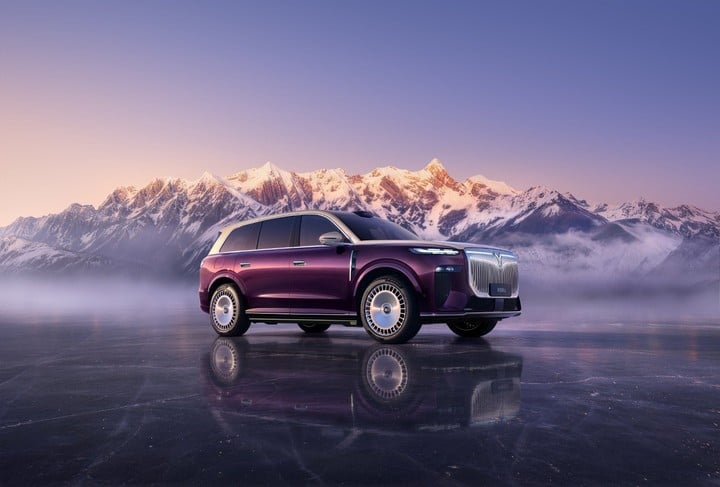
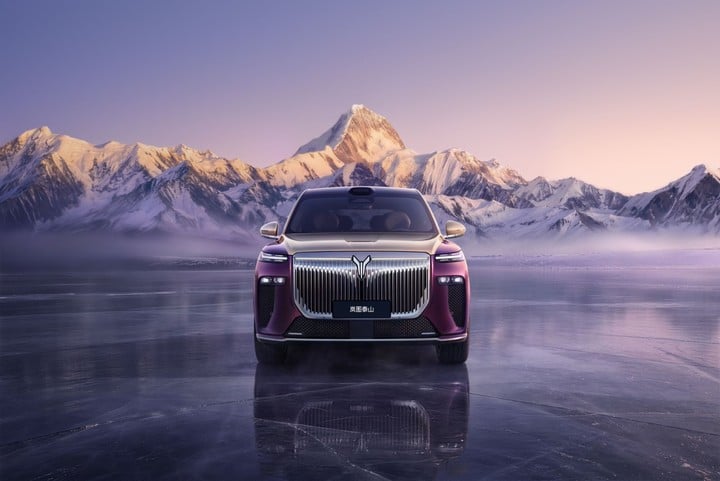
In terms of exterior, the Voyah Taishan follows a square and wide-body route, and the front face's light waterfall grille design is similar in spirit to the company's MPV Dreamer.
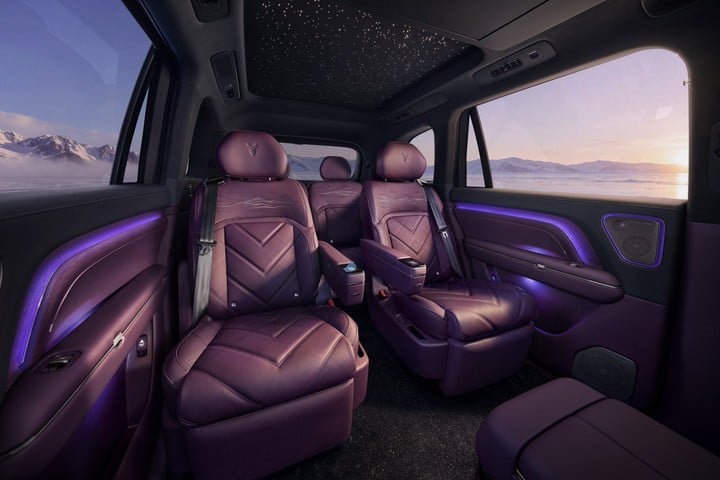
Inside the car, Voyah, having built the Dreamer, has also carried the rear-row thinking of its flagship MPV into the Taishan.
The Taishan's overall room-utilization rate reaches 86.8%. In addition to ensuring legroom for third-row passengers and 175mm third-row electric adjustment, it also leaves a 108L electric front trunk and a rear trunk expandable to a maximum of 1268L, solving luggage anxiety when six people are fully loaded.
The second-row seats are equipped with a side-sliding system, supporting 170mm inward lateral movement and 160mm rearward movement.
For business receptions or two-person long-distance travel, sliding the second row toward the center and rear turns the whole vehicle into an independent large four-seat layout without disturbing each other. The front seatbacks can also fold flat and connect with the second row into a fully flat bed.
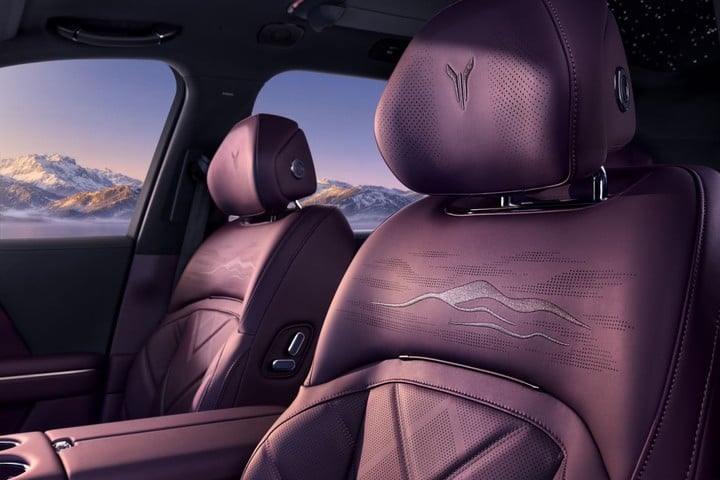
The zero-gravity seat on the right side of the second row packs 66 high-precision sensors, supports 22-way electric adjustment and 26-point massage, and can actively inflate the side bolsters at a speed of 0.8 seconds during cornering to provide extra support for the body.
The windows are equipped with 4.96mm thickened sound-insulating laminated glass and RNC road-noise active cancellation technology, and the rear windows support 10-level stepless intelligent dimming. Voyah officially states that in privacy mode, the light transmittance of the rear windows is below 1%.
Like most full-size flagship SUVs, the Taishan's doors also adopt smart sensor electric doors with active anti-collision.
In terms of safety, the Taishan's body uses 78% high-strength steel and aluminum alloy, together with 9 airbags throughout the vehicle including 60L side curtains covering all three rows and maintaining pressure for 6 seconds. The company claims it can withstand a 110km/h high-speed rear-end collision with zero intrusion into the third row.
The previous 2026 Voyah Taishan plug-in hybrid version indeed had a considerable span in configurations, but it also paved the way for Voyah to some extent and tested consumers' sensitivity to different configurations. The 2027 pure electric version opening pre-sales today directly lays out all configurations with a single fully loaded model at 439,900 yuan.
But when it officially launches in early December, Voyah will still need to show enough sincerity on price to give consumers one more reason to buy it.