 AIFeed
Robotaxi to Launch Driverless Operations, Robot Delivers Speech Without Script, XPeng Tech Day Ushers in Its Own "Singularity Moment"
2026-11-26 10:25
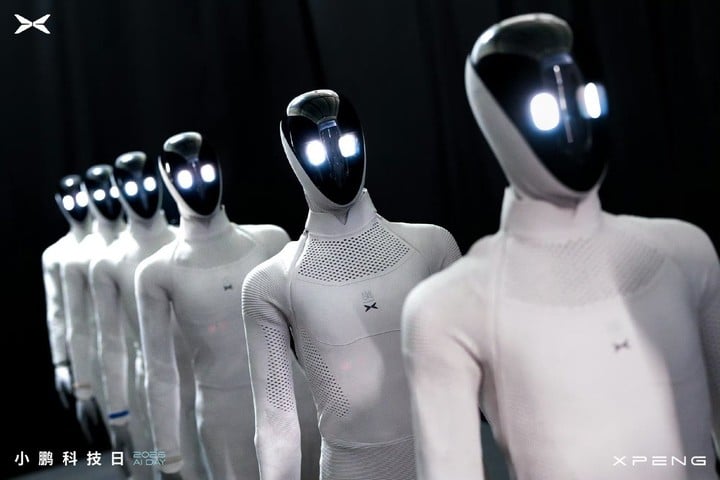
Time flies—before we know it, it's XPeng Tech Day again, and once again time for the humanoid robot IRON to take the stage.
Last year on the same stage, IRON stunned the audience with a highly humanlike catwalk, but amid controversy, XPeng ultimately had to cut open its skin to prove there was no real person hidden inside.
This year, IRON is still impressive, but it no longer needs to cut open its skin to prove itself.
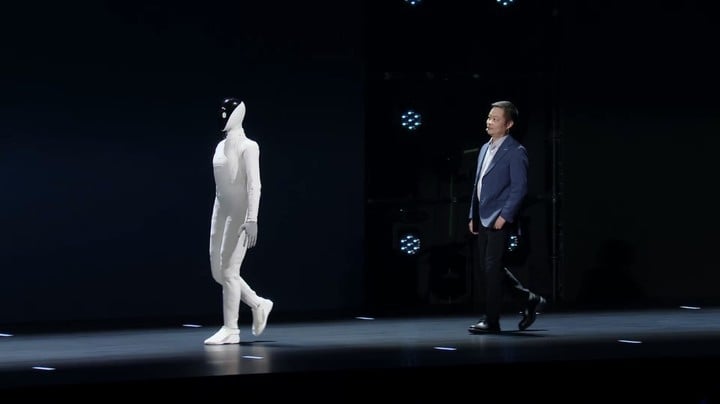
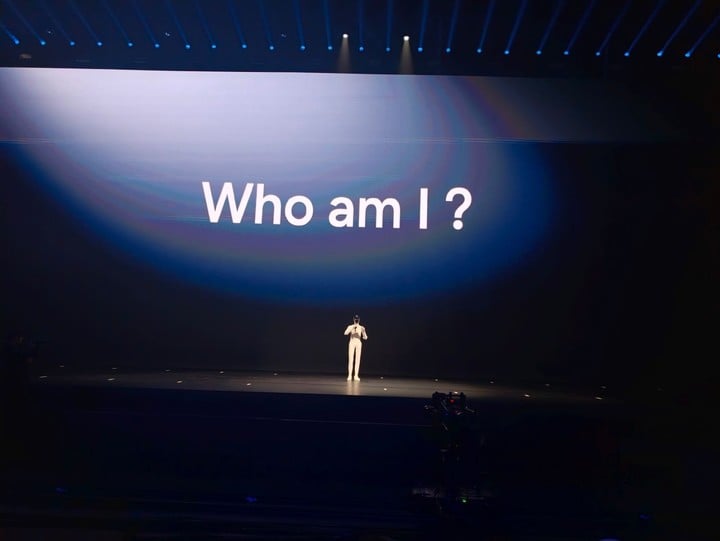
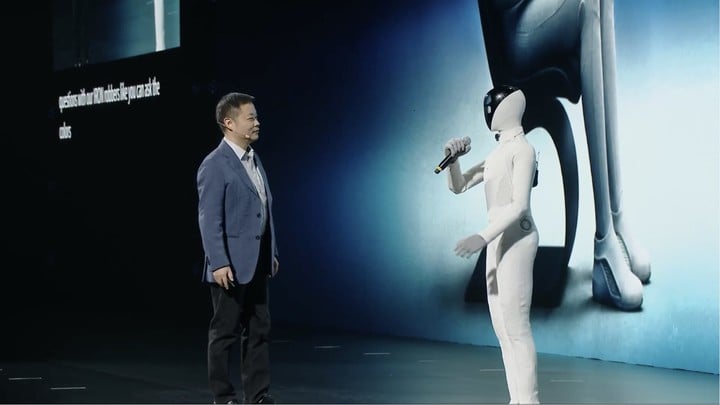
At XPeng Tech Day 2026, the humanoid robot IRON was again the showstopper. This time IRON had no manual remote control throughout—it walked onto the stage on its own and delivered a speech in both Chinese and English without a script. Although the large model behind IRON still showed a somewhat flustered tendency to "talk over" when facing questions, this further proved that IRON's appearance was not a pre-arranged program.
Although no new car was launched, this XPeng Tech Day was packed with information. But to sum it up, there was only one core thread: after the second-generation VLA was proven out, XPeng's intelligent driving capabilities are spilling over outward.
XPeng's "Cybercab Moment"
XPeng has recently emphasized its "Paris moment" in Europe multiple times.
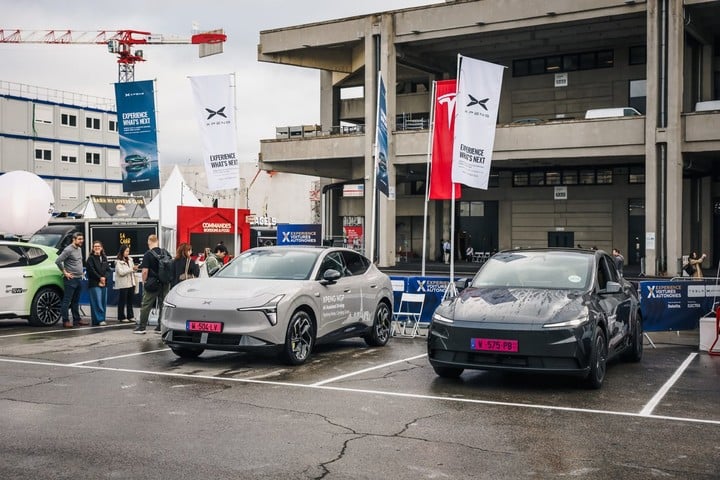
Since July this year, XPeng NGP equipped with the second-generation VLA has successively completed localized generalization testing in Germany, the Netherlands, and France. In November, XPeng opened public test rides of urban high-level intelligent driving at its Paris store, becoming the first Chinese automaker to open this experience in Europe, with the goal of starting the first global deliveries in the first half of 2027.
At the Paris Motor Show, the show organizers arranged a public street intelligent driving experience event, requiring vehicles to drive directly on complex streets in downtown Paris and around the Eiffel Tower. In the end, only XPeng and Tesla actually took to the road for testing.
At today's Tech Day, XPeng pushed the same technology base to a higher level of L4 autonomous driving—XPeng's Robotaxi.
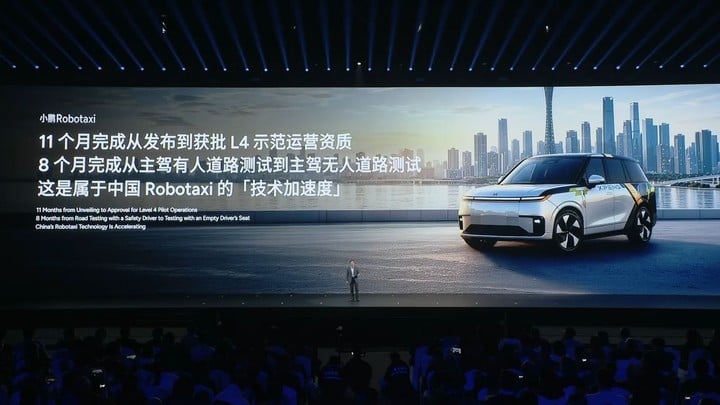
XPeng Robotaxi went from testing with a person in the driver's seat to testing with no one in the driver's seat in just 8 months, and from business launch to obtaining L4 demonstration operation qualification in just 11 months. Currently, XPeng has begun driverless passenger experience, and plans to launch driverless demonstration operations in some areas by the end of 2026.
Yes, it is now broadly the end of 2026, which means we will soon see XPeng's driverless passenger vehicles on the road.
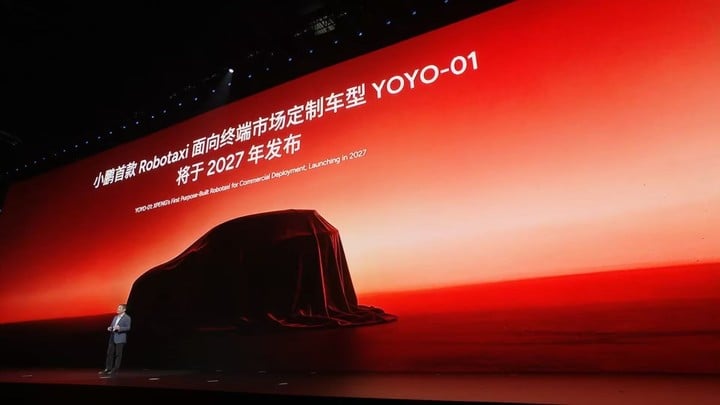
More importantly, XPeng is no longer just modifying existing production cars for testing. Its first customized model for the end market, YOYO-01, is planned for release in 2027.
On the commercial path, XPeng positions itself as a technology service provider, offering global mobility platforms a "ready-to-deploy" vehicle platform and autonomous driving capabilities, with operations left to local partners.
This could change the cost logic of the L4 industry in mainland China. For years, whether it was Waymo abroad or a host of traditional L4 companies domestically, to cushion the extremely low fault tolerance, they stacked large numbers of expensive sensors around the vehicle body and made autonomous driving work through heavy-asset modification. It is technically feasible, but per-vehicle hardware costs are high, production line modification is slow, and commercial scaling is not easy.
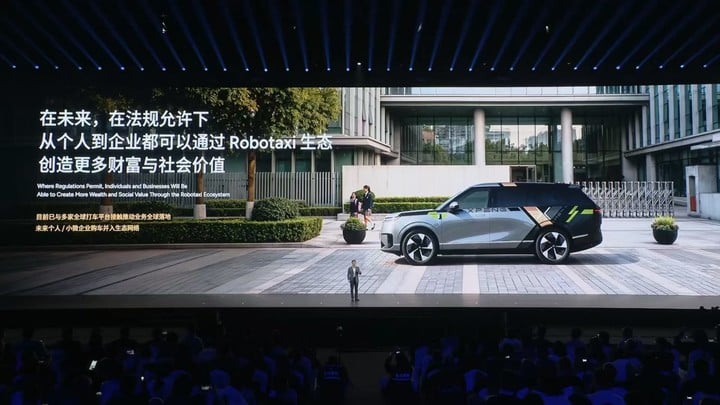
XPeng, by contrast, did not start from scratch and stack expensive sensors. Instead, it used regular automotive-grade cars built for L2 and the same underlying base, crossing directly into L4 demonstration operations in 11 months.
If automotive-grade mass-produced cars can achieve L4, then those L4 companies that built barriers on heavy hardware solutions will face a direct impact on their original cost models and business prospects.
Overseas, this is Tesla Robotaxi's playbook. Perhaps we can say this will be XPeng's "Cybercab moment."
While pushing capabilities upward, XPeng will also launch subscription-based charging for high-level assisted driving.
According to official disclosure, in the first month of the second-generation VLA's official rollout, the proportion of assisted driving mileage already exceeded 50%. Based on this usage stickiness, XPeng announced that Turing AI intelligent driving plans to launch subscription service for new car buyers globally starting from the second quarter of 2027, and the intelligent driving rights of users who place orders before the service starts will remain unchanged for life.
As for owners of the dual Orin-X platform, starting in December this year they will successively receive the first rollout of the distilled version of the second-generation VLA, with the remaining dual Orin-X models covered in the first quarter of 2027.
VLA Human-Machine Co-Driving Is Novel, but Likely Won't Get Its Own "Moment"
If Robotaxi is intelligent driving capability spilling upward, another high-profile release at Tech Day—"Turing AI Co-Driving"—is capability spilling downward into the human-driving domain after becoming abundant.
Relying on the fully self-developed X-VMC 2.0, XPeng pushed vehicle control from the motion domain to whole-vehicle domain fusion, launching the industry-first "Turing AI Co-Driving" (VLA human-driving version).
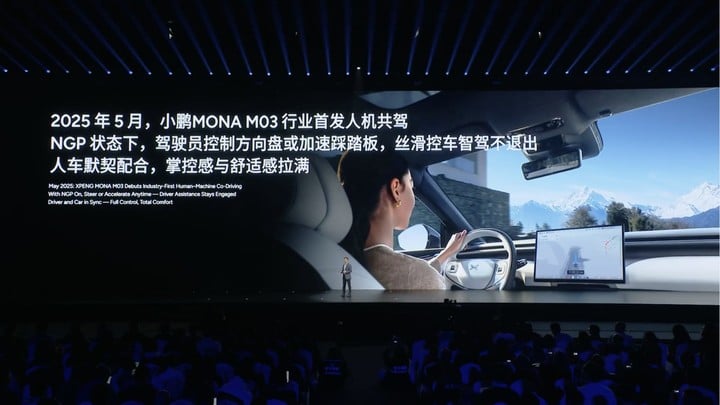
Unlike the past logic of "intelligent driving exits, human takes over," this time intelligent driving is online throughout while the person is driving, assisting acceleration, braking, and steering in real time.
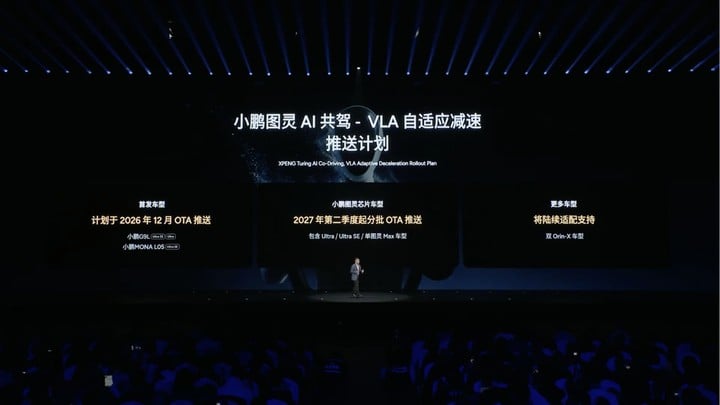
Its first implemented feature is called "VLA Adaptive Deceleration." You hold the steering wheel and drive yourself, and the system intelligently adjusts energy recovery and deceleration strength based on road conditions ahead, reducing the motion sickness caused by frequent hard braking. Official data shows that in congested road conditions, brake pedal intervention can be reduced by 95%, and real urban commuting range increases by 12.4%.
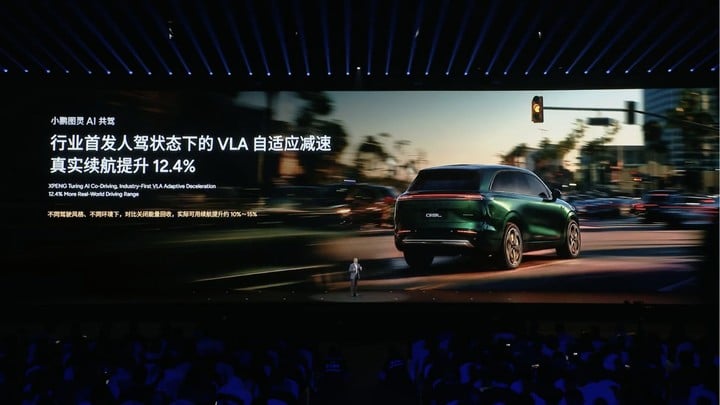
The feature is planned to be rolled out via the first OTA with G9L and MONA L05 in December 2026, cover other Turing chip models in the second quarter of 2027, and dual Orin-X Max models are also being continuously adapted.
Frankly speaking, this idea is fresh enough, and when following traffic during evening rush hour, your right foot really can save quite a bit of effort.
But on calm reflection, the long-term independent significance of "human-machine co-driving" may not be that great. In cars with sufficiently excellent intelligent driving capability, users' driving choices are actually quite pure: either enjoy the pleasure of complete control of the vehicle yourself, or hand the steering wheel, accelerator, and brake entirely to the system.
The intermediate state of "you control the steering wheel, the system helps you press the accelerator and brake" is indeed quite novel from the perspective of technological innovation, but once the novelty wears off, users will soon discover the logical awkwardness: since the system is already smart enough to control acceleration and deceleration more smoothly than I can, why not just hand it all over?
Several other updates across the vehicle also confirm the same spillover effect.
On safety, XPeng launched AEX 360° omnidirectional active hazard avoidance technology, extending protection from forward to all directions, able to identify standing water, snow, and potholes and actively steer around them.
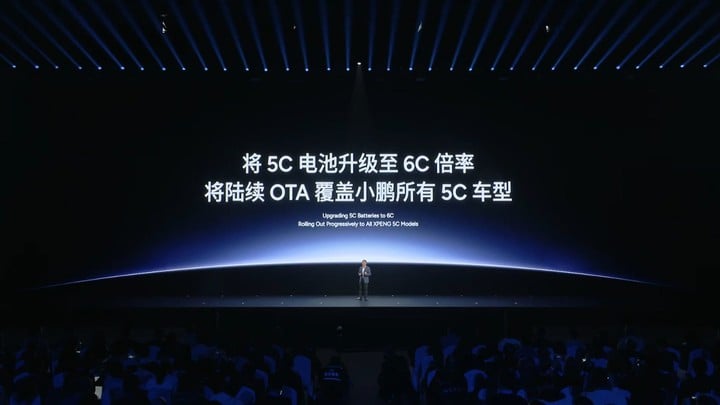
What existing owners will notice even more is charging. XPeng achieved the industry's first OTA improvement of charging rate. With hardware completely unchanged, using AI big data to optimize charging strategy, it directly upgraded 5C ultra-fast charging to 6C rate, needing only 10.7 minutes to charge from 10% to 80%. This improvement will successively cover all 5C models, with both lithium iron phosphate and ternary lithium supported.
XPeng's "DGX Moment"
After talking about cars, let's return to IRON on stage.
This time XPeng released the "Turing Embodied Intelligence Architecture" (VLA 3.0), connecting the "brain" System 2 responsible for reasoning, the "cerebellum" System 1 responsible for motion, the "ultra-fast system" System 0 responsible for instinct, and the hardware body. There is no need to dig deep into the concept; the core is just one sentence: AI cars and humanoid robots share the same foundation of computing power, control, data, and safety.
In other words, IRON is likewise a product of XPeng's intelligent driving and physical AI capabilities spilling outside the car.
XPeng did not spend a lot of time boasting about how much weight it can carry or how many somersaults it can do, but instead put much of its focus on posture, temperature, and interactive affinity. It is not hard to see that in XPeng's eyes, IRON is a robot meant to enter millions of households, positioned as a high-level general-purpose "work partner" for ordinary people's daily spaces, real services, and home life scenarios.
According to the plan, IRON will enter the hardware mass production stage in January 2027, first intern at XPeng stores as a shopping guide in the first quarter, and officially launch externally in the second quarter.
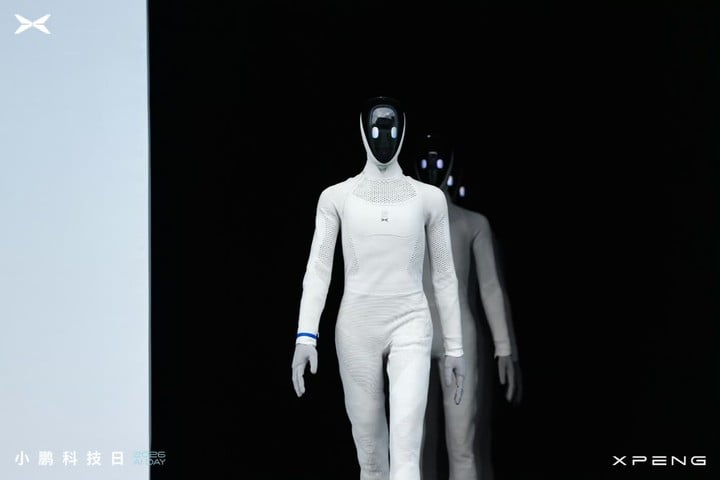
Centered on "Aliveness," IRON is 170 centimeters tall and weighs 62 kilograms, uses a new generation of bionic skin and flexible muscles, and even controls the temperature of its whole body and both hands between 25°C and 40°C to avoid the cold feeling of human-machine contact. Its walking sound is below 52 decibels, and 9 degrees of freedom in the waist and hips make turning and the sequence of sitting down closer to those of a real person.
Article title: Robotaxi Is About to Begin Driverless Operations, Robots Give Unscripted Speeches — XPeng Tech Day Ushers In Its Own "Singularity Moment"
Body: What is somewhat intriguing, however, is that on site, when He Xiaopeng earnestly spoke on stage about the warmth, sense of life, and interaction of robots, many in the audience were not actually all that focused. When a car company as people remember it starts talking about robots, quite a few people more or less only half understood.
This scene brings to mind a story Jensen Huang has repeatedly told on podcasts.
At the 2016 GTC conference, Jensen Huang unveiled the world's first AI supercomputer purpose-built for deep learning, the NVIDIA DGX-1, priced at $129,000. Jensen Huang said he spoke with great passion on stage, but the audience was dead silent. No one understood what the machine was for, and at first there wasn't even a single order, until Musk helped OpenAI buy the first one. In August 2016, Jensen Huang personally drove the world's first DGX-1 to OpenAI's office in San Francisco.
Looking back a few years later, that DGX-1, launched to a cold reception, was precisely the starting point of the entire AI wave.
Perhaps this moment is just like that moment: everyone is used to measuring XPeng by the coordinate system of a new-force carmaker, and for a robot that won't even start interning in stores until next year, people have yet to find an anchor point.
But taking a longer view, when XPeng's underlying capabilities simultaneously spill over into L4, human-driven whole vehicles, and humanoid robots, it is no longer just a car company. Looking back years from now, today's Tech Day may well be XPeng's "DGX moment" of turning toward becoming a robotics and physical AI company.