 AIFeed
Article title: Why ChatGPT's upcoming major update has longtime users up in arms
Body:
Why ChatGPT's upcoming major update has longtime users up in arms
2026-11-26 17:51
ChatGPT really is turning into WorkGPT.
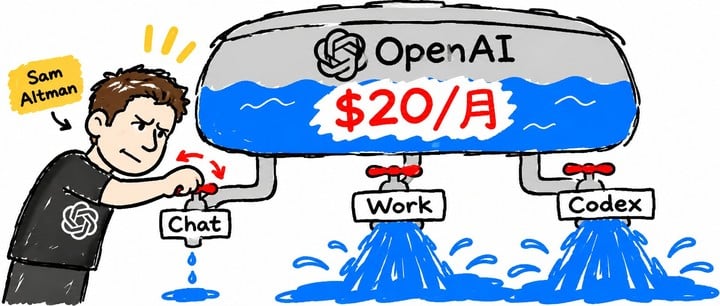
Yesterday, OpenAI announced it had begun rolling out a merged Chat and Work experience to some ChatGPT Pro users, sparking discontent among many paying users, with some even threatening to cancel their subscriptions.

According to OpenAI's official documentation, starting this December, Plus, Pro, and Business users will share a single usage allowance across advanced reasoning conversations, Work agent tasks, and Codex coding tasks; only the Instant chat mode is unaffected.
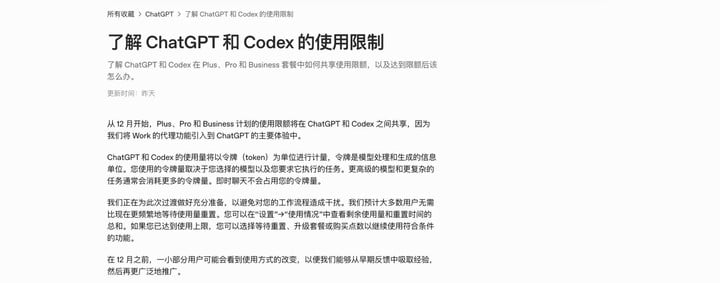
According to OpenAI, some heavy users may hit their usage limits sooner. The membership fee hasn't gone up by a cent, but advanced reasoning, coding, and Agent tasks are now competing for the same pool of compute.
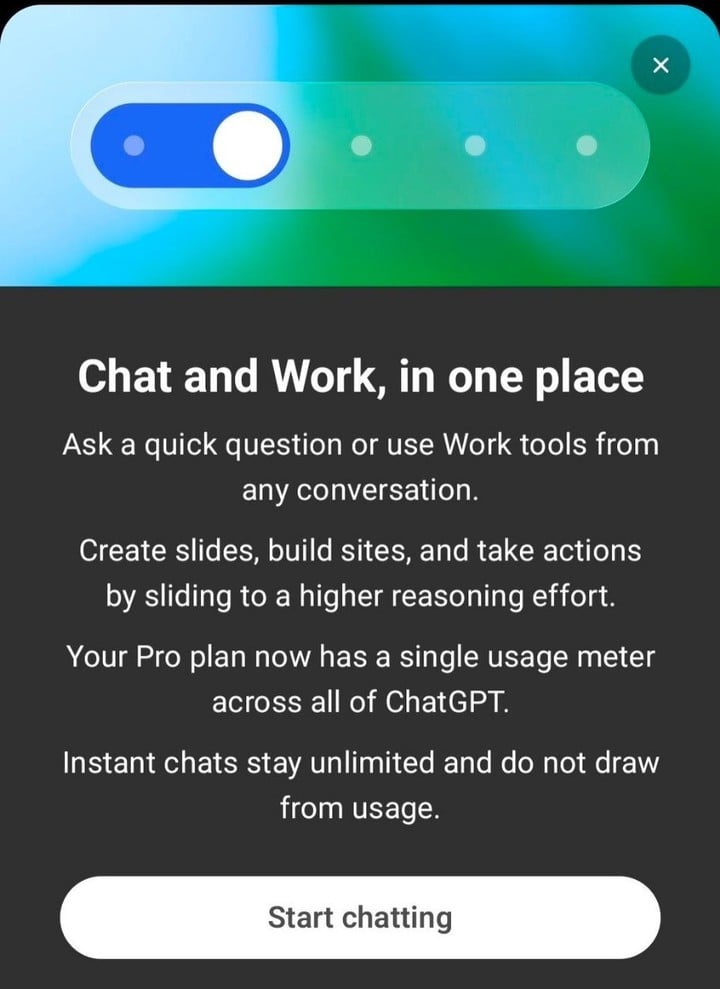
Chat and Work merge, but what users really care about is Tokens
From a product design standpoint, the merger of Chat and Work is not hard to understand.
As AI Agent capabilities grow stronger, the line between everyday chatting and work tasks is blurring. A user might finish discussing travel plans with ChatGPT and immediately want it to look up flights and organize an itinerary, or after discussing a technical approach, ask Codex directly to write the code.
Back in September, Anthropic had already integrated Claude's chat service and its work-oriented Cowork into a single interface.
Tech blogger Peter Yang also said on X that he was surprised so many people opposed the merger; in his view, there was never any need to separate the two in the first place. OpenClaw founder Peter Steinberger's reply hit the nail on the head.
"In the end, it's still about Tokens."
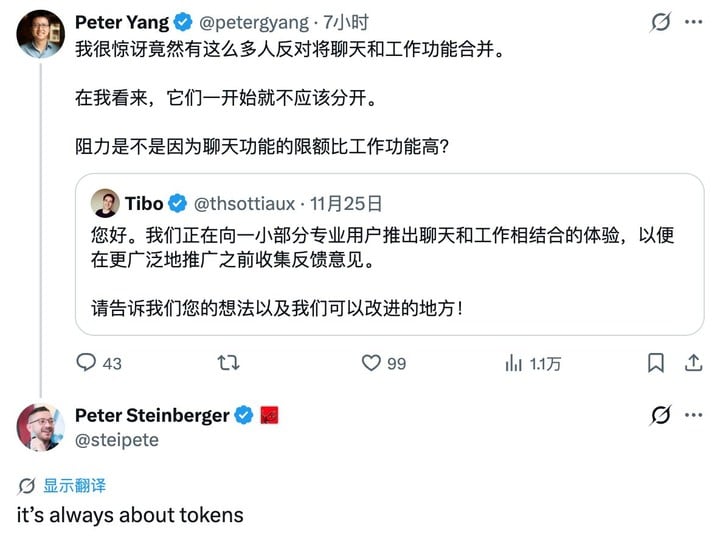
Previously, ChatGPT's advanced reasoning conversations had a usage allowance separate from Work and Codex. Developers could discuss technical approaches with ChatGPT, then have Codex carry out coding tasks; even after the coding allowance ran out, they could still return to ChatGPT to analyze code and troubleshoot issues.
But starting in December, all of these operations will draw from the same allowance.
Under OpenAI's new rules, usage will be measured on a Token basis; the more advanced the model chosen and the more complex the task, the more allowance is typically consumed. Once the allowance runs out, users can wait for a reset, upgrade their membership, or purchase additional Credits.
OpenAI says it expects most users will not hit usage limits more often than they do now, and that it will continue to improve model efficiency.

However, in the Codex community on Reddit, a post opposing the merger has already drawn more than 300 comments. One user said the main reason they kept their ChatGPT subscription was that even when Codex's allowance was down to just 1%, they could still keep using Chat.

Another user who had paid for more than two consecutive years and used ChatGPT up to eight hours a day said they had already bought a Google AI membership and would cancel their subscription once the new policy rolled out to their account.

On OpenAI's official developer forum, a Plus user who has long used ChatGPT to write novels even said they would be willing to pay more to keep the original chat experience, but could not accept the changes brought by unified allowances and automatic task routing.
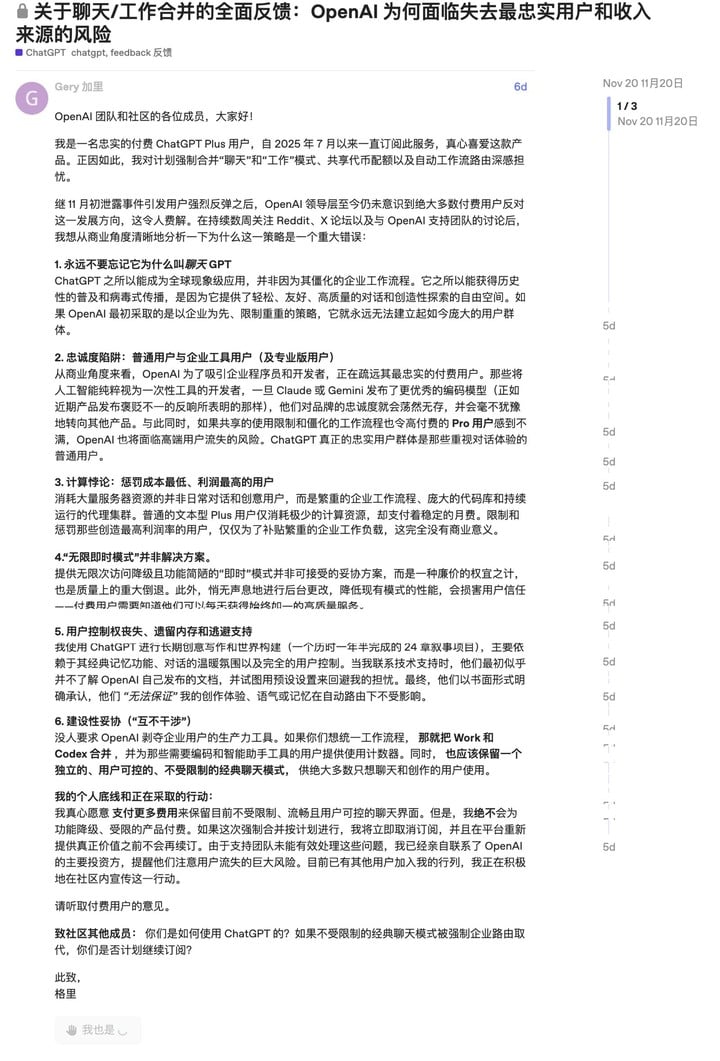
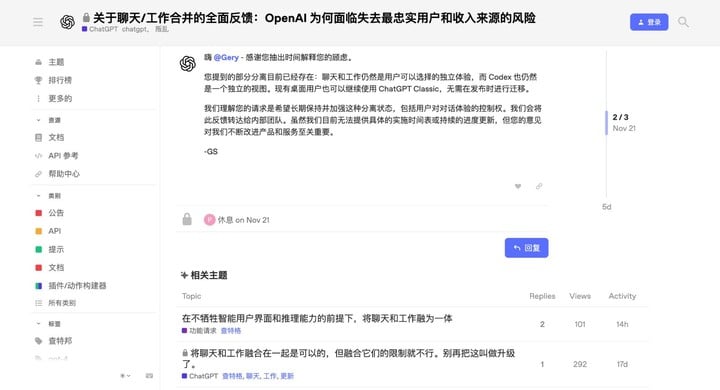
In response, OpenAI's official customer service said the existing desktop app still offers entry points for choosing Chat and Work, Codex retains its separate view, and existing users can continue using ChatGPT Classic in the initial rollout period without being forced to migrate.
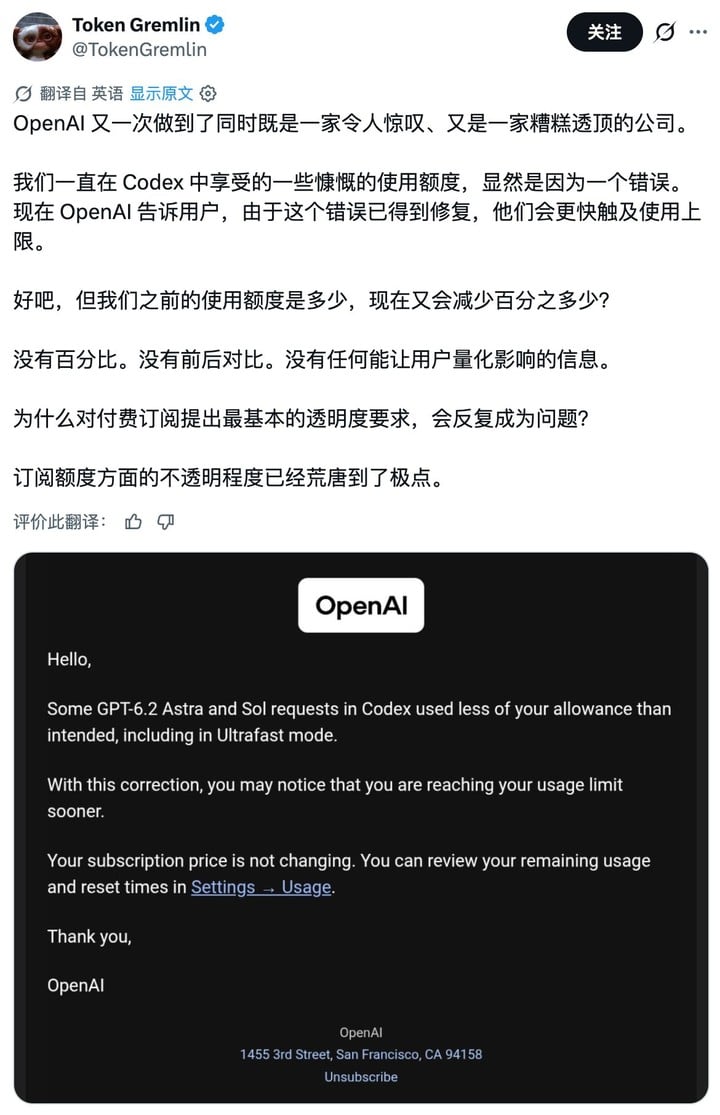
And just as the allowance merger was sparking controversy, the rate at which GPT-6.2 consumes allowance also changed.
OpenAI product lead Tibo has just posted acknowledging that a billing error occurred when GPT-6.2 launched, which meant most users enjoyed an extra allowance discount.
With the error fixed, users will hit their usage limits 40% and 25% faster with GPT-6.2 Astra and Sol, respectively, compared with last week.
However, Tibo said these two models still use allowance more efficiently than the previous generation, GPT-6 Astra and GPT-6.1 Sol, and other models are unaffected by this adjustment.
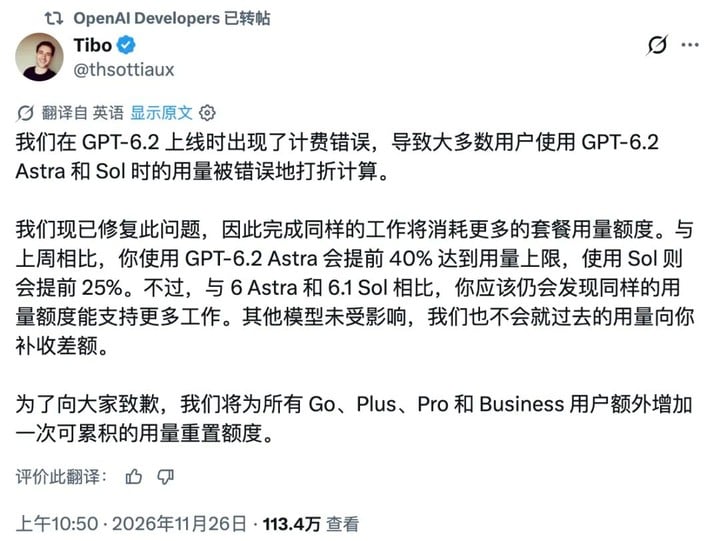
As compensation, OpenAI will give Go, Plus, Pro, and Business users one additional allowance reset that can be saved for later use, and allowance that was under-deducted in the past will not be clawed back.
On one side, Chat, Work, and Codex are about to share an allowance; on the other, the main models are consuming allowance faster, and OpenAI has yet to publish a specific before-and-after usage comparison for the allowance merger. Paying users hand over the same membership fee every month, but how much allowance they actually get remains a murky account.
For the same $20 membership, who is actually more generous?
In fact, the differences in AI membership allowances may be even larger than many people imagine.
Since vendors generally do not disclose the specific total Token amounts tied to membership plans, third-party researchers usually estimate value by testing actual usage and converting subscription allowances at the corresponding models' API prices, in order to measure the value of different membership plans.
This October, SemiAnalysis, a well-known semiconductor and AI industry research firm, published a research report that tested different AI subscription plans in detail.
It found that under a typical Agent workload, memberships using Claude Opus 5.5 delivered more than 5 times the equivalent API value of GPT-6.1 Sol across the $20, $100, and $200 tiers.
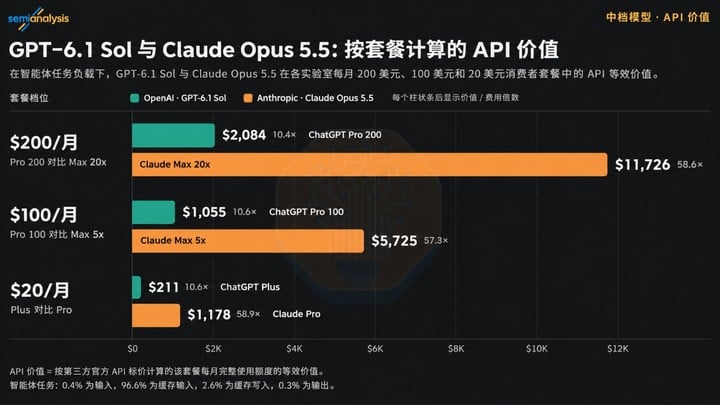
Taking the $20 membership as an example, Claude's monthly equivalent API value was about $1,178, while ChatGPT's was only $211. At the $200 tier, Claude Opus 5.5's estimated total Token amount reached about 2.8 times that of GPT-6.1 Sol.
However, on top flagship models such as GPT-6 Astra and Claude Fable 5.1, the equivalent API value of the two companies is much closer.
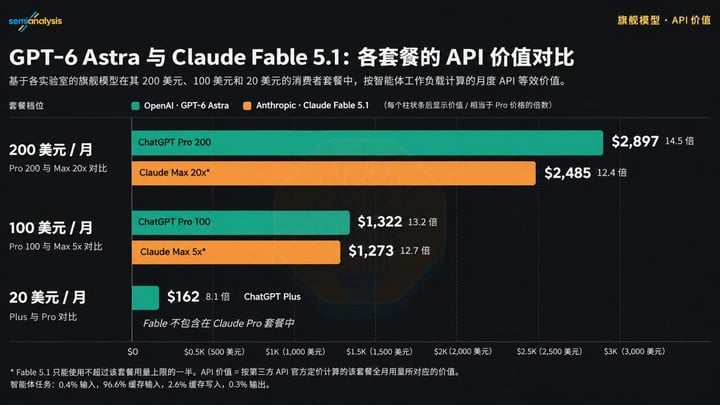
At the end of October this year, OpenAI again raised the usage allowance for some Pro plans, further narrowing the gap between its high-priced memberships and Claude.
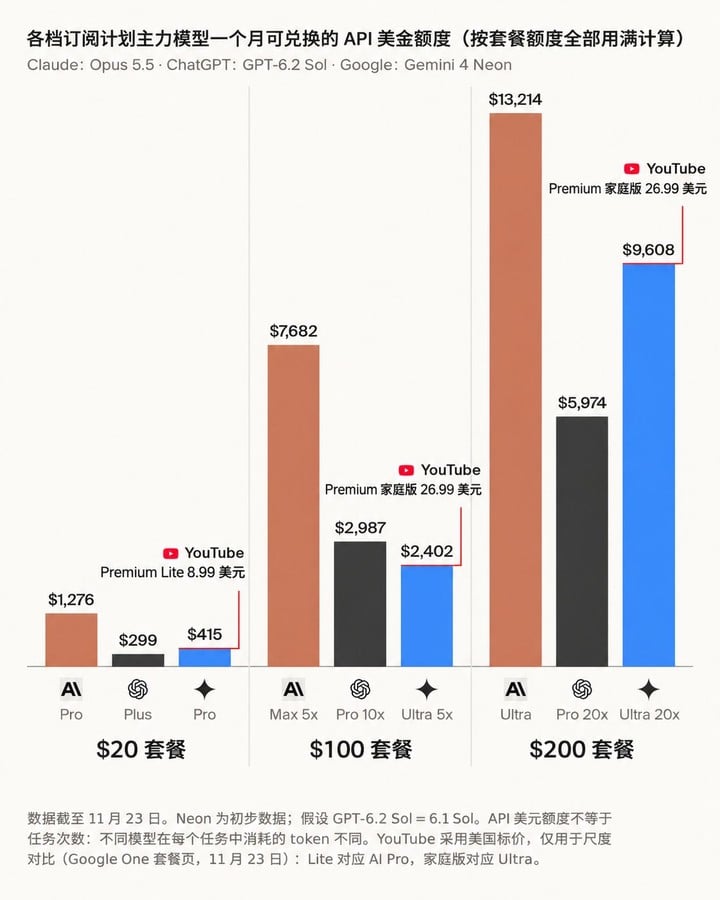
And according to a latest estimate published by researcher Adam Holter as of November 23, when the monthly subscription allowance is fully used up, Claude still ranks first among the three mainstream subscription tiers in terms of equivalent API value provided.
Among them, the $20 Claude Pro's equivalent API value is about 4.3 times that of ChatGPT Plus at the same price. At the $200 tier, Claude and Gemini reach about 2.2 times and 1.6 times that of ChatGPT Pro, respectively.
Some Google membership plans also come with additional benefits such as YouTube Premium and cloud storage.
Article title: Why ChatGPT's upcoming major update is causing longtime users to collectively lose their cool
Body: The so-called equivalent API value refers to how much it would cost to purchase the model resources used by a subscriber at public API prices. It is not entirely equivalent to the actual number of tokens or the number of tasks completed.
In the past, when people bought AI memberships, they mainly cared about whose model was the smartest. Now, as model capabilities converge, whose membership is more durable is also becoming an important competitive metric.
For people who rely on AI to get work done every day, a mainstay model that can keep working continuously is sometimes more valuable than a flagship model that is more capable but frequently hits usage limits.
A $20 membership fee can't support an AI that works around the clock
The traditional AI subscription model is a bit like a gym, relying on subscription revenue from a large number of light users to spread the high costs generated by a small number of heavy users.
In the past, human typing speed and reading speed naturally limited token consumption, but with the spread of Agents, users only need to send a single instruction to let AI keep working in the background for hours, or even launch multiple Agents in parallel to handle tasks at the same time.
In June this year, SemiAnalysis's extreme testing found that a ChatGPT Pro account with a monthly fee of $200 could consume tokens with an equivalent API value of about $14,000 per month, while Claude Max at the same price was about $8,000.
Estimated at 30% of API prices, the former may generate actual inference costs of more than $4,000 per month.
The enterprise side is also facing a surge in compute spending. With the rapid spread of Claude Code among engineering teams, Uber exhausted its entire 2026 AI budget in just four months.
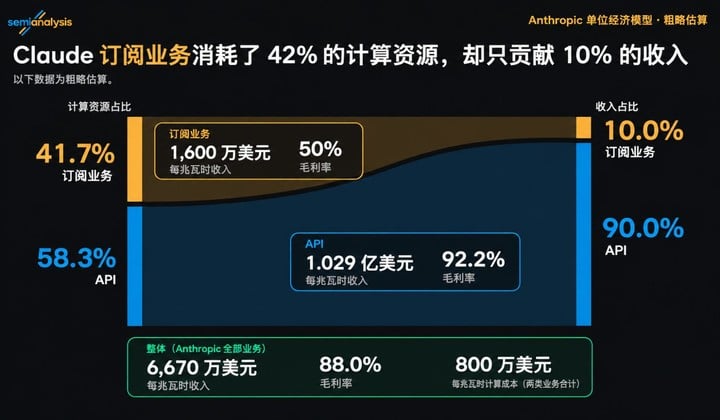
Anthropic's IPO prospectus also shows that in the first half of this year, the subscription business contributed only 20% of the company's revenue, while according to SemiAnalysis estimates, this segment consumed about 40% of paid inference compute.
Quite strikingly, research by Epoch AI shows that since 2023, the inference price for achieving equivalent AI performance has fallen to about one-thirteenth of its original level each year, but the spread of Agents is further amplifying compute demand.

However, falling inference costs do not necessarily bring corresponding growth in market demand. YC CEO Garry Tan recently pointed out that, based on Ramp's enterprise credit card spending data, the AI industry's "Jevons paradox" seems to be failing: inference costs continue to fall, but AI usage has not grown substantially in tandem.

At the same time, the spread of Agents has significantly increased the compute consumption capacity of a single heavy user, putting greater cost pressure on the fixed-price subscription model.
Large model companies have thus fallen into a rather awkward business dilemma: they need to attract more people to pay for AI, while also needing to control usage by existing paying users.
In the past, a $20 membership fee corresponded to a chatbot that answered every question; now, the same $20 has to support a digital employee that can keep working continuously.
From shared usage quotas to limiting the call frequency of flagship models, and then to launching more expensive membership plans, large model companies are managing users' compute consumption in increasingly granular ways.
For users who do not want to increase subscription spending, it is also necessary to develop some token-saving habits, such as starting a new conversation when switching topics to reduce the consumption of irrelevant historical context, delegating everyday Q&A and translation to Instant or lightweight models, and using advanced reasoning only for complex tasks.
Developers can reduce Agent quota costs by streamlining configuration files such as CLAUDE.md, using MCP to retrieve materials on demand, and reducing the use of high-multiplier acceleration modes such as Ultrafast.
Over the past few years, large model companies have been working hard to persuade users to hand more work to AI. Now, as AI finally has the ability to take on more and more work, users are starting to learn how to use AI sparingly.
A rather absurd phenomenon is emerging in the AI industry: intelligence is getting cheaper and cheaper, but using intelligence to the fullest is becoming an increasingly expensive privilege.