 AIFeed
The "X-ray" of the AI 3D World Is Here! One Image Directly Produces a Baroque Sculpture, Ready for 3D Printing Out of the Box

Heng Yu, reported from the Non-Obvious Temple, Quantum位 | WeChat official account QbitAI
Lately, the 3D results everyone has been getting from GPT-6.2 Astra are really something.
We've seen plenty of eye-catching modeling results, but this time we wanted to push the difficulty to hardcore levels.
Let's see whether Astra can withstand the test and fully reproduce this Baroque sculpture with its intricate structure and dense details.

The moment the 3D model came out, we couldn't help but murmur.
This old Astra really has something going for it—pretty impressive!

But when we expanded the thinking process, well, well—it turned out Astra had on its own called VAST's open-source model TripoSR.

Calling other companies' models is not allowed!
We immediately ordered GPT-6.2 Astra to use only Blender and do the modeling itself!

The sculpture's surface got sanded down, and the figures, lion, and horse all took on an quaint, back-to-basics look.
Could it be that this hell-level sculpture already exceeds the upper limit of current AI 3D capabilities???
With a give-it-a-try mentality, we got the latest Tripo 3D model from VAST—heard it's stronger—

This professional player that holds its ground in the "hell-level" group sculpture is VAST's newly released next-generation high-precision AI 3D base model, Tripo H3.5 Preview.
Compared with the previous generation H3.1, H3.5 Preview has significantly improved in complex structure reproduction, fine geometry generation, input-output alignment, and reasonable inference of unseen parts.
Currently, H3.5 Preview is live on the international version of Tripo Studio.
(Direct link: https://studio.tripo3d.ai/)
Under the conditions of unified input, uniformly adopting the highest geometric quality, and stripping textures and normal maps, Tripo H3.5 Preview demonstrated performance significantly superior to the other 5 latest AI 3D flagship models:

Among them, in a blind evaluation by senior 3D artists of 192 untextured model cases, H3.5 Preview's generated results took first place 82 times, accounting for 42.8%, with a win rate 2.3 times that of the second place.
In actual production environments, professional 3D artists hold the power to judge whether "an asset can enter the pipeline," and the evaluation results also mean that H3.5 Preview's generated results better meet actual production standards.

To measure the model's multi-view 3D reconstruction capability—especially integrating images from different angles into a unified, complete, and conflict-free 3D structure—VAST compared the 3D generation results of several models under single-view and four-view settings.
In a blind test covering more than 200 cases and combining Agent judges with expert ranking, H3.5 Preview had no defeats across 22 summarized comparisons (across two evaluation sets and single/four views).

In addition, H3.5 Preview also has ceiling-level text recognition capability.
After removing textures, H3.5 Preview's recognition rate for 3D embossed text reached as high as 90.7%, approaching the recognition upper limit of the input image and significantly higher than Tripo H3.1's 46.1%.

VAST introduced that the focus of this technical upgrade can be summarized in two keywords:
True Fidelity, Disciplined Detail.
Let's Look at Tripo H3.5 Preview's Real Skills
To get a clear picture of Tripo H3.5 Preview's true colors, we selected three types of high-difficulty scenarios that easily expose AI modeling, and directly looked at its untextured model performance.
The first category tests embossed reproduction capability.
As the input image, this is an original artwork of a bronze three-legged li vessel with double phoenixes and extremely high texture density.
On the bronze three-legged li with double phoenixes, the phoenixes' neck feathers, wing feathers, and long tails cover a fine leiwen-pattern background, with bead-dot decorations surrounding the outside.

The difficulty of this task lies in multiple levels of ornamentation densely distributed on the same curved surface; the model must both recognize the semantics of different ornaments and accurately express the geometric height relationships between them.
Zooming into H3.5 Preview's generated result, the double phoenixes' neck feathers, wing feathers, long tails, and background patterns remain clearly layered, and the leiwen band at the vessel neck also maintains good continuity.

These details themselves belong to the model's three-dimensional geometric structure, rather than being drawn relying on textures.
Embossed text greatly tests the model's detail reproduction capability: after removing textures, the text must be presented through real protrusions or recesses on the surface, with clear and separated strokes, for OCR to read it.
Compared with H3.1's distortion, H3.5 Preview not only accurately reproduces the text on the box surface but also preserves the depth of the embossing.

The second category tests the model's understanding and shaping of complex spatial structures.
Problems such as collapsed slender structures and stuck narrow gaps have long been disaster areas in AI 3D modeling.
Take the sci-fi rifle, a typical hard-surface asset in game art scenes, as an example!
In the input image, the receiver and magazine are covered with scrolling-vine cross emblems and skull decorations, and the stock stuffs multiple layers of wings, circular skull badges, slots, and chain-like paper ribbons into an extremely narrow area.

Even so, Tripo H3.5 Preview, while preserving the large panel structure of the receiver, still keeps the skull clearly semantically recognizable, and the scrolling-vine twigs also retain independent branching layers.

In another round of actual testing, we selected a complex object like the armillary sphere, which places extremely high demands on spatial understanding.
It is nested from multiple layers of rings in different directions, supports, gears, and spheres; the components both interlock and remain independent; a large number of slender rings visually occlude one another, and connection points, interpenetration relationships, and hollow areas are also easily misjudged, stuck together, or filled in during generation.
The model not only needs to recognize the form of each component but also understand their hierarchy, orientation, and connection logic in three-dimensional space.

The test results show that H3.5 Preview can fairly well reproduce the armillary sphere's complex spatial structure: rings in different directions remain independent, the connection relationships between interlocking components are clear, and internal cavities and hollow areas are also preserved.
In other words, what the model generates is not an overall outline that "looks like an armillary sphere," but a more complete geometric expression of its multi-layer nested, mutually interpenetrating structural relationships.
The third category of difficulty mainly tests the model's ability to infer unseen parts.
Single-image 3D generation has a natural challenge: the reference image can only provide visual information from a limited viewpoint, and the back, sides, and occluded parts of the object all need to be inferred by the model itself.
Take the input image below as an example; the character's equipment and appearance structure are complex.
To make the generated 3D model freely usable in game asset creation, the structure of the armor transitioning from the front to the back, and the extended form of clothing folds relying on the body, all need to be inferred and completed by the model.

Let's look at the result produced by H3.5 Preview:

Now look at the manticore (a classic fantasy monster in Persian mythology) figure generated by H3.5 Preview, where you can observe the model's geometric inference of occluded areas and the coherent performance of cross-view structures.

The back structure completed by the model maintains good continuity with the front design, and the form and component relationships under different viewpoints are basically consistent.
Compared with the input image, the result is truly not bad:

More importantly, this high-precision performance is not the result of repeated roll-the-dice luck.
By scaling up model capacity and systematic training, Tripo H3.5 Preview greatly improves the reliability of first-round generation. Even when faced with complex and diverse real user inputs, it significantly reduces structural errors, making single-pass generation results more stable and usable.
Breaking the "false fidelity" of blindly piling up polygon counts and resolution
Over the past year, a wave of models has emerged in the AI 3D space, with "high polygon count" and "high voxel resolution" as their main selling points.
In actual production, however, parameter scale does not equal geometric quality—
Importing models into slicing software for 3D printing, or into DCC tools for baking, often exposes problems such as non-manifold geometry, self-intersections, local breakage, fused details, and distorted structural relationships, making it hard to meet downstream requirements for model integrity and editability.
Many past AI 3D model demos looked impressive but ran into frequent problems in real-world use, and the root cause lies in this evaluation logic that is easy to take for granted.
Along the way, there are several evaluation criteria that seem self-evident but are actually wrong.
First, high polygon count and high resolution ≠ high-quality reconstruction.
Ultimately, sampling resolution and polygon count are merely the carriers through which detail is presented; they are not the detail itself.
If a model's understanding of 3D structure and its geometric representation capability are not enhanced in tandem, then simply raising voxel grid resolution or piling triangle counts up to the ten-million level is like rephotographing an out-of-focus photo at a higher pixel count: denser sampling does not mean clearer contours and structure.
Such parameter increases do not automatically generate accurate structure; instead, they may amplify the uncertainty and artifacts in the generation process—more surface noise, blurred edges on hard surfaces, and fused narrow gaps and overlapping regions.
Whether for 3D printing or game asset production, redundant geometric noise still consumes polygon budget, and erroneous structure can be rendered just as completely by a high-resolution mesh.
Second, texture detail ≠ geometric detail.
If fine features such as carvings, reliefs, text, logos, gears, and chamfers are merely "painted" onto the surface via textures, the model itself has no corresponding three-dimensional structure.
Third, good renders and contour alignment ≠ structural completeness and production usability.
Beautiful renders can mask problems such as collapsed thin structures, fused hollows, deformed crossed poses, and errors in back-side structure.
In real workflows, 3D printing usually requires models to have closed, non-manifold-free mesh structures, while digital asset production has its own requirements for topology quality, structural completeness, and editability. Any geometric defect can translate into additional manual repair costs.
As AI 3D increasingly enters professional production pipelines, this "false fidelity" built on parameter stacking and texture embellishment must be broken, and the accuracy, reasonableness, and usability of geometric detail need to be given greater priority.
How can every bit of geometric representation budget be spent where it counts? How can models be uncompromising where fine carving is needed, and avoid over-engineering where smoothness suffices?
This calls for a closer look at the two keywords around which Tripo H3.5 Preview's technical upgrade is centered: "True fidelity" and "Disciplined details."
True fidelity is fundamentally about being faithful to the reference image, faithful to geometry, and faithful to production.
It requires not only accurate reconstruction of overall proportions, part structure, and plausible forms on unseen sides, but also emphasizes carving details into the 3D geometry for real, ensuring a clean and closed mesh, directly addressing the fundamental question of whether the generated result is accurate, real, and usable.
For example, in the test set below, H3.5 Preview both reproduces the forging marks on the helmet surface and preserves the armor's structure—the inner wall is visible through the opening at the bottom.
By contrast, Model E falls short in reproducing the helmet surface material and hair detail, and its inner cavity is not opened up.

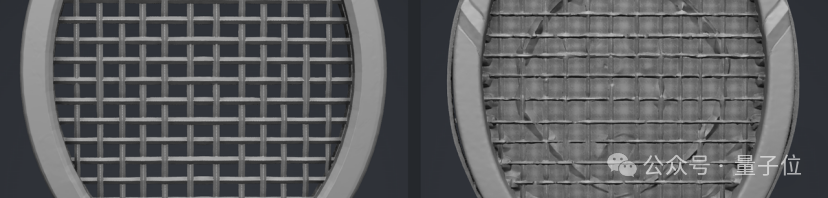
This shows that Tripo H3.5 Preview can maintain consistency among overall layout, local forms, and fine engraved lines, making details both rich and structurally clear and meaningful.
"Disciplined details," meanwhile, focuses on the semantic accuracy, structural reasonableness, and surface cleanliness of local details.
The model precisely models key areas such as facial features, fingers, fasteners, gears, vents, clearly legible text, and sharp chamfers, while restrainedly keeping adjacent smooth surfaces flat and noise-free, truly solving the quality problem of geometric detail.
In actual tests, H3.5 Preview both accurately reconstructs faces and preserves the sense of hierarchy between the dragon-head relief on the armor and the auspicious cloud patterns in the background.
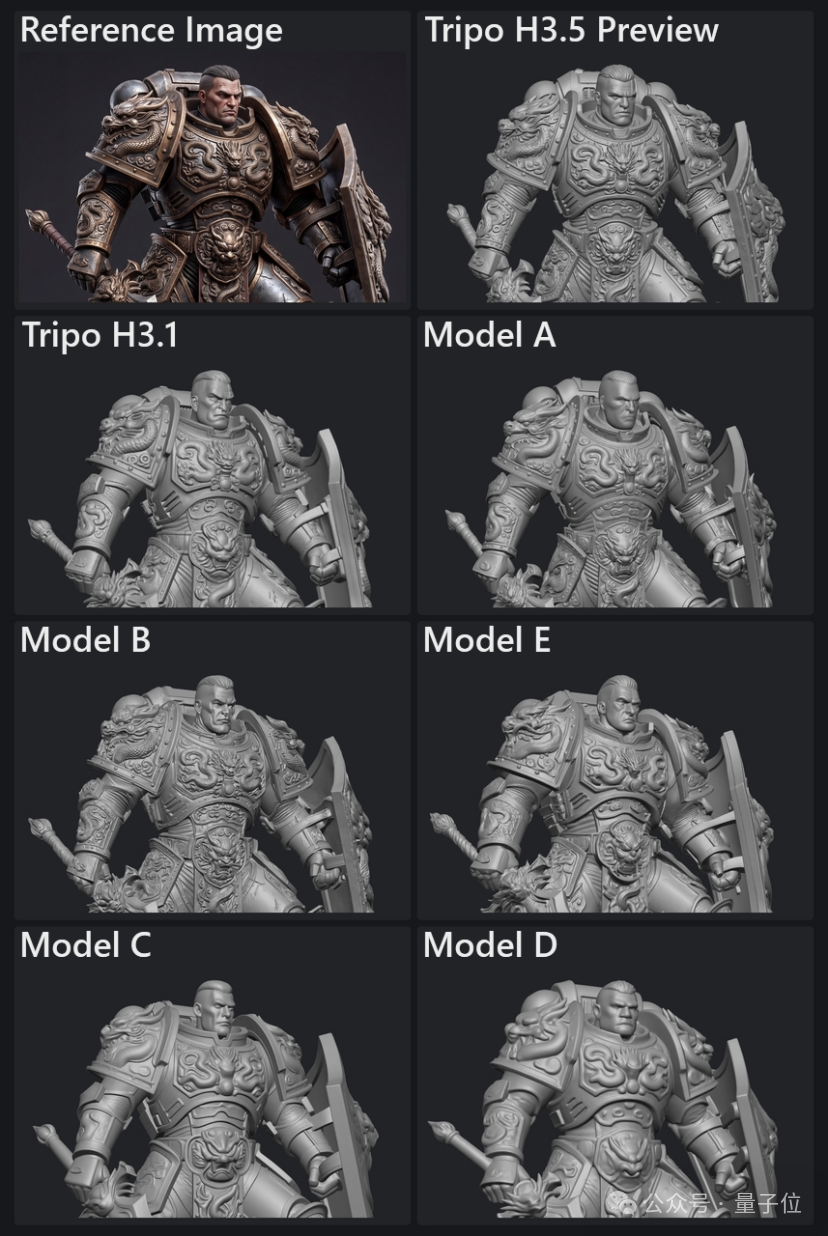
The higher the geometric precision, the more the model needs to accurately grasp the object's overall form and structural relationships.
For example, rich detail and clean surfaces have always been hard to achieve at the same time: a detail-sparse, glossy blob (Model A) easily scores high on cleanliness; a noise-filled, over-sharpened surface (Model B) can create a "hallucination" of high detail.
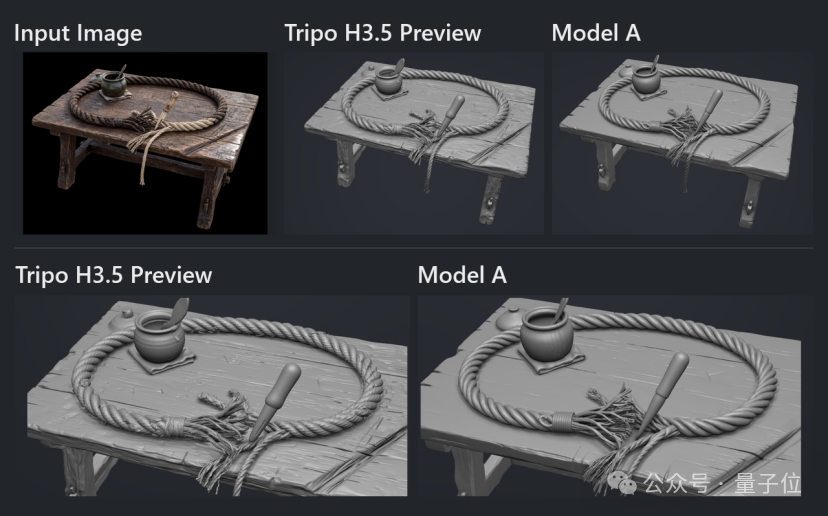
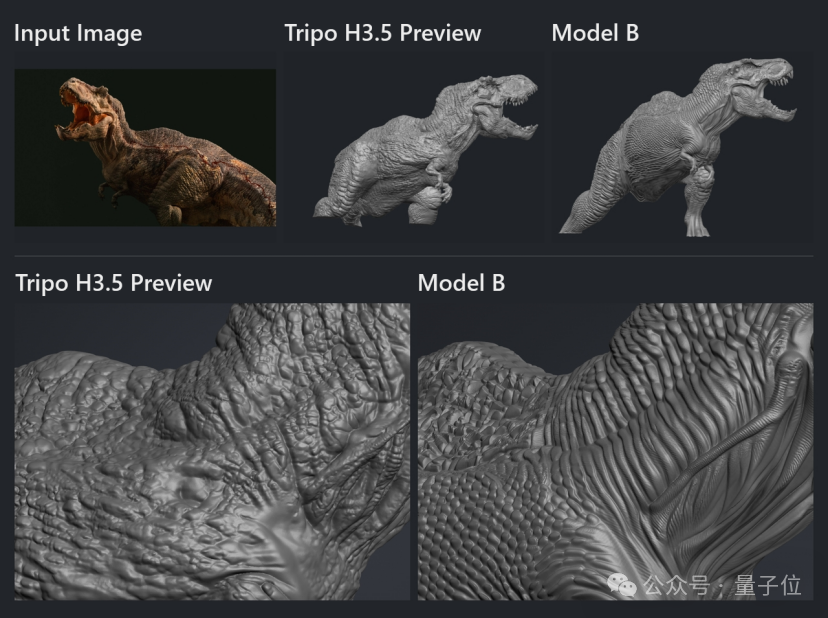
Evaluations show that under both single-view and four-view generation, Tripo H3.5 Preview maintains a certain level of surface cleanliness while possessing a clearly leading detail reconstruction capability.
It is worth emphasizing that on these two dimensions, its capability even surpasses models that support higher polygon counts.
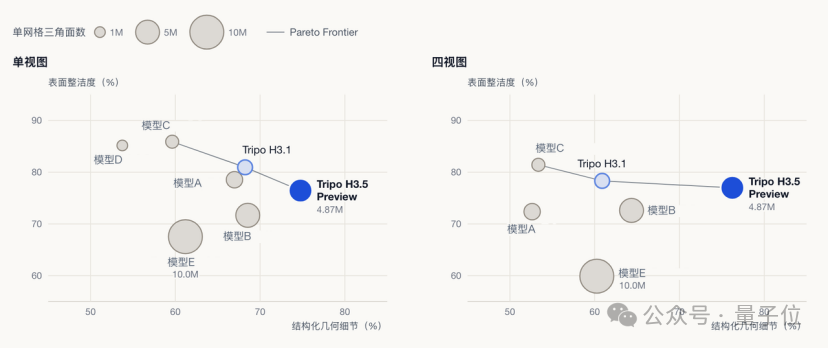
This relies on the technical judgment Tripo has built through continuous iteration and real-world deployment: which capabilities genuinely improve a model's reconstruction fidelity, and which merely add surface detail and amplify geometric noise.
Based on these judgments, Tripo keeps adjusting its technical path to achieve a better balance between detail richness and structural accuracy.

Truly running through 3D printing and production pipelines
When fine structures can be genuinely generated, AI 3D capability gains a new way to be tested.
From the armor seams and equipment fasteners of sci-fi characters, to the lion-head pauldrons and layered reliefs of Eastern warriors, to the scales, horn crowns, and skin folds of dragon heads, these cases all require the model to turn complex details into clear, complete solid geometry.
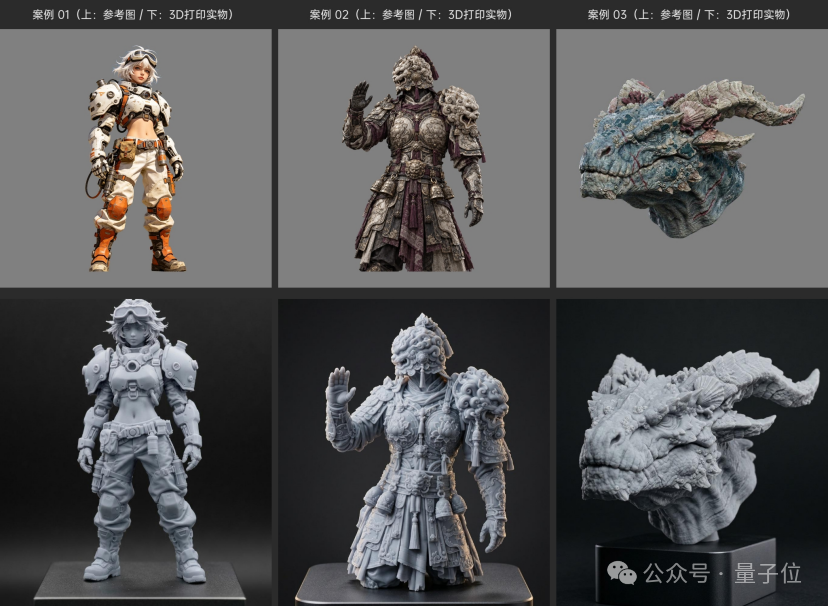
Models generated by Tripo H3.5 Preview can go directly into printing preparation workflows such as slicing and support setup, and retain crisp contours and rich layers in the printed object, letting on-screen structure and detail truly land in physical form.
Previously, AI-generated models often still required manual repair of geometric defects to meet printing requirements.
In this upgrade, Tripo H3.5 Preview specifically targets industrial-grade high-precision 3D printing, an application that demands extremely high geometric quality.
Tripo H3.5 Preview can directly generate 3D meshes with fully closed surfaces (i.e., natively watertight bodies), reducing the subsequent manual model repair workload and providing a foundation for models to enter the 3D printing workflow.
Alongside the release of H3.5 Preview, Tripo has also launched two features: printability detection and automatic repair.
The former can automatically detect thin walls, watertightness, and non-manifold edges of a model according to the target print size; the latter supports one-click repair of holes and non-manifold edges, and adjusts wall thickness according to printing process and size requirements.
The entire process is completed within the same interface, saving users part of the work of switching back and forth between modeling software and slicing tools and manually repairing models, letting AI-generated 3D models enter the physical printing stage more smoothly.

After generation, models can enter slicing and physical printing workflows without cumbersome manual repair, and are compatible with desktop FDM, resin, and full-color devices.
In fact, Tripo already has many partners across the 3D printing industry chain.
It was the first AI 3D large model to integrate with Bambu Lab's MakerWorld; in July this year, Tripo also reached a strategic partnership with Heygears to bring its full-color content generation engine into the HeyVerse platform.
Today, leading hardware manufacturers including Bambu Lab, Heygears, Creality, Anycubic, and Elegoo have all integrated it, and the AI modeling capabilities provided by the Tripo series models are being woven into the content production ecosystem of mainstream 3D printing devices.
BTW, beyond physical printing, Tripo H3.5 Preview also has considerable value in digital content production scenarios such as games.
In traditional AAA game asset production, high-poly models often require multiple rounds of refinement, including base form construction, repeated proportion adjustment against references, and detail sculpting. The faces, armor, and ornaments of complex characters especially depend on artists shaping them layer by layer, leading to long production cycles, high labor input, and costs that easily escalate through repeated revisions.
For such assets that pursue high-fidelity detail, Tripo H3.5 Preview can provide an initial high-poly model with relatively complete structure and detail, front-loading part of the time-consuming reference alignment and form completion work, allowing artists to devote more energy to subsequent editing, design adjustments, and detail refinement, accelerating the asset production workflow.
In game pipelines that prioritize iteration efficiency and direct engine output, VAST has positioned Tripo P2.0, which focuses on native quad topology.
It can generate models with clean topology layouts within seconds, reducing retopology work and providing a foundation for subsequent engine import, rigging, and animation, better serving scenarios such as rapid game asset production and UGC gameplay.

With the continuous improvement of foundation model capabilities, VAST is also exploring how to make professional 3D production workflows more intelligent and efficient.
To truly integrate AI 3D model capabilities into everyday production workflows, VAST recently announced three Tripo Agents designed for professional production scenarios, connecting to downstream steps in professional 3D pipelines.
- Tripo Agentic Canvas
Aimed at batch asset production. Users can organize production workflows on a visual canvas and reuse workflows accumulated from one creation session for subsequent tasks.
Integrated into the professional 3D production software Blender, allowing artists to invoke AI capabilities within their familiar working environment and continue editing and refining the generated assets.
Aimed at 3D printing, further lowering the interaction barrier. Users can express creative intent through natural language, multiple reference images, circled annotations, and other means to complete modeling and pre-print preparation for various printed parts, including functional structural components.
Currently, the international version of Tripo Agentic Canvas is already live, and Polipop will soon open its waitlist.
Combined with the printable detection and automatic repair features mentioned earlier, Tripo H3.5 moves part of the pre-print processing work that originally required manual effort forward into the generation stage.
When code intelligence meets 3D native intelligence, professional production has no "substitute"
VAST co-founder and chief scientist Cao Yanpei once used Tripo P2.0 to generate a mechanical spider.
Leveraging the model's native semantic part decomposition capability, he had a large model name the spider's individual parts, write and debug the motion logic, and ultimately achieved part-level animation control of the entire mechanical spider.
In this way, in today's burgeoning 3D Vibe Coding scenarios, the division of labor between the two types of models is already quite clear—general-purpose large models excel at understanding natural language intent, planning interaction logic, writing code, and continuous debugging, while their operation depends on a batch of rapidly generated, structurally accurate 3D objects as the basis for manipulation.
On the other side, demand for 3D foundation models in professional production fields such as games, film and television production, and 3D printing is also deepening.
Game development requires balancing asset topology, polygon budgets, and runtime efficiency; film and television production requires precise control over spatial layout, character positioning, and camera movement; and 3D printing has high requirements for geometric precision and structural integrity.
These production standards formed over decades of industry development also constitute the technical depth of AI 3D foundation models.
This is exactly why VAST has consistently emphasized Production-Ready on the Tripo series models.
Around the goal of Production-Ready, VAST has accumulated several years of technical work.
On the technical route, VAST persists in exploring 3D native representations and generation architectures, advancing from the H series' SparseFlex to the P series' Nexus, continuously pushing forward in directions such as geometric precision, native topology, and generation efficiency.
At the data and engineering level, according to VAST, it has accumulated the world's largest 3D native data asset library and has self-developed training and inference infrastructure, forming a complete engineering system from frontier algorithm research to online model services.
Supporting these technical explorations is also a team with backgrounds in both AI and computer graphics research.
VAST co-founder and CTO Liang Ding formerly served as head of general models at SenseTime, holds bachelor's, master's, and doctoral degrees from Tsinghua University, and studied under Dai Qionghai, academician of the Chinese Academy of Engineering; co-founder and chief scientist Cao Yanpei also studied for his undergraduate and doctoral degrees at Tsinghua University, under Hu Shimin, academician of the Chinese Academy of Sciences, and has long been engaged in 3D digitization and generative 3D research.
Since the beginning of this year, from P2.0 achieving native quad topology generation, to H3.5 Preview further improving geometric fidelity and printability, to the real-time world model EdenLive's exploration of dynamic, interactive world generation, VAST has made new progress in multiple technical directions.
From a holistic perspective, VAST has now completed the joining of the technical main line from "static 3D asset construction" to "dynamic physical world operation."
In just a few short years, advances in AI 3D technology have enabled more and more people without professional modeling experience to participate in 3D creation. Tripo's applications have also extended from game art, UGC creation, and 3D printing to fields such as XR and film and television production.
As the barrier to 3D creation continues to lower, more needs originally constrained by production cost and technical difficulty have the opportunity to be released. At the same time, professional users' demands for generation quality, asset editability, and production efficiency continue to rise.
As more and more 3D assets are put to real work, "true fidelity" and "orderly detail" naturally carry greater weight.
- Industry's first "end-side super node," enabling end-side AI to compute as a team: AI efficiency surges 270% without changing chips or models 2026-11-24
- Top-tier commercial-grade AI video for just 0.5 yuan per second! China's new open-source force takes global first place 2026-11-26
- A Chinese computer vision luminary starts a second venture! Leaving Apple to focus on next-generation spatial and physical AI 2026-11-25
- Yao Shunyu and the Hunyuan team answer netizens on Reddit, Hy small model already on the roadmap 2026-11-21
Related Reading
The SOTA automatic rigging open-source framework is here! The 3D version of DeepSeek's open-source month gift pack keeps unpacking
Also open-sourced HoloPart for generating complete editable parts for any 3D model
Intuitive and instant 3D model drawing, with text prompts, VAST has open-sourced again
A 3D version of Douyin is expected to be born, the zero-barrier 3D creation era is coming | VAST Song Yachen @MEET 2025
The secret behind 7 million 3D generative models worldwide
The 3D version of DeepSeek kicks off open-source month: two foundation models take SOTA first! Again, it's VAST
Make characters without knowing modeling! VAST upgrades its AI tool, hands-on test is here: one-click part separation/magic brush/rig anything
All directly address pain points in past modeling workflows