 AIFeed
Article title: In 2026, Can Domestic Models Still Catch Up with Opus 5.5?
Body:
In 2026, Can Domestic Models Still Catch Up with Opus 5.5?
2026-11-26 18:02
Based on our past understanding of consumer electronics, after a new generation of chips is released, older chips should become cheaper and cheaper.
But in the AI computing market, the rental price of the H100, which Nvidia released four years ago, keeps rising.
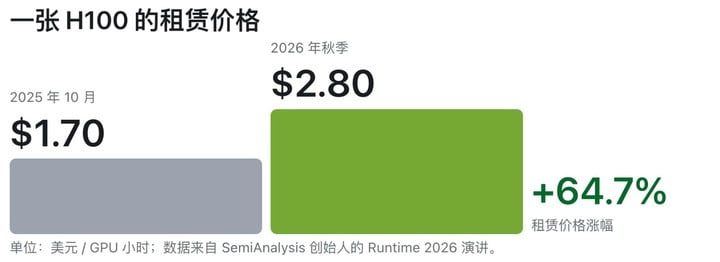
In a recent public speech at the Runtime 2026 conference, Dylan Patel, founder of the well-known semiconductor research firm SemiAnalysis, shared a set of data.
Last October, H100 rental prices once fell as low as $1.7 per hour. Today, the median transaction price for one-year rental contracts has reached $2.8 per hour, more than 60% higher than the previous low.
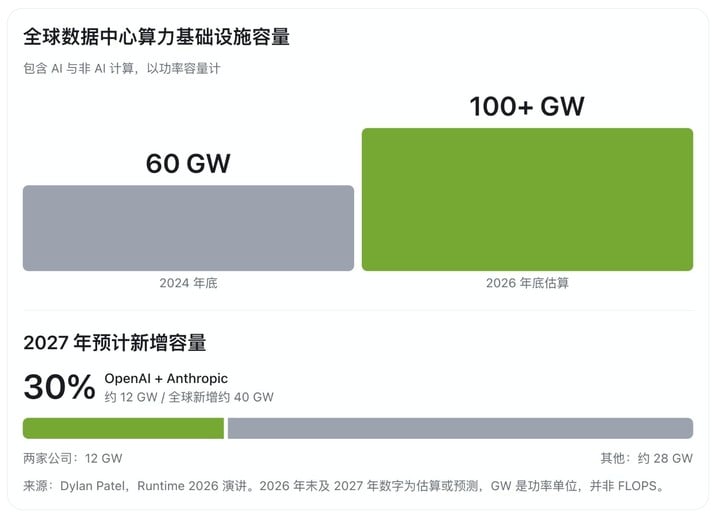
At the same time, Patel estimates that OpenAI and Anthropic will add about 12 GW of compute infrastructure capacity in 2027, while the global新增 scale for that year is expected to be about 40 GW.
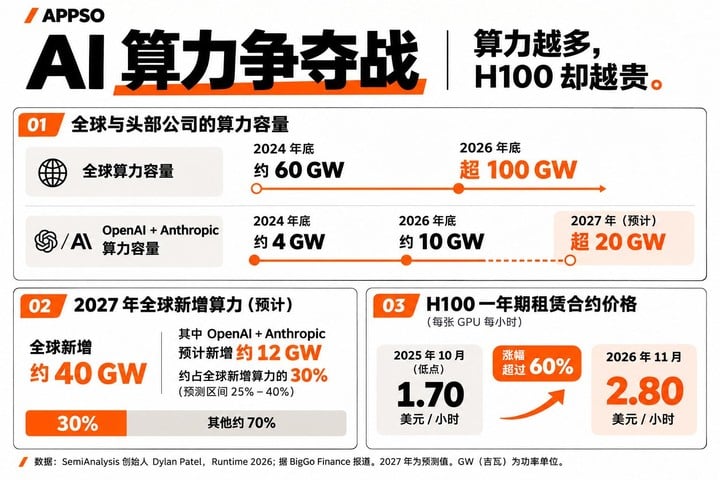
These two companies alone may account for 30% of global new capacity. Patel said bluntly, "For most players in the market, the question is no longer whether they can afford compute—they simply can't buy it."
Why is it that AI chips keep getting stronger, yet compute keeps becoming scarcer?
How Much Does Training a Large Model Really Cost
We use AI every day to write articles, generate images, and write code, but we may rarely think about how much compute it takes to train such a large model.
Take DeepSeek-V3, which has publicly disclosed detailed training costs. According to its technical report, this model has 671 billion parameters and activates 37 billion parameters each time it processes a token. It used 14.8 trillion tokens for pre-training and consumed a cumulative 2.664 million H800 GPU card-hours.
What is a GPU card-hour? Simply put, one GPU working for one hour is one GPU card-hour. If 1,000 GPUs work simultaneously for one hour, that is 1,000 GPU card-hours.
DeepSeek-V3 adopts the MoE (Mixture of Experts) architecture that is very common in today's large models. Traditional dense models need to use most of the model parameters involved in computation when processing each token. MoE models, by contrast, can select a subset of different expert modules to perform computation.
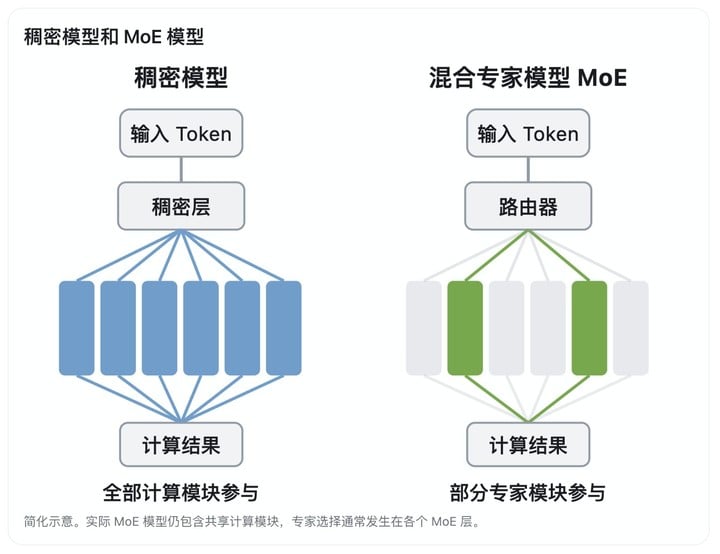
It is like a hospital with many departments: when you go to see a dentist, you do not need doctors from the entire hospital to consult on your case.
The pre-training compute of a large language model can usually be roughly estimated with a formula: C ≈ 6ND.
Here, C represents the total number of floating-point operations required for training, N represents the number of parameters involved in computation, and D represents the total number of tokens processed during training. For MoE models, N can approximately use the number of activated parameters.
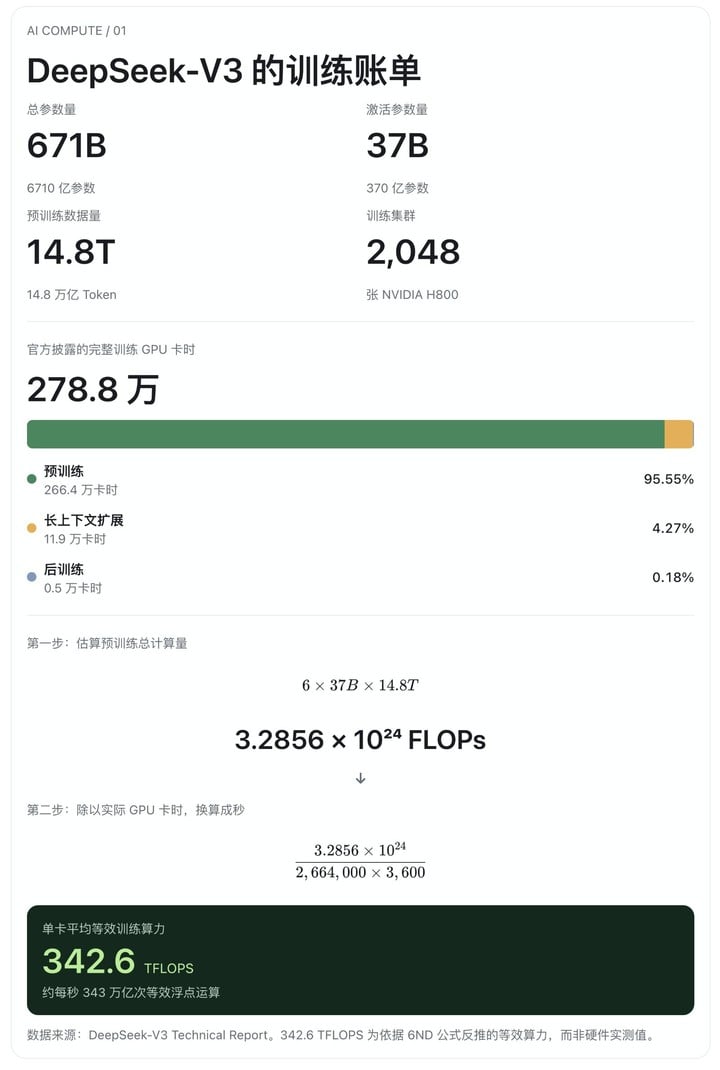
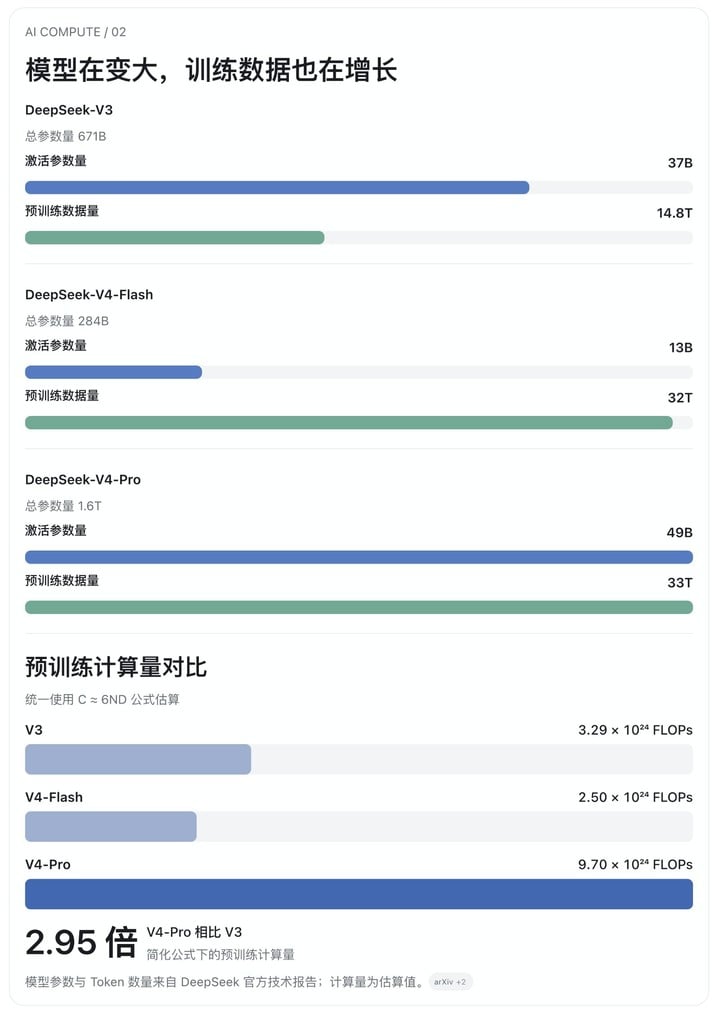
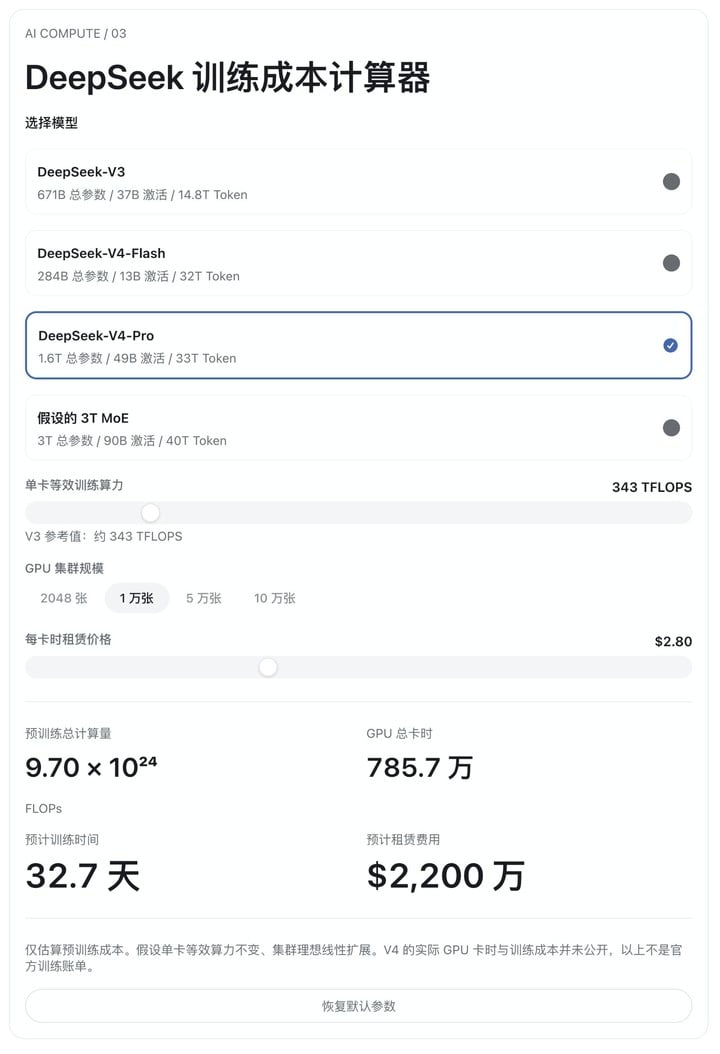
Working backward from DeepSeek-V3's publicly disclosed training data, each H800 provided an average of about 343 TFLOPS of equivalent training compute.
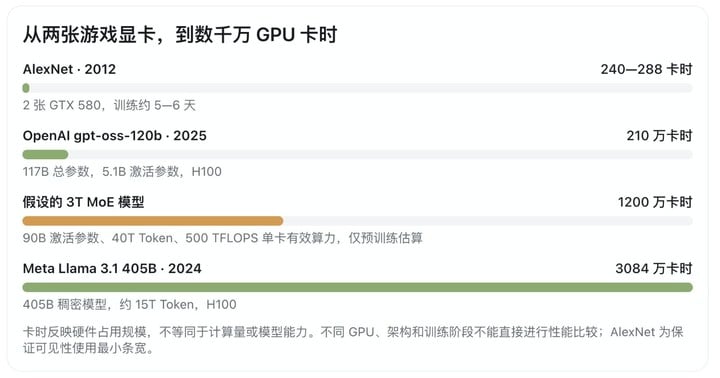
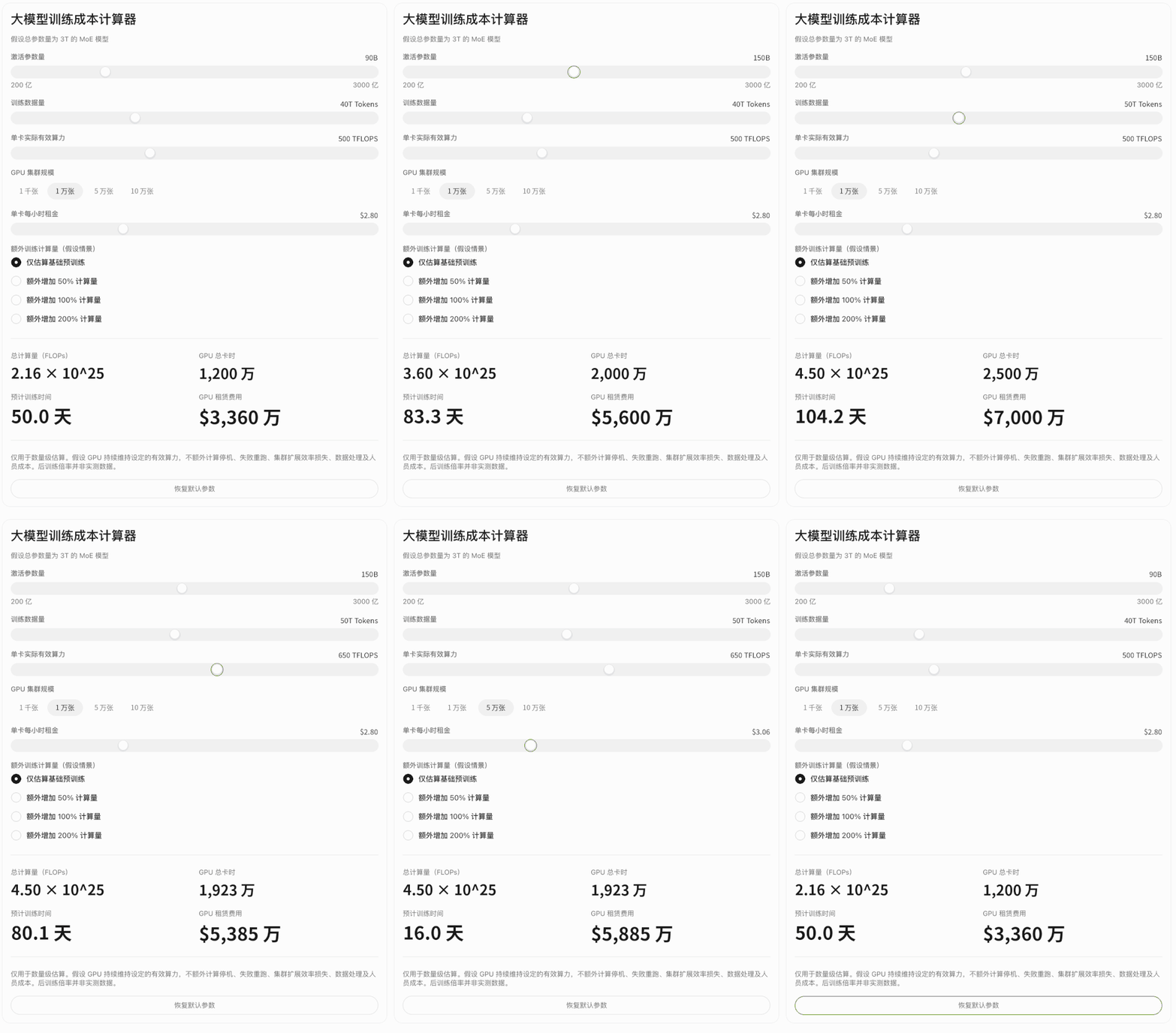
Suppose we now want to train an MoE model with 3 trillion total parameters, 90 billion activated parameters, and 40 trillion tokens of training data, and continue to use the above computational efficiency. Then:
- The total pre-training compute is about 2.16 × 10²⁵ FLOPs;
- About 17.5 million GPU card-hours are needed;
- Using 10,000 GPUs for continuous training would take about 73 days;
- Assuming a rental price of $2.8 per GPU per hour, the compute cost would be close to $49 million.
This only counts the cost of basic pre-training.
For an AI company, training a model does not mean renting 10,000 graphics cards, pressing the start button, and coming back more than two months later to collect the results.
Researchers need to test different model architectures, data mixes, and training methods, and also conduct supervised fine-tuning, reinforcement learning, and capability evaluation. With the development of reasoning models and Agents, the post-training stage also requires more and more compute.
According to data disclosed by SemiAnalysis, the power capacity of the compute infrastructure Anthropic currently controls is about 4 GW, and its goal by the end of this year is to reach 4–5 GW.
For reference, 1 GW of infrastructure power capacity can roughly correspond to hundreds of thousands of high-end AI accelerator chips, depending on the hardware and data center configuration.
And the inference compute supporting Claude Code in serving users worldwide is estimated by Patel to account for only about 1 GW of that. Anthropic also needs to allocate compute for other inference businesses, as well as for training and research on next-generation models.
With more GPUs, a company can run more experiments simultaneously, validate new technical directions faster, and launch next-generation models faster.
Buying compute is, to some extent, also buying R&D time.
Why It Has to Be GPUs, and Why It Has to Be Nvidia
Since chips are so scarce and rentals so expensive, why don't tech companies switch to other chips?
GPUs were originally designed to handle computer graphics. Compared with CPUs, which are good at handling various complex tasks, GPUs are better at executing large numbers of structurally similar mathematical operations simultaneously.
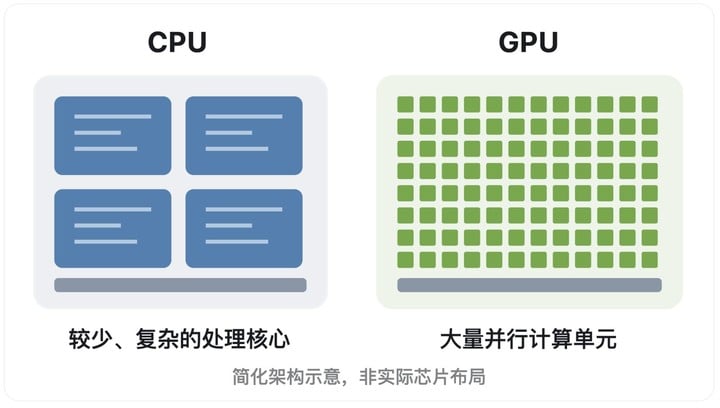
Training and inference in AI neural networks happen to require large numbers of matrix operations.
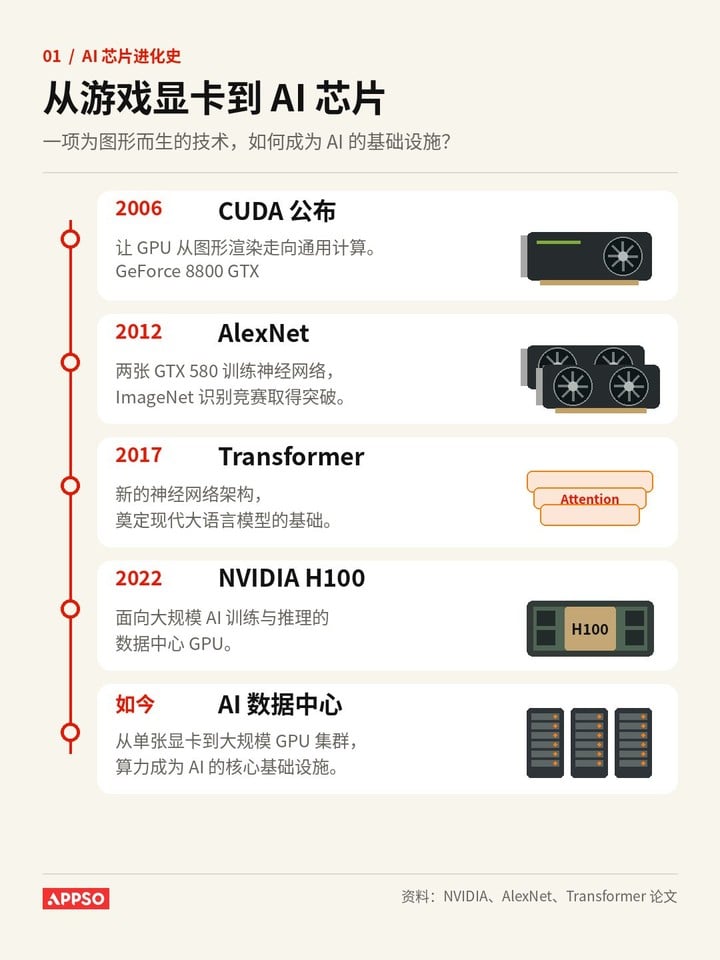
As early as 2006, Nvidia announced the CUDA architecture, enabling developers to use GPUs for general-purpose computing tasks beyond graphics rendering.
In 2012, AlexNet used two Nvidia GTX 580 gaming graphics cards and trained for five to six days, then took a large lead over other contestants in the ImageNet image recognition competition.
More than a decade later, the GPUs in today's data centers need to solve problems far more complex than those of that era.
The first is computational precision. By using numerical formats such as BF16 and FP8, AI models can reduce the overhead of computation and data transmission while controlling precision loss.
The second is memory capacity and bandwidth. A model with 3 trillion parameters would require about 6 TB of space just to store its model parameters in 16-bit format. If the GPU cannot read the data needed for computation in time, even the strongest compute is hard to fully utilize.
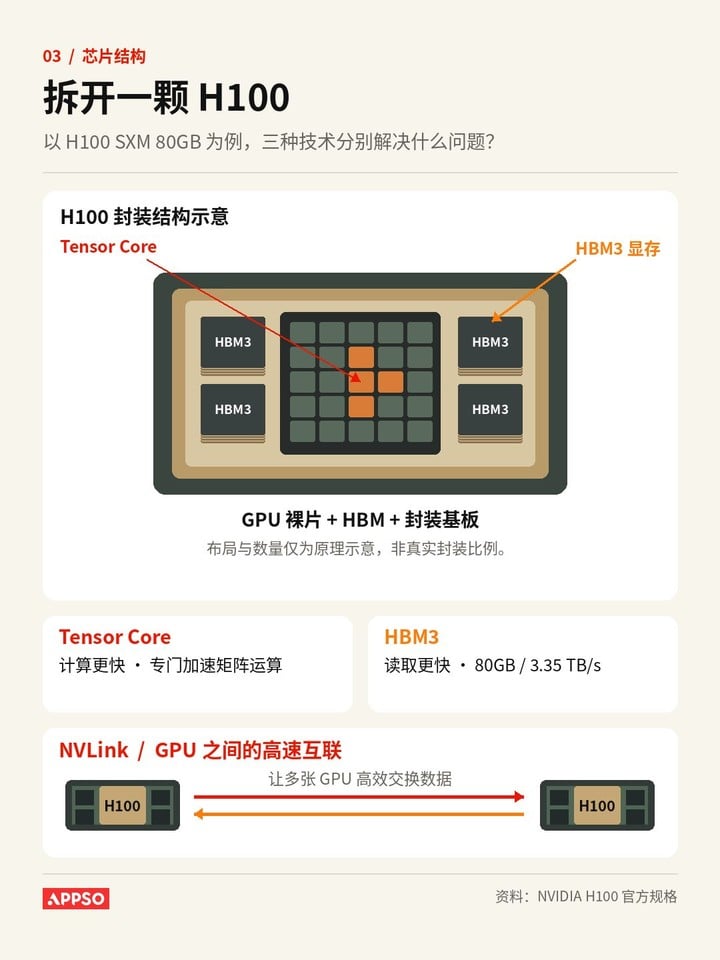
Finally, there is communication between chips. When a model needs to be distributed across thousands of GPUs, how to make these GPUs collaborate efficiently and how to continue training when some hardware fails are both complex engineering problems.
Around these requirements, Nvidia has built a complete ecosystem ranging from chips and high-speed interconnects to computing libraries, communication libraries, and training tools. A large number of AI development tools have already been optimized for this technology system.
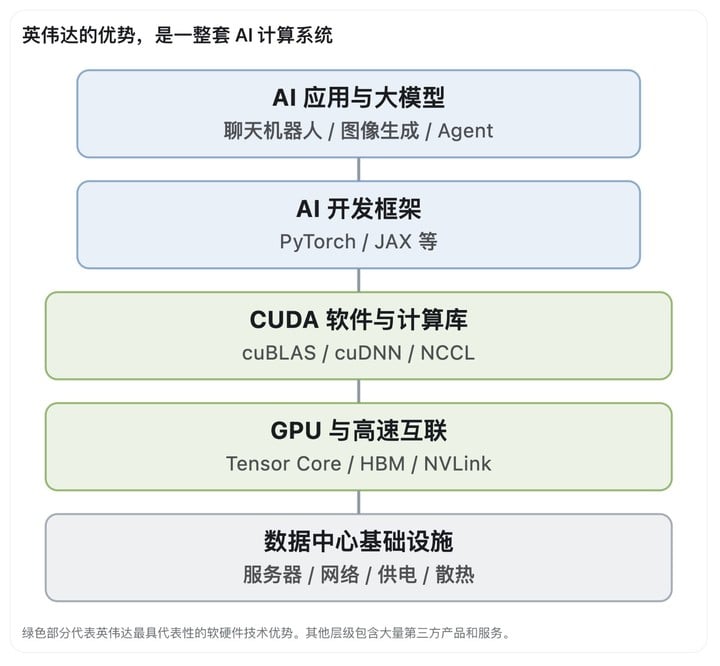
For an AI company, switching chips is not as simple as replacing a graphics card in our computer. Whether existing code can run, whether the training framework is compatible, whether computational efficiency will decline, and whether the system can run stably at the scale of ten thousand cards all need to be re-validated.
Of course, AMD's GPUs, Google's TPUs, and Amazon's Trainium are all competitive in the AI training and inference market.
But for the many companies that already use Nvidia's technology system, migration itself means additional R&D costs and time. In today's world where models iterate monthly, this is also a calculation they need to consider.
The More Compute There Is, the Less There Seems to Be
Over the past few years, GPU performance has improved rapidly, and model architectures have become increasingly efficient.
According to estimates by SemiAnalysis, by the end of 2026, the power capacity of global data center infrastructure will exceed 100 GW, compared with about 60 GW at the end of 2024. More and more chips are being manufactured, but AI companies' demand for compute is growing even faster.
Article title: In 2026, Can Domestic Models Still Catch Up with Opus 5.5?
Body:
Besides training models, commercial inference is also an important driver of growing compute demand. SemiAnalysis did the math: renting an NVIDIA B300 compute cluster with a power capacity of 1 MW (megawatt) overseas costs as much as $14 million a year.
But if a model like DeepSeek V4.1 Flash is deployed on it and Tokens are sold externally, at its set Token price and a 60% compute utilization rate, the theoretical annual revenue could reach $70 million.
As long as Token sales still leave enough profit margin, compute service providers have the incentive to keep renting GPUs at high prices.
And as users of AI products, the way we consume compute is also changing. A few years ago, we used AI perhaps just to answer a few questions or write an email. But now, we can let Claude Code run continuously for hours, having AI search for information, analyze files, write programs, and test code.
A seemingly simple instruction may involve dozens or even hundreds of model calls behind it. As AI can accomplish more and more work, the Tokens we consume also increase.
This phenomenon has a similar concept in economics called the Jevons Paradox: when the efficiency of using a resource improves and its cost of use falls, its total consumption may instead increase.
GPUs are undergoing a similar process. New-generation chips let AI companies train larger models and run more experiments, and let AI products serve more users. Older chips can still be used for model inference, fine-tuning, and other computing tasks.
For AI companies with relatively limited compute scale, they not only have to bear higher compute costs but also must make trade-offs between training new models and keeping existing products running.
Can Domestic Models Catch Up with Opus 5.5 This Year?
Compute is becoming increasingly scarce, which also makes us re-examine a question many AI users have been concerned about recently: why does the speed at which domestic open-source models catch up with overseas closed-source models seem no longer as fast as before?
For a period in the past, the AI industry held a relatively optimistic judgment: the window in which closed-source models lead open-source models might be only three months.
Whenever OpenAI or Anthropic releases a stunning new model, it seems we only need to wait a few more months before we can use open models with comparable capabilities, lower prices, and even the ability to deploy ourselves.
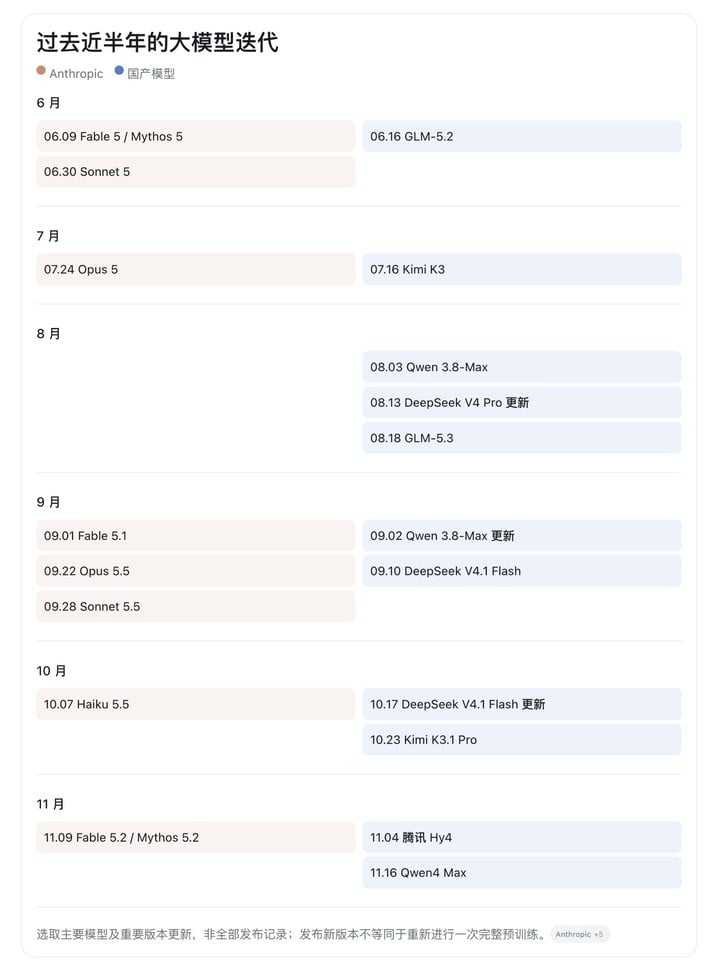
But in the second half of this year, that waiting time seems to be getting longer. In June, Anthropic released Claude Fable 5. Subsequently, over the following months, Kimi, Alibaba, Zhipu, and DeepSeek also released new-generation models one after another.
Meanwhile, Anthropic successively launched Opus 5, Fable 5.1, Opus 5.5, and Fable 5.2 released in November.
In Artificial Analysis's latest comprehensive capability evaluation, the top-ranked Claude Fable 5.2 scored 65, while the highest-ranked open-weight model, Kimi K3.1 Pro, scored 47. The models near Kimi K3.1 Pro are Opus 5, released by Anthropic in July this year, and Fable 5.1, released in September.
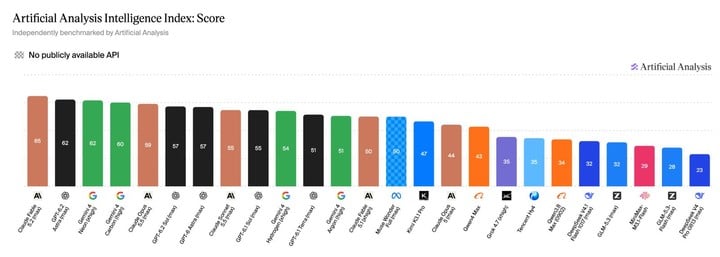
A single leaderboard cannot fully reflect a model's capabilities; model architecture, training data, and research level all affect final performance. But the gap in compute scale can indeed affect a company's R&D speed.
As training data scales grow larger and post-training becomes more complex, if computing resources do not grow in tandem, then a catch-up that could originally be completed in three months may in the future require six months, or even nine months.
And during those six months, the rival it wants to catch up with is also continuously releasing new models.
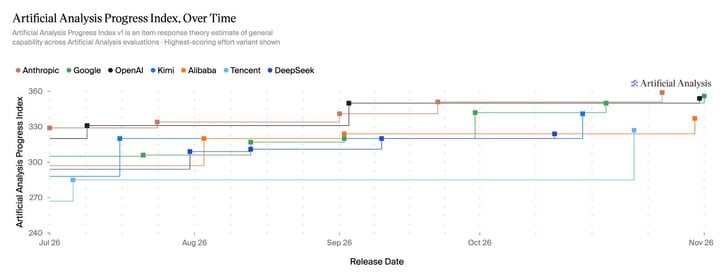
Not long ago, open models such as DeepSeek and Kimi let us begin to see the rise of domestic models and a new open-source narrative. We can use near-frontier-level AI at lower prices, choose different API service providers, run models on our own computers, and even modify models according to our needs.
The scarcity of compute may make the catch-up of open-source models begin to take longer. But more efficient model architectures and more mature training methods still have the chance to narrow this gap.
Only this time, we may need to give them a bit more time.