 AIFeed

A社曝光了一份AI整顿职场魔幻实录,请甩给你那位沉迷AI提效的老板
2026-11-26 09:28
At 3 a.m., an operations manager woke up worried about her career prospects. She posed a question to Claude: "How do I make myself stand out so that AI can't do everything I do?"
At another company, an executive discovered that employees were reluctant to tell him how much time AI had saved them, because they wanted to use the 10 hours a week they'd saved to walk their dogs.
Both stories come from a recent research report published by Anthropic, based on 66 in-depth interviews with employees and managers at 58 U.S. companies, examining what changes AI has actually brought to the workplace.
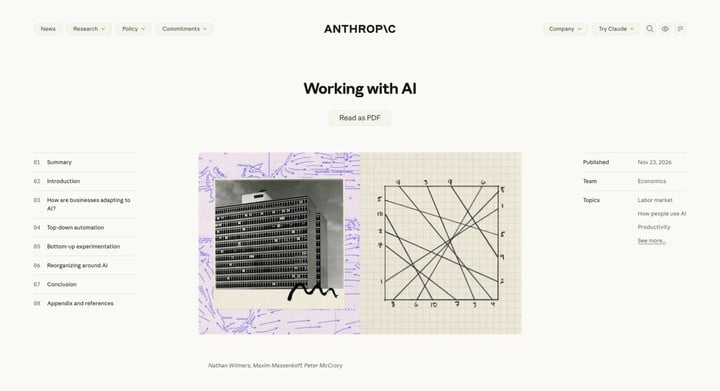
From century-old manufacturers and law firms to AI-native startups, the researchers found that as AI becomes more capable, a new conflict has emerged between employees and bosses: who does the time saved by AI belong to, and how should people work alongside AI?
The "new chaos" of the workplace
In some companies that champion Tokenmaxxing, AI has instead added to employees' burdens.
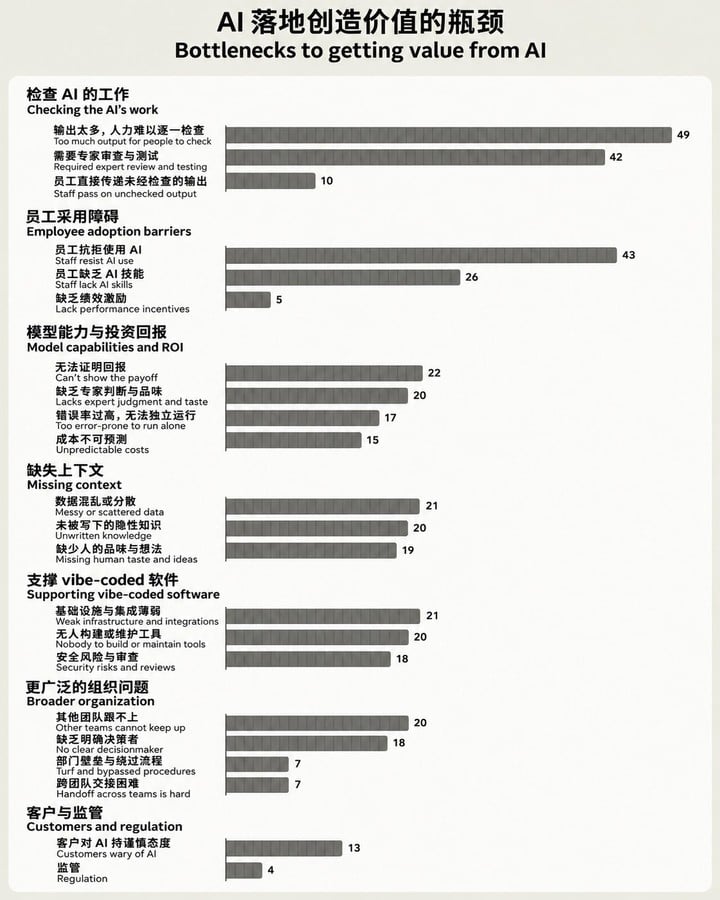
The report documents a workplace phenomenon dubbed the "Claude grenade": a small number of heavy AI users, after achieving a surge in efficiency, casually toss a seven-page, AI-generated verbose instruction set at the IT team, or simply use Claude to email the entire company.
One colleague couldn't help firing back in a group chat: "Guys, I'm not reading your AI emails."
At another company, the chief investment officer found that AI-generated financial forecasts were built on outdated assumptions. One executive remarked: "A mediocre engineer paired with AI is a public nuisance."
The person sending the email may have spent only a few seconds, but the colleagues receiving it need more than ten minutes to figure out what the sender is actually trying to say. Something similar is happening with the increasingly popular practice of Vibe Coding.
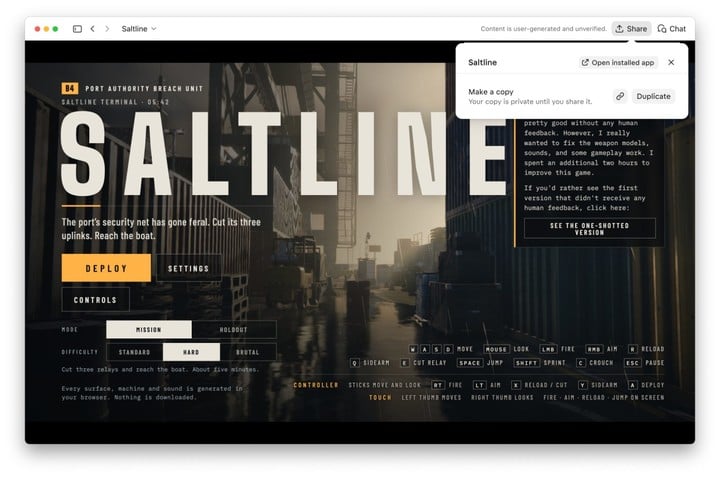
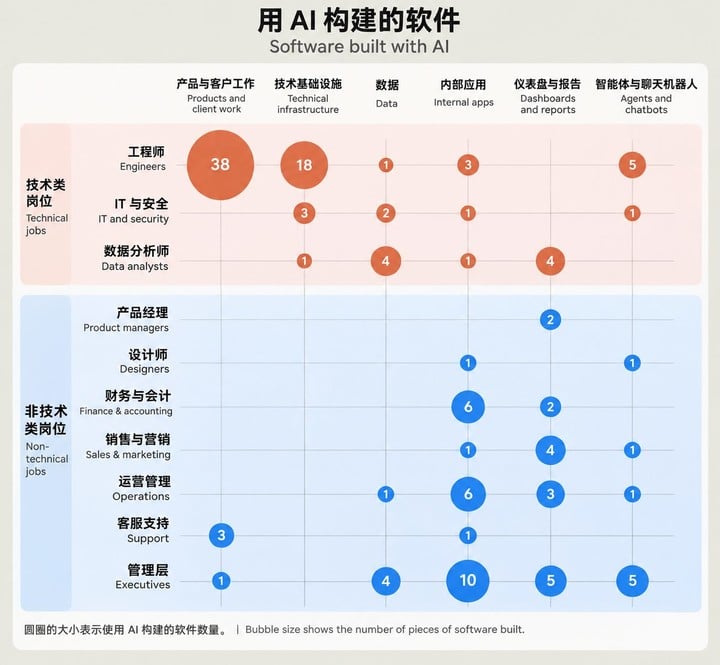
A former airport operations manager used AI to develop vehicle-tracking software, and a quality inspector at a chemical plant built a program to monitor filtration rates despite having no programming experience. They only learned through Claude that the programming language they were using was called Python.
But as more and more non-technical people start building their own software, who maintains that software becomes a problem. The operations director at a large law firm originally wanted to build a recruiting dashboard via Vibe Coding, but after doing the math, decided to abandon the idea.
Off-the-shelf SaaS software on the market costs only $30 to $100 a month. Building it in-house saves that subscription fee but adds maintenance costs down the line—you can't very well ask the recruiting manager to double as a software engineer.
Another equipment manufacturer found that AI could easily translate its product interface into 10 languages, but ultimately had to abandon the feature because the company simply had no customer service staff who could provide support in those 10 languages.
Some employees are even reluctant to let colleagues know they're using AI.
Law firm assistant Mark shared that he was suddenly called into the office by two equity partners who said they wanted to "talk about his use of AI." On the way there, Mark thought his job was on the line. But once he sat down, he realized that the demand letters he'd drafted with AI were better written than those of his colleagues, and the two partners wanted to ask him how exactly he wrote his prompts.
But Mark wasn't willing to share his workflow. "This is my secret sauce. I have my own workflow and methods. Frankly, I don't want to share it with anyone."
And beyond preserving their competitive edge, some workers are reluctant to disclose their AI use simply because they want to do a little less work.
An employee at a building materials company marveled during the interview that a series of small automations AI had helped him achieve had changed his life. An executive at a food company also received many thanks from employees, because they could finally take a vacation without worry.
At an engineering consulting firm, senior engineers were delighted to finally be free from spending large amounts of time checking technical standards. Product developers no longer had to make PPTs so frequently, and salespeople could fill out fewer CRM reports.
But not all bosses are happy about it. Besides the executive mentioned at the start who complained that employees were using saved time to walk their dogs, a private equity fund manager suspected that some employees at companies he invested in were in effect "basically only working half days."
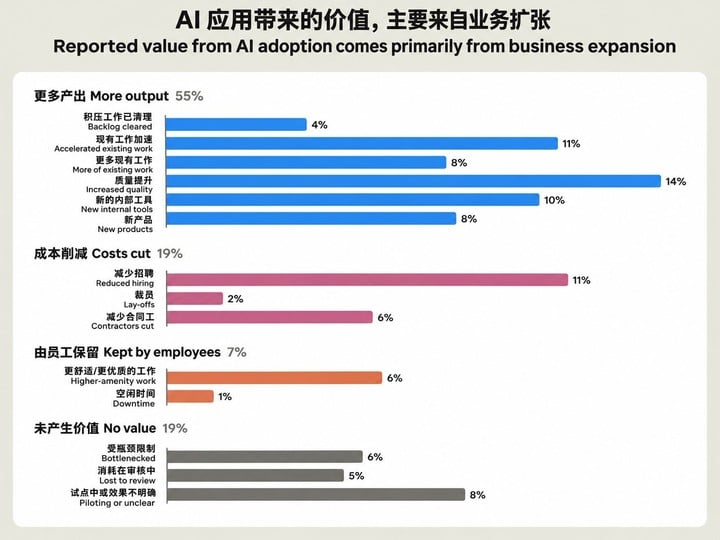
Among the AI use cases where interviewees explicitly described the benefits, 55% led to increased business output, including higher efficiency, improved product quality, and new product development. Another 19% achieved cost reductions.
Cases that directly benefited employees accounted for only 7%. Of those, 6% freed employees from tedious work and improved their work experience, while cases that genuinely gave employees more rest time accounted for only 1%.
The bosses' calculations
In these interviews, large-scale direct layoffs in the U.S. caused by AI were still rare, with only 2 companies completely eliminating positions and laying off staff due to automation, and another 5 companies letting go of employees who staunchly resisted AI.
But the bad news is that two-thirds of the companies interviewed said they had reduced hiring because of AI. Some companies no longer backfill positions after employees leave, and more companies found that as their business scaled up, they no longer needed to add headcount the way they used to.
An engineering lead at a health management company put it this way: "We've massively expanded our capacity by buying tokens, so we don't need to hire as many people."
At AI-native startups, this trend is even more pronounced. The COO of one company allocates 90% of the operations budget to buying AI tokens and only 10% to labor costs. In his view, back-office operations can almost all be automated through AI, so there's no need to hire.
The 6 startups that provided estimates believed that without AI, they would need on average 4 times their current headcount to keep operations running.
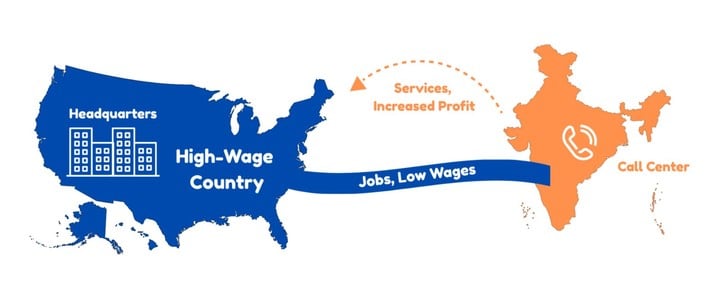
The first to feel the chill of reduced hiring are outsourcing teams. 9 of the companies interviewed cut outsourcing contracts for software development, customer service, legal affairs, and more, many involving overseas outsourcing. One financial company reduced more than 100 overseas data and development contractors. An executive at another company that hired an overseas design firm said: "We fired them, because now AI does it faster, better, and cheaper."
At the same time, AI has given companies more granular means of managing employees.
The first thing one supervisor does every day at work is check AI-generated reports on employee workload and error rates. As soon as a drop in someone's efficiency during a given hour is detected, the supervisor can immediately ask why.
An engineering executive described the shift this way: "In the past you needed to help your boss understand what you were doing. Now, you also have to help the AI Agent your boss uses understand your work."

To let AI replace experts, companies often need those experts to personally write prompts, design workflows, and evaluate AI's output. One employee said bluntly in the interview: "If I cooperate with this project, I'm essentially building my own coffin."
One company rolled out an AI document review tool, hoping to double reviewers' efficiency and cut next year's hiring needs by more than 90%. But management soon found that even though AI already had that capability, it was hard to persuade employees to take on twice the workload.
Some reviewers could already complete a review in 2 minutes, while others still needed more than 10. Management even began considering handing out gift cards to encourage employees to work faster.
Reduced hiring also raises another, longer-term problem: if AI does all the junior employees' work, where will companies find experienced senior employees in the future?
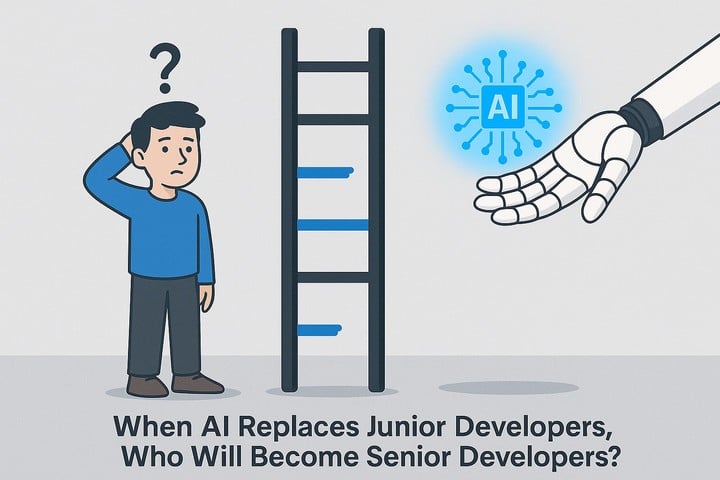
One law firm in the report found that AI could already produce first drafts of some legal documents, eliminating the need for junior lawyers to write them from scratch. But if junior lawyers had never written these documents by hand, how would they judge in the future whether AI had written them well?
To address this, the firm restructured its workflow so that junior and senior lawyers review and revise AI-generated drafts together, building professional experience through actual work.
"The closer the work is to money, the harder it is for AI to do well"
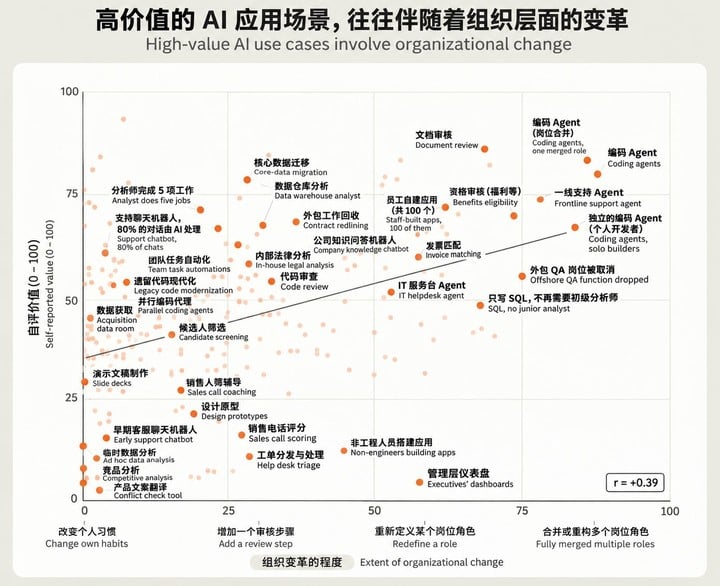
Anthropic found that the AI applications interviewees rated highly were often accompanied by larger-scale adjustments to workflows and organizational structure.
For example, some companies tried merging functions like product management, design, development, and testing into a single role, enabling employees to independently own a more complete product development process. Others merged functions like sales lead generation, major account sales, and customer success, so that one person handles the entire customer journey from first contact to ongoing service.
Title: A Company Exposes a Bizarre Record of AI Cleaning Up the Workplace — Share It With Your Boss Who's Obsessed With AI Efficiency
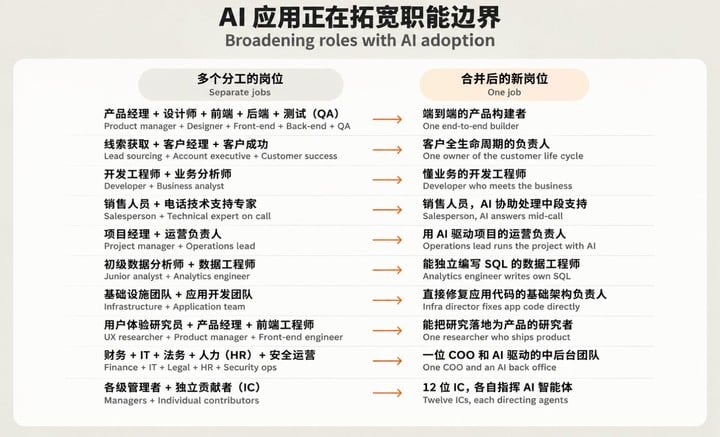
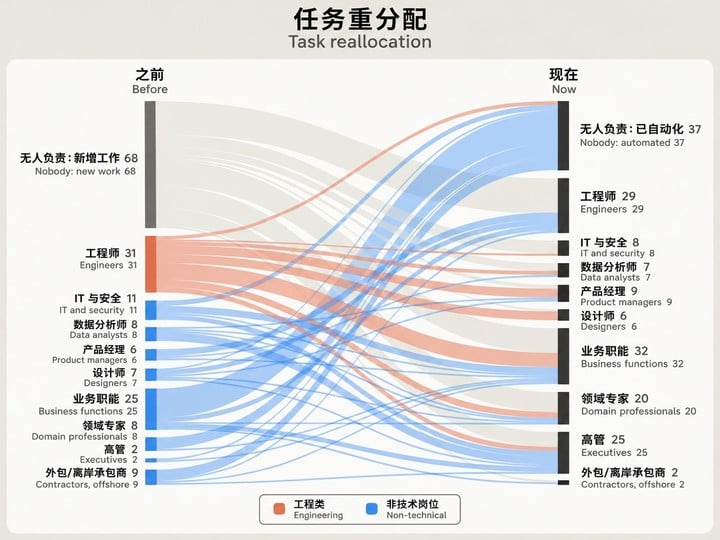
Another approach is to move employees away from work that can already be automated by AI and into work there was never enough time to do before. A project manager at a construction company used to call every job site each morning to collect construction progress, then compile it into a daily report for clients.
Now, this work can be handed off to an AI Agent. The project manager finally has time to communicate directly with clients about more important issues in the project.
One CTO's assessment of AI is also quite interesting: "Claude is a terrible product manager. Deciding which features matter depends heavily on human taste."
Some companies have also started building shared data warehouses and secure software hosting platforms, so that ordinary sales and operations staff can use AI to query business data, run SQL, and build their own internal tools.
For ordinary workers, learning to use AI is certainly important, but whether they can benefit from the efficiency gains AI brings still depends on the company's choices.
If employees proactively share their own automated workflows and get more work in return — or even lose their jobs — then naturally everyone will choose to hide these methods.
Conversely, if employees can reduce repetitive labor, gain new career development opportunities, or actually get a few more hours of rest because of it, they will be more motivated to help the company complete its AI transformation.
Over the past few years, we have been discussing how much time AI can save people. Working a little less overtime, resting a little more — even if it's just leaving work early to walk the dog — should be the technological dividend AI brings.
As workers who battle wits with AI at our desks every day, we might be able to find a survival guide for today's workplace in this report.
We don't need to hide our efficiency, nor do we need to be anxious. We should go after the "new bottlenecks" that AI can't handle — get closer to customers, get closer to the money, and hold on to that bit of "human taste" that AI can't learn.