 AIFeed
Seedance 2.5-Level Quality at One-Tenth the Price: We Tested the Soon-to-Be-Open-Source MAGI-2
2026-11-25 13:21
If there's still a barrier to AI video generation today, "expensive" is surely one that can't be avoided.
For most AI video creators, if they want better image quality and more natural physical motion, they often still have to choose a top-tier closed-source model like Seedance 2.5. But the high generation cost makes every attempt feel like "burning money."
Turning to open-source models can lower the barrier to use, but they often run into problems with complex narratives, long-video consistency, and visual realism.
Today, Sand.ai officially released its new-generation video generation model MAGI-2, and this situation of "the good ones are unaffordable, while the open-source ones fall short" may be about to change.
According to the evaluation results on the Artificial Analysis video generation leaderboard, MAGI-2 surpasses Seedance 2.5 in the image-to-video (I2V) dimension, ranking first in the world.
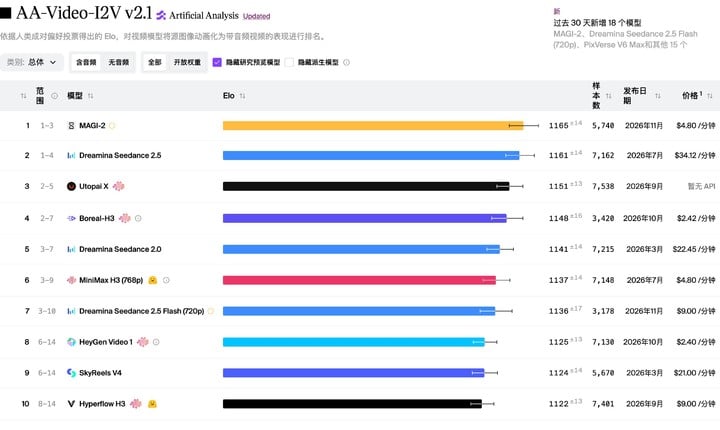
More notably, Sand.ai also announced plans to open-source MAGI-2's model weights as soon as possible, allowing developers to use this model with top-tier video generation capabilities.
The price is equally attractive. MAGI-2's official list price at 1080p resolution is only 0.5 yuan/second, about one-tenth the price of Seedance 2.5 at the same specification.
With the price cut to one-tenth and the model weights also planned for open source, how does MAGI-2 actually perform in real generation?
APPSO obtained early access to test MAGI-2, trying out native 30-second video generation, mixed multi-asset referencing, precise video editing, and stylized creation in LibTV.
From Street Racing to a Kitchen Escape, Shooting a Whole Scene in 30 Seconds
Complex actions and continuous long takes have always been scenarios where AI video generation is more likely to expose problems. The first scene we set for MAGI-2 was a native 30-second single take.
We uploaded a GTA 6 game screenshot and asked the model to generate "a game god's-eye view pushing in to a cinematic tracking shot, two people driving at high speed along the Miami beachfront, speeding, aggressive S-shaped driving, loud in-car radio music."
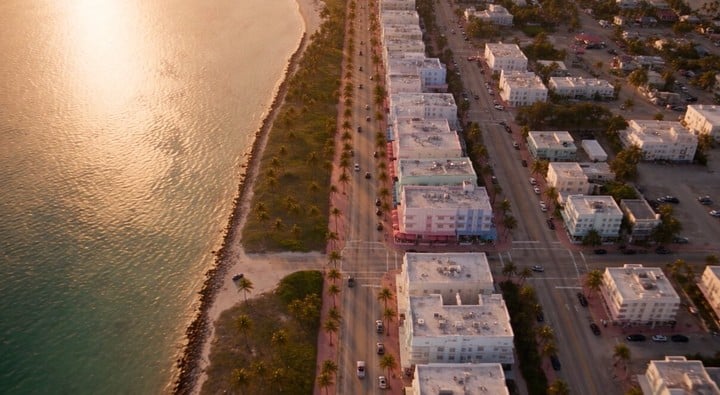
Throughout the full 30 seconds of visual progression, MAGI-2 showed almost no major problems, from the empty shot of Miami's sunny beach to the car chase tracking on the streets; the camera's breathing feel and various staging choices were all good.
Because MAGI-2 has autonomous camera planning capability even with brief prompts, even though we didn't specify in the prompt which second to push in or which second to drift, the model still worked out a reasonable camera progression rhythm and dynamic composition on its own.
We then asked it to generate a 30-second realistic cinematic-style short film, with the concept title "The Extreme Escape of an Orange." The entire film is a single continuous shot with no cuts and no time jumps, the camera always following the same orange, using realistic physical motion and continuous causality to tell a tense yet humorous kitchen escape.
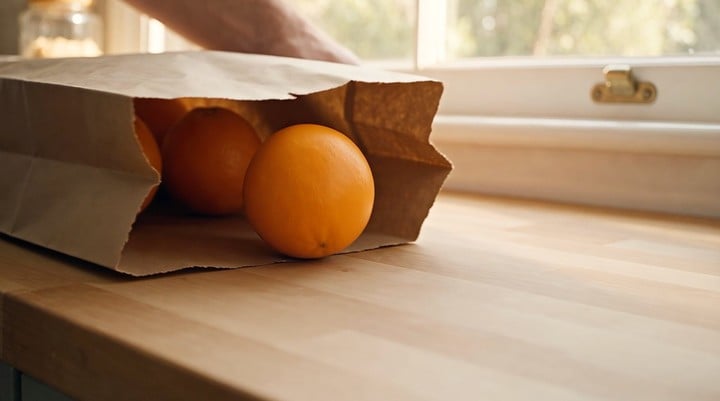
This time, unlike the GTA segment, thanks to MAGI-2's support for ultra-long context input of up to 20,000 characters, we directly wrote a script of over 1,700 characters, putting the kitchen's spatial layout, countertop obstacles, and the orange's every-second rolling trajectory, impact rebounds, and center-of-gravity changes all into the prompt.
Compared with the GTA case where we let the model arrange the camera itself, this time we wanted it to follow the script as closely as possible.
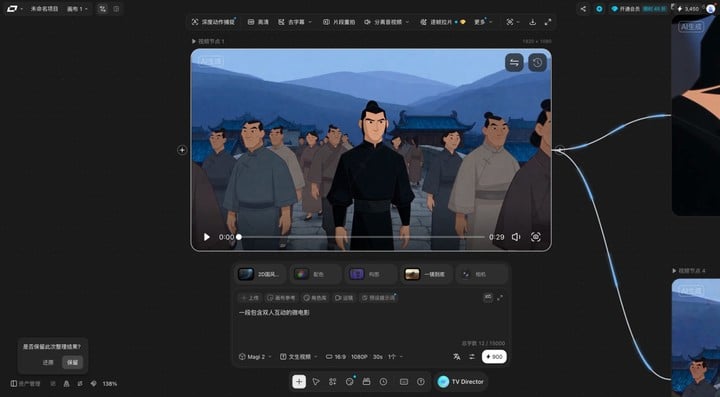
We also tried turning off the large language model's prompt enhancement feature (PE), inputting only one sentence, "a micro-film containing two-person interaction," then selecting "2D Chinese-style animation" from LibTV's cinematic style library, and choosing the "single take" camera movement style.
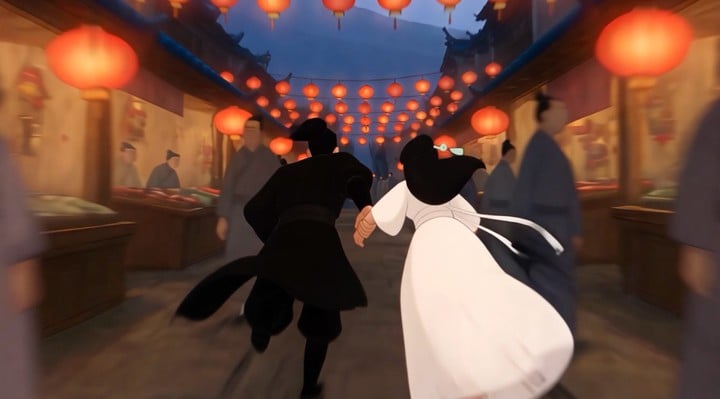
From GTA's street racing to an orange starting from a tabletop, and to an animated short without a subject, what MAGI-2 has to handle includes both continuity of scenes and actions and the rhythm of an entire story.
The native 30 seconds gives it more complete room to perform; we can arrange setup, change, and ending within a single generation. Brief prompts let the model fill in camera staging, while detailed scripts let us further specify actions and timing. This also means creators can decide how much work to hand to the model and how far they want to maintain control, depending on how mature their ideas are.
Protagonist, Camera Movement, and Rhythm All Have Reference Answers
When actually producing commercial ads and short dramas, text descriptions alone are often not enough. The client may require a specified model holding a specified product, using the camera movement style of a certain reference video, and switching shots according to a specific musical rhythm.
For such needs, MAGI-2 offers an all-around mixed reference feature. In a single generation, it supports inputting up to 10 images, 5 videos, and 5 audio clips at the same time, 20 assets in total, and allows creators to assign a clear role to each asset.
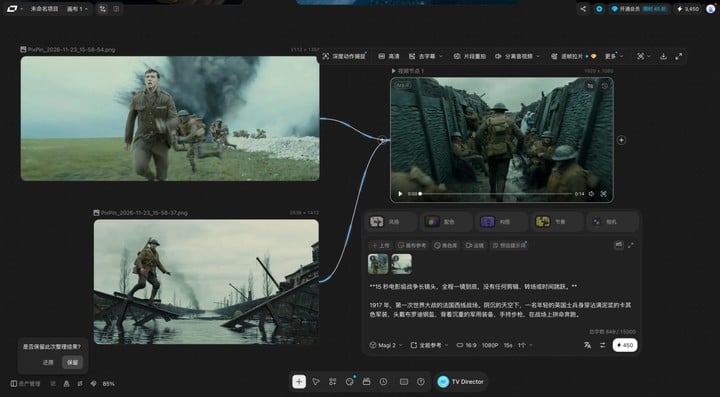
We first found a few film stills from the movie 1917, then uploaded them to MAGI-2 as all-around references, and added a rough scene description in the prompt: "15-second cinematic war long take, single continuous shot throughout, no cuts, transitions, or time jumps."
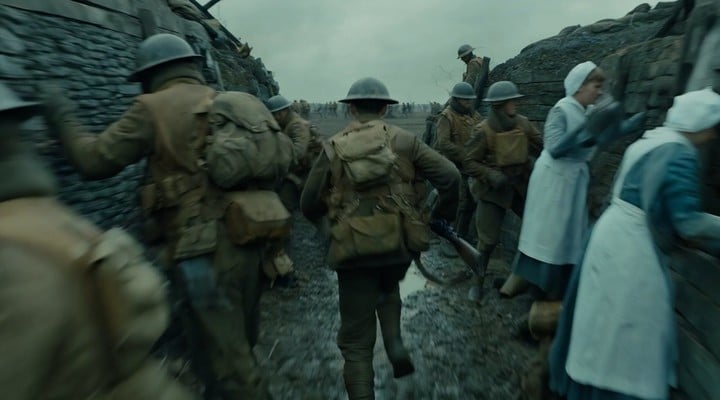
The generated video retained the visual atmosphere of a war film, and the visuals and sound effects were fairly coordinated.
This kind of all-around reference means the model must simultaneously remember the interrelated things in these reference images. On one hand, the model needs to draw on the visuals, and the generated scene must match the images we uploaded; on the other hand, the camera must learn to draw on the motion of the reference video.
Like this 30-second cinematic continuous long take in space, the model can learn that the camera is like an observer unbound by gravity, freely floating, orbiting, rolling, approaching, and moving away between the astronaut and the spacecraft.
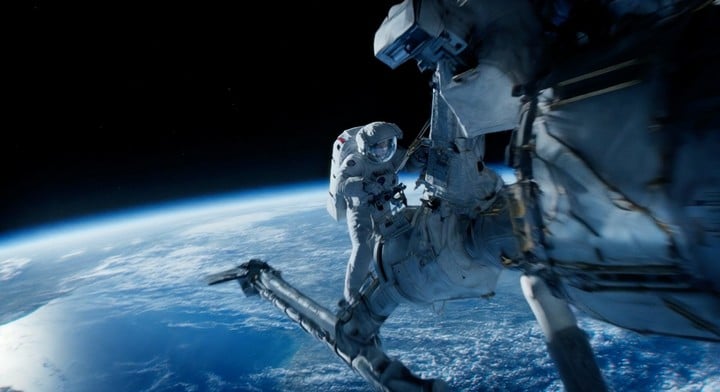
Compared with simply describing "cinematic camera movement," directly providing a reference video can hand the desired camera movement style to the model more concretely.
Finally, we further increased the complexity of the input assets, using multiple images, videos, and audio for mixed reference at the same time.
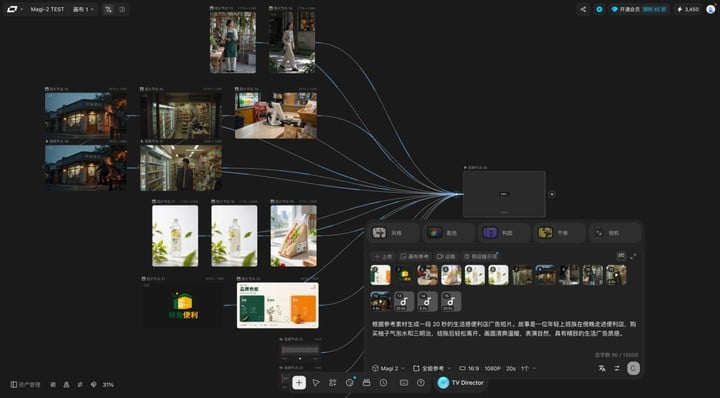
Whether it was the uploaded logo image, the convenience store scene, or the character's appearance, MAGI-2 basically preserved the features of the reference content. Throughout the process, simply providing the corresponding reference assets allowed the model to generate a complete video according to these requirements.
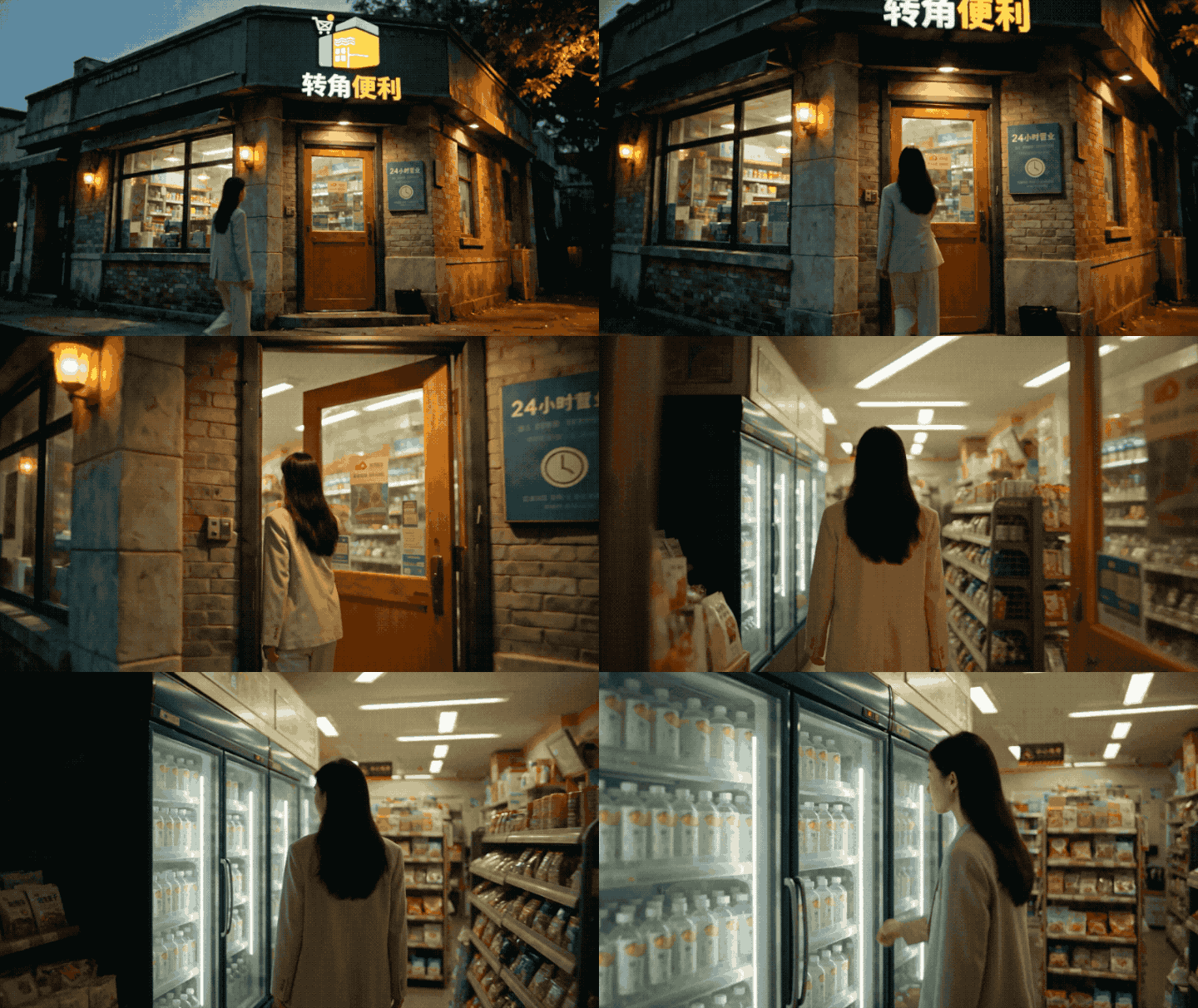
This is also the most noteworthy aspect of MAGI-2's all-around reference feature.
For advertising, e-commerce, and short drama production with clear visual requirements, creators can directly provide product images, character designs, action videos, and background music, reducing the work of repeatedly revising prompts just to describe the visuals.
Keep the Good Shots, Then Give the Creativity a New Style
Beyond video generation, we also tested MAGI-2's ability to modify existing videos.
The first task was to have the model change a roughly 15-second product spokesperson video from its original language into French and Italian respectively, while preserving the person's actions, camera, and visual composition as much as possible.
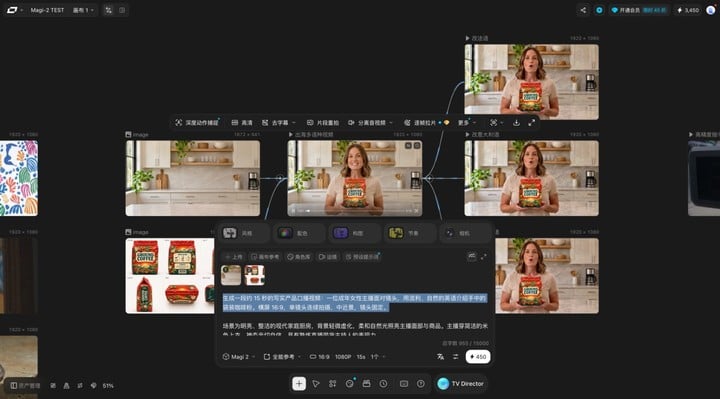
In the generated results, the host's lip movements could change with the language, while the original camera position, visual composition, and the person's body movements were basically preserved.
This kind of localized editing is very valuable for commercial video production. Especially for product ads that need to be distributed in different countries and regions, already-confirmed shots and character performances can continue to be used, with only the voice and lip movements adjusted.
[11月23日.mp4]
Beyond modifying existing videos, we also tested the model's ability to follow temporal instructions.
This time we asked MAGI-2 to generate a timer and, at the 3rd second, 5th second, and 7th second, have the display flash yellow, green, and blue in sequence.
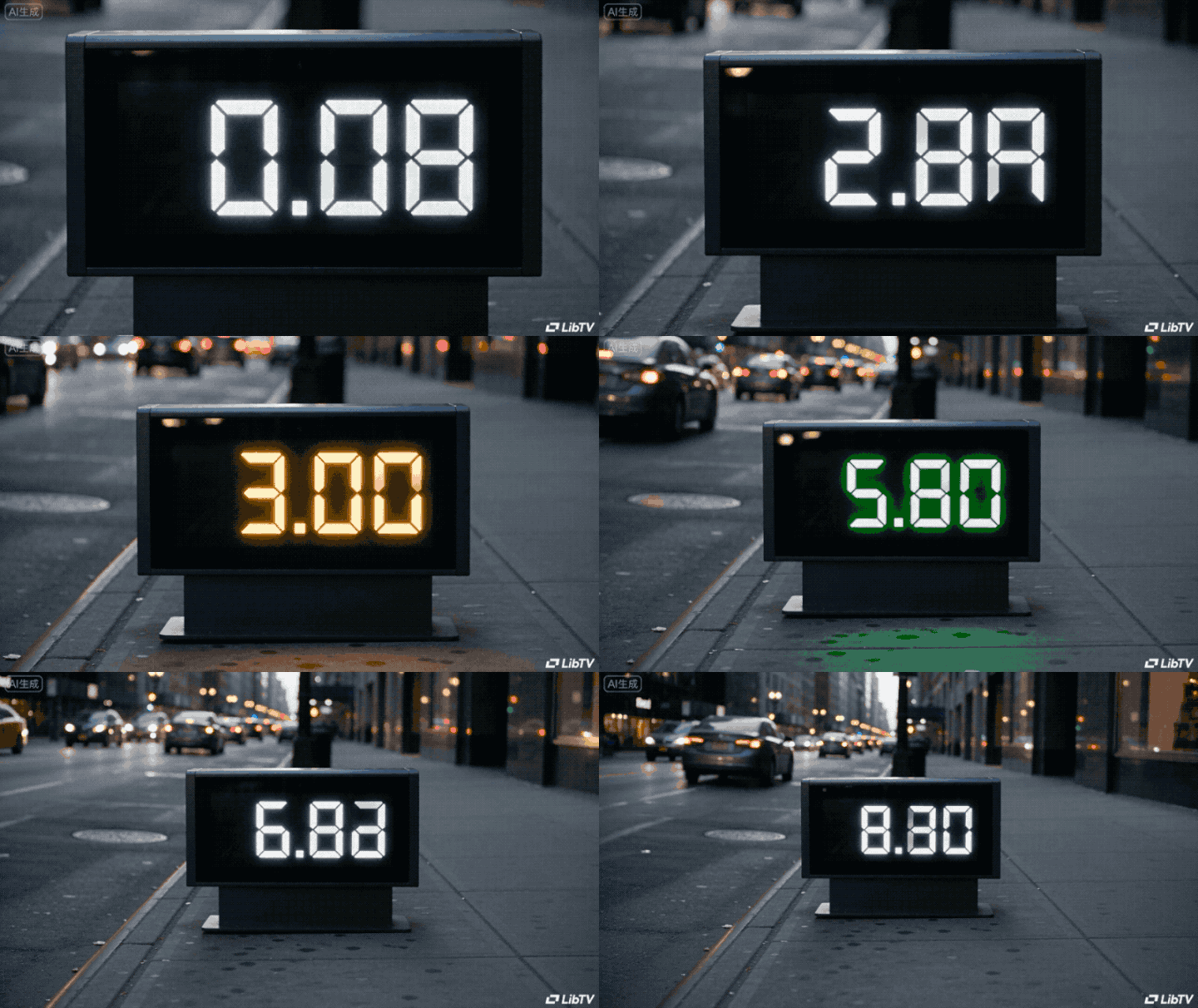
The generation results completed the color changes in the specified order, and several key time points also matched the prompt's requirements. For content that needs actions, effects, or visual changes to appear at specific times, this kind of control can reduce the hassle of repeated adjustments in post-production.
Even more surprising is that this precise control can also extend smoothly into global stylization.
In commercial projects, after we complete local edits and confirm that the motion and camera positions are perfectly correct, we often still need to create visual packaging for different channels. We can now upload an image, and MAGI-2 can generate a video in the corresponding style from that image.
First, referencing Matisse's "Parakeets and Mermaids," we asked the model to generate a 20-second handmade stop-motion animation.
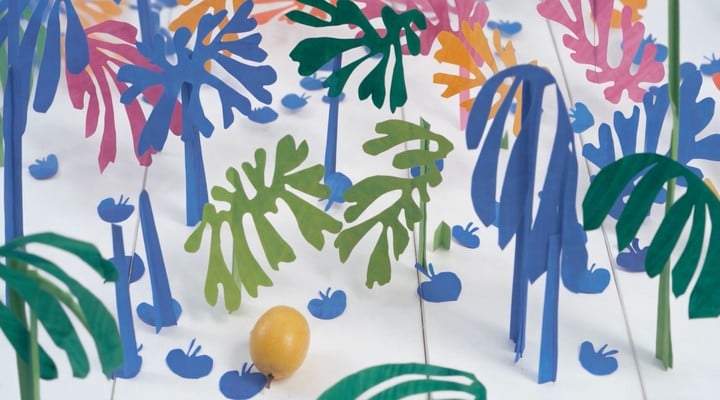
Prompt: Referencing the painted paper cutouts of Matisse's "Parakeets and Mermaids," create a 20-second handmade stop-motion animation. On a white paper surface, blue leaves lift up one after another, yellow fruits roll gently, and a paper-cut parakeet moves among them. The camera slowly descends from an overhead shot to paper-surface height, and the originally flat plants stand up layer by layer, turning into a paper-sculpture garden that can be walked through. The outline, color, and cutout notches of each leaf remain consistent. At the end, the camera rises again, and the entire garden reassembles into the opening flat composition.
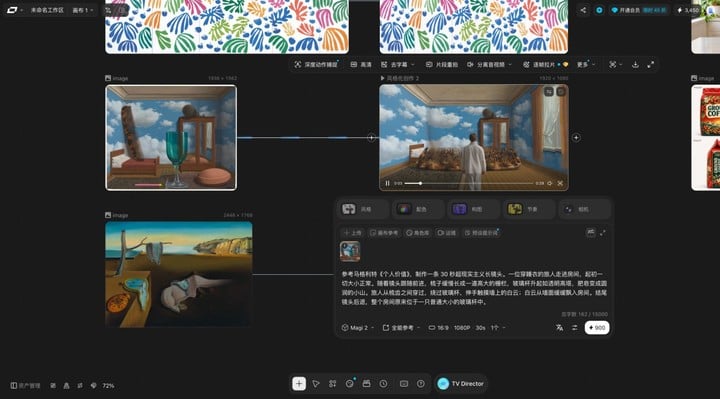
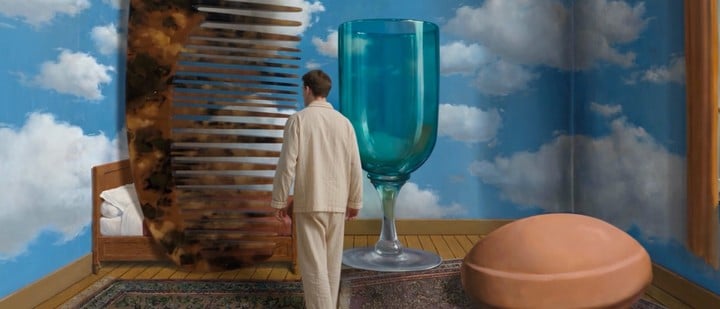
Next, we referenced Magritte's "Personal Values" and tried having the model generate a surreal scene in which object proportions keep changing.
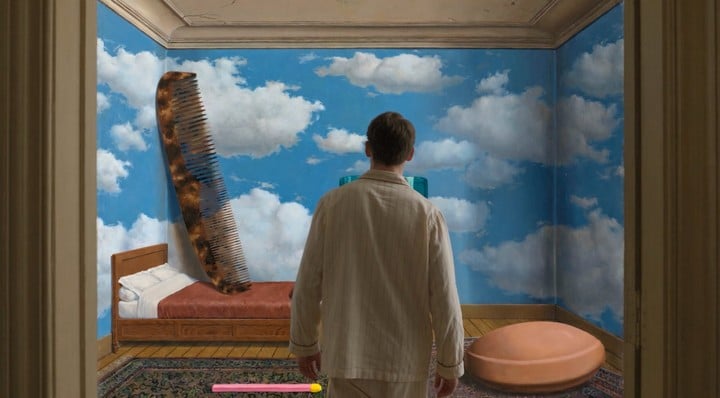
Prompt: Referencing Magritte's "Personal Values," create a 30-second surreal long take. A traveler in pajamas walks into a room, and at first everything is normal in size. As the camera follows forward, a comb slowly grows into a tall fence, a glass rises like a transparent tower, and a bar of soap becomes a rounded hill. The traveler passes between the teeth of the comb, walks around the glass, and reaches out to touch the white clouds on the wall; the clouds slowly drift from the wall into the room. At the end, the camera pulls back, and the entire room is revealed to be inside an ordinary-sized glass.
Compared with the earlier film references, these cases place a different kind of demand on the model. It needs to keep a specific artistic style while making the objects in the frame truly move. Especially in scenes like paper-cut leaves standing up layer by layer or everyday objects constantly changing size, the model also has to handle the spatial relationships before and after the objects change.
From local edits to multilingual spoken narration, to timing control for timers, to video generation in different artistic styles, MAGI-2 can already cover many of the steps in real creative work that require repeated adjustment.
For video production that requires repeated confirmation and continuous delivery, being able to preserve the parts that are already right directly affects the number of generations and the amount of post-production work.
How exactly does a video model that is ten times cheaper do it?
Another notable aspect of MAGI-2 is its technical roadmap from Preview all the way to the 480B official version.
On the data strategy side, as Sand.ai expanded its pretraining data 3x to 4T tokens (about 1 billion samples), it still preserved real data distributions such as multi-person interaction, complex motion, frequent shot changes, on-screen text, and complex sound fields as much as possible, and relying on a high-throughput data pipeline, it completed annotation of this scale of data within three weeks.
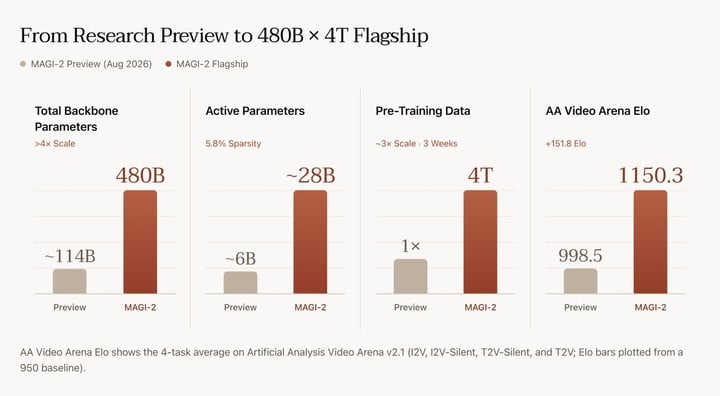
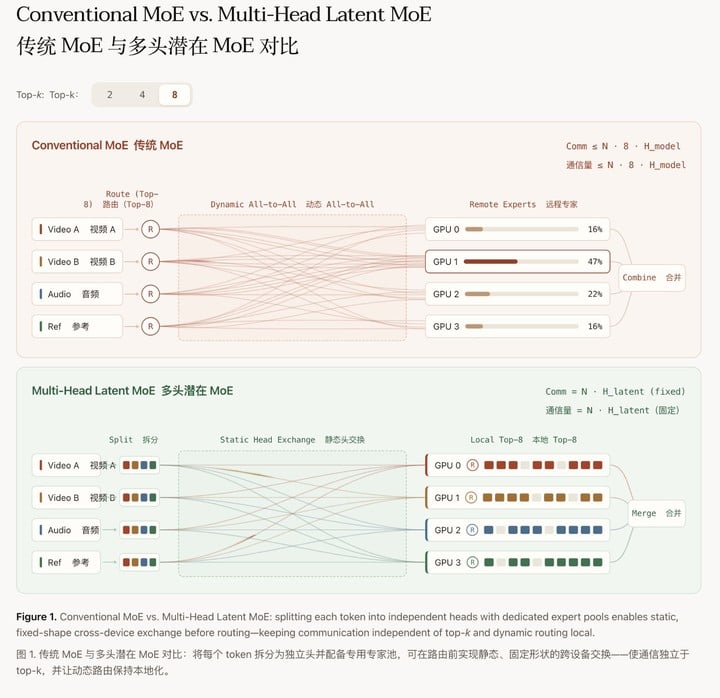
In terms of model architecture, MAGI-2 continues the single-stream architecture that handles text, video, and audio in a unified way, and expands its core backbone Multi-Head Latent MoE (Multi-Head Latent Mixture-of-Experts architecture) to 480B total parameters, while activating only about 28B parameters per inference.
Compared with traditional MoE, the greatest value of this architecture lies in being "easy to scale and free of congestion." In video training at tens of billions to hundreds of billions of parameters, video, audio, and reference materials are mixed together, and traditional MoE is prone to problems such as uneven cross-card communication load and idle compute.
Multi-Head Latent MoE splits the latent space into multiple independent subspaces, first completing cross-card exchange according to a fixed structure, then performing expert routing locally, completely eliminating communication fluctuations. Combined with system-level optimizations such as the in-house Head Parallel, MagiFSDP, MagiMoE, and MagiMuon, it achieves about 22% training acceleration at the 480B scale compared with LatentMoE.
It is worth mentioning that this technical roadmap has also completed adaptation to domestic compute platforms such as Hygon and Moore Threads. The joint design from data and architecture to the system layer not only supports MAGI-2's performance in complex video generation, but also provides the conditions for driving down inference costs.
But for ordinary creators, what is easiest to feel is still the change in generation price.
Beyond fifty cents a second, what else can open source bring
Based on the officially announced list price of 0.5 yuan/second for 1080p video, the base cost of generating a single 15-second video is about 7.5 yuan, and a 30-second video is about 15 yuan. Of course, the actual cost also needs to take into account retries after failed generations, as well as the specific billing methods for platform and editing features.
For a long time in the past, there has always been a clear gap between open-source video models and the world's top closed-source models. Open-source models are suitable for geeks to tinker with, but it is hard for them to go head-to-head with closed-source benchmarks on complex storytelling and commercial delivery.
If you want video quality close to that of top closed-source models, you often need to bear higher generation costs.
Now, with its performance topping the AA leaderboard for I2V and its actual generation quality, MAGI-2 already has the hard power to compete with the world's top closed-source models. As the model weights are officially opened to the community, the capability ceiling of the open-source video generation field will be raised to the Seedance 2.5 level.
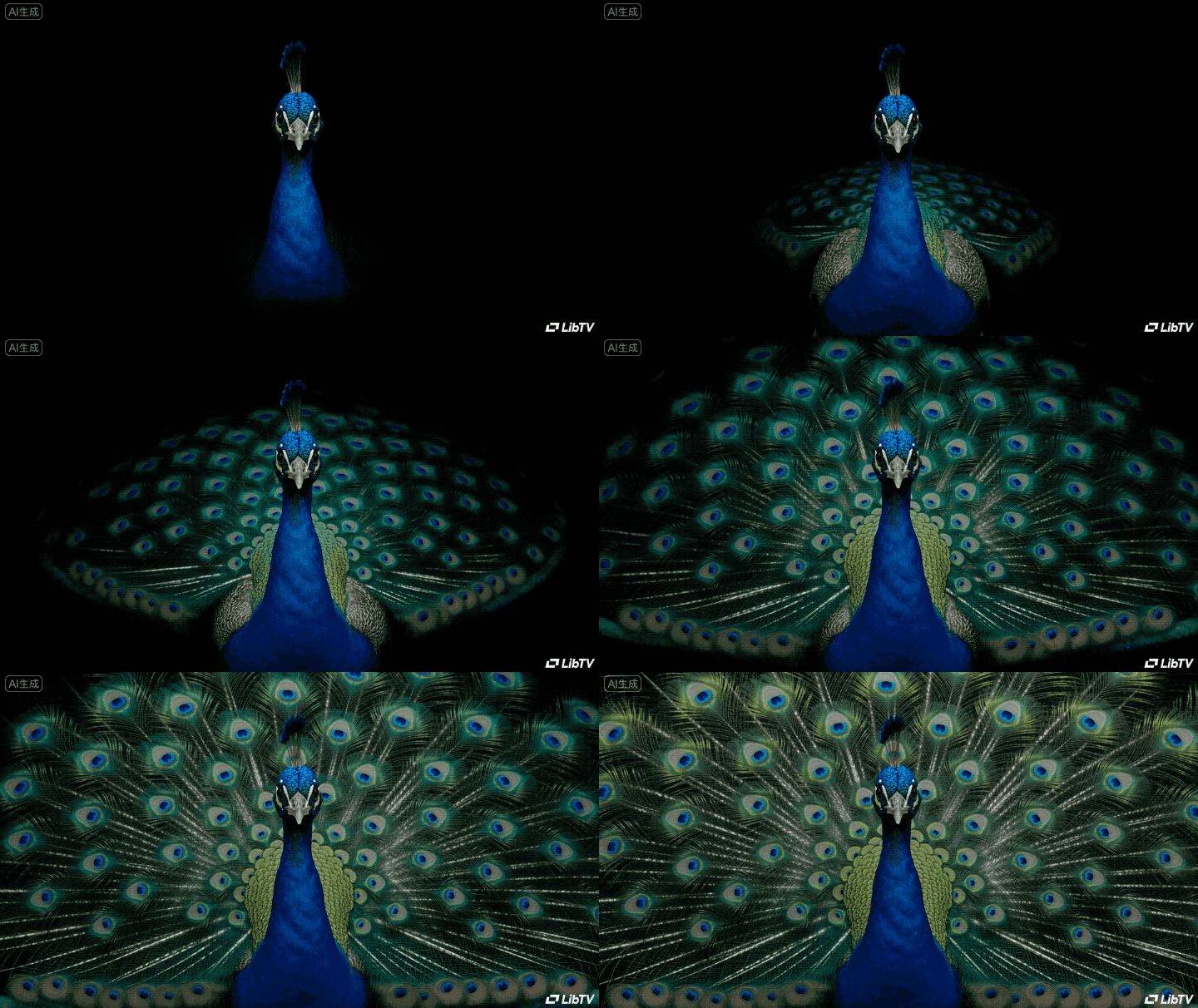
We can see that top-tier video generation capabilities are becoming cheaper and easier to obtain.
For creators who frequently use AI to generate videos, the price of 0.5 yuan/second gives us more room to experiment. Native 30-second generation, multi-material referencing, and precise editing give us the chance to keep the shots we are already satisfied with and modify only the parts we are not.
And the planned open-sourcing of the model weights will bring even more possibilities. Teams with technical capabilities can deploy it themselves and fine-tune it for specific scenarios, and developers can also build more tools around it that suit specific creative needs.
When generating a video is no longer so expensive, creators can also worry less about cost and spend more time trying different shots, stories, and ideas.
For film and television creators, a new era with unlimited possibilities is arriving.