 AIFeed
NIO Launches NOMI 4.0! 0.6-Second Ultra-Fast Response, Officially Entering the "Agent" Era
2026-11-25 18:47
Today is NIO's 12th birthday.
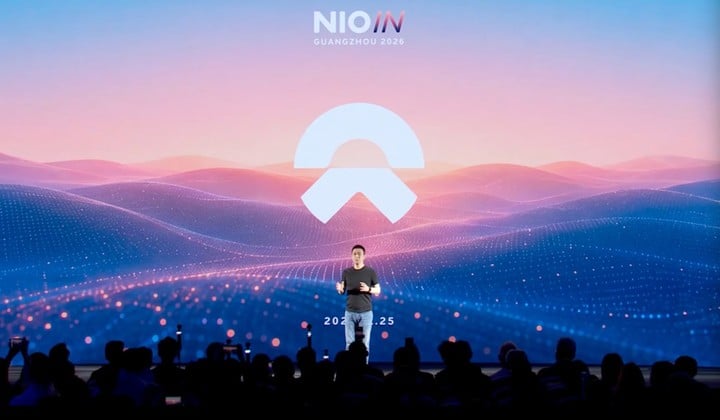
At this afternoon's NIO IN (NIO Innovation Technology Day), NIO talked about a lot. From organizational structure to the battery swap system, and from assisted driving to the voice assistant. But in reality, from start to finish they talked about only one thing: AI.
Over the past year, large models and embodied intelligent robots have absorbed nearly all the spotlight in the tech world, leaving the auto industry, mired in price wars, looking somewhat forlorn. Not long into his opening, NIO founder, chairman, and CEO William Li smilingly pierced that thin veil:
The auto industry hasn't been having a great time lately, with relatively high pressure all around. It feels like the spotlight has been stolen by AI, and industry confidence is a bit weak. Everyone feels that media folks covering cars might also be considering pivoting to AI media, right?
But in Li's view, this anxiety stems from failing to see the essence of the industry. In his eyes, the auto industry entered the era of Physical AI long ago—
Every smart electric vehicle inherently possesses the complete capabilities of perception, decision-making, and execution.

In fact, the Smart EV is the Physical AI industry with the largest unit value, the greatest user value, the largest industrial scale, and the greatest social value. There will be a great many embodied intelligent robots in the future, but for them to reach the scale of today's auto industry will take a very long time.
As the car becomes the core carrier of Physical AI, how should an automaker use AI to reinvent itself? This is the question on the mind of 12-year-old NIO.
When AI Enters the Organization
Li mentioned at the launch event that the global auto industry chain is worth between $7 trillion and $9 trillion. If AI can boost efficiency by 15%, that means more than $1.2 trillion in new value. But turning that calculation into business results requires far more than employees using a few AI tools.
More importantly, a comprehensive AI-oriented transformation of the company's organizational structure, business processes, and decision-making mechanisms is needed to convert AI's efficiency gains into real business results. Becoming an AI Native organization is the key to industry competition and transformation in the next stage.
NIO's solution is the six-layer "AI Native CBU Operation" architecture:
With AI infrastructure as the foundation, data assets are organized around specific operating objects (CBUs), connected to general-purpose and enterprise-proprietary large models, modeling business system capabilities, and ultimately turning them into thousands of Agents for operating entities (BUs) to invoke.
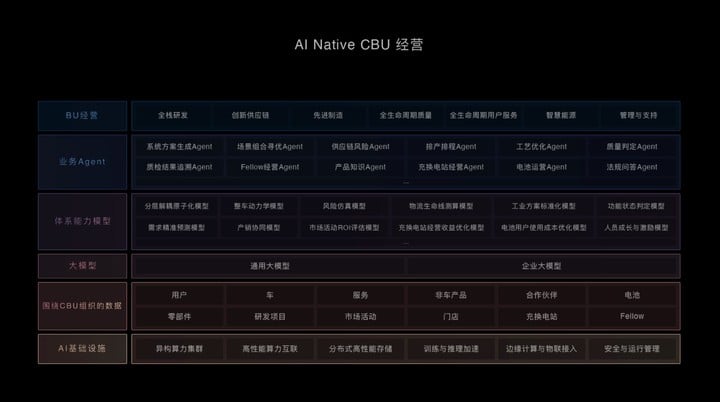
Since exploration began in 2023, NIO has launched over 7,500 Agents in the business management domain, with cumulative running instances exceeding 2.9 million.
Official data shows that compared with 2023, NIO's overall R&D efficiency has improved by 35% and per-capita efficiency by 13%; in the industrialization domain, the OTD on-time delivery rate reaches 99%, and inventory turnover has accelerated by 23%; in the user service domain, more than 9,750 Fellows (NIO user advisors) use the intelligent assistant "Mai Bao" to invoke Agents, with per-Fellow operating efficiency up 44.5% year-over-year and value creation up 8.1%.
After Li laid out the framework, NIO CFO and NIO Power head Qu Yu took the stage, using the most asset-heavy energy business to demonstrate how this system "saves money and makes money."
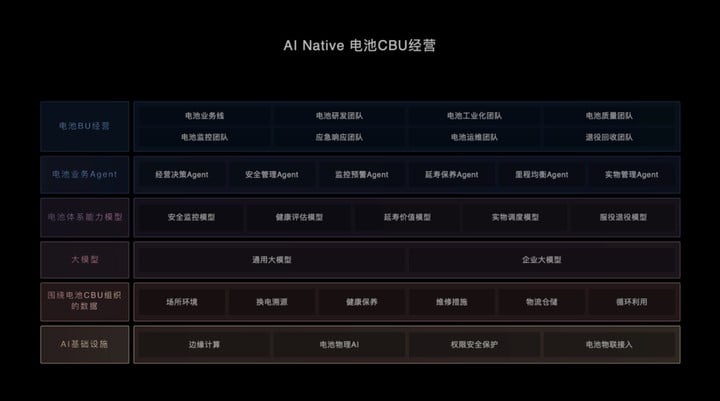
Currently, NIO Power manages 1.45 million batteries (original asset value exceeding 115.9 billion yuan) and 9,896 charging and battery swap stations, having provided over 236 million services cumulatively, with power supply about to surpass 10 billion kWh.
In Qu Yu's telling, the essence of AI Native is treating every battery and every swap station as an independent operating unit.
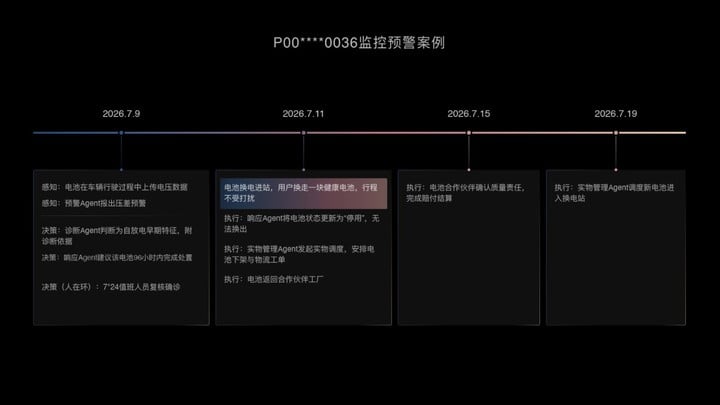
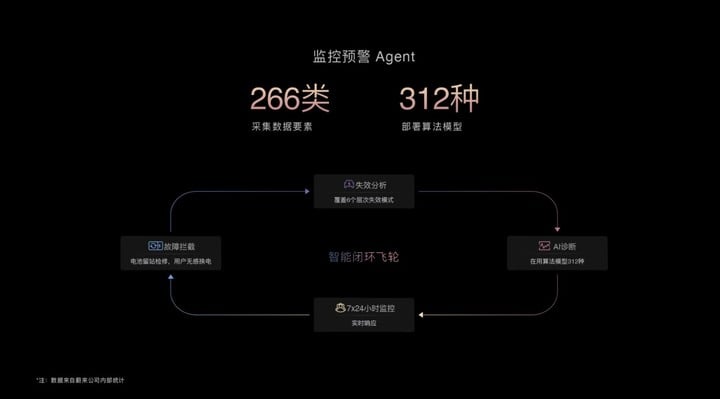
Take batteries as an example: each battery has a unique ID and a full lifecycle record. On July 9 this year, a monitoring and early-warning Agent discovered that a battery whose ID ended in "0036" had offline cell data. After review confirmed an early-stage hazard, it was immediately intercepted. The user, completely unaware, entered the station and completed an ordinary battery swap, while the hazardous battery was conveniently kept at the station and taken out of service.
The highest level of doctor treats illness before it arises; the highest level of safety is preventing trouble before it happens. All 1.45 million-plus batteries are managed at the same level of granularity.
This early-warning system, covering 266 categories of data and 312 algorithms, not only made NIO the first automaker in China to pass GB/T 45688 national standard testing, but also saves over 100 million yuan in losses each year. At the same time, a life-extension maintenance Agent customizes resting, slow-charging, and water-cooling strategies for each individual battery (sampled batteries' expected lifespan extended from 12.5 years to 14.2 years), adding approximately 814 million yuan in lifecycle value cumulatively since launch.
The same logic applies to the 9,896 charging and swap stations. Site selection, scheduling, and electricity price forecasting that once relied on expert experience are now codified into ten major models and eight business Agents.
AI Native is redefining the way we work: data speaks, models simulate, humans decide, Agents execute.
Site selection is based on a comprehensive ROI greater than 1. The intelligent site-selection Agent accounts for swap revenue, car-sales support, and brand value together—the Sinopec No. 10 station in Shanghai achieves an ROI of 3.34 from service revenue alone, while the Sailimu Lake station in Xinjiang, with only 7 users within 3 kilometers, reaches a comprehensive ROI of 2.3 when long-distance charging support and brand value are included.
In daily operations, single-day battery swaps exceeded 183,000 during the National Day peak, and the proportion of orders requiring no charging wait rose to 95.1%; the intelligent charging Agent raised valley-electricity utilization from 30% to nearly 50% within two years, absorbing an additional 505 million kWh of valley electricity. Combined with the fifth-generation swap station compatible with multiple brands, NIO Power has set its 2030 goals:
Manage over 300 billion yuan in battery assets, surpass 10,000 swap stations, and exceed 10 billion kWh in annual charging and swapping volume.
Physical AI Must Drive Like a "Seasoned Driver"
Returning to the vehicle product itself, the core task of Physical AI remains "driving." NIO Vice President of Smart Driving R&D Ren Shaoqing offered a set of figures:
As of now, NIO users' cumulative assisted driving mileage has reached 9.6 billion kilometers; its active safety system has not only avoided or mitigated over 9 million accident risks but also reduced accident safety losses by 38.43%. In addition, more than a thousand new vehicles roll off the line at NIO's factory every day and complete unmanned transport directly relying on the same software and hardware system as production L2.
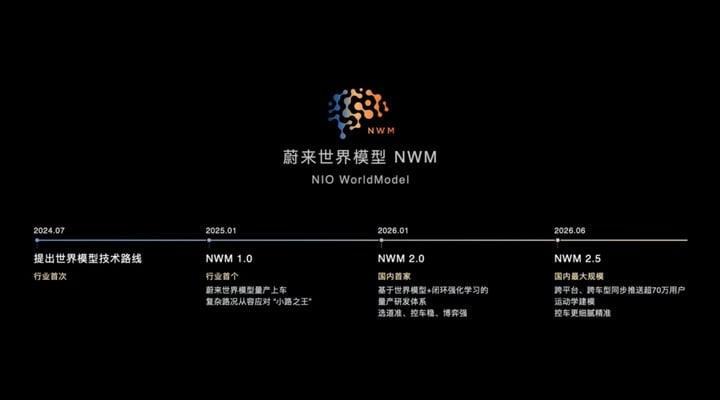
After first launching the world model NWM in 2024, releasing 2.0 with closed-loop reinforcement learning in January this year, and achieving cross-platform rollout to 700,000 vehicles with 2.5 in June, NIO officially released NWM 3.0.
In Ren Shaoqing's view, language models can tolerate a few seconds of latency, but at 100 km/h, 100 milliseconds of latency equals 2.8 meters—directly determining whether there's a crash or not. Around scaling physical intelligence, NWM 3.0 focuses on solving three challenges.
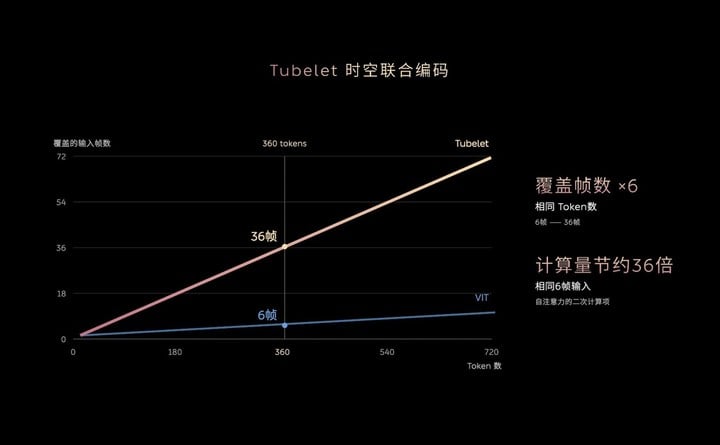
NWM 3.0 abandons traditional frame-by-frame independent processing and introduces 4D spatiotemporal compression and Tubelet spatiotemporal joint encoding, stitching and comparing 6 frames of images along the time dimension—not only shortening sequence length by 6 times but also reducing attention on-device compute by 36 times.
After deep integration with the Shenji chip toolchain and the self-developed chassis, chassis control latency is reduced by 78%, and average vehicle control latency by 54%; on the Cedar platform, response to pedestrian "ghost probes" (sudden dart-outs) is improved by 75.83%, and "dooring" by 44.85%.
Second is breaking the compute bottleneck. Facing the massive data generated daily by a million-vehicle fleet, NWM 3.0 uses Agent-based automated mining to boost data efficiency 3 times and expand training data volume 7 times.
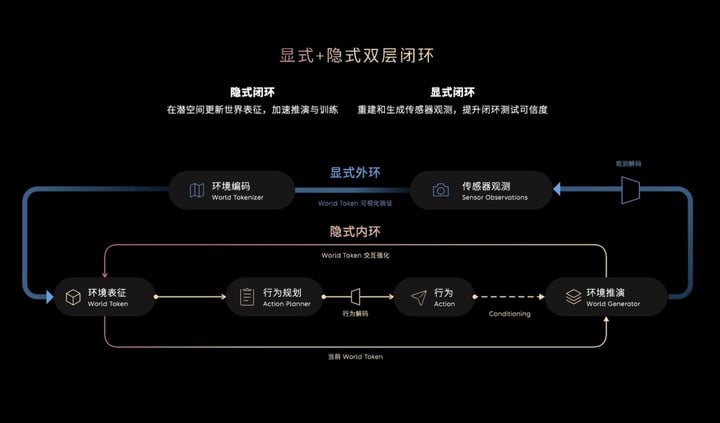
To address the resulting compute consumption, NIO introduced an implicit world model alongside the explicit video world model—removing video rendering and performing inference directly in the neural network's latent space, compressing each frame from 8 million pixels into thousand-level Tokens, achieving hundred-fold acceleration in training compute; the explicit world model was upgraded to 11 viewpoints, dedicated to closed-loop testing. Combining explicit and implicit closed loops boosted overall training efficiency 5 times.
Past reinforcement learning mainly relied on hard-coded rules written by engineers to score models, but under complex road conditions these rules often conflict with each other, and models tend to become conservative to avoid mistakes—on the road, this turns into the vehicle waiting forever in place.
A rule-based feedback mechanism is somewhat like a teacher who reads straight from the textbook. What we need now is a good teacher who teaches according to aptitude and adjusts dynamically.
This "good teacher" is the Reward Model introduced by NWM 3.0. Sharing an encoder with the driving model, it possesses predictive capability and long-range navigation memory, and is trained on "good/bad driving behavior pairs" collected by the million-vehicle fleet, teaching the car to choose when to maneuver around obstacles under the premise of safety.
Article title: NIO Releases NOMI 4.0! 0.6-second ultra-fast response, officially entering the "agent" era
Body:
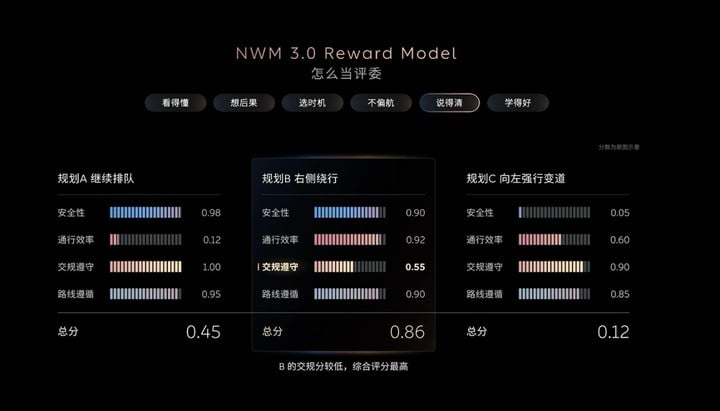
Ultimately, in complex scenarios, NWM 3.0 reduced the intervention rate by 40.38% compared with version 2.5, while the sense of reassurance increased by 59.65%. The new version will begin filing next month, and after approval, it will be fully rolled out across the four major platforms: Banyan, Cedar, Cedar S, and Coconut Plus.
NOMI 4.0 enters the "whole-vehicle agent" era
Li Tianshu, Vice President of NIO's Digital Systems, who took the finale, brought the entire launch event back to what NIO does best: emotion and warmth.
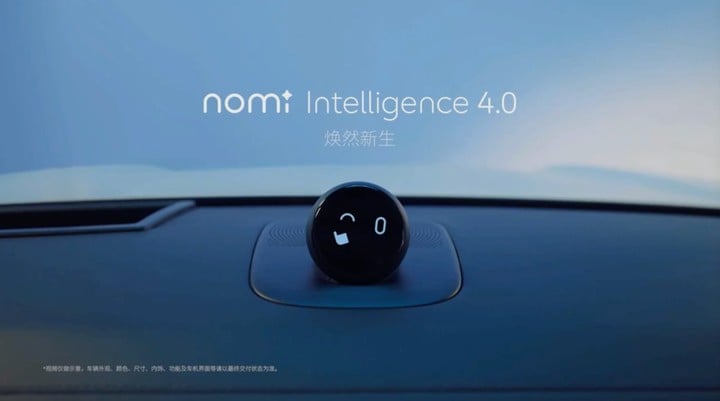
When the EVE concept car was unveiled in 2017, NOMI was born out of "Know Me." Entering the agent era, NIO decided at the beginning of this year not to patch things up, but to tear everything down and rebuild from scratch, bringing NOMI Intelligence 4.0.
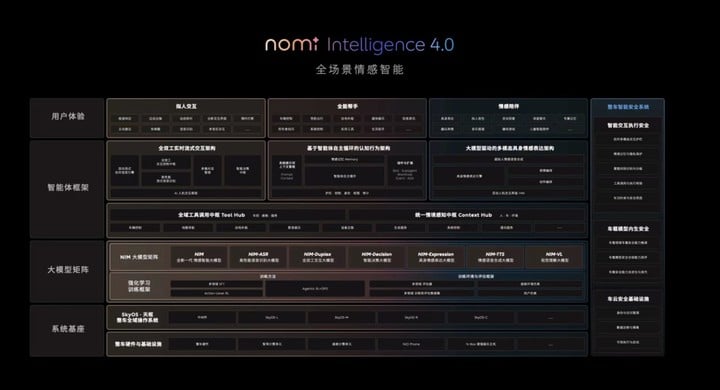
We use "reborn anew" to represent this technological upgrade. As you can see, it is a complete reconstruction—in plain terms, "all the code from the past nine years has been deleted."
The core of the "reconstruction" consists of two major pillars.
The first is the NIM emotional intelligence large model, which has over 100 billion parameters and adopts a MoE architecture.
Through closed-loop reinforcement learning with the industry-first "user and environment dual simulation simulator," this model raised the vehicle control task completion rate from over 40% to 95.3%, kept the first-token response in mass production within 0.6 seconds, and comprehensively led general large models in real in-vehicle evaluations.
The second is NIO's industry-first whole-vehicle native agent operating framework, NOMI Intelligence Harness.
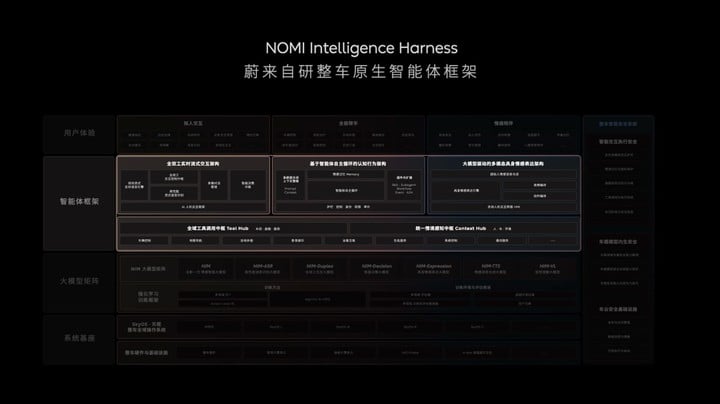
Through Agent Loop, it breaks the rigid rule-distribution model of traditional voice assistants, connects at the underlying level the Tool Hub (an all-domain tool hub) covering 22 major functional domains and the Context Hub (an all-domain contextual awareness hub) aggregating nearly 3,000 atomic pieces of information, and is paired with the NASS native security system, which achieved a 100% pass rate in both vehicle control and privacy evaluations.
In the on-site demonstration, when the user said they wanted to go home to pick something up, buy flowers, and then go to Hongqiao to pick someone up at the airport, NOMI not only planned a multi-stop route in one go, but also proactively asked for the flight number and, after discovering that the usual flower shop was in the opposite direction, automatically recommended a flower shop that was more on the way.
When the user wondered why the car always locks automatically when washing it, and why the air conditioning blows at the face with no airflow, NOMI could troubleshoot like a technician, identifying that auto-lock on leaving the vehicle and the front defog mode were taking up the airflow, and conveniently adjusted the settings for the user.
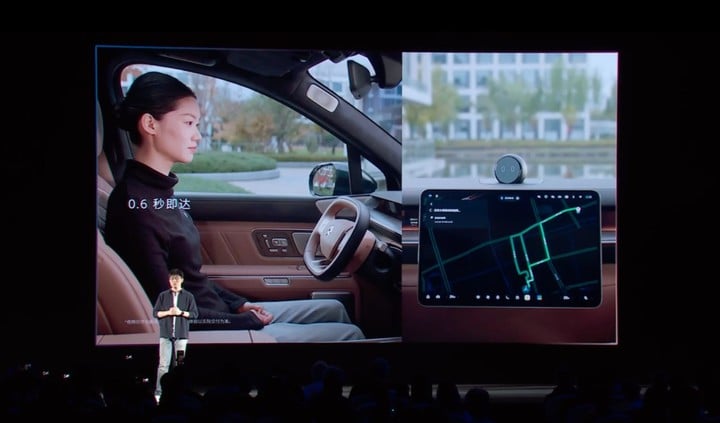
In terms of interaction, the self-developed full-duplex framework enables NOMI to "listen, think, and speak simultaneously," with end-to-end response speed more than twice as fast as 3.0, and high-frequency vehicle control completed in just 0.6 seconds. The self-developed speech recognition model, trained on more than 10,000 hours of road noise, greatly improved recognition in complex environments—on site, NOMI even chatted with the audience about tea drinking in fluent Cantonese.
And on the NOMI Mate physical unit that accompanies more than 800,000 households, the NIM embodied emotional expression large model freed it from "pre-made dish"-style fixed movements, enabling it to autonomously generate natural and appropriate expressions based on real human micro-expression data.
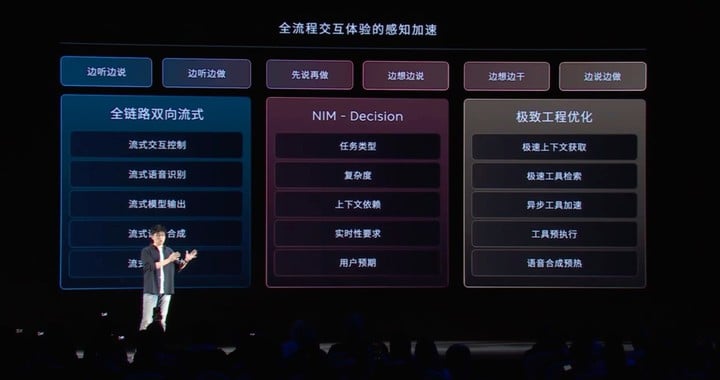
More importantly, NIO wrote eight positive behavior guidelines and six safety red lines into the model's underlying training and evaluation system:
When AI begins to make decisions autonomously, personality can no longer be merely an outward expression, but the value criteria behind every action and judgment. In doing AI, being a person comes first.
According to the plan, NOMI Intelligence 4.0 will be first rolled out in December with Cedar 2.0.0, support Cedar S and Banyan in Q2 2027, and subsequently gradually empower the ONVO Coconut system.
Twelve years ago, NIO bet on smart electric vehicles from zero; twelve years later today, facing the AI wave sweeping everything, NIO has proven with a pragmatic tech day that the automotive industry has not been left behind by the times.
Whether it is using 7,500 agents to refine company operations, or letting the world model learn to play the game in complex road conditions, for NIO, physical AI is not a concept that stays on the launch event stage—it must ultimately return to the company's daily operations and every trip users take.