 AIFeed
Main
The taxonomic classification of East Asian late Middle Pleistocene and early Late Pleistocene hominins has been a subject of intense debate. These hominins are consistently characterized by plesiomorphic features, including a long and low neurocranium with a thick vault, a massive supraorbital torus, a sloping forehead and a robust mandible with a retreating symphysis, combined with derived traits such as an enlarged cranial capacity, a highly arched temporal squama, reduced prognathism and simplified dental morphology2,3,4,5. Phenotypic and molecular evidence has increasingly aligned these hominins with Denisovans2,6,7,8. For instance, the Harbin and Xujiayao crania, the Bianfu Cave radius, and the Xiahe and Penghu partial mandibles have been classified as Denisovan on the basis of palaeoproteomic and/or mitochondrial DNA analyses1,4,6,7,8,9. Phylogenetic studies based on trait matrices have linked Harbin Denisovans to Dali, Jinniushan, Hualongdong and Xiahe, suggesting a potentially broader distribution of Denisovans across mainland East Asia2.
However, morphological heterogeneity persists among these hominins, for instance, cranial capacities of approximately 1,700–1,800 ml and a Neanderthal-like temporal labyrinth configuration and/or the presence of a suprainiac fossa in Xuchang and Xujiayao, and a round orbit in Maba10,11,12. Such variations have led to the proposal of distinct species, that is, pre-modern Homo sapiens, Homo juluensis and a Neanderthal-related lineage13,14,15,16,17. Moreover, most specimens attributed to the Denisovan assemblage have originated from northern and central China, with few contemporaneous hominin fossils reported from southern China, particularly subtropical regions. Thus, it remains unclear whether the East Asian late Middle Pleistocene archaic Homo represent only Denisovans or multiple lineages adapted to diverse environments across a vast territory.
Resolution of this question requires the discovery of more hominin fossils dating to the Denisovan period, especially from regions where such remains have not yet been reported. A comprehensive comparative study centred on such fossils should be conducted, incorporating a wide range of Eurasian Homo samples to establish a robust evolutionary framework for taxonomic identification. In addition to morphological comparisons, molecular analyses are essential for accurate taxonomic assignment. However, ancient DNA preservation is poor in the warm, humid conditions of southern China, particularly for late Middle Pleistocene specimens4,18,19. In such cases, palaeoproteomic analysis offers a vital complementary approach. This technology has been successfully applied to the identification of Denisovan specimens from diverse environments (including the Xiahe partial mandible4 and rib20 from the high-altitude Tibetan Plateau; the Penghu partial mandible6 from the Taiwan strait; the Bianfu Cave partial parietal bones, radius and teeth9 from southwest China; the Xujiayao cranium and mandible1 from north China; and the Harbin cranium7 from the plain of northeast China) and the phylogenetic placement of Homo antecessor (approximately 949–772 thousand years ago (ka)) and East Asian Middle Pleistocene Homo erectus21,22.
A group of hominin fossils has been recovered from two sites in Nanning (Chuanshandong in Long’an County) and Liuzhou (Longchuandong in Luzhai County) within the karst terrain of Guangxi, a region renowned for its rich Pleistocene mammalian fossils, during surveys of late Middle Pleistocene cave deposits by our interdisciplinary team since 2016 (Fig. 1 and Supplementary Fig. 1). These investigations spanned an area extending more than 500 km from Chongzuo City in the southwest to Guilin City in the northeast. The discovery of these new hominin remains in this area will be critical for clarification of the geographical distribution of Denisovans and assessment of whether multiple archaic Homo lineages existed in mainland East Asia during the Middle and Late Pleistocene.
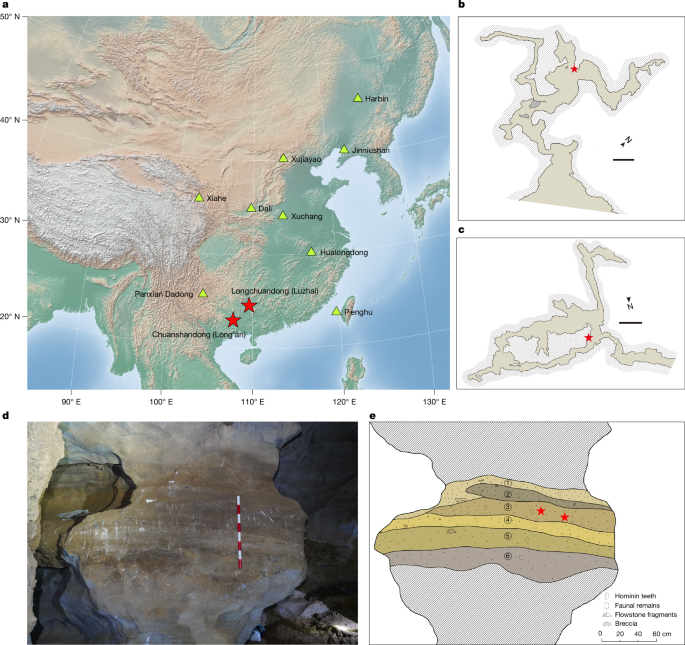
a, Geographical locations. b,c, Plan views of Chuanshandong in Long’an (b) and Longchuandong in Luzhai (c). d,e, Photograph (d) and schematic (e) showing stratigraphic deposition at Chuanshandong. Red stars in a indicate the locations of two cave sites in this study, while red stars in b, c and e indicate the locations where hominin teeth were recovered. Base map data in a from Natural Earth (https://www.naturalearthdata.com). Scale bars, 5 m (b), 10 m (c).
Here we present direct U-series dating results for hominin teeth from Chuanshandong and Longchuandong (more than 100.8 ka and 104.5–42.6 ka, respectively), the optically stimulated luminescence (OSL) ages of the hominin fossil-bearing layer (between 49.5 ± 2.6 ka and 34.2 ± 4.1 ka) and a biostratigraphic chronology based on the faunal assemblage (late Middle to early Late Pleistocene age, younger than 300 ka). To determine the taxonomic affinity of the hominins, we performed detailed morphological descriptions and comprehensive metric and non-metric comparisons with a broader range of Eurasian Homo specimens. In addition, we conducted palaeoproteomic analyses of hominin teeth and compared the results with published data from H. erectus, H. antecessor, Denisovans, Neanderthals and H. sapiens to further clarify the taxonomic affinity of these new hominins. The integration of these approaches will enhance our knowledge of the diversity of the East Asian late Middle Pleistocene hominins.
Locations, stratigraphy and chronology
Chuanshandong lies in the karst terrain of Long’an County, Guangxi (Fig. 1). Two hominin teeth and associated abundant mammalian teeth were recovered from layer 3 of an approximately 1.2-m-thick consolidated deposit adhering to the cave walls of the western chamber entrance, the bottom deposit of which was eroded (Fig. 1, Supplementary Text 1 and Supplementary Fig. 1). The sedimentary sequence consisted of the following six layers, from top to bottom: yellowish-brown sand (layer 1), consolidated brown calcareous-cemented sand (layer 2), greyish-brown sandy silt (layer 3), yellowish-brown brecciated sand (layer 4), brown gravel-bearing clayey silt (level 5) and yellowish-brown gravel-bearing silt (level 6). The two hominin teeth were separated from each other by approximately 5 cm vertically and 20 cm horizontally within layer 3. The deposit in layer 3 consisted of homogeneous, fine-grained particles without lamination, with grain-size and size distributions similar to those of modern soil near the cave entrance. They were all polymodal, mostly dominated by the clay fraction with very low proportions of particles larger than 63 μm (less than 8.4%) and relatively low percentages of coarse fraction (Supplementary Fig. 2 and Supplementary Table 1). This suggested that the deposit of layer 3 was derived from the modern soil outside and transported by low-energy, intermittent and short-term water activity. The hominin and mammal fossils from layer 3 were dominated by isolated teeth and may have been transported gradually into the inner cave by slope gravitation resulting from a depth gradient of approximately 5 m between the cave entrance and the burial location of the teeth. Therefore, the burial age of the fossils may substantially lag behind their true age.
Longchuandong is situated in the karst landscape of Luzhai County, Guangxi (Fig. 1). Two isolated hominin teeth and numerous faunal remains were discovered in the brownish-yellow clay (Fig. 1, Supplementary Text 1 and Supplementary Fig. 1). Given that most fossils from Longchuandong are isolated teeth, the fossils were highly likely to have been sorted and transported into the deep cave by water. No stone artefacts or other cultural relics were associated with hominin fossils at these two sites.
To estimate the ages of these hominin teeth, we applied both laser-ablation-based and classic isotope-dilution-based U-series dating analyses to the hominin and associated mammalian teeth (Supplementary Text 2, Supplementary Figs. 3–5 and Supplementary Tables 2 and 3). The lower right third premolar (P3) from Chuanshandong yielded laser ablation U-series ages ranging from 72.2 ± 1.4 ka to 63.8 ± 1.3 ka and an isotope-dilution-based age of 62.1 ± 0.3 ka. The left P3 yielded laser ablation U-series ages ranging from 109.2 ± 2.7 ka to 97.7 ± 4.6 ka and an isotope-dilution-based U-series age of 100.8 ± 0.2 ka. These two P3s could have originated from one individual, considering their similar morphology and degree of occlusal wear (minimum number of individuals = 1). The isotope-dilution-based U-series age of 100.8 ka thus provides a minimum age for the Chuanshandong. This age was also included in the range of the laser-ablation-based U-series ages of the associated mammal teeth (211.1–37.8 ka) (Supplementary Figs. 6–8 and Supplementary Table 4). However, the OSL ages of the hominin fossil-bearing layer in Chuanshandong ranged from 49.5 ± 2.6 ka to 34.2 ± 4.1 ka; that is, they were significantly younger than the U-series ages of the hominin teeth and most mammalian fossils, suggesting slow transportation or delayed burial of these materials (Supplementary Text 3, Supplementary Fig. 9 and Supplementary Table 5).
The upper right second molar from Longchuandong (M2) yielded laser-ablation-based U-series ages of 46.9 ± 2.2 ka to 37.7 ± 2.0 ka and an isotope-dilution-based age of 42.6 ± 0.4 ka, whereas the lower right fourth premolar (P4) from the same layer returned laser ablation ages of 111.0 ± 3.6 ka to 96.7 ± 3.5 ka and an isotope-dilution-based age of 104.5 ± 0.4 ka. These ages fell within the range of the laser-ablation-based U-series ages of the associated mammal teeth (160.4–30.1 ka) (Supplementary Figs. 10 and 11 and Supplementary Table 6). Associated faunal remains from both sites represented a typical Ailuropoda-Stegodon fauna (Supplementary Figs. 12 and 13). The presence of Elephas maximus and Tapirus indicus, together with the relatively small tooth size of Ailuropoda in Chuanshandong and T. indicus in Longchuandong, all indicate a late Middle to Late Pleistocene age (younger than 300 ka). Despite the limitations of each dating method, the integration of U-series, OSL and biostratigraphic context supports a Middle and Late Pleistocene age for the Chuanshandong and Longchuandong hominins.
Dental morphology
We described the dental morphology of a pair of P3s from Chuanshandong and one P4 and one M2 from Longchuandong and compared them with a broad range of Homo specimens (including H. erectus, East Asian late Middle Pleistocene archaic Homo, Denisovans, Neanderthals and H. sapiens) to determine their taxonomy (Fig. 2 and Supplementary Tables 7–11). These materials occupied an intermediate morphological position between H. erectus and H. sapiens, characterized by a mosaic of dental traits and the absence of autapomorphic Neanderthal features. Nevertheless, the two assemblages exhibited distinct phenotypic profiles.
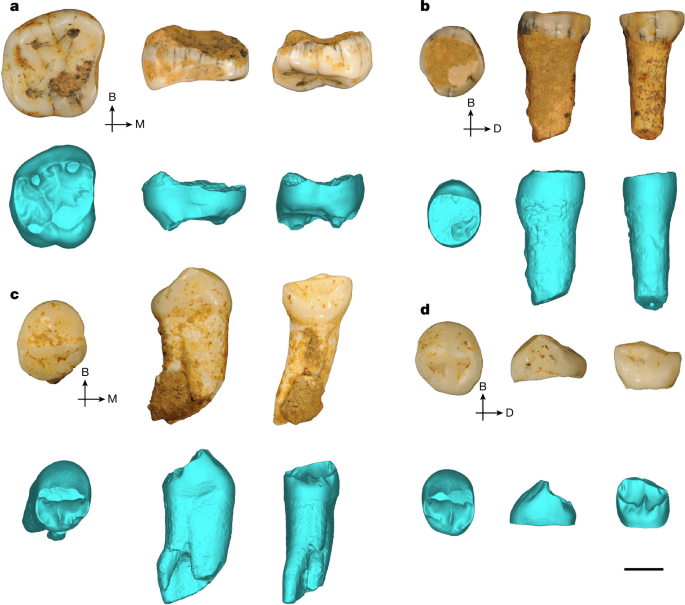
a,b, Longchuandong M2 (a) and Longchuandong P4 (b) from Luzhai. c,d, Chuanshandong left (c) and right (d) P3s from Long’an. The fossils and virtual reconstructions of the EDJ (shown in cyan) are displayed in the following order: occlusal, mesial and lingual views. B, buccal; M, mesial; D, distal. Scale bar, 5 mm.
The first phenotypic pattern was represented by the P4 and M2 of Longchuandong hominins. These individuals resembled the East Asian late Middle Pleistocene archaic Homo with respect to both M2 and P4 morphology and exhibited notable affinity to Denisova 4 from Denisova Cave (Altai) in terms of M2 characteristics (Figs. 2 and 3, Supplementary Text 4 and Supplementary Figs. 14–17). Their P4s shared an approximately symmetrical buccal and lingual contour (unlike the mesiobuccal protruding contour typical of H. erectus and distolingual protruding contour typical of Neanderthals) and non-tapering roots (distinct from the tapering roots of H. sapiens)3,23,24 (Supplementary Fig. 17). Their M2s had comparable hypocone size, similar enamel–dentine junction (EDJ) shape and a non-dendritic EDJ surface, distinct from the tall crown topography and the absence of a hypocone or only ridge-like hypocone of H. sapiens, and from the symmetrically trapezoidal EDJ viewed occlusally and dendritic EDJ surface of H. erectus23,25,26,27,28,29,30,31 (Fig. 3, Supplementary Fig. 15 and Supplementary Table 12). The Longchuandong M2 did not exhibit clear variation compared with Neanderthals, especially in diffeomorphic surface matching analyses of EDJ shape (the typicality probabilities of being classified as Neanderthals were 42.13% and 39.11% in the between-group principal component analysis and canonical variate analysis, respectively), although Neanderthals tend to be characterized by a more skewed M2 crown viewed occlusally and a higher occurrence of transverse crest (23.5% in early and late Neanderthals)28,32 (Fig. 3 and Supplementary Table 12). In particular, the Longchuandong M2 most closely resembled Denisova 4 from Denisova Cave (Altai) when all dental features analysed were considered, including the two-dimensional crown outline shape and three-dimensional EDJ shape, in addition to the crown size, relative hypocone size and degree of elevation of the crista obliqua, which overlap among different taxonomic groups to varying degrees33,34,35 (Supplementary Figs. 15, 18 and 19).
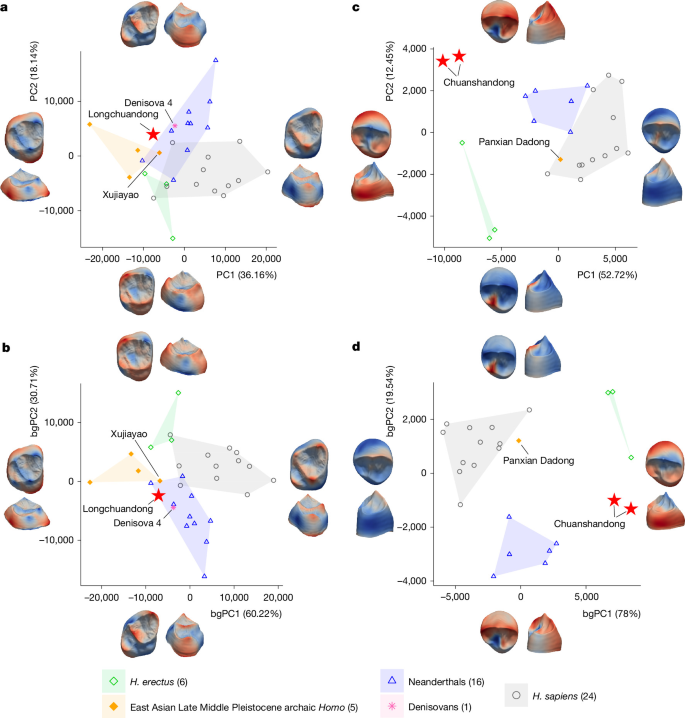
a,b, Bivariate plots of principal component 2 (PC2) against PC1 (a) and between-group principal component 2 (bgPC2) against bgPC1 (b) based on the diffeomorphic surface matching analysis of the EDJ of the Longchuandong M2 (Luzhai) compared with other samples. c,d, Bivariate plots of principal component 2 (PC2) against PC1 (c) and between-group principal component 2 (bgPC2) against bgPC1 (d) based on the diffeomorphic surface matching analysis of the EDJ of the two Chuanshandong P3s (Long’an) compared with other samples. The magnitude of displacement between the global mean shape and each extreme conformation is shown as a colour map from dark blue (contracted) to red (bulged).
The second phenotype was represented by the paired P3s of the Chuanshandong hominin and did not align well with any established East Asian Homo member. These samples retained an erectus-like short EDJ that could be clearly distinguished from that of Neanderthals and H. sapiens and a complex root system with approximately constant root breadth from cervix to apex, which is normally found in H. erectus (for instance, the single Tomes’s root with bifurcated apex in Zhoukoudian and two-rooted pattern in Sangiran) but rarely occurs in Neanderthals or H. sapiens28,36,37,38,39 (Figs. 2 and 3, Supplementary Text 4, Supplementary Figs. 20–22 and Supplementary Table 13). However, the Chuanshandong P3s exhibited derived traits that were shared with other later Homo and distinct from those of H. erectus: reduced crown asymmetry, less pronounced distolingual protrusion, a lingually displaced polygon area, absent metaconid apex (probably sharper protoconid dentine horn) and a less crenulated mesial vertical groove on the buccal surface40,41. They were distinguishable from the East Asian late Middle Pleistocene archaic Homo from Panxian Dadong, which falls within the H. sapiens range, with a slightly asymmetrical crown and tall EDJ topography, despite a non-tapering root42 (Fig. 3 and Supplementary Fig. 22).
Palaeoproteomic analysis
To provide molecular evidence for taxonomy and sex attribution, we conducted ancient protein extraction on three of the hominin samples: Longchuandong M2, Longchuandong P4 and Chuanshandong right P3. After searching against the Hominidae enamel database, we removed peptides that were detected in the extraction blank or attributed to contaminant proteins to control contamination from the experiment; this resulted in 2,894, 2,038 and 2,099 identified peptides for the three samples, respectively. The endogeneity of the proteome was supported by high deamidation rates of asparagine and glutamine, as well as relatively short peptide length caused by degradation (Fig. 4). We evaluated the replicate consistency by calculating the shared and specific peptide counts between two runs of liquid chromatography coupled with tandem mass spectrometry (LC–MS/MS) for each fraction from these teeth, as well as two fractions from Longchuandong P4 (Supplementary Table 14). Although more than 50% of total peptides were shared, indicating some replicate consistency, specific peptides from each run or fraction accounted for 40% or more in total; this demonstrated the necessity of conducting multiple runs or collecting multiple fractions to improve the coverage of recovered proteome. To avoid misassignment, we removed peptides matching multiple genes, and a typical enamel-specific proteome was retrieved from the three hominin samples (Supplementary Table 15). Abundant amelogenin, Y isoform (AMELY)-specific peptides indicated that all were from male individuals. We further inspected the phylogenetically informative single amino acid polymorphisms (SAPs) to determine their population assignments by validation with BLASTp, assessment of peptide depth across three software tools, evaluation of spectral quality and quantification of deamidation rates (Methods, Table 1, Supplementary Text 5, Supplementary Table 16, Supplementary Data 1 and 2 and Supplementary Figs. 23–28).
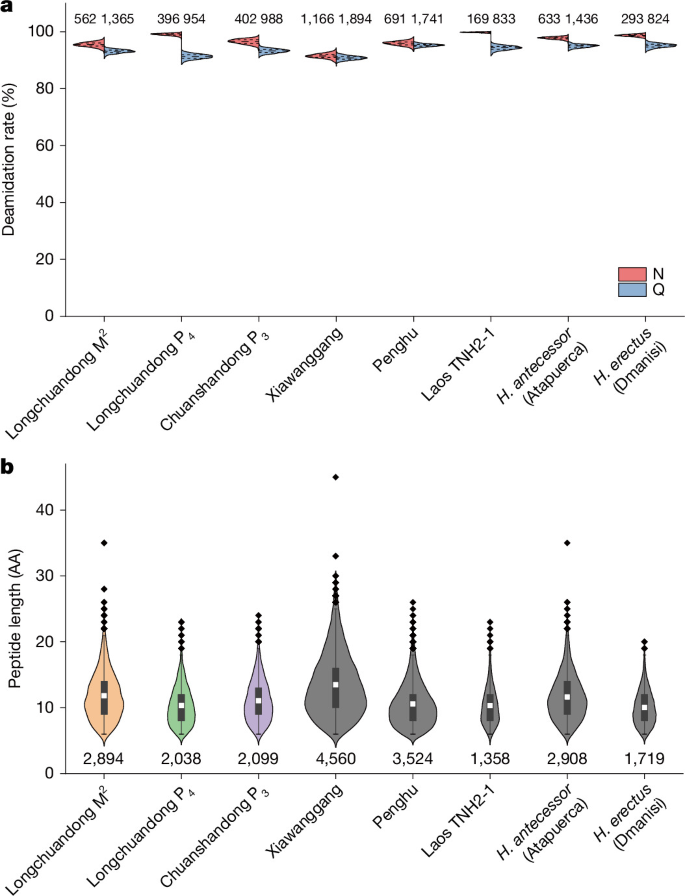
a,b, Deamidation patterns (a) and peptide length distributions (b) of three hominin samples compared with the published proteome6,21,46. The data analysis process for published archaic individuals was the same as that used for the Chuanshandong and Longchuandong samples, except that for Laos TNH2-1, H. antecessor (Atapuerca) and H. erectus (Dmanisi), we used an expanded database with the main dentine collagens (COL1A1, COL1A2 and COL2A1). In a, values were derived from 1,000 bootstrap replicates of sequence deamidation. Numbers of peptides containing N or Q with valid intensity are shown for each sample. In b, numbers of peptides are also indicated. In b, box plots represent the range of the data; box edges show the lower and upper quartiles, white squares in the boxes represent median values, and whiskers extend to 1.5 times the interquartile range, with black diamonds representing outliers beyond this range.
图表:Table 1 The details of SAPs within Homo identified in three hominin samples
Both the Longchuandong M2 and P4 exhibited ameloblastin (AMBN) 273V (55 and 59 supporting peptides; Table 1), which is shared with East Asian Middle Pleistocene H. erectus, Harbin, Penghu, Bianfu Cave, Denisova 25 and Denisova 3, and with some H. sapiens from Southeast Asia and Oceania with high levels of Denisovan introgression6,9,22,43,44,45. In phylogenetic analysis, the two Longchuandong samples were grouped with Denisova 3 with 100% support (Supplementary Text 6 and Supplementary Fig. 29). Given the age of the samples and the morphological similarity between the Longchuandong M2 and Denisova 4 from Altai Denisova Cave, the Longchuandong samples are likely to represent a Denisovan-affinity lineage in south China.
Unlike the two Longchuandong samples, Chuanshandong carried a SAP, AMBN 253G, supported by nine peptides (Table 1), among which seven peptide-spectrum matches (PSMs) had a complete series of y- and b-ions surrounding the SAP. This SAP has been reported in three groups of late H. erectus from Zhoukoudian, Hexian and Sunjiadong22, but all other comparative specimens in Hominidae present AMBN 253A, including H. antecessor from Atapuerca21, H. erectus from Dmanisi21, Harbin7, Penghu6, Bianfu Cave9, TNH2-1 from Laos46, Denisova 3 (ref. 43), Denisova 25 (ref. 45), 9 Neanderthals47,48,49,50,51,52, Ust’-Ishim53, H. sapiens and non-human great apes. In addition, AMELY 179M, an ancestral variant that is shared with H. antecessor21 and non-human great apes but not with H. sapiens, Neanderthals or the Denisovan clade, was also identified in Chuanshandong with seven supporting peptides (Table 1); among these, two PSMs had two b-ions bracketing the SAP, and eight PSMs had one b-ion when the SAP was located at the amino terminus. Phylogenetic analysis showed that Chuanshandong formed a sister group to the common ancestors of Neanderthals, Denisovans and H. sapiens (posterior probability: 100%; Supplementary Fig. 29). The integrated evidence indicates that Chuanshandong may belong to a lineage distinct from the Denisovan in mainland southern China.
Discussion
The scarcity of hominin fossils from subtropical southern China during the Middle to Late Pleistocene transition has hampered our understanding of the geographical distribution of Denisovans and the potential existence of other Homo lineages in mainland East Asia. Here we report 4 isolated hominin teeth from Guangxi (Chuanshandong and Longchuandong), dated to at least 100.8 ka and 104.5–42.6 ka, respectively. These ages establish the specimens as contemporaries of northern Denisovans (approximately 300–45 ka)4,7,8,20,54,55 that provide important fossil evidence of non-sapiens Homo in subtropical regions adjacent to southeast Asia during this interval. Although both the Chuanshandong and Longchuandong hominins exhibited a mosaic of plesiomorphic and derived traits, palaeoproteomic analysis revealed variations in AMBN 253 and 273, as well in as AMELY 179, which allowed phylogenetic placement of these samples. The results indicate that at least two non-sapiens Homo populations may have existed in southern China’s subtropics during the Middle and Late Pleistocene.
Among these diverse populations, the Longchuandong materials provide compelling evidence for the presence of a Denisovan-affinity population in subtropical southern China. Compared with H. erectus and H. sapiens, the Longchuandong more closely resembled other East Asian late Middle Pleistocene archaic Homo, Altai Denisova 4 and Neanderthals with respect to M2 morphology but could be differentiated from Neanderthals by its P4 features. These two specimens carried the AMBN 273V variant found in Harbin, Penghu, Bianfu Cave and Altai Denisovans, whereas Neanderthals and most H. sapiens carry the AMBN 273M variant6,7,9,43,44,47,48,49,53. These integrated morphological and molecular data together support the identification of Denisovan-affinity populations in subtropical southern China. In previous enamel proteomic studies, AMBN 273 was found to be polymorphic in Denisovans, with the M variant in Laos TNH2-1, M/V in Denisova 25 and Harbin, and V in Longchuandong, Penghu, Bianfu Cave and Denisova 3 (refs. 6,9,22,43,45,46), indicating regional variation of molecular characteristics within this lineage. Taking the Longchuandong finding into account, there is evidence that Denisovans were distributed in Siberia, northern China, the Tibetan Plateau, the Taiwan Strait, subtropical southern China and tropical Laos, suggesting their possible adaptability to diverse environments, from cold and arid high-altitude plateaus to hot and humid low-altitude regions4,6,7,8,9,20,46,56,57. Neanderthals have not been discovered in regions with confirmed Denisovan distribution other than Siberia. Given their widely separated geographical regions, the morphological similarity between Longchuandong Denisovans and Neanderthals (for instance, with respect to M2) does not necessarily indicate hybridization. Instead, it may simply reflect the limited diagnostic value of certain anatomical features in distinguishing these two taxa. Unlike the similarity in M2 morphology, Denisovans and Neanderthals can be effectively differentiated by other dental traits, such as the crown shape of P4 and M1, the labial convexity and tuberculum dentale of I1, and other cranial and mandibular traits1.
In contrast to Longchuandong, the remains from Chuanshandong were marked by an ancestral variant (AMELY 179M) shared with H. antecessor and great apes and another variant (AMBN 253G) shared with East Asian Middle Pleistocene H. erectus but absent from contemporaneous Denisovans, Neanderthals and H. sapiens. In addition, Chuanshandong retained a plesiomorphic short crown and complex roots, differing notably from Neanderthals, H. sapiens and the Panxian Dadong (which is considered to be potentially Denisovan on the basis of broader dental comparisons with other East Asian late Middle Pleistocene archaic Homo)42. Although Chuanshandong differed from East Asian H. erectus in having more progressive dental features and in the presence of AMBN 273M, the fact that they shared AMBN 253G implies that they may be related. The presence of an ancestral variant (AMELY 179M) and an erectus-like variant (AMBN 253G) suggests that the Chuanshandong hominin belongs to a primitive Homo lineage that may have survived into the Late Pleistocene in a geographical refugium. Admixture among existing archaic Homo in southern China or gene flow from H. erectus are plausible explanations for the unique molecular and morphological attributes of Chuanshandong hominin.
The findings of this study show that the subtropical area in southern China may have hosted multiple populations of archaic Homo during the Middle and Late Pleistocene. In addition to the previously suggested Neanderthal-related hominin at Maba in the adjacent Guangdong Province16,17,58, we have now identified both a Denisovan-affinity hominin and another unresolved non-sapiens archaic Homo in this region. However, such phylogenetic inference based on the limited proteomic data is preliminary. More molecular data accumulated in the future, spanning broad geographical regions and time periods, and including ancient DNA from these archaic hominins, will provide us with a better understanding of the taxonomic value of specific proteomic mutations or variants and their variability between archaic and modern populations. Moreover, key diagnostic characteristics, especially trait combinations that significantly vary among different taxa, should be systematically screened from the relatively rich morphological dataset to define a lineage. Finally, it will be crucial to propose possible interpretations that can account for both morphological diversity and molecular variability, to further illustrate the framework of human evolution in East Asia.
Methods
Morphological description and comparison
A sliding calliper was used to measure the mesiodistal and buccolingual dimensions of the hominin teeth, with recordings taken to the nearest 0.1 mm. We applied the terminology and grading criteria of the Arizona State University Dental Anthropology System59, as well as the standards of Martinón-Torres et al.28, to describe and score crown characteristics, including the hypocone size, the crista obliqua, the transverse crest of the upper molar and the transverse crest of the lower premolar. Root structures of lower premolars were scored using Wood’s system60. The Chuanshandong and Longchuandong hominins were compared mainly with East Asian late Middle Pleistocene archaic Homo or Denisovans, East Asian/Southeast Asian H. erectus, Homo heidelbergensis, early and late Neanderthals and H. sapiens.
Two-dimensional geometric morphometric analysis
To quantify the crown contour shape, cusp and fovea arrangement, and main occlusal groove orientation of the M2 and P3, we conducted two-dimensional geometric morphometric analyses on the basis of occlusal photographs of the teeth oriented in anatomical position following the procedure introduced in refs. 32,40. All specimens were digitally mirrored to the same antimeres as the Chuanshandong and Longchuandong specimens in Adobe Photoshop 12.0 when they were from the opposite side. Before semilandmark placement, the interproximal wear facet was digitally restored to its original state according to the extent of wear and the profile of the neighbouring contour.
For the P3 analysis, four landmarks were placed at the anterior fovea, posterior fovea, protoconid apex and metaconid apex. Forty equidistant semilandmarks were defined along the crown contour. For the M2, three landmarks were placed at the intersections of the buccal and central grooves with each other and with the crown contour. These landmarks delineated four distinct curves along the crown contour and in the occlusal grooves. Each of them was divided into different and equidistant segments, and the dividing points were designated as semilandmarks. In total, 3 landmarks and 36 semilandmarks were defined on the occlusal surface of M2.
Landmark and semilandmark coordinates were digitized using TpsDig2 v.2.12 (https://www.sbmorphometrics.org/soft-dataacq.html)61. Procrustes superimposition (minimizing Procrustes distances) was performed on the raw coordinates using the geomorph package (v.3.5)62. Principal component analysis was then conducted on the resulting shape variables. The ggplot package (v.4.0.3)63 was used to produce a scatter plot of principal component 1 against principal component 2 for visualization of morphological variation among different taxonomic groups.
Microcomputed tomography imaging and surface reconstruction
The teeth from Chuanshandong and Longchuandong were scanned using the Phoenix V|tome|x M microfocus CT cabinet system at the Institute of Vertebrate Paleontology and Paleoanthropology, Chinese Academy of Sciences. The scanning parameters were as follows: 160 kV, 120 μA, isotropic voxel size of 34.20 µm, 0.2-mm-thick copper filter. Microcomputed tomography data of Neanderthals from Krapina were downloaded from the NESPOS database64. Tomographic slices in TIFF format were imported into Mimics v.17.0 (Materialise, https://www.materialise.com) for segmentation of enamel and dentine and virtual reconstruction of the pulp cavity. The resulting EDJ was exported in STL format for subsequent shape analysis. The worn dentine horn apices of Longchuandong M2 and Chuanshandong P3s were restored by two observers independently following a geometric method validated in previous studies in Avizo v.9.2 (https://www.thermofisher.com/amira-avizo)65 (Supplementary Fig. 30).
Diffeomorphic surface matching of the EDJ
The three-dimensional EDJ models were imported into Avizo 9.2, and all specimens were superimposed using the ‘Align Surface’ function. Following superimposition, the STL files were saved and converted into VTK format using ParaView v.5.6.0 (https://www.paraview.org/). The VTK files were then read into Deformetrica v.4.3 (https://gitlab.com/icm-institute/aramislab/deformetrica) for quantification of deformations among the EDJ surfaces, modelled as diffeomorphisms66. Control points and momenta encoding the deformation parameters were generated and imported into R v.4.1.0 (https://www.r-project.org/)67. Principal component analysis, between-group principal component analysis and canonical variate analysis were performed using the following packages: RToolsForDeformetrica v.0.1 (ref. 68), ade4 v.1.7-17 (ref. 69), Morpho v.2.8 (ref. 70), gtools v.3.9.5 (ref. 71) and freesurferformats v.0.1.15 (ref. 72). Two sets of EDJ, independently reconstructed by two authors, were also analysed, and the results were compared to provide an indication of the reliability of the virtual reconstructions of the worn dentine horns (Supplementary Fig. 31).
Grain-size analysis
Six samples were collected from the fossil-bearing layer of the Chuanshandong section, as well as two samples from the modern soil near the cave entrance, for grain-size analysis. Bulk samples were first treated with 30% hydrogen peroxide to remove organic matter, followed by 10% hydrochloric acid to remove carbonates. Subsequently, the samples were dispersed with 0.5 N sodium hexametaphosphate. Grain-size was measured using a Malvern Mastersizer 3000 particle analyser with an analytical precision of less than 1%.
U-series dating
High-resolution U-series in situ analysis using laser ablation system coupled with multi-collector inductively coupled plasma mass spectrometry (LA–MC-ICP-MS) was conducted to directly date the Chuanshandong and Longchuandong hominin teeth. Laser ablation was performed using an NWRimageGEO high-energy laser ablation system (Elemental Scientific Lasers), and mass spectrometry was performed with a Neoma MC-ICP-MS system (Thermo Scientific). A high-precision MC-ICP-MS U-series dating method using solution nebulization after chromatographic separation was also applied to hominin teeth as an accuracy test. Integration of both procedures provided a minimum age for the hominins at Chuanshandong and Longchuandong. Laser-ablation-based U-series analyses were also conducted on freshly cut cross-sections of associated mammalian teeth recovered from the same stratigraphic layer within a 1-m radius of the hominin teeth (Chuanshandong). These analyses were carried out at Nanjing Normal University and the Institute of Vertebrate Paleontology and Paleoanthropology, Chinese Academy of Sciences, using the LA–MC-ICP-MS methods described in ref. 73 and the solution method described in ref. 74.
Luminescence dating
The age of the hominin teeth from Chuanshandong was constrained by optical dating of the hominin fossil-bearing sediments. Three sediment samples were collected using stainless steel tubes (20 cm long, with a diameter of 5 cm) hammered horizontally into a freshly dug vertical stratigraphic section. The tubes were immediately sealed with aluminium foil, wrapped with black plastic bags and taped to prevent light exposure and moisture loss. Sediment from the light-exposed end of each tube was separated and used for dose rate measurements, and material from the middle was used for equivalent dose (De) measurements. Sample preparation followed standard procedures described previously75. Coarse-grained quartz (90 μm to 150 μm) was extracted for De measurements.
Luminescence measurements were performed on a Risø Model DA-20 TL/OSL reader equipped with a 90Sr/90Y beta source for irradiation76 and an EMI 9235QA photomultiplier tube. Blue light-emitting diode stimulation (470 ± 30 nm) was used at 90% of 50 mW cm−2 full power, and 7.5 mm Hoya U-340 filters (transmission between 290 nm and 370 nm) were used for the quartz OSL measurements. The single-aliquot regenerative-dose protocol was used to determine the De (refs. 77,78) (Supplementary Table 17).
The uranium, thorium and potassium concentrations of the three samples were measured by inductively coupled plasma optical emission spectrometry and used to calculate the environmental dose rate. In situ water content (moist mass/dry mass) was determined by weighing samples before and after drying and assigned an absolute uncertainty of ±5%. Elemental concentrations were converted into an effective dose rate using the revised dose rate conversion factors79 and water content attenuation factors80. The cosmic dose contribution was estimated on the basis of the burial depth of the sample, the thickness of the overlying cave roof (approximately 30 m), the zenith-angle dependence of cosmic rays, and the latitude, longitude and altitude of the site81. Final dose rates and deposition ages were calculated using DRAC82. Details of sample preparation, measurement and data analysis are provided in Supplementary Text 3.
Palaeoproteomic analysis
Protein extraction
Microinvasive acid etching was conducted on the tooth enamel for protein extraction, using an approach modified from a published protocol83. After cleaning with a disposable toothbrush, the tooth was wrapped with parafilm with the small etching region exposed. Then, the etching region was washed with 3% hydrogen peroxide for 30 s and rinsed with ultrapure water. We conducted an initial etch of 2 min by placing the etching region on to the 5% (v/v) hydrochloric acid solution in the cap of a 1.5-ml microcentrifuge tube. This etch solution was discarded. Then, a second etch of 15 min was performed twice in the cap of another microcentrifuge tube, and the etch solutions were combined. After desalting with C18 ZipTips (Thermo Fisher Scientific), the peptides were eluted into 0.1% trifluoroacetic acid in 80% acetonitrile. The eluted solution was further vacuum-evaporated before being subjected to LC–MS/MS analysis.
A Neolithic human tooth from the Xiawanggang Site (approximately 5 ka) in Henan Province, China, was chosen as a positive control sample (referred to as ‘Xiawanggang’). The positive control sample and a blank extraction (negative control sample) were processed in the same batch as the hominin samples with the same protocol. All sample treatments were performed in the dedicated clean room for ancient protein analysis in the Molecular Paleontology Laboratory at the Institute of Vertebrate Paleontology and Paleoanthropology, Chinese Academy of Sciences. To evaluate the replicate consistency and improve the coverage of recovered proteome, we etched two spots on Longchuandong P4 and obtained two fractions. Two LC–MS/MS runs were conducted for each fraction from these teeth.
Liquid chromatography–tandem mass spectrometry
The eluted peptides were analysed in data-dependent acquisition mode on an Orbitrap Exploris 480 (Thermo Fisher Scientific) interfaced with an Easy n-LC 1200 HPLC system (Thermo Scientific) at the Central Laboratory, Capital Medical University, Beijing, China. A trap column (100 μm i.d. × 2 cm, C18) and analytical column (150 μm i.d. × 15 cm, C18) were used, both packed in-house with 3 μm reversed-phase silica (Reprosil-Pur C18 AQ, Dr. Maisch GmbH). Mobile phase A was 0.1% formic acid in water, and mobile phase B was 0.1% formic acid in 80% acetonitrile. The peptides were separated using a 125-min linear gradient program (0–1 min, 1–9% B; 1–101 min, 9–28% B; 101–113 min, 28–42% B; 113–117 min, 42–99% B; 117–125 min, 99% B) at a flow rate of 350 nl min−1. For the mass spectrometry, full scans were measured with a m/z range from 350 to 1,500, a resolution of 60,000, an AGC target of 300% and a maximum injection time of 50 ms. The precursors were selected for higher-energy collisional dissociation fragmentation with an isolation window of 1.6 m/z and a dynamic exclusion of 60 s. MS2 scans were obtained with a resolution of 15,000, a normalized collision energy of 30%, an AGC target of 75% and a maximum injection time of 22 ms.
Data analysis
All the raw data files from the hominin samples, as well as those from the positive and negative control samples, were searched using PEAKS Online (v.11.5)84, MaxQuant (v.2.6.0.0)85 and pFind (v.3.2.2)86. Multiple rounds of target database searching were supplemented with searching of a contaminant database used in a previous publication7.
First, the data were searched against the entire human reference proteome downloaded from UniProt (proteome ID UP000005640, accessed on 20 May 2022) using PEAKS Online, including peptide de novo, PEAKS DB, PTM and SPIDER. The precursor ion mass tolerance and fragment ion mass tolerance were set to 10 ppm and 0.02 Da, respectively. Unspecific digestion was chosen. Deamidation (NQ), oxidation (M), hydroxylation (P), phosphorylation (STY), pyro-Glu from E and pyro-Glu from Q were set as variable modifications, and a maximum of three modifications were allowed for each peptide. The peptide length was set from 6 to 45. A false discovery rate of 1% at the spectral level was used to filter the results. Proteins were accepted if at least two peptides were present. Main enamel proteins were identified in the hominin samples, whereas no dentine-related collagens were detected. This was not unexpected, because the acid etch approach can only extract proteins from the superficial enamel and cannot access deeper layers such as dentine. Thus, dentine collagens were excluded from further analysis.
A second round of database searching was conducted using three software tools against a custom-built database, referred to as the ‘Hominidae enamel database’ in this study. This database was composed of sequences for 12 main enamel proteins: amelogenin, X isoform (AMELX), AMELY, AMBN, enamelin (ENAM), amelotin (AMTN), odontogenic ameloblast-associated protein (ODAM), matrix metalloproteinase 20 (MMP20), kallikrein 4 (KLK4), tuftelin (TUFT1), collagen α1(XVII) chain (COL17A1), albumin (ALB) and α2-HS-glycoprotein (AHSG). Species were restricted to Hominidae, including archaic hominins such as Denisovans and Neanderthals. Protein sequences, including canonical and isoform sequences, were downloaded from UniProt and obtained from the translated Hominid Palaeoproteomic Reference Dataset available at Zenodo87. Previously published protein sequences from extinct archaic hominins (H. antecessor, H. erectus, Penghu)6,21,22, Paranthropus88 and Gigantopithecus89 were also incorporated. The parameters for data searching on PEAKS Online were the same as those used in the initial search against the entire human reference proteome. The parameters for MaxQuant and pFind were similar, with a few adjustments: for MaxQuant, phosphorylation (STY) was excluded from the variable modifications, the PSM and protein false discovery rates were set to 1% and 10%, respectively, and the ion tolerance and maximum number of modifications for each peptide were set to default values; and for pFind, hydroxylation (K) was also set as a variable modification, and open search was enabled. The possible mutations identified by PEAKS SPIDER and pFind open search were added to the original database for iterative data search and validation.
After removal of peptides detected in the negative control sample or assigned to contaminant proteins, we used the remaining peptides from each hominin and positive control sample to calculate deamidation profiles to support their endogeneity90.
Validation of phylogenetically informative SAPs
After excluding SAPs that were supported by a single peptide or indistinguishable owing to post-translational modifications7, we manually checked the variants within the Homo genus that met initial thresholds (PSM count ≥ 2, PSM ratio ≥ 10% and intensity ratio ≥ 10%) to confirm their reliability6,7,88. The criteria were as follows.
- (1) BLASTp: first, all the supporting peptides were submitted to BLASTp search against the NCBInr database. Peptides that also matched proteins from other genes or from some archaeal, bacterial or fungal species were removed from further evaluation and calculation.
BLASTp: first, all the supporting peptides were submitted to BLASTp search against the NCBInr database. Peptides that also matched proteins from other genes or from some archaeal, bacterial or fungal species were removed from further evaluation and calculation.
- (2) Depth across different software: after BLAST filtration, variants were retained for further consideration only if each software tool retained at least two peptides.
Depth across different software: after BLAST filtration, variants were retained for further consideration only if each software tool retained at least two peptides.
- (3) MS2 support: we manually inspected the MS2 spectra of all supporting PSMs to confirm the presence of y- and b-ions around the SAP. Two levels of criteria were applied: ‘MS2 support’ required at least one y- or b-ion linked to the SAP, whereas ‘strict MS2 support’ required at least two y-ions or two b-ions bracketing the SAP. An exception was made for terminal SAPs, for which a single associated ion was accepted for the strict classification. The number of peptides meeting each criterion was then calculated.
MS2 support: we manually inspected the MS2 spectra of all supporting PSMs to confirm the presence of y- and b-ions around the SAP. Two levels of criteria were applied: ‘MS2 support’ required at least one y- or b-ion linked to the SAP, whereas ‘strict MS2 support’ required at least two y-ions or two b-ions bracketing the SAP. An exception was made for terminal SAPs, for which a single associated ion was accepted for the strict classification. The number of peptides meeting each criterion was then calculated.
- (4) Deamidation rate: using peptides containing asparagine or glutamine residues, we calculated deamidation levels on the basis of spectral count and ion intensity. The number of PSMs and total count of covered N and Q sites were also recorded. An elevated deamidation rate in these peptides suggested an endogenous origin, which reinforced the reliability of the SAP identification.
Deamidation rate: using peptides containing asparagine or glutamine residues, we calculated deamidation levels on the basis of spectral count and ion intensity. The number of PSMs and total count of covered N and Q sites were also recorded. An elevated deamidation rate in these peptides suggested an endogenous origin, which reinforced the reliability of the SAP identification.
Using these criteria, we evaluated eight positions across the three hominin samples (Supplementary Data 2) and confidently identified four of them. One of these was AMELY 59M, a male-specific SAP commonly used for sex identification83; details of the other three reliable SAPs are shown in Table 1.
Consensus sequence reconstruction and phylogenetic analysis
We combined the overlapping results from the three software tools and used them to generate consensus sequences for each protein from the three hominin samples with Biopython (v.1.83)91. For sites with more than two amino acid variants, we calculated the number of PSMs, the PSM ratio and the intensity ratio for each variant. In PEAKS Online and MaxQuant, a variant was considered to be reliable if it met all of the following thresholds: PSM count ≥ 2, PSM ratio ≥ 10% and intensity ratio ≥ 10% (ref. 7). In pFind, the intensity ratio was discarded. Confident heterozygous positions were identified as those for which multiple amino acid variants passed these filters. On the basis of the overlapping results from the three tools, no heterozygous positions were retained in the three hominin samples. Amino acid variants supported by a single peptide were excluded. The unreliable phylogenetically informative SAPs inspected above were also marked as ‘X’ in the consensus sequences. Finally, the consensus sequences of six proteins, AMELX, AMELY, AMBN, ENAM, COL17A1 and ALB, were reconstructed.
The comparative dataset contained four archaic individuals, five extant great ape species, a gibbon (Nomascus leucogenys) and a macaque (Macaca mulatta). The protein sequences of four archaic individuals were obtained from the Hominid Palaeoproteomic Reference Dataset87; these individuals comprised Denisova 3, Altai Neanderthal, Chagyrskaya 8 and Vindija33.19. Protein sequences for extant great apes and other primates were retrieved from UniProt and NCBI (Supplementary Table 18). The six proteins were aligned using MAFFT (v.7.490)92 and concatenated with R package phylotools (v.0.2.2; https://github.com/helixcn/phylotools), resulting in a dataset with a total length of 4,108 amino acid positions. We also detected 16.67%, 14.51% and 14.68% non-missing sites in Longchuandong M2, Longchuandong P4 and Chuanshandong P3, respectively. Leucines were converted into isoleucines, as these two amino acids are isobaric and were indistinguishable in the tandem mass spectrometry used in this study.
We performed phylogenetic analysis on the aligned dataset using MrBayes (v.3.2.6)93. The best partitioning schemes and substitution models were chosen using PartitionFinder (v.2.1.1)94. Two Markov chain Monte Carlo runs were performed for 10,000,000 generations, with sampling every 5,000 generations. Convergence was evaluated using the average standard deviation of split frequencies and log likelihood values. Effective sample sizes were checked using TRACER (v.1.6)95. After 25% burn-in, effective sample size values for all parameters were greater than 200, indicating sufficient sampling. Then, a 50% majority-rule consensus tree was constructed, with clade frequencies representing posterior probabilities.
Ethics statement
The protein analyses of the hominin specimens were approved by the Institute of Vertebrate Paleontology and Paleoanthropology, Chinese Academy of Sciences, and Guangxi Institute of Cultural Relics Protection and Archaeology. The researchers involved in the study are affiliated with these institutes.
Reporting summary
Further information on research design is available in the Nature Portfolio Reporting Summary linked to this article.