 AIFeed
Chinese Computer Vision Luminary Starts a Second Company! Leaving Apple to Focus on Next-Generation Spatial and Physical AI

Complex-scene 3D modeling costs cut to under $10
Heng Yu, reporting from Waifeisi, QuantumBit | WeChat Official Account QbitAI
Apple's Chief Scientist of Spatial Intelligence bids farewell to Apple and enters the spatial and physical AI startup arena.
"Pure 3D modeling generation may gradually be swallowed up by large language models." As a world-class founder of visual geometry, seeing the spatial understanding and 3D reconstruction capabilities demonstrated by GPT-6-Astra released this September, Long Quan—who has studied 3D vision for nearly 40 years—could hardly remain unmoved.
In 1988, he published the first ICCV paper by an ethnic Chinese researcher in computer vision; in 1995, he proposed the "six-point algorithm" that laid the foundation for three-view reconstruction; later he became the first person in vision research at the Hong Kong University of Science and Technology, and trained a group of scholars and entrepreneurs active in China's computer vision field.
In 2015, Long Quan founded the 3D reconstruction cloud platform Altizure, which was acquired by Apple in 2020, and he joined Apple along with it, serving as Apple's Chief Scientist of Spatial Intelligence.
Now, Long Quan is re-entering the arena with a new company, Envision AI, starting from his strongest area—3D vision—to build native Spatial & Physical AI foundation models.
"Envision AI hopes to make up for the shortcomings of current large language models in expressing spatial and physical information, as well as in generalization capability," said Long Quan.

This "reverse-approach" underlying architecture has already shown a striking efficiency gap.
On extremely complex tasks such as large-scale spatial (e.g., city) 3D modeling, GPT-6-Astra often requires hours to complete inference, with a per-scene cost as high as $100 to $600; while Envision AI's self-developed native foundation model lowers per-scene inference cost to less than $10.
Not only are compute and token costs substantially reduced, but its scene scale and level of detail also outperform mainstream large models, achieving an order-of-magnitude improvement in overall construction efficiency.

And on the data layer, regarded as one of the biggest obstacles for physical AI, this just-announced startup has already built a massive moat comprising 30 million high-quality spatial-physical data assets, over 40 million spatial-physical video data, and over 5 million complex scenes.
A 3D Vision Luminary Assembles an Elite Startup Team
From classical visual geometry to deep learning, and now to spatial intelligence and physical AI, Long Quan's nearly four-decade research career has run almost through the entire evolution of modern computer vision.
In the 1980s, Long Quan went to France as one of the first government-sponsored students after Reform and Opening Up, pursuing a doctorate at the National Polytechnic Institute of Lorraine in France, then joining the French National Institute for Research in Computer Science and Automation (INRIA), studying under Roger Mohr, a pioneer of French projective geometry and computer vision.
In 1988, Long Quan published the first paper in history written by an ethnic Chinese scholar at the top computer vision conference ICCV.
In the 1990s, Europe was in the golden age of 3D computer vision research. Institutions such as France's INRIA and Oxford University gathered a group of top scholars researching multi-view geometry and 3D reconstruction.
In 1995, Long Quan proposed the famous "six-point algorithm," thoroughly solving the classic problem of three-view geometry and making his name, establishing his internationally leading position in the field of 3D reconstruction.
At that time, three ethnic Chinese scholars studying and conducting research in France—Long Quan, Songde Ma (researcher and doctoral supervisor at the Institute of Automation, Chinese Academy of Sciences), and Zhengyou Zhang (Chief Scientist of Tencent, Director of the Robotics X Lab)—later profoundly drove the early development of China's computer vision field, and were known in the industry as the "Three Musketeers of French Chinese Vision."

In 2001, Long Quan returned to China to join the Hong Kong University of Science and Technology, single-handedly founding the VisGraph (Vision + Graphics) laboratory and becoming the first person in vision research at HKUST.
Over the following two decades, he trained a host of talents in China's CV academia and industry, including HKUST professor Ping Tan, Baidu Chief Scientist of Computer Vision Jingdong Wang, AutoX founder Jianxiong Xiao, former Megvii Shanghai Research Institute Director Yichen Wei, Peking University School of Intelligence Science and Information Science Center researcher and doctoral supervisor Gang Zeng, and Microsoft Research Asia Principal Research Manager Lu Yuan.
Currently, Long Quan's Google Scholar citations exceed 23,000.

Long Quan is not a scholar who stays only in the ivory tower. Ten years ago, he began trying to bring 3D vision technology into real products.
In 2015, consumer drones and smartphones were rapidly spreading, and cameras began recording the real world at an unprecedented scale.
Seizing this moment, Long Quan, together with his doctoral students Tian Fang, Yao Yao, and others, co-founded the 3D reconstruction cloud platform Altizure in 2015.
Using Altizure, users only needed to take photos with devices such as drones and phones to reconstruct real scenes into 3D models.
Later, Altizure gradually shifted toward enterprise markets such as smart cities, surveying and mapping, and geographic information.

With its stunning performance in on-device 3D reconstruction, Altizure was acquired by Apple in 2020. Apple even set up a dedicated R&D center in Central, Hong Kong and expanded hiring for it.
After the acquisition, Long Quan served as Apple's Chief Scientist of Spatial Intelligence.
Within Apple, Long Quan's team continued to deepen on-device 3D reconstruction and spatial intelligence, participating in the R&D of products and technologies such as ARKit, Apple Vision Pro, Apple Intelligence, and the Object Capture API, providing algorithmic support for Apple's spatial perception and 3D reconstruction capabilities.
For Long Quan, this experience meant that the 3D vision algorithms he had painstakingly studied for years entered consumer electronics products serving massive numbers of users.
But as ChatGPT triggered a new round of AI technological transformation, he—who could have "coasted into retirement" at Apple—again could not sit still.
Long Quan, with a keen sense for technological windows, has an urgency of "not wanting to be left behind by the times."
In his view, having almost fully experienced the previous decades of computer vision development, the technological路线 of this round of generative AI and spatial-physical intelligence is rapidly converging. "I've worked in 3D vision for almost forty years; if I don't enter the arena now, I'll likely be left behind by the industry, and the remaining time afterward would truly be only for retirement and playing tennis."
So Long Quan began seriously considering leaving Apple to start a company again.

Once the idea of starting a company again took hold, Long Quan began assembling a brand-new team.
This time, he hopes to start from the underlying architecture and explore a unified foundation model for spatial and physical AI. Compared with the past focus on 3D reconstruction technology R&D, the new goal requires simultaneously integrating vision, geometry, physics, and large-model reasoning capabilities, placing different demands on the team's research background and engineering capabilities.
Engineers adapted to the previous generation of product R&D models may not be suited to the large-model era; building foundation models requires young people who can switch thinking extremely fast and truly belong to the AI Native era.
Around the spatial-physical foundation model, Long Quan has assembled a co-founder lineup spanning two generations of academic lineage and combining academic research with big-tech engineering experience—
As founder and chairman, Long Quan himself is mainly responsible for technology strategy, overall architectural direction, and talent development.
Co-founder and CEO Dr. Feihu Zhang graduated from the Department of Computer Science at Oxford University and is one of the young scholars who earliest introduced deep learning into 3D vision and conducted Sim2Real research; his research was shortlisted as a finalist for the CVPR Best Paper, and his Google Scholar citations exceed 4,000.
Envision AI is already his third startup experience.
Previously, Feihu Zhang participated in founding 6d.ai, which was later acquired by Google, and then founded DreamTech, launching the world's first public native 3D large model Direct3D, with related work cited by tech giants such as Meta, Apple, and Adobe.
During the DreamTech period, Feihu Zhang's team was the first to propose an end-to-end 3D Diffusion Transformer architecture, pushing 3D generation into the Scaling Law era.
Behind Direct3D there is another researcher, who is now also on Envision AI's founding team—Yao Yao, co-founder and head of frontier exploration.
He received his doctorate under Long Quan, was a founding member during the Altizure period, later joined Apple as a senior researcher following the acquisition, and is currently an associate professor at Nanjing University.
Yao Yao's Google Scholar citations exceed 10,000, and his representative works include MVSNet, which pioneered deep-learning-based 3D reconstruction, Direct3D, and the Agentic 3D series.
Among the Ant LingBot series models that attracted particular attention this year, he is not only one of the authors of the hour-level open-source interactive world model LingBot-World 2.0, but also the corresponding author of the streaming 3D reconstruction foundation model LingBot-Map (with his two doctoral students as co-first authors).
To date, LingBot-Map has garnered 19.1k stars on GitHub and received an ECCV 2026 Best Paper nomination.

Co-founder and head of engineering Jingxi Xu's representative work is a software familiar to the general public—Tencent Meeting.
Jingxi Xu holds a doctorate in computer science from the Chinese University of Hong Kong, studying under Wenyin Hua, the first ethnic Chinese president of the IEEE Computer Society, and is his last doctoral student.
As a founding member of Tencent Meeting and head of video transmission algorithms, he was deeply involved in the 0-to-1 R&D of Tencent Meeting and WeCom Meetings, and the related products won Tencent's highest award.
At Envision AI, Jingxi Xu is responsible for AI infrastructure, engineering architecture, and large-scale system deployment.
There is another scholar on the founding team who has come all the way from the era of classical visual geometry.
Co-founder and Chief Scientist Philip Torr is a tenured professor of engineering science at Oxford University, a dual Fellow of the Royal Society and the Royal Academy of Engineering, and Feihu Zhang's doctoral advisor.
Title: A Leading Figure in Chinese Computer Vision Starts His Second Venture! Leaving Apple to Focus on Next-Generation Spatial and Physical AI
Back in 1998, he won the Marr Prize, one of the highest honors in computer vision, for his research on 3D vision.

Under this core management team, Envision AI's R&D team is made up entirely of post-90s core members and post-00s geeks.
Founded not long ago, Envision AI has already brought in dozens of post-00s PhD students from universities at home and abroad. This young team is trying to gather a talent configuration close to that of top-tier big-tech research teams, but with a leaner organizational scale.
As large models begin to devour 3D, what opportunities remain for spatial and physical AI?
In September this year, OpenAI's release of GPT-6-Astra sounded an alarm for the entire embodied intelligence and 3D track.
Some spatial understanding, physical reasoning, and motion planning tasks that previously required specialized models have now entered the capability range of general-purpose large models.
In Quan Long's view, this change is redefining the competitive rules in the spatial and physical AI field.
First, the generalization capability of large models is directly absorbing vertical embodied models and world models.
In NVIDIA's RoboLab-120 simulation benchmark, GPT-6-Astra achieved a 74.8% operation success rate through Agent workflows such as task decomposition, spatial memory, and tool calling.

Second, the ceiling of traditional 3D vision companies has already appeared.
Currently, 3D generation companies on the market based on the 3D DiT architecture mainly solve the problem of "whether the shape and appearance look alike," and they output static visual assets.
This technical route correspondingly lacks expression of underlying physical laws, material properties, and spatial logic, making it difficult to move down to the level of physical interaction.
Finally, the "plug-in" path of mainstream large models has a natural efficiency bottleneck.
Multimodal routes like GPT-6-Astra, which evolved from a pure language foundation model, are still essentially language-backboned and rely on calling Agents and external CAD tools to understand and reconstruct the physical world.
This interaction method has a complex process, extremely low reasoning efficiency, and astronomical computing costs, making it difficult to meet the stringent requirements of real-time interaction in the physical world.
As mentioned at the beginning, giving GPT-6-Astra an image and asking it to build a model often takes several hours of waiting. Time, tokens, and real money all flow away like water.

Quan Long believes that as spatial and physical tasks become increasingly complex, relying entirely on enormous language models to handle these problems may not be the most efficient choice.
So where exactly are the real opportunities for spatial and physical AI?
"The focus of competition in physical AI in the future will shift from specialized small models for single tasks to unified foundation models capable of handling multiple spatial and physical tasks simultaneously," Quan Long judged.
In Quan Long's view, the breakthrough point for next-generation spatial and physical AI needs to be found in a more foundational model architecture.
For this reason, Envision AI chose to build a native unified foundation model for space and physics.
The team hopes to continue the reasoning, planning, and generalization capabilities already present in large language models, while starting from 3D geometry and physical laws to explore underlying representations and computational architectures better suited to expressing the real world.
The ultimate goal is to overcome the generalization challenge of spatial and physical AI, enabling the spatial and physical knowledge learned by the model to transfer across tasks and scenarios and reducing dependence on task-specific training and external tools.

From 3D reconstruction to understanding the physical world, how does Envision AI plan to do it?
Envision AI summarizes the problems that next-generation spatial physical AI needs to solve into three progressive levels: space—physics—generalization.
- The first step is to understand space. Traditional large models' Positional Encoding is mainly used to express position information in a sequence, whereas true spatial intelligence requires explicitly handling the 3D position, shape, scale, and complex geometric topological relationships of objects.
Traditional large models' Positional Encoding is mainly used to express position information in a sequence, whereas true spatial intelligence requires explicitly handling the 3D position, shape, scale, and complex geometric topological relationships of objects.
- The second step is to understand physics. On the basis of mastering spatial structure, further express objects' materials, motion, forces, light reflection, and physical causal relationships that change over time, so that machines can both describe the current state of the world and predict the changes that may occur after a certain action is applied.
On the basis of mastering spatial structure, further express objects' materials, motion, forces, light reflection, and physical causal relationships that change over time, so that machines can both describe the current state of the world and predict the changes that may occur after a certain action is applied.
- The third step is to achieve generalization. Through large-scale mixed training, enable the spatial and physical knowledge mastered by the model to transfer to tasks and scenarios it has never seen before.
Through large-scale mixed training, enable the spatial and physical knowledge mastered by the model to transfer to tasks and scenarios it has never seen before.
To achieve these capabilities within the same foundation model, the first problem to solve is how to express information across different modalities.
On the basis of a model architecture that breaks away from the conventional path of "patching a language foundation model," Envision AI's technical approach is the Formalization of space and physics.
Natural language is discrete, while images and physical space have characteristics such as continuity and high dimensionality.
Quan Long believes that Natural Language is only part of language; the mathematical language in scientific systems and the Programming Language in computers can likewise undertake the tasks of information expression and logical reasoning.
The team is exploring incorporating spatial position, geometric structure, local editing rules, light and shadow rendering, and even physical field logic into a unified formalized representation system, so that the complex physical world can be expressed in a way that machines can reason about, interpret, and edit.
According to Envision AI's technical vision, native physical representation needs to have four key characteristics.
- Programmable, enabling agents to construct objects and scenes through code and precisely modify their structure and behavior.
- Computable, enabling the model to solve geometric and spatial relationships and transform physical requirements such as collision avoidance and support into constraints that machines can verify.
- Samplable, enabling the model to generate multiple possible structures, layouts, and motion trajectories under the same conditions.
- Differentiable, enabling the system to back-optimize geometry, materials, and physical parameters based on the deviation between predictions and actual observations.
These four characteristics also provide the foundation for building a formal verification system oriented toward the real world. The solutions given by the model can be executed and checked, and the feedback generated by each check can in turn become the basis for adjusting and optimizing the next solution.

The complexity of spatial and physical information also brings new challenges to the model's computational efficiency.
At the algorithm level, Envision AI has developed logical encoding, sparse representation, and spatial attention mechanisms.
Unlike traditional large models' Positional Encoding, which is mainly used to express sequence position information, the team has developed logical encoding with physical meaning, combined with self-developed Sparse Representation and spatial attention mechanisms, to reduce the computational overhead brought by complex spatial information while preserving 3D spatial structure and physical logic.
This combination can better preserve 3D spatial structure and physical logic while directly improving the model's training efficiency by an order of magnitude (10x), greatly cutting computing costs.
For the model to truly master complex spatial and physical laws, sufficiently large-scale and diverse data is also indispensable.
And data accumulation happens to be one of Quan Long's team's advantages.
From early multi-view geometry research to large-scale 3D reconstruction during the Altizure period, and then to spatial intelligence R&D at Apple, the team has always been working with real-world 3D data.
The tens-of-millions-level spatial physical data assets and millions of complex scenes mentioned earlier mainly come from data accumulated in long-term research and industrial practice, data collection and construction oriented toward physical interaction, and synthetic data obtained through high-fidelity physical simulation and generative models.
The combination of native architecture and large-scale data has already shown interim results in multiple sets of demos recently disclosed by Envision AI.
- First, on "scale consistency" and "spatial logic" in grand scenes
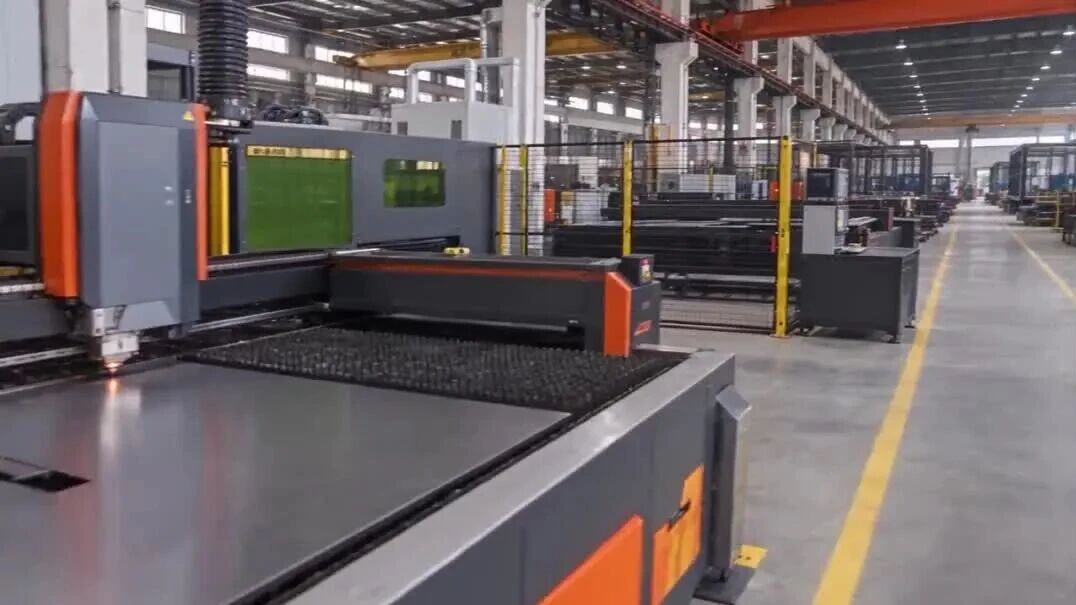
In the long-take roaming demo of a modern heavy-industry manufacturing plant shown by Envision AI, facing an ultra-long-depth space containing large laser cutting machine tools, overhead orange truss cranes, and modular steel-structure workshops, when the camera shuttles and advances substantially within the plant, the yellow safety markings on the ground, the scale ratios of near and far equipment, and the 3D spatial perspective all remain highly consistent, with no geometric distortion.
Precisely because spatial and physical constraints are directly embedded in the underlying architecture, the model does not need to repeatedly call external tools by trial and error like mainstream multimodal large models, thereby compressing the modeling cost of complex large scenes—which originally often ran to hundreds of dollars—to within ten dollars, and shortening inference speed from several hours to the minute level.
- Second, on "compliance with physical laws" in precision machinery and interaction
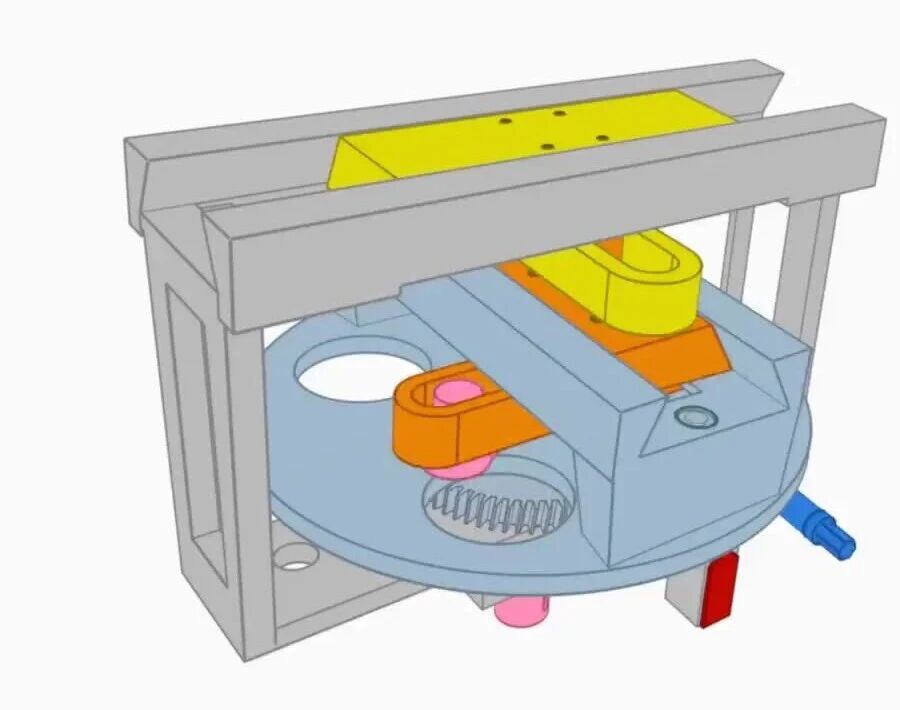
Unlike traditional video generation models, which merely rely on pixel fitting to "look like physical laws" while actually lacking underlying spatial perception, Envision AI directly encodes geometric topology, material properties, and physical logic at the underlying level.
In the team's dynamic demonstrations of multiple sets of CAD-level mechanical transmission mechanisms, whether it is a Geneva intermittent mechanism, a slider rotating disk, a cam follower, or a universal joint coupling, all parts strictly follow the kinematic laws of rigid body collision, axis constraints, and gear meshing during high-speed operation, with no clipping or deformation distortion.
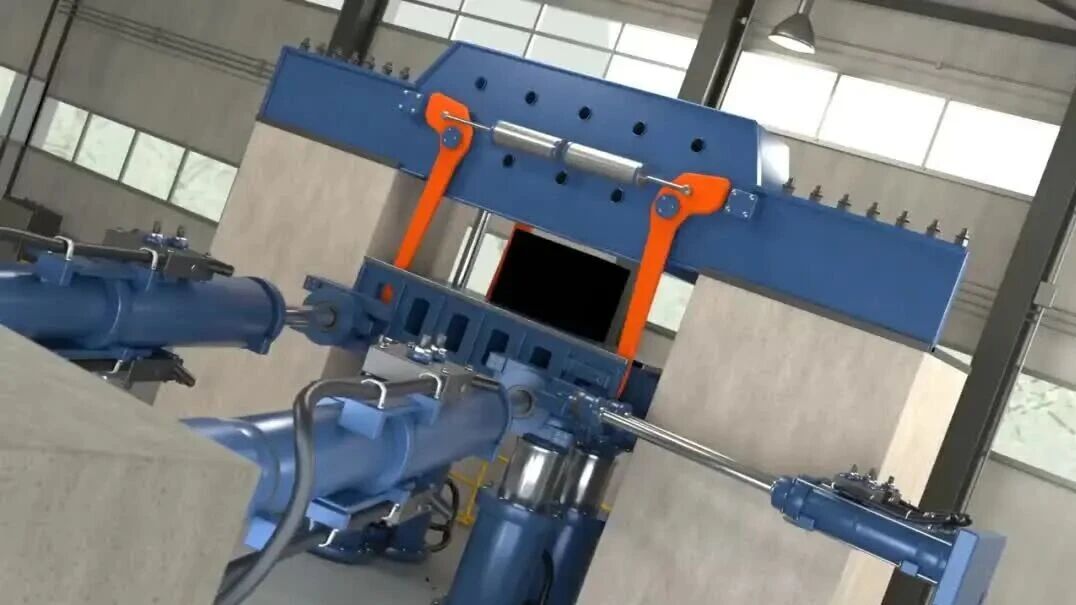
In the simulation of heavy hydraulic stamping equipment, the extension and retraction of multiple hydraulic push rods and the force-linked movement of the robotic arm connecting rods also fully conform to real engineering physical logic.
Chinese Computer Vision Luminary Starts a Second Startup! Leaves Apple and Focuses on Next-Generation Spatial and Physical AI
Built on this foundation—native capabilities that “understand space and physics at the underlying level and output with built-in code logic”—Envision AI’s capabilities are rapidly landing across multiple high-value directions, including synthetic data and model distillation, 3D content generation platforms, next-generation controllable video generation, physics simulation, UE game construction, and real-time interaction and on-device models.
With hardcore performance in underlying architecture and industrial deployment potential, this young international team is also making rapid progress in commercialization.
Currently, Envision AI has reached substantive commercial and strategic partnerships with multiple leading technology giants at home and abroad, and has begun generating revenue.
One More Thing
At the end of the exchange, Professor Long Quan said with emotion that after two startups ten years apart, his mindset and goals are now completely different.
Ten years ago, founding Altizure was a single-point breakthrough driven by an academic’s technology; this time, founding Envision AI, the team’s goal is long-term independent growth, ultimately becoming an AGI company with world-class influence that can achieve an independent IPO.
The team has set itself an ambitious benchmark: to become the Anthropic of the physical AI track.
This means Envision AI hopes to take foundation model R&D as its core, continuously drive breakthroughs in underlying intelligence capabilities, and thereby support broader downstream applications.
Today, general large models are extending into the physical world, and directions such as 3D vision, world models, and embodied intelligence are accelerating their convergence.
At a time when the technological landscape of next-generation spatial physical AI has not yet taken shape, Envision AI hopes to secure its own key position through exploration of native foundation models.
- Yao Shunyu and the Hunyuan team answered netizens on Reddit; the Hy small model has entered the roadmap 2026-11-21
- Riemann Hypothesis Proven?! With Claude’s Support, 34-Year-Old Mathematician Releases Lean Proof 2026-11-21
- Industry First Proposes “On-Device Super Node”, Enabling On-Device AI to Compute as a Team: AI Efficiency Soars 270%, No Need to Change Chips or Models 2026-11-24
- Chinese Computing Takes a New Path to the Peak 2026-11-21