 AIFeed
Tldr: Some thoughts on mathematical “explanation,” and on what makes a given bit of math helpful.
What is still unexplained, after a proof?
If I saw a physical phenomenon I did not understand (eg the tides, pre-Newton), I’d try to hold it in my mind, as a known clue to the unknown forces. I’d add it to my lists of clues, and would collide hypothesized new patterns against it to see if they made a match. (I’d know the tides were a good clue, because tides are ‘thingy’; they are obviously patterned.)
Now imagine a person stumbles upon the Pythagorean theorem. Perhaps they are an ancient mathematician setting foot where none had tread before; perhaps they are a contemporary kid being told a thing on e.g. educational television. Regardless: our person is initially surprised: “huh, really? What? Why? How’s it work?” they say. They say this because, like the tides, the Pythagorean Theorem is obviously ‘thing-like.’ It is not an arbitrary-looking conglomeration, like the letters on my license plate or the coffee grounds on my rug. There’s a pattern here.[1]
And then our person encounters a proof. Or lots of proofs. One of my favorites:
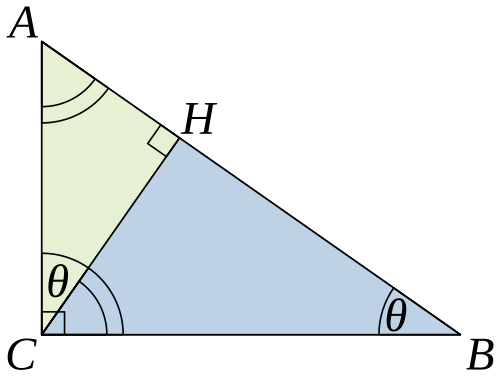
Note that triangles ACH, CHB, and ABC are all similar to each other. The green triangle ACH is proportional to AC^2, the blue triangle is proportional to BC^2, and the whole is proportional to AB^2. Also, the green plus the blue is the whole. (Image source)
Anyhow: even after understanding the above proof solidly, and becoming quite certain the theorem is true, I am personally inclined to say something like “okay, I see that it’s true, but I still don’t fully see why.” And then to keep staring and mulling and trying to “understand” why. Let us suppose our person is like me in this way (it seems to me a fairly common reaction). What, exactly, are they (or I) seeking, here? What is still worth studying about the Pythagorean Theorem, after one understands already its proof?
It seems to me the “still worth studying” thing is: why something so pithy ended up appearing here. What the recurring “character” is of e.g. right triangles, and squares and Euclidean geometry and whatnot, such that I should in some sense be not-surprised to see a result “like this.” I’ll explain what I mean in a bit.
Worthwhile mulling must eventually pay rent
First, more concretely: if this mulling is to be worthwhile, it should improve our predictions; it should not merely let us “feel ourselves in the presence of mysterious forces.”
Mulling on the Pythagorean theorem in particular seems to me to pass this checksum. It helps (some) mullers in two ways:
Specific benefits: Finding “related” theorems
Often, “near” a mull-worthy theorem T one finds other theorems, e.g. new theorems that can be proven with the same key trick used to prove T, or theorems that can be found by applying T to a new domain, or theorems that generalize T in some way.
For example, with the Pythagorean Theorem:
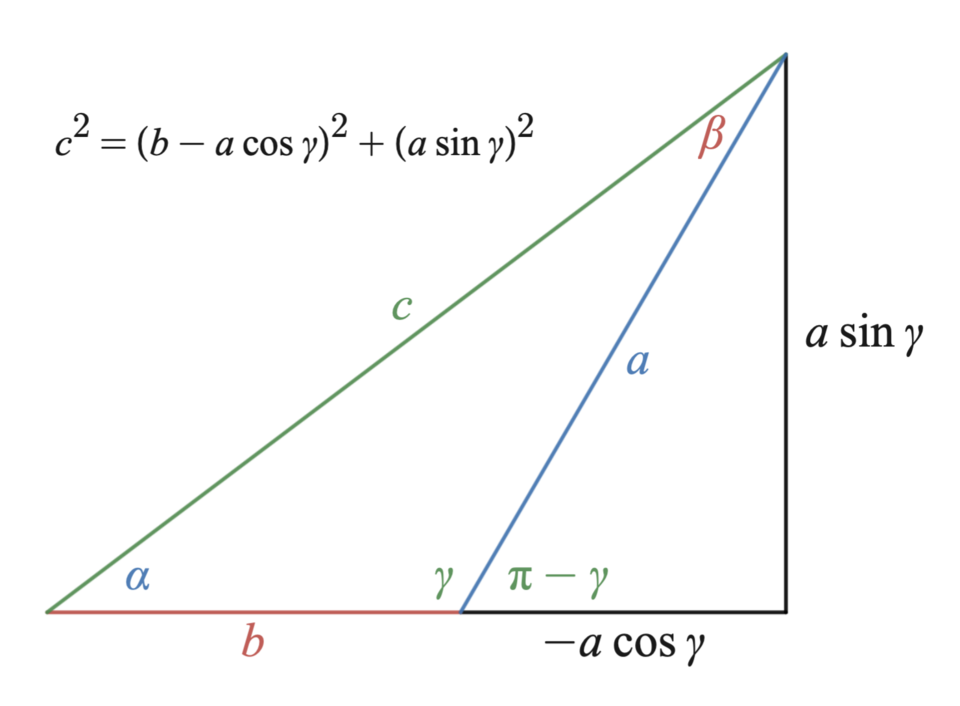
Example: The law of cosines offers a generalization of the Pythagorean Theorem, as shown. (Image source)
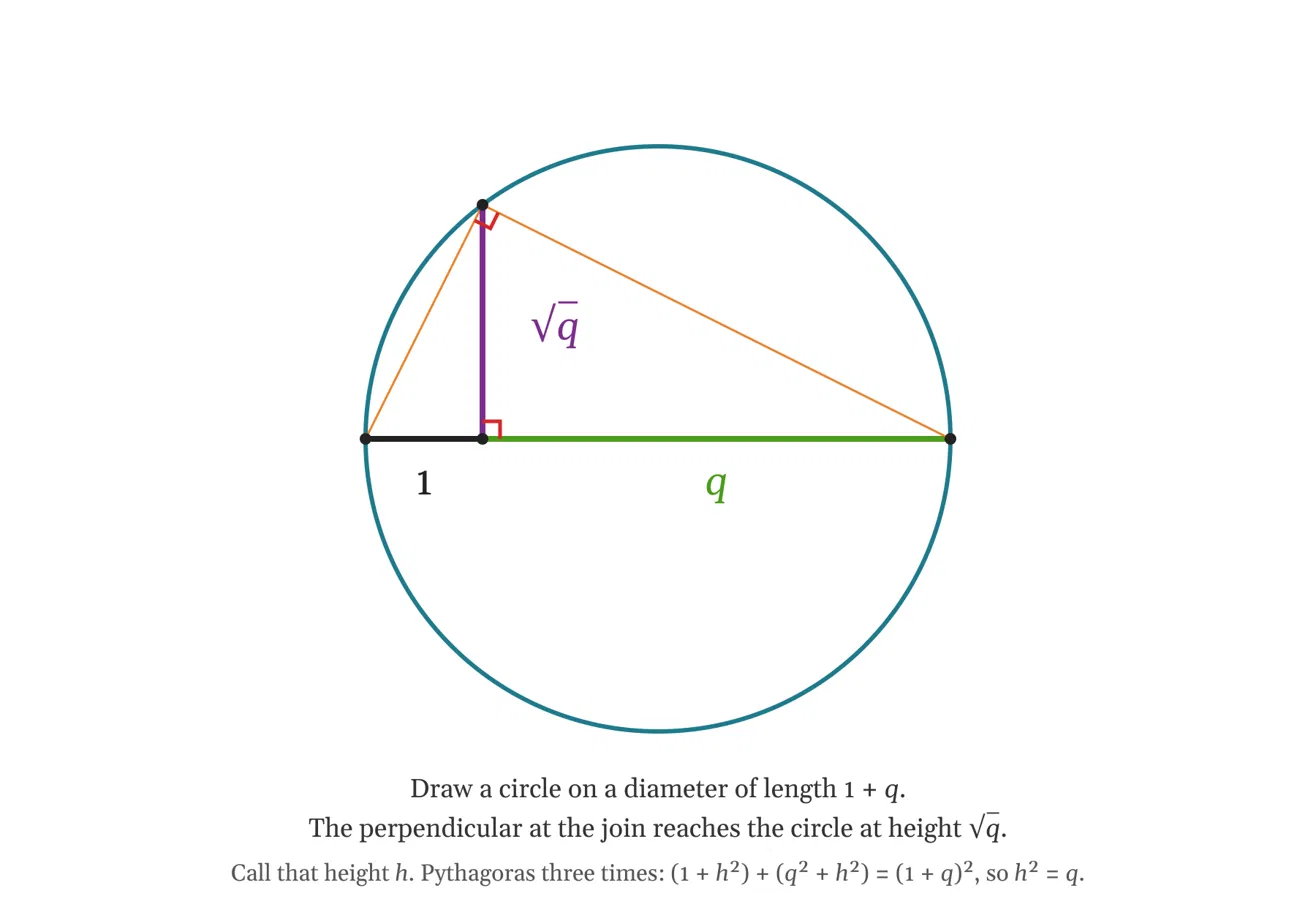
Example: The Pythagorean Theorem makes it clear that sqrt(q) can be ruler-compass constructed for all positive rational numbers q.
(Plus many others.)
Diffuse benefits: “Mathematical maturity”
Students who study math typically get better at learning ~all other math (e.g., my university required calculus before discrete math to build "mathematical maturity," despite calculus being never used in discrete math).
How exactly does this work? Saying that calculus helps a student with discrete math because it builds their "mathematical maturity" is frustratingly similar to saying a pill makes a person sleep because of its "dormitive potency." My guess is a big chunk of what is called "mathematical maturity" is familiarity with what kinds of mathematical patterns tend to pop up around different "wholes" (such as circles, prime numbers, proofs by contradiction) and that mulling on the "still unexplained thing, after knowing the proof" tends to help this extra content digest.
Pieces of math with their own “character”
My friend Valerie has her own patterns, such that when I see a new Valerie puzzle (“huh; she did what? How come?”), and I mull on it, it makes me better at past and future Valerie puzzles. My friend Zack has his own patterns, quite different from Valerie’s. The Truckee river (which I’ve spent a great deal of time staring at, in varied seasons) has its own patterns. And so on.
I believe there’s a sense in which “the Pythagorean Theorem” can be usefully viewed as a “whole” with its own patterns, similar to Valerie or Zack or the Truckee river.
What do I mean, here?
Well, for many things Valerie might do, it could be reasonable to say she did them “because Valerie [general characteristic or pattern].” E.g., “why is she hosting a superbowl party?” “Because Valerie takes an interest in football and football players.”
I suspect the same is true for the Pythagorean Theorem, and for various related “wholes” that appear in it, or that it appears in, such as “right triangles,” “Euclidean geometry,” and “oddly pithy theorems.” Each of these things, like Valerie or the Truckee river, has its own character that can be gradually discerned and then used in prediction. It seems fair to say that right triangles are somehow “special” and “have a lot of neat theorems about them,” for example. Also that “the Pythagorean theorem has a way of popping up in highly varied fields, such as number theory, much more than most theorems from Euclidean geometry.”
Some might ask what it means to say that Valerie and her football-interest can be “explanations” of anything, when really it is all quarks. Someone else might ask what it means to say the character of right triangles can be an “explanation” of anything, when really it’s all the axioms of Euclidean geometry. My main response is to say that I can’t actually predict Valerie’s superbowl party by thinking about quarks, but I can by thinking about Valerie.
Different math thingies have highly varying amounts of “their own distinctive character.” Small integers (e.g. 2, 3) have way more of it than most large integers (e.g. 7823418). Right triangles have more of it than do e.g. “triangles with a 73 degree angle.” Pithy theorems, such as the Pythagorean Theorem, often have more of it, too.[2]
To “cast new light on old results”
When my dad was a young math student, he asked his advisor, Dominic Soda, how to tell what math research is really worth doing. Dominic told him that the good math “casts new light on old results.”
What does this mean? It means to somehow help a reader better understand the character of the various “wholes” mathematicians are already mulling on, so that the old results become less confusing in hindsight, and so that new results that themselves “cast new light” can perhaps become easier to spot. (Is it really inductive, in this way? I don’t have a theory saying it should be; but empirically I think it is.)
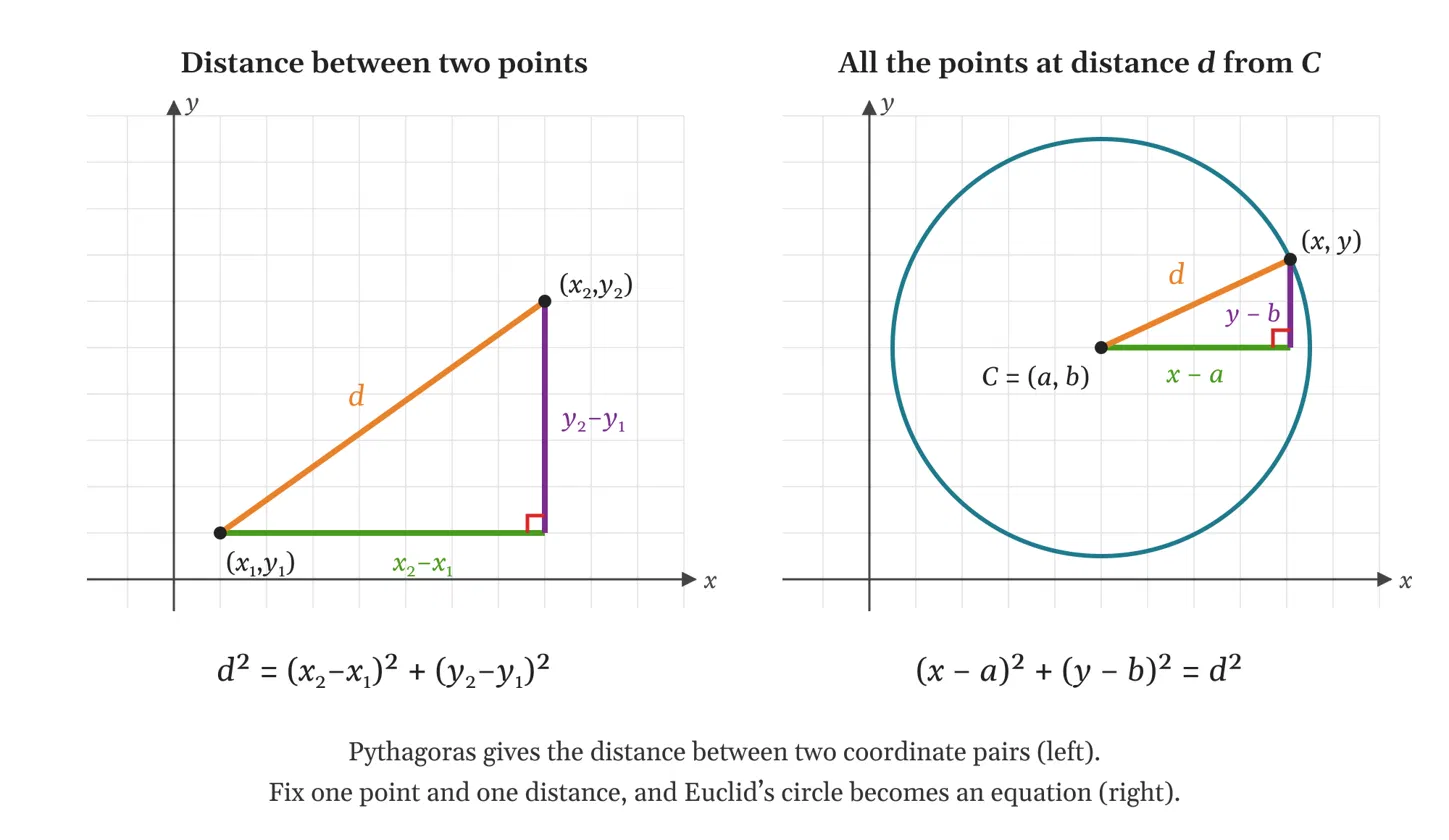
The Pythagorean Theorem, for example, is part of how Descartes was able to map geometry onto algebra using coordinates -- to pull off the mapping, Descartes needed to be able to says "all the points distance d away from center C" in coordinate-geometry terms, and the Pythagorean theorem offered a simple algebraic expression for the distance between two pairs of coordinates.
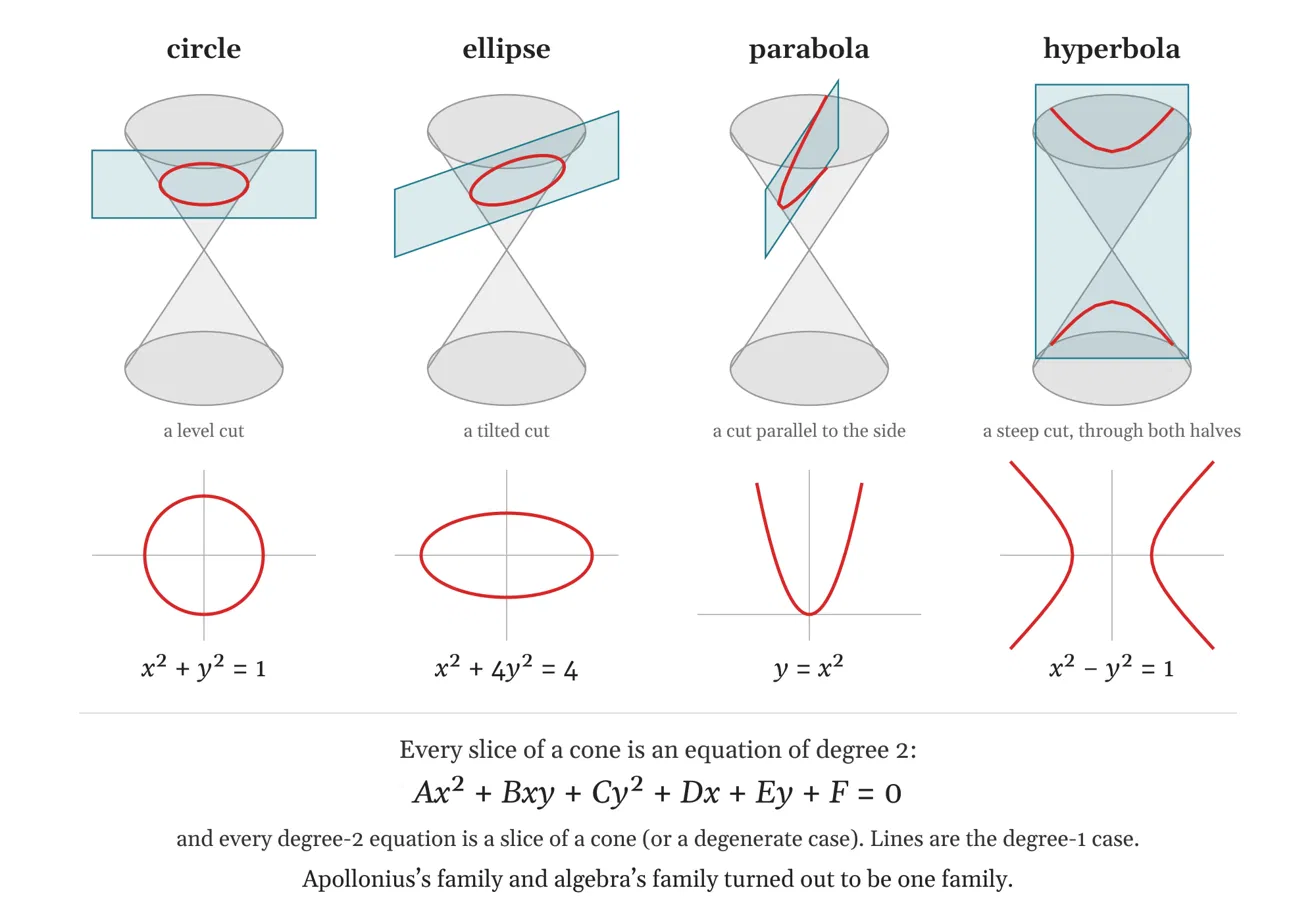
Descartes's mapping then turned out (!) to map [lines, points, circles, parabolas, and hyperbolas] – objects of great prior interest for e.g. Euclid and Apollonius – onto linear and quadratic equations – objects of great prior interest to folks doing algebra. This mapping cast much light on both (e.g. by allowing the “circles” of Euclid, and equations such as “(x-3)^2 + (y+5)^2 = 36”, to become faces of a common whole, so that folks’ experience with the character of one could inform their expectations about the other).
- ^In this way it half-reminds me of Paley’s watch – the famous thought experiment in which a person walking across a heath encounters a watch, and, observing its intricately ticking gears, infers a watch-maker. Dawkins and Dennett made a fine extension of Paley to biological evolution (the intricate cellular mechanisms around ATP, for example, testify to the presence of a “blind watch-maker" – parts not under active selection do not look that way). The Pythagorean Theorem differs from the watch or the ATP-mechanisms in that it’s a single ‘thingy’ pattern rather than a constellation of obviously-linked mechanisms, and also in that I’m a bit confused whether to view mathematicians as the relevant watch-makers. But there’s a half-rhyme here that gives me to mulling, a bit like the Pythagorean theorem does.
- ^To spell out what I mean here: for any given X, we can ask how helpful past experiences with X are for predicting future experiences with X-in-particular, as opposed to with math in general. I believe the answer varies greatly for different values of X, as described.