 AIFeed
Original text(via HN AI)
Post
Ahmed Heakl on X: "Today we introduce Looped Weight-Space Programming! 🚀 We asked Claude Opus 5.5 to solve hard mazes. It got only 26% right. Then we asked it to write a transformer that solves them, setting every weight directly. It took just 39 minutes and $19. No training. The model it wrote solves 100% of our test mazes. 🧵"
Conversation
- Ahmed Heakl@ahmedmm72234641Today we introduce Looped Weight-Space Programming! 🚀 We asked Claude Opus 5.5 to solve hard mazes. It got only 26% right. Then we asked it to write a transformer that solves them, setting every weight directly. It took just 39 minutes and $19. No training. The model it wrote solves 100% of our test mazes. 🧵2:15 PM · Nov 23, 2026·56KViews56


- Ahmed Heakl@ahmedmm7223464120h8/ Our takeaway: an LLM that can't solve a problem directly may still write a tiny model that does. Blog: mbzuai-oryx.github.io/LoopedWSP/ Demo: mbzuai-oryx.github.io/LoopedWSP/demo… Code: github.com/mbzuai-oryx/Lo… With co-first author @Python8723, Abdelrahman Shaker, Fahad Khan and @KhanSalmanH.Looped Weight-Space Programming: LLM-Written Transformers for Long Algorithmic ReasoningFrom mbzuai-oryx.github.io1Ahmed Heakl@ahmedmm7223464119h9/ Claude Opus 5.5 is a co-author on this one, since it wrote every single weight by hand 😄 @AnthropicAI @claudeai1

- Ahmed Heakl@ahmedmm7223464120h1/ This builds on Weight-Space Programming by @rikiyatakehi @jayden_teoh_ @a1zhang & @lateinteraction, who showed LLMs can read and edit neural weights directly. We asked something different: can an LLM write weights that implement a whole, reusable algorithm?1
- Ahmed Heakl@ahmedmm7223464120h3/ Could gradient descent find the same solution? We trained Claude's architecture from random weights on the same mazes. It solved 0%. The best trained baseline, Energy-Based Reasoners, reached 93.5%. Curious to hear @ylecun's take on writing weights vs learning them.1

- Ahmed Heakl@ahmedmm7223464120h2/ Claude wrote a looped transformer. One small block runs again and again, advancing a shortest-path search by one step per pass. The same weights solve 100% of our 100×100 test mazes, even though Claude only ever tested it on mazes up to 45×45.GIF

- Ahmed Heakl@ahmedmm7223464120h5/ Tower of Hanoi next, where reasoning models start to collapse around 7–8 disks. In 27 minutes, for about $5, Claude wrote a 3,686-weight transformer that plays all 1,048,575 moves of the 20-disk puzzle with zero mistakes. One tiny block, looped two million times!

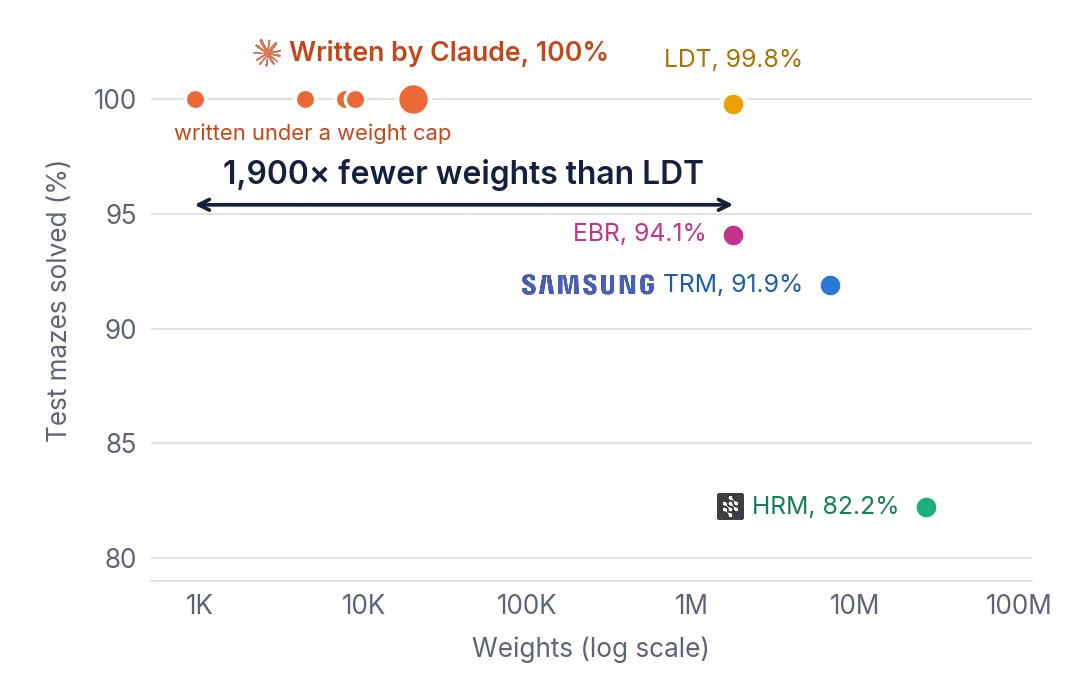
- Ahmed Heakl@ahmedmm7223464120h4/ Then we set a cap: fewer than 1,000 weights. Claude wrote a maze transformer with 928, and it still solves 100% of our test mazes. LDT, the best trained model on Maze-Hard, uses about 1,900× more weights.
- Ahmed Heakl@ahmedmm7223464120h7/ Perhaps the most interesting part: interpretability. What the transformer has learned is NOT a black box. Each weight is deliberately constructed to implement an algorithm. We can inspect the intermediate states, trace each step, and understand exactly how it reaches an answer.

- Ahmed Heakl@ahmedmm7223464120h6/ Same approach on Sudoku-Extreme, GraphWalks with 1M-token prompts, and two BIG-Bench Extra Hard tasks: 100% on every test set we evaluated. The weights are readable too. Given only the weights, a fresh Claude session worked out the whole algorithm in about 2 minutes.

- Riccardo Ali@Riccardo_Ali_12h...have you tried asking to write a Python script? I bet it would cost you even less1
