 AIFeed
Article title: Just now, the lead figure behind Claude's Riemann Hypothesis proof responds to everything
Body:
Just now, the lead figure behind Claude's Riemann Hypothesis proof responds to everything
2026-11-24 10:10
Over the past few days, the discussion surrounding Claude's involvement in proving the Riemann Hypothesis has swept through almost the entire tech world and mathematics community. One of the most talked-about details was that if this proof were translated into text humans could read, it would exceed 250,000 pages.
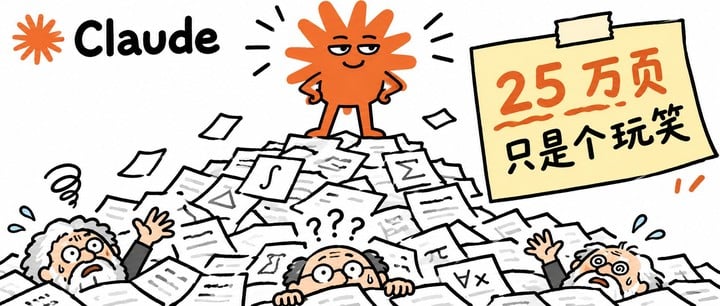
However, the person at the center of the matter has finally come forward to clarify: the so-called 250,000 pages was actually a joke he made.
Just now, Anthropic mathematician Levent Alpöge posted a long thread on X, responding to the many controversies surrounding the Riemann Hypothesis proof over the past few days and reflecting one by one on the mistakes he made during the release of the results.
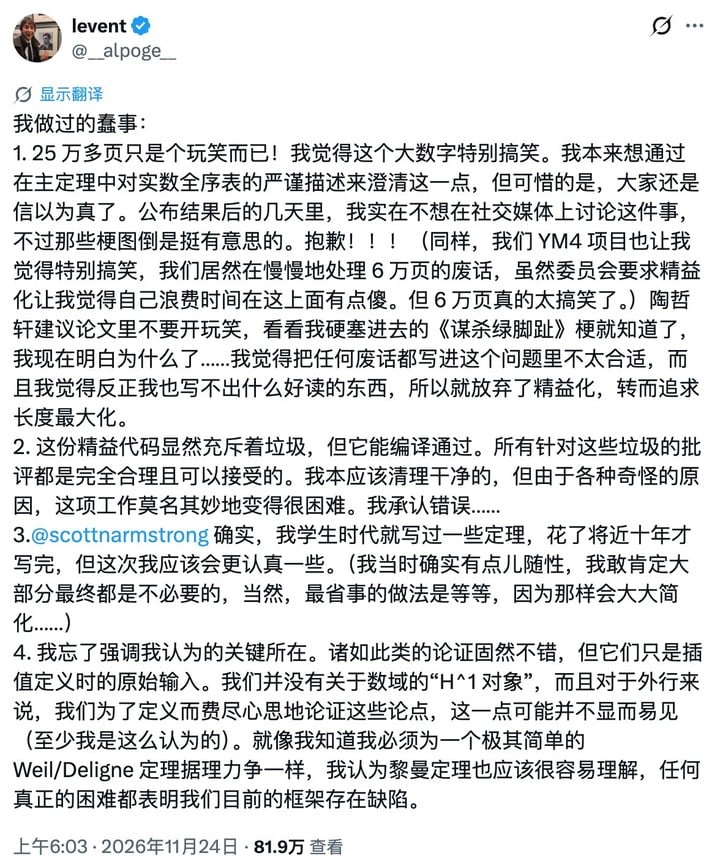
"Guys, over 250,000 pages is a joke! I just think really big numbers are very funny."
Alpöge said he had originally thought that his deliberately cumbersome description of the total order relation on the real numbers in the main theorem would be enough for people to recognize the humor in it, but he never expected the outside world to take the number as fact and spread it widely.
Since he did not want to speak on social media in the days after the results were announced, he also did not clarify in time, though he did see quite a few memes made by netizens. "Terence Tao suggested not making jokes in papers, and now I finally understand why."
250,000 pages is a joke, but 17.37 million lines of code is a real challenge
The story starts on November 20.
That day, Alpöge announced on his personal website that he and Claude had completed a formal proof of the Riemann Hypothesis and the Generalized Riemann Hypothesis.
According to previously disclosed information, the entire research project started on October 6 and lasted about 41 days. Alpöge and Claude completed the final step of the core proof on November 15, and then extended the research results to the Generalized Riemann Hypothesis on November 16.
Unlike the traditional way of publishing mathematics research, Alpöge did not provide a complete natural-language paper, but instead released a mere 4-page explanatory document and an astonishingly large set of Lean formal proof code.
According to previously disclosed statistics, this codebase contains 175,187 Lean source files, about 17.37 million lines of code, split into 14 compressed packages for the public to download.
Lean is a formal proof assistant that can check whether mathematical reasoning conforms to strict logical rules through a computer kernel. Mathematicians can use it to translate theorems, definitions, and reasoning processes into code that machines can verify.
On November 21 local time, the Lean and Mathlib communities issued a joint statement expressing full confidence in the correctness of this formal proof. MIT mathematician Andrew Sutherland also independently verified the relevant code.
However, code passing formal verification is still a different matter from mathematicians completing their understanding of the entire proof idea, peer review, and the Clay Mathematics Institute formally recognizing the result.

In this response, Alpöge also admitted that the Lean code he submitted did indeed have a large amount of redundancy and quality problems.
"There is obviously a lot of garbage in the Lean code. Although it compiles, all the criticism of this garbage code is valid, and I fully accept it."
He said he should have cleaned up the code before release, but for various reasons this work was much harder than expected.
Facing outside questions about the progress of organizing the proof, Alpöge also admitted frankly that as early as his student days, he had spent nearly ten years organizing theorems he had already proven. But for a major result like the Riemann Hypothesis, he believed he should have acted more responsibly.
He also revealed that a large amount of the content in the existing proof may ultimately prove unnecessary, and that as researchers deepen their understanding of the proof structure, the entire argument is expected to be greatly simplified.
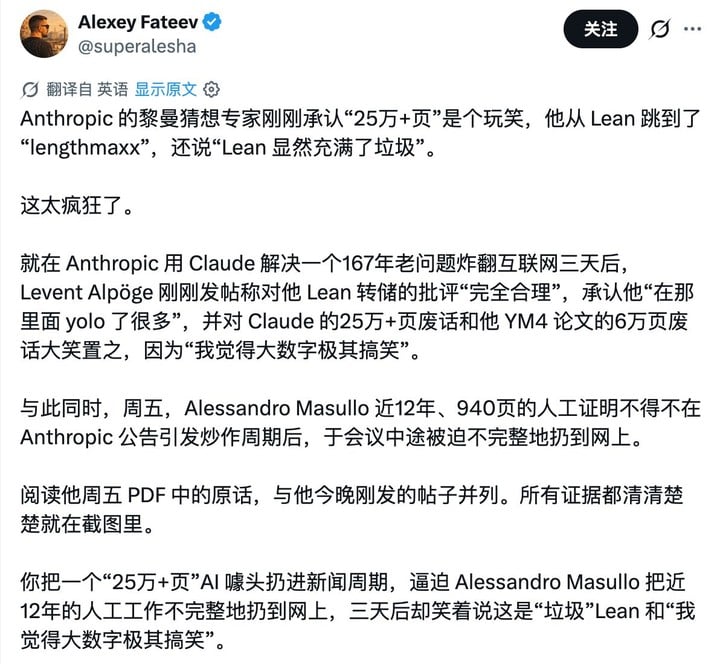
However, netizen Alexey Fateev criticized this, arguing that the wave of public attention triggered by Anthropic forced another mathematician, Alessandro Masullo, to publish early his nearly 12-year, 940-page manuscript on the Generalized Riemann Hypothesis. Against this backdrop, Alpöge's later explanation of "250,000 pages" as a joke seemed somewhat irresponsible.
Something more important than proving the Riemann Hypothesis
Beyond responding to the controversy, Alpöge's post also deliberately added a mathematical point he had not sufficiently emphasized when first announcing the results.
In his view, proving the Riemann Hypothesis is certainly important, but the mathematical ideas generated during the proof should also serve a deeper goal: establishing more natural and unified mathematical definitions and theoretical frameworks.
For example, the mathematics community has not yet established an "H¹ object" over number fields that matches his conception. Alpöge believes that one important purpose of mathematicians devoting so much effort to studying complex arguments is to accumulate material for constructing new mathematical concepts.
He hopes the Riemann Hypothesis can ultimately have a more natural and concise proof, just as he previously pursued a concise understanding of the theories related to Weil and Deligne.
"I think the Riemann Hypothesis should be easy. Any real difficulty may mean that the theoretical framework we currently use is not good enough."
Of course, "easy" here means that under a suitable mathematical theoretical framework, the proof process is expected to become natural and concise; it does not deny the research difficulty of this problem that has troubled the mathematics community for 167 years.
It is worth noting that Claude had already made research progress related to the Riemann Hypothesis in August this year.
At that time, Anthropic announced that Claude had independently completed a mathematical study, raising the lower bound on the proportion of nontrivial zeros of the Riemann zeta function lying on the critical line from 41.6% to 67.2%.
However, Anthropic also clearly stated at the time that the technical approach used in that research was not expected to directly prove the full Riemann Hypothesis.
By contrast, the results announced in November adopted a research approach in which human mathematicians and AI collaborated, with Alpöge guiding the direction of mathematical research and Claude undertaking a large amount of derivation and formalization work.
According to Alpöge's earlier disclosure, as the research neared completion, Claude's pace in advancing the argument had already surpassed his own, so much so that by the time the entire formal proof was complete, he still had not fully digested some of the mathematical details in it.
To some extent, this mix-up over the 250,000-page proof happens to expose a problem that is becoming increasingly hard to avoid once AI participates in frontier mathematical research.
In the past, mathematicians needed to spend a great deal of time finding proofs, and once the answer was found, the research work made decisive progress. But as AI begins to participate in mathematical derivation on a large scale, the speed of generating proofs may far exceed the speed at which humans can understand them.
Computers can check whether an argument holds, but extracting new mathematical concepts from complex derivations, finding more concise proofs, and turning these ideas into knowledge that can inspire other research still requires a great deal of work.
As AI begins to accelerate the answering of mathematical questions, the challenge human mathematicians will face next may be how to make these answers truly part of human knowledge.