 AIFeed
Twist! 黄仁勋 Weighs Return to 英伟达, Tech Leaders Form "War Room" Overnight
2026-11-16 08:56
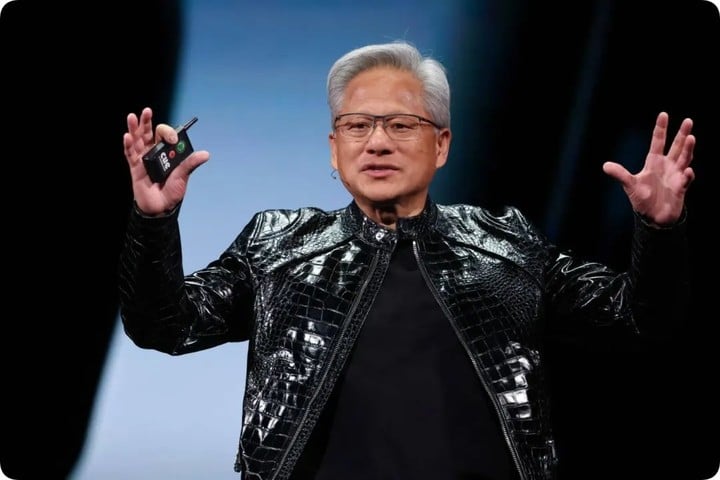
A couple of days ago, everyone was still lamenting the fate of 63-year-old 黄仁勋, assuming the leather-jacket-wearing knife man who spent thirty-three years on the job had bid a final farewell to the stage of history.
But just after the weekend, things suddenly took a dramatic new turn. According to the latest scoop from the Financial Times, Lao Huang, who resigned barely days ago amid an extramarital affair scandal, not only has no intention of stepping back into retirement, but has already been discussing with his core confidants the possibility of returning to 英伟达 to continue as CEO.
Even more gripping: a group of top Silicon Valley tech executives built Lao Huang a War Room overnight, pressing the 英伟达 board to reinstate him while preparing to rally more outside support.
One ally involved in the lobbying put it bluntly, saying that apart from a few leading closed-source labs, every notable figure in tech likes Lao Huang, and that this comeback effort has received Lao Huang's own nod of approval.
Meanwhile, a public petition site called "Bring Back Bring Jensen" went viral over the weekend, with signatures surging past the 160,000 mark. A look at the breakdown of signatories on the page is practically a Silicon Valley half-the-industry team-building event.
Page data shows nearly 8,000 current 英伟达 employees, over 1,400 former employees, and 86,000 shareholders—though the employee and shareholder tags on the site are mainly self-reported and checked off by signers themselves, without strict third-party background verification, so it's hard to say how many casual onlookers are mixed in.
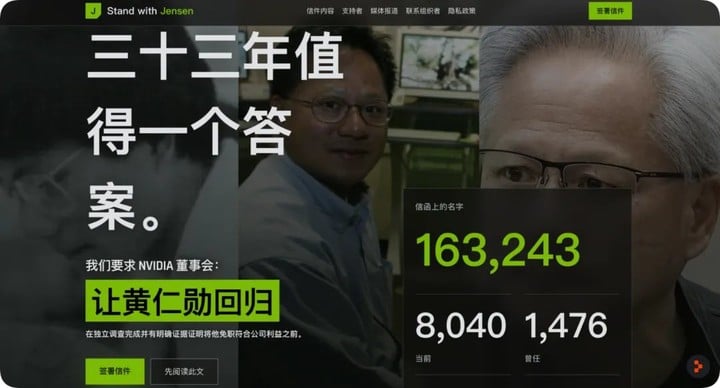
But the big names leading the public endorsement are genuinely heavyweight, prominently including 马斯克, Epic Games head Tim Sweeney, Replit CEO Amjad Masad, and YC head Garry Tan.
Even major institutional shareholders with deep pockets—Altimeter Capital founder Brad Gerstner and Atreides Management boss Gavin Baker—fired off open letters on Friday demanding the board keep all options on the table, including bringing back 黄仁勋.
Good grief—when Altman was ousted back in the day, it was at least just a bunch of internal employees flooding the internet with threats to quit. Lao Huang's saga has turned into a collective Silicon Valley tech-world petition to keep him.
Plenty of big shots are invoking the script of Steve Jobs being driven out of Apple to protest the injustice done to Lao Huang, but the underlying logic of these two cases is actually completely different.
When Jobs left Apple, Macintosh sales falling short of expectations and Apple posting losses were important context, but the root cause was the long-running fierce opposition between Jobs and Sculley over corporate governance and the product commercialization path; the Mac failure amplified the conflict, the board chose to back Sculley under business pressure and stripped Jobs of operational authority, and Jobs ultimately departed.
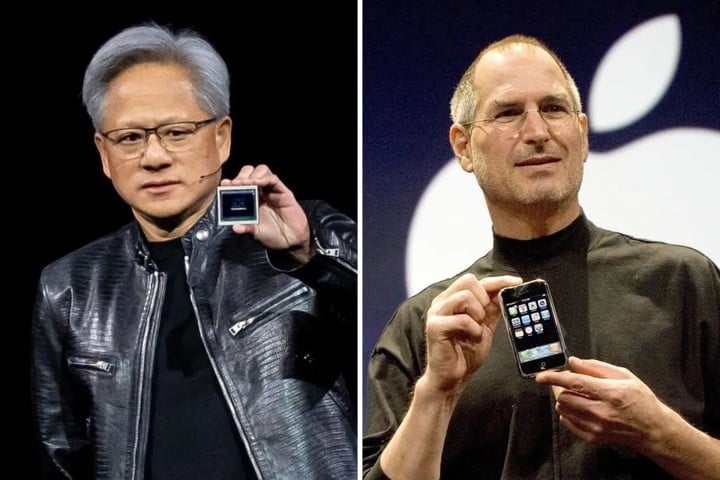
By contrast, today's Lao Huang has not the slightest business slip-up—the 英伟达 he leads is at its peak, printing money while lying down.
Of course, an extramarital affair with a subordinate is definitely a firing red line—even the allies rallying for Lao Huang privately admit this can't be whitewashed under company rules. So why are 马斯克 and a host of tech leaders still stepping forward to back him?
The answer is very simple: because with Lao Huang gone, the global AI world's open-source ecosystem and compute supply chain really will suffer. The first to get restless is the entire open-model circle.
Prominent AI scholar Nathan Lambert stayed up over the weekend to publish a long piece, directly describing Lao Huang's departure as a heavy blow to the open-source AI ecosystem. Many outsiders assume 英伟达 is just a hardware vendor selling graphics cards, but in reality, over the past two years, Lao Huang has been the most important financier for the global open-model camp.

The logic is simple: if the world were left with only a few closed-source giants like OpenAI and Anthropic, they would sooner or later kick 英伟达 aside with their own chips; only by nurturing thousands of open models and small-to-mid-sized inference companies in full bloom will everyone keep lining up to buy Lao Huang's GPUs.
Over the past two years, whenever the open-source community faced external regulatory skepticism or waves of pessimism, it was Lao Huang who personally picked up the phone to communicate and coordinate, casually showering money on the open-source ecosystem along the way.
More interestingly, on today's open-source track, the ones truly carrying the banner are long since China's domestic players—DeepSeek, Qwen, Kimi, Zhipu, Minimax, and Hunyuan—while Silicon Valley's homegrown open-source forces have fallen seriously behind.
Even Thinking Machines, founded by former OpenAI CTO Mira Murati, just released Inkling 2 Small, billed as the West's village-wide hope—yet pulled out for comparison, its performance still lags far behind our Kimi K3.1 Pro, and overseas developers are even eagerly awaiting Zhipu's upcoming big GLM update.
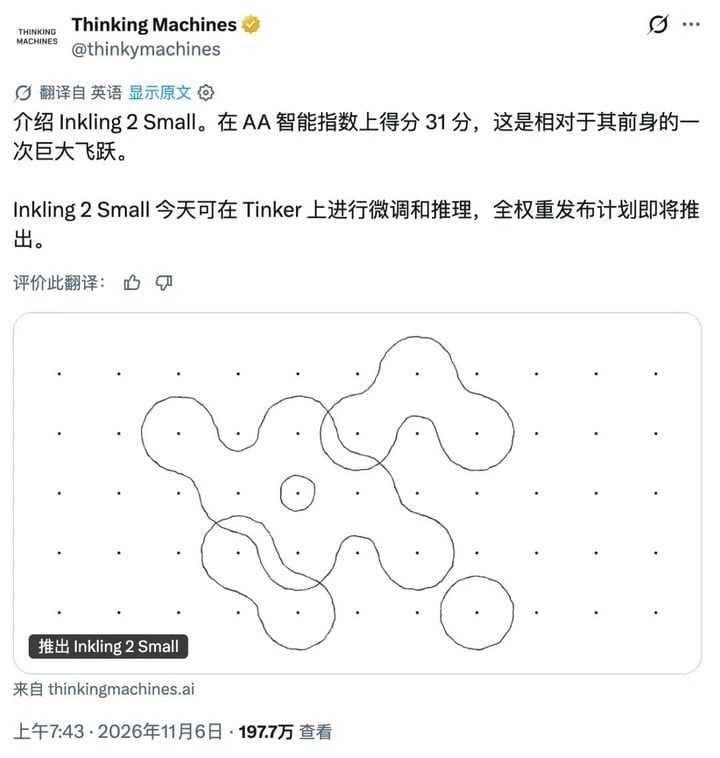
In other words, that bunch of hard-chasing open-source entrepreneurs in Silicon Valley were all counting on Lao Huang to keep giving money, giving cards, and giving policy buffer time to help them keep their seat at the table. Now that the leather-jacket godfather most willing to burn cash for the open-source camp has suddenly been ousted, replaced by a professional manager who only looks at short-term financials, the open-source ecosystem's funding lifeline could be cut off at any moment.
Beyond the long-term open-source ecosystem layout, Lao Huang's other truly irreplaceable trump card is his extremely strong personal rallying power and coordination ability with the East Asian semiconductor supply chain. Everyone is worried: with a suit-and-tie professional manager stepping in, will 英伟达's chips still be delivered on time over the next two years?
You see, 英伟达 is essentially a Fabless design company without its own fabs. In an era of extreme compute hunger, global wafer and packaging capacity simply cannot be bought with money—it's allocated by queue based on long-term trust.
Over the past thirty-plus years, Lao Huang has built up an extremely deep reservoir of trust capital with the heads of Taiwan's contract manufacturing giants and with Korea's memory giants. Back in the early industry downturn when graphics cards wouldn't sell, Lao Huang gritted his teeth and refused to cut orders, helping suppliers absorb capacity and weather the storm; back when no one was bullish on HBM high-bandwidth memory, it was Lao Huang who repeatedly flew to communicate long-term demand to Korean executives, persuading them to sink billions of dollars into heavy-asset production lines.
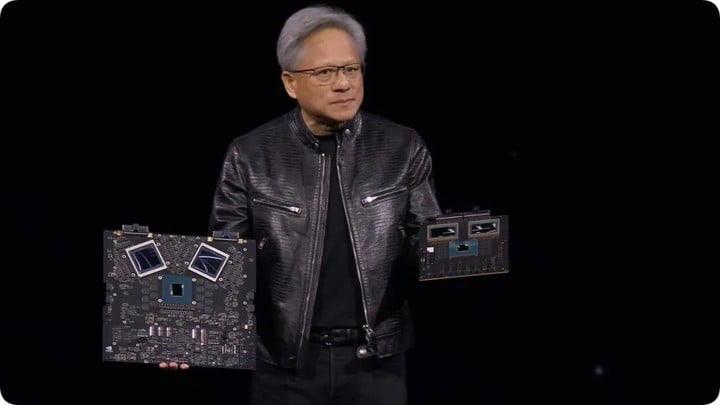
Even when the Blackwell architecture recently hit a serious yield crisis, Lao Huang was the first to step up and take responsibility himself, absolutely refusing to dump the blame on TSMC—which is what earned him the foundry's overnight mobilization of its elite engineers to help put out the fire.
Many emergency reallocations, last-minute order additions, and process accommodations that break contract boundaries were all settled by Lao Huang shaking hands and making the call face-to-face with each chief executive, with legal and procurement teams only filling in the paperwork afterward.
This kind of strategic community, built on consistently making partners big money and sharing risk in moments of crisis, long ago transcended cold commercial buyer-seller contracts. Now if you ask the finance-background interim CEO Colette Kress, or Arm CEO Rene Haas, a potential successor the board has just made contact with, to seamlessly align rhythms with the heads of the entire supply chain, the picture is somewhat maxed out on incongruity.
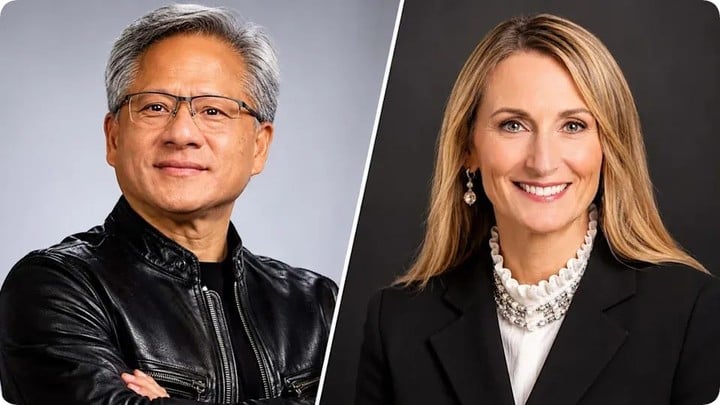
A deeper layer of anxiety: as Bill Gates, Steve Jobs, and Google's two founders have successively passed the torch, Lao Huang is almost the last of Silicon Valley's tech giants who combines a madman's vision with stage charisma as a first-generation founder CEO.
Although 英伟达's product roadmap and TSMC capacity for the next two years are already locked through 2027, so business won't halt immediately in the short term, Lao Huang's true irreplaceability lies in his willingness to bet his entire fortune on the future in no-man's-land when no one else is bullish.
Whether it was 1996, when the company had only one month of payroll left and he cut half the staff to go all-in on the Riva 128 graphics card, or twenty years ago when he forced the entire gross margin into the CUDA ecosystem despite a 50% cost surge per card and zero market demand—that founder's boldness to decide and go all-in in four days while others bicker for weeks is something no stability-seeking professional manager can offer.
Of course, for Lao Huang's comeback drama to truly replicate the 2023 Altman-style ending, the real-world resistance is far greater than imagined. After all, unlike founders such as Zuckerberg or 马斯克 who hold super-voting rights, Lao Huang's 英伟达 shares do not carry absolute control—which is why when the board applied pressure last week, he didn't even have a veto chip to play.
At the same time, external opposition is hardly insignificant. Just this weekend, as Silicon Valley busied itself signing petitions, U.S. Treasury Secretary Scott Bessent openly stated on a Sunday TV program that the 英伟达 board should look outside the company for a new CEO to carry out a thorough leadership reshuffle.
No matter how many Silicon Valley founders and investors queue up to sign petitions and call for due process rather than trial by public opinion for Lao Huang, at a moment when an independent law firm's investigation has just begun and external regulators are watching closely, for the board to withstand the pressure and bring Lao Huang back would be hellishly difficult. 英伟达 releases its latest quarterly earnings early Wednesday morning, and the interim management's only thought right now is to steady the ship fast.
On one side, 160,000 signatories and Silicon Valley big shots loudly calling for the boss's return; on the other, hardline external statements demanding a management blood transfusion. Whether Lao Huang's black leather jacket, worn for thirty-three years, can be put back on after this storm will likely have to wait for the coming investigation and maneuvering to give the final answer.
Recommended Articles
Values written like {{NAME_ab12cd34}} are placeholders for real values. Use them exactly as written, in replies and in tool calls alike: they are filled in with the real values before anything runs. Don't ask to verify them, and don't replace them with examples.