 AIFeed

The Pentagon has been testing packs of autonomous ground vehicles (UGVs) in simulated combat situations. In mid-October, at Fort Knox’s St. Vith Range in Kentucky, four UGVs “worked as a team, negotiating and surveilling the rolling landscape in search of enemy forces,” recalls a DARPA blog post. These UGVs are highly modular and can be kitted out with a wide range of tactical add-ons, but target engagement was controlled by a human operator. This latest exercise was prompted by the request of European allies.
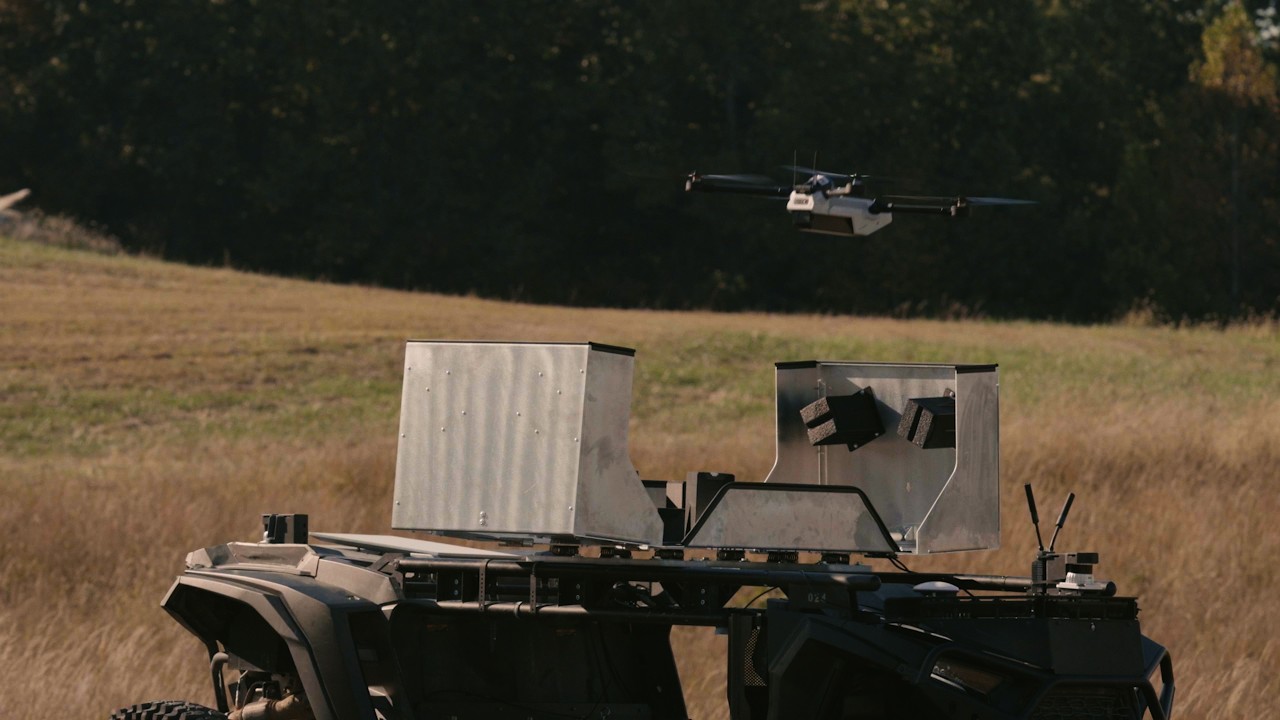
“Out here at Fort Knox, we’re looking at how autonomous mobility technology can be paired with payloads to enable new warfighter capabilities,” explained Jason Gregory, technical advisor at DARPA. The blog notes that this location was also chosen as it represents a similar landscape to the European theater.
During the demo an operator received a tip about a simulated threat alongside some satellite imagery. They then sent the pack of UGVs to the area to surveil the landscape and identify targets. Smartly, a sole UGV went ahead of the pack to scout, with the three others waiting behind. The scout UGV was equipped with a flying drone. In a real-world scenario this could have been flown for better visuals or to strike the targets from the sky. “Soldiers can mount anything and everything onto – 240 Bravos, drones, rockets,” said a technician attending the demo, as they are “super modular platforms.” The blog says three of the four UGVs in the exercise had drones.
After the designated area was scouted by the leading autonomous ground vehicle, other UGVs followed on “to provide cover and support.” A simulated rocket was fired at a target identified about 300 yards from the robot pack. Finally, the last robot came out of cover, higher up over a ridge, to assess the field of conflict.
It was emphasized that during the exercise, a human operator was controlling any kinetic engagement. “All the mobility, all the movement, all the detections, all of that is autonomous,” explained Gregory. “But they don’t pull the trigger until a human says pull the trigger.”
This exercise was part of DARPA’s Robotic Autonomy in Complex Environments with Resiliency, or RACER program. Expertise required for RACER’s success includes vehicle design, algorithm technologies, super intelligence, and secure communications.
After five years of work, these UGVs can now be instructed to complete tasks on the battlefield, instead of being manually driven, notes Gregory. They roam off-road as fast as any human driver could manage, at a minimum.
Get Tom's Hardware's best news and in-depth reviews, straight to your inbox.
Testers reckon the UGV packs are ready for deployment and use in “a host of other missions, including food, ammunition and supply logistics and more,” according to the DARPA blog. More UGV pack hunting tests are scheduled for December, with a group of serving soldiers involved.

Download the Tom's Hardware app for up-to-the-minute updates on iOS and Android. Also follow Tom's Hardware on Google News, or add us as a preferred source, to get our latest news, analysis, & reviews in your feeds.

Mark Tyson is a news editor at Tom's Hardware. He enjoys covering the full breadth of PC tech; from business and semiconductor design to products approaching the edge of reason.
- More dystopian news to fuel everyone's nightmares of Terminators roaming the earth... Fun times. Reply
- So they are building/using a map inside a small communication grid. Question? Is this local or via a network? Bigshrimp said:More dystopian news to fuel everyone's nightmares of Terminators roaming the earth... Fun times. Clinically we already have those things in small numbers. Some nations have big and small robot-units that roams the streets, others make them look like every-day things. These units generates a virtual-map they use for tracking rather then GPS ( from above ). Imagine an area with no or limited signals. A full on human-doll is doable, but the batteries to power it, versus the ability to carry heavy materials, and network to operate it is questionable, then of course is A.I. ( Choice ) when not connected. With drones for instances they cut the signal ( operate in a lower frequency less detected ), to change course, rather then guide it like a plane. We are in that world already. Reply
Bigshrimp said:More dystopian news to fuel everyone's nightmares of Terminators roaming the earth... Fun times.
- I'm not particularly a fan of arming these, but at the same time we've been flying drones for decades without it being an issue. Something being on the ground is much easier to get command of though. I very much like everything else about the concept though because it has big logistics improvement potential. Reply
- thestryker said:I'm not particularly a fan of arming these, but at the same time we've been flying drones for decades without it being an issue. Something being on the ground is much easier to get command of though. I very much like everything else about the concept though because it has big logistics improvement potential.Its when AI control these is what worries people. Reply
thestryker said:I'm not particularly a fan of arming these, but at the same time we've been flying drones for decades without it being an issue. Something being on the ground is much easier to get command of though. I very much like everything else about the concept though because it has big logistics improvement potential.